What the 21 November 2024 event actually showed
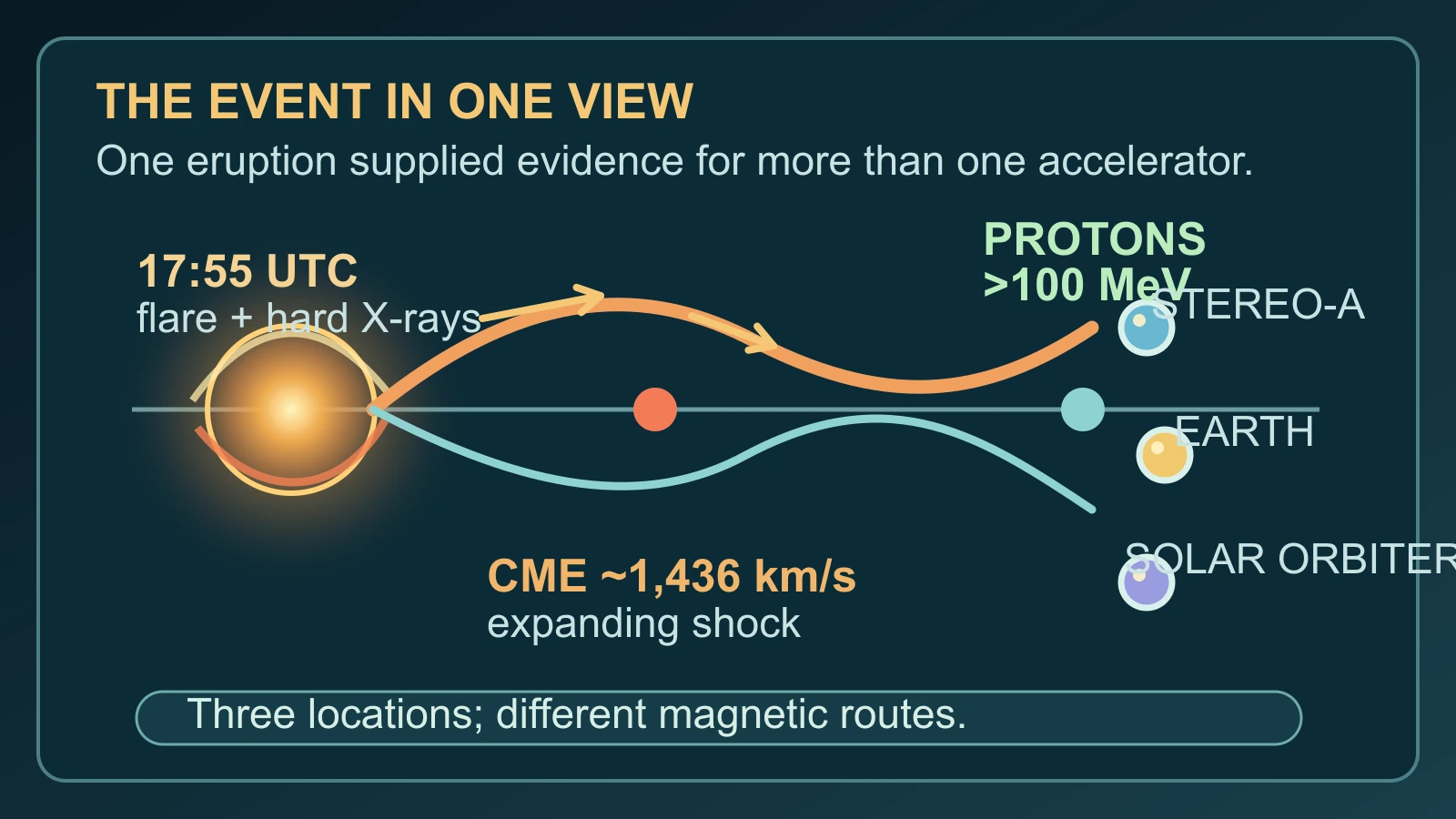
The short answer is that the CME shock probably helped, but it was not the whole accelerator. On 21 November 2024, a flare on the far side of the Sun was followed by a fast coronal mass ejection. Detectors at Earth, STEREO-A and Solar Orbiter recorded a widespread solar energetic-particle event with protons above 100 MeV.
The event is useful because the spacecraft were not looking from the same place. Their different distances and heliolongitudes gave the researchers several arrival-time records and several magnetic routes back toward the Sun. That made it possible to test whether one local source could explain every observer's earliest particles.
The paper's answer is no: the measurements are best explained by an early population with flare-related signatures, plus a CME-shock contribution whose importance changed with the observer's magnetic connection to the expanding front. That is a mixed, event-specific interpretation, not proof that every CME accelerates protons in the same way.
How a CME shock can give protons repeated energy boosts
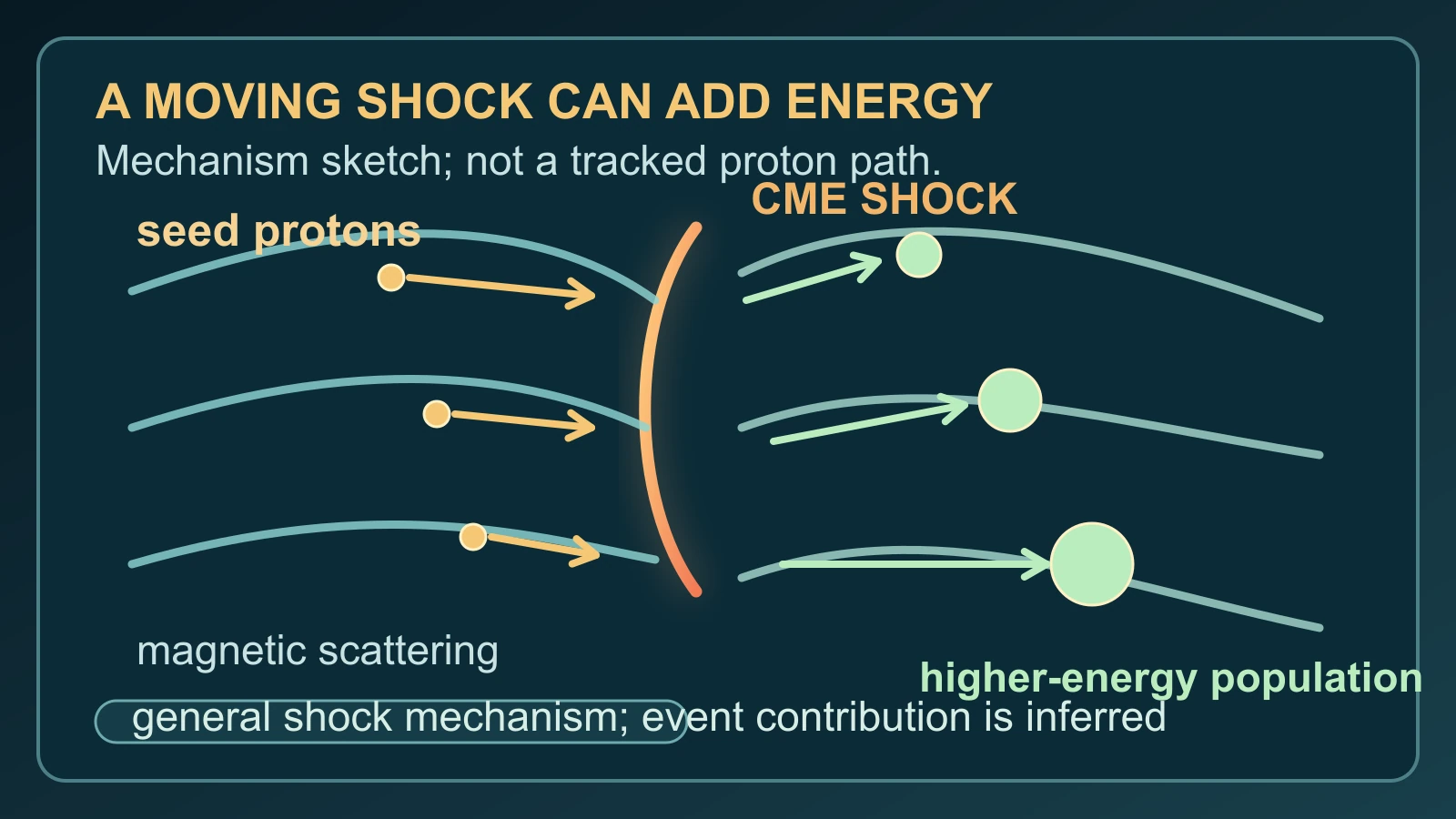
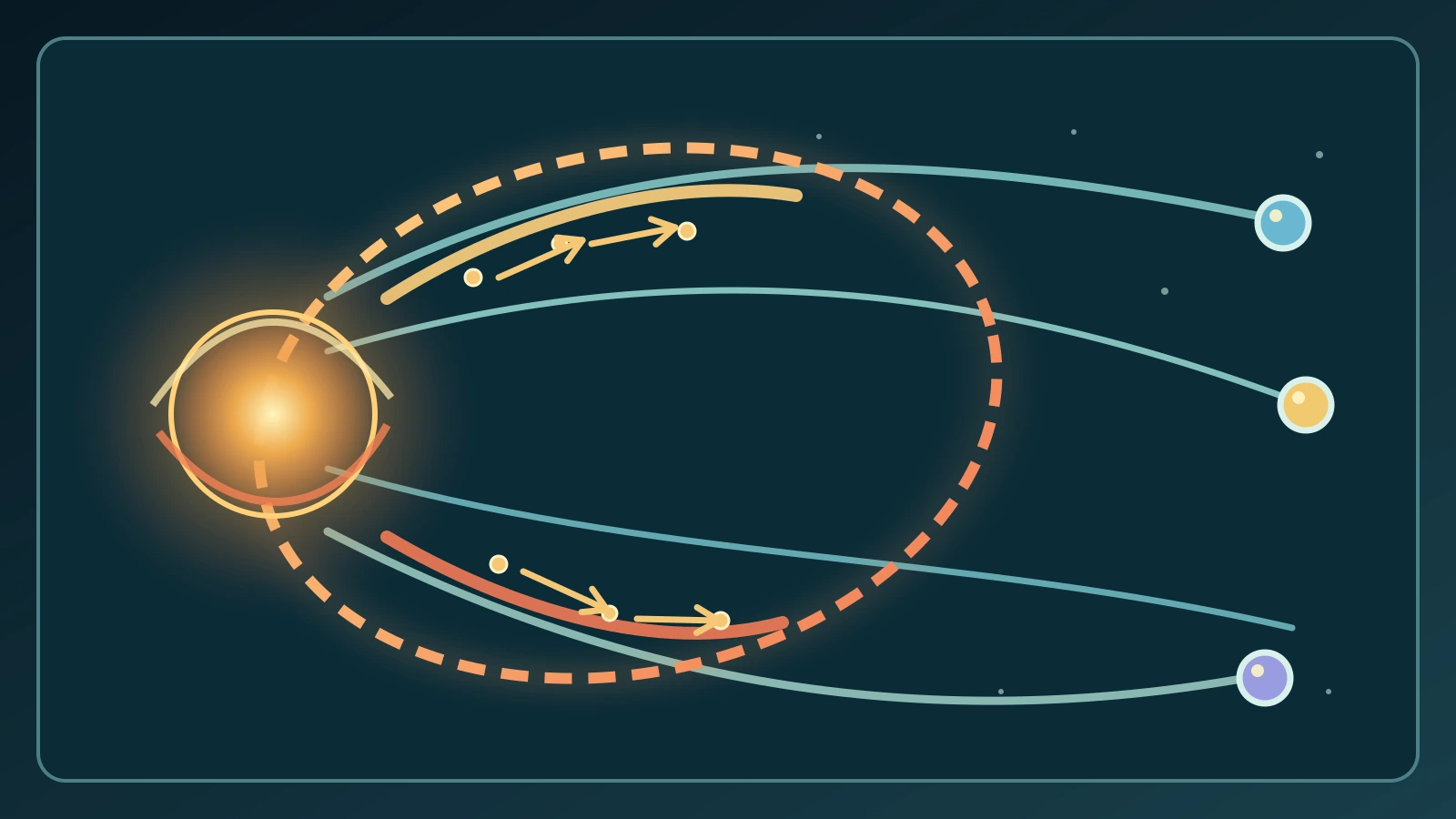
A CME is a huge expulsion of plasma and magnetic field. When it moves faster than the surrounding solar wind, it can drive a shock: a moving compression that travels ahead of the ejecta. Charged particles interacting with that front can gain energy as magnetic scattering sends them back and forth through the changing flow.
That is the general mechanism. The 2026 study did not follow one proton like a camera tracking a ball. Instead, it reconstructed the three-dimensional shock and calculated how its strength and geometry changed along magnetic field lines connected to different spacecraft. Stronger, more favourable shock regions were then compared with particle timing, spectra and composition.
This distinction matters. The diagram shows why a shock can be an accelerator, while the event-specific conclusion comes from the agreement—and disagreement—among several independent measurements. It explains the mechanism without pretending that a schematic arrow is a tracked proton path or a direct measurement of the shock's full contribution.
Why timing and radio bursts point to more than one route
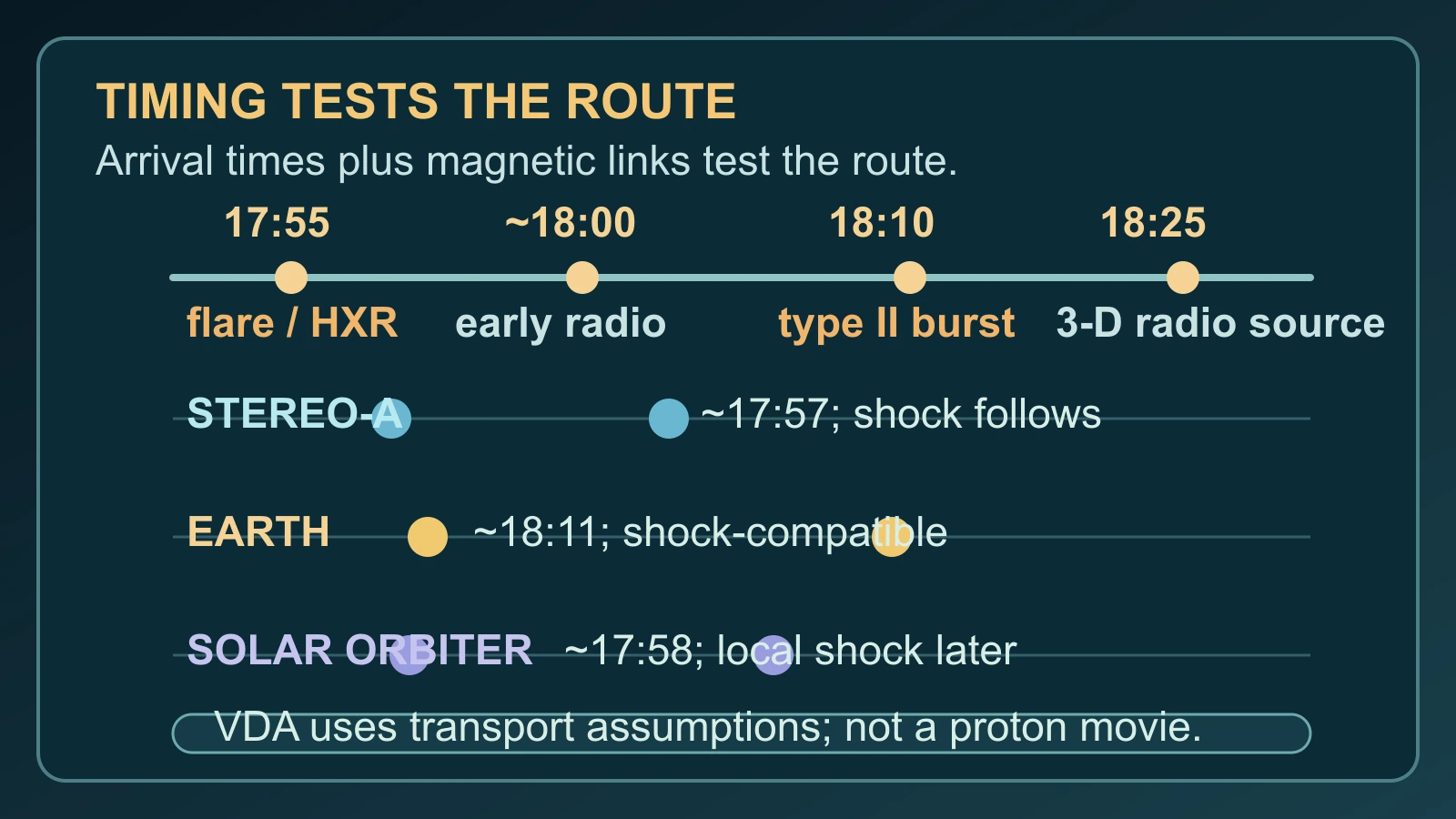
The researchers used velocity-dispersion analysis to estimate when particles at different energies were released near the Sun. Under the method's shared-path assumptions, the inferred release was about 17:57 UTC for STEREO-A, 17:58 for Solar Orbiter and 18:11 for the near-Earth observer, with uncertainties reported in the paper.
The timing does not say the same thing at each spacecraft. STEREO-A was well connected to the flare region and then to an efficient part of the CME shock. The near-Earth release came after its nominal shock connection, which is compatible with a shock contribution. Solar Orbiter's inferred release came before its local connection to the reconstructed front, so the earliest particles there cannot be assigned to that local shock alone.
Radio observations added a second check. The event included early type-III activity and a later type-II signature commonly associated with shock-related electron acceleration. A three-dimensional reconstruction placed the type-II radio sources near the expanding shock, but the paper also warns that radio interference and ionospheric refraction limit how precisely those source positions can be known.
What the evidence still cannot separate
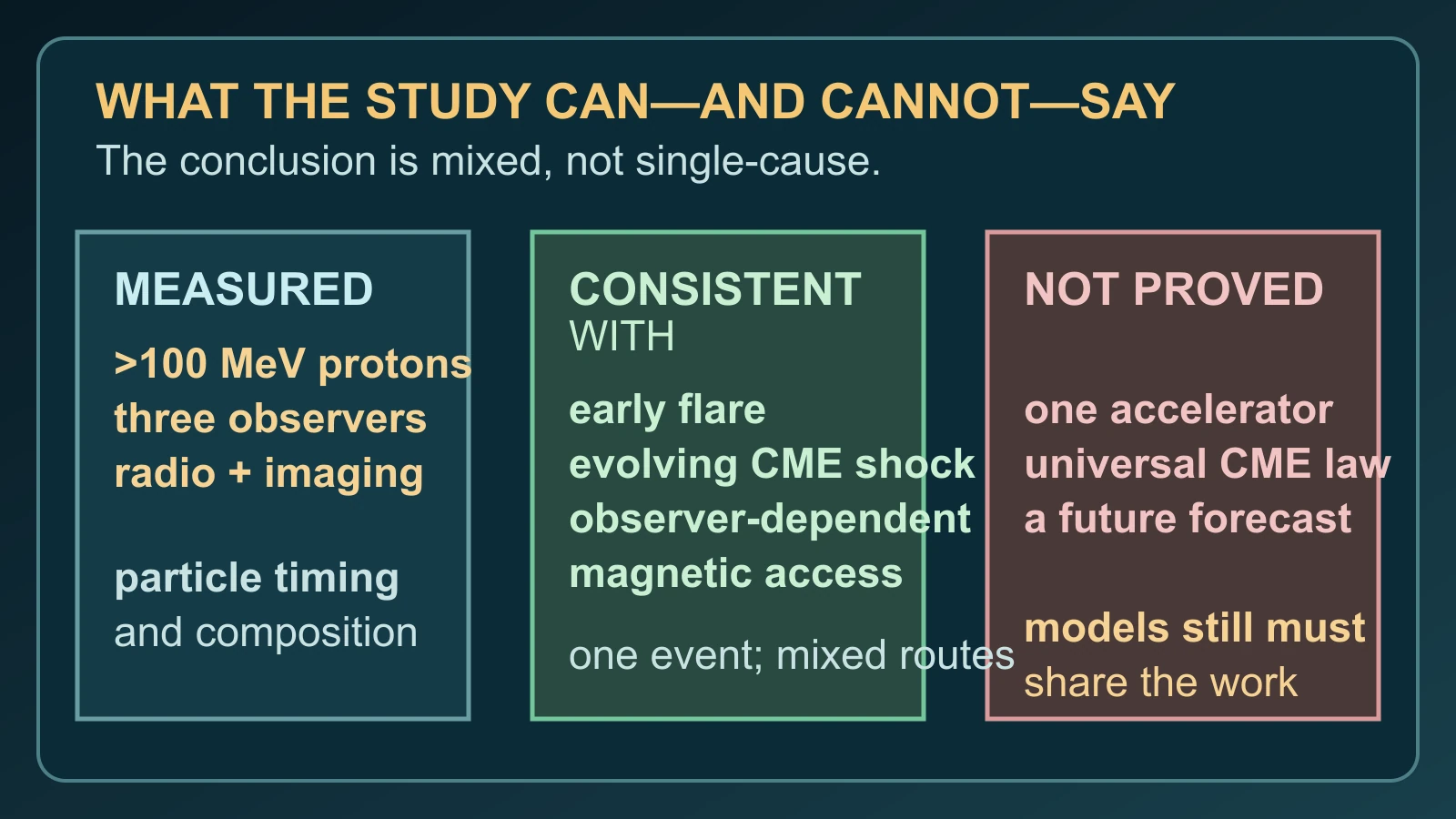
The strongest conclusion is a mixed one: an early flare-accelerated population was followed or supplemented by an evolving CME-shock contribution, and magnetic connectivity controlled which spacecraft sampled which part of that history. Iron enrichment and traces of helium-3 also support a flare-related contribution in the measured particle population.
The study does not assign one percentage of the particles to the flare and another to the shock. Its release-time method depends on transport assumptions, the reconstructed shock is model-dependent, and the local shock properties vary along different field lines. Quantifying the split requires coupled acceleration-and-transport modelling constrained by the timing, spectra and radio data.
Nor is this event a universal CME law or a forecast. NOAA's operational explanation establishes why fast CMEs can make particle-accelerating shocks, while NASA describes energetic particles as a broader space-weather phenomenon. The paper itself answers a narrower question: how several diagnostics can reveal mixed acceleration routes in one unusually well-observed event.
Sources and further reading
This article was written for Curiosity Desk. We do not copy other publishers or invent quotes. If a material error is found, we correct it openly.
Read the full standards →One answer should lead to a better question
Bring your curiosity to the group
Curious Minds is our public Facebook community for surprising science, strange history, Australian wildlife and everyday questions. No copied posts, no personal-friend invitations and no link dumping.
- Three self-contained discussion prompts each week
- Sourced answers and honest uncertainty
- Respectful conversation without spam