What Webb reveals through infrared filters
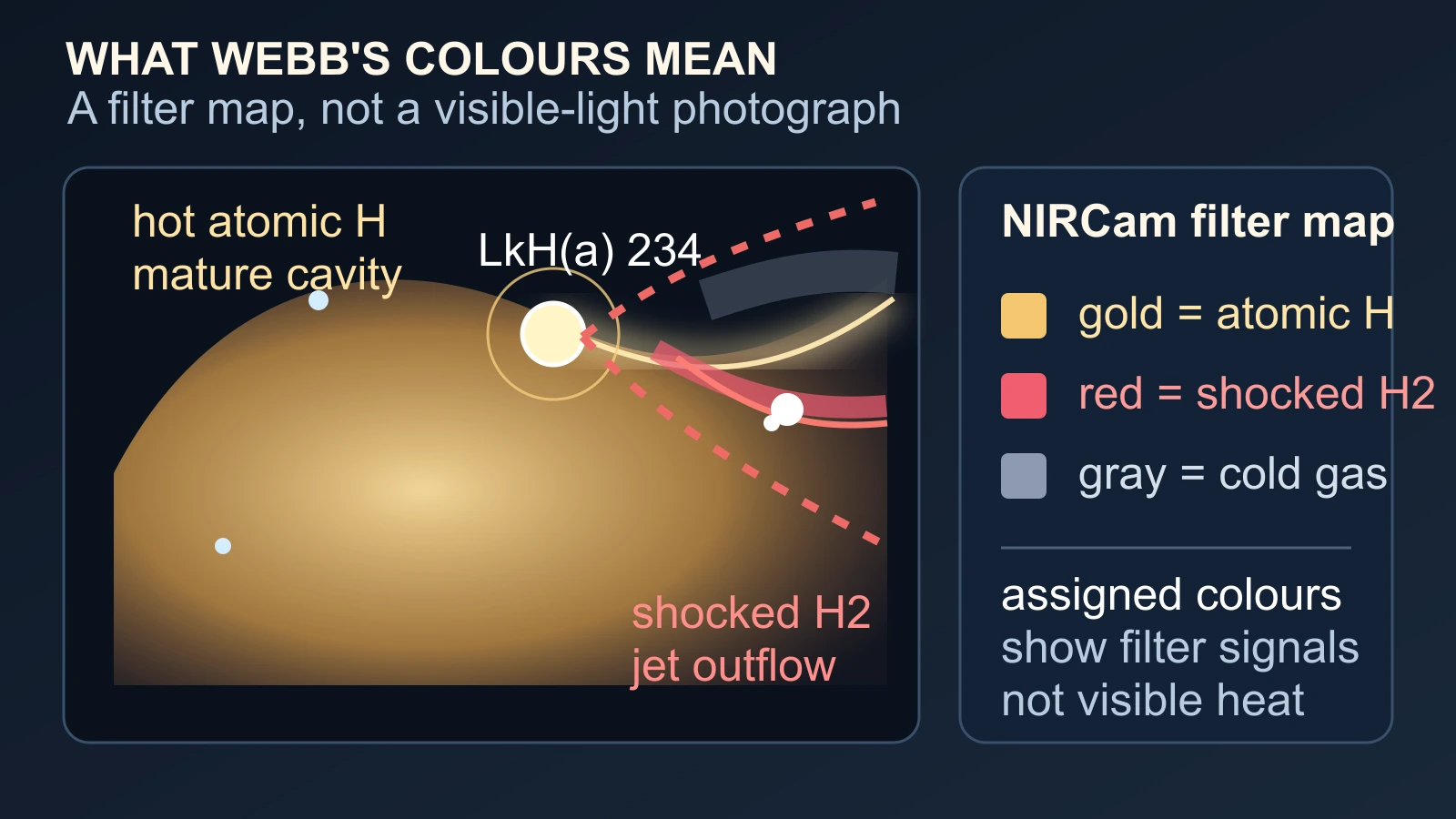
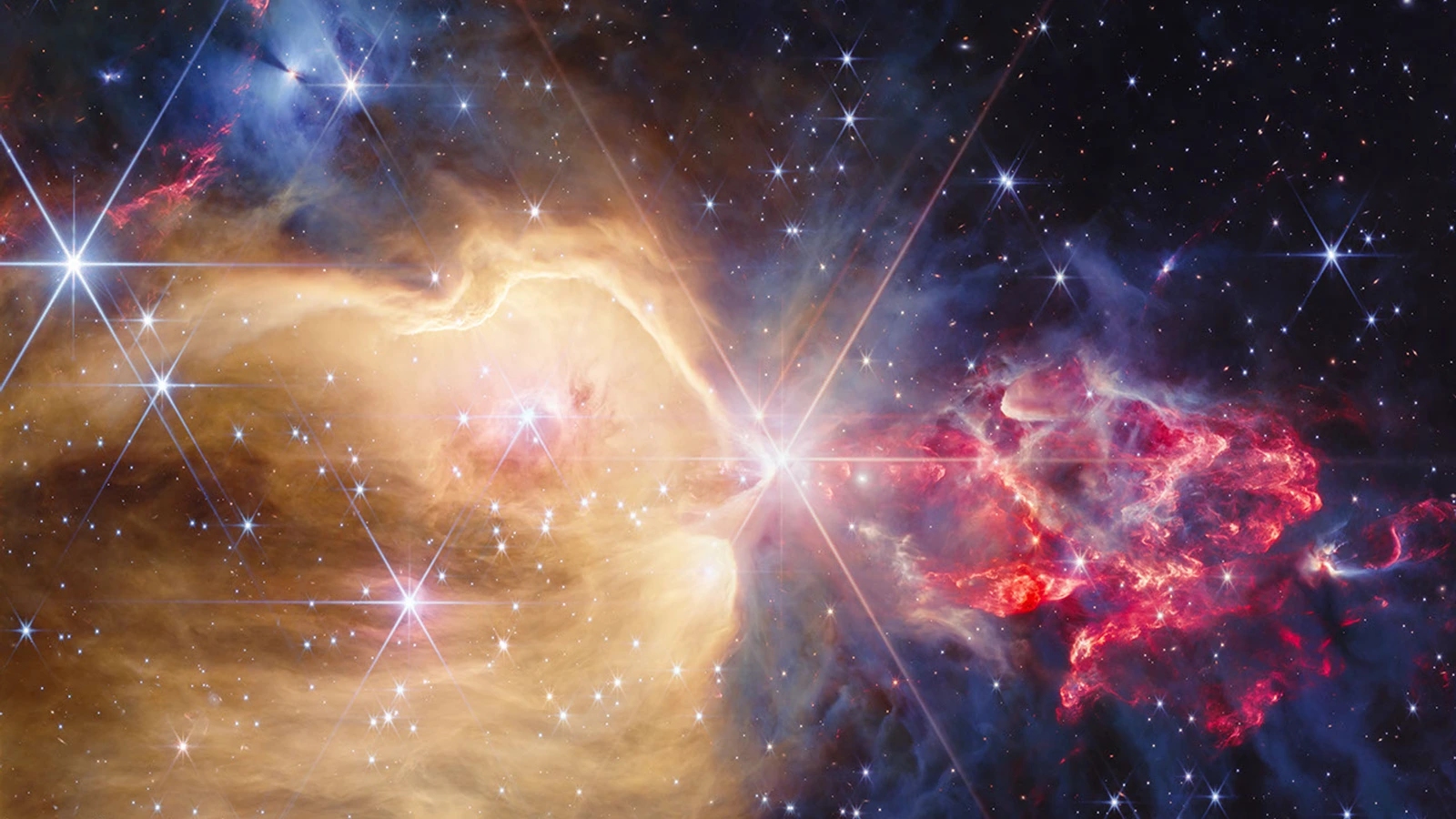
The new Webb view is not a conventional colour photograph. NASA's NIRCam image combines several filters, then assigns colours to the separate grayscale signals. The official asset record lists F115W, F187N, F200W, F335M, F444W and F470N, with blue, cyan, yellow and red mapped to those bands. The colour is a way to make different infrared signals visible together.
That mapping reveals a physical contrast inside NGC 7129. NASA describes the region to the left of the central star as hot atomic hydrogen with a golden glow, while the region to the right contains cooler molecular hydrogen. Protostars in that cooler region eject outflows that shock and heat the gas, giving parts of it a red hue and clumpy texture. The red is therefore a signal selected by the filters, not a claim that the gas would look red to human eyes.
Webb's advantage is partly its ability to see through dusty stellar nurseries. In this image it brings out protostars and gas structures that earlier, lower-resolution views could not separate as clearly. The observation is a map of light from particular filters; it is not, by itself, a full three-dimensional movie of the cloud.
How outflows and bow shocks carve cavities
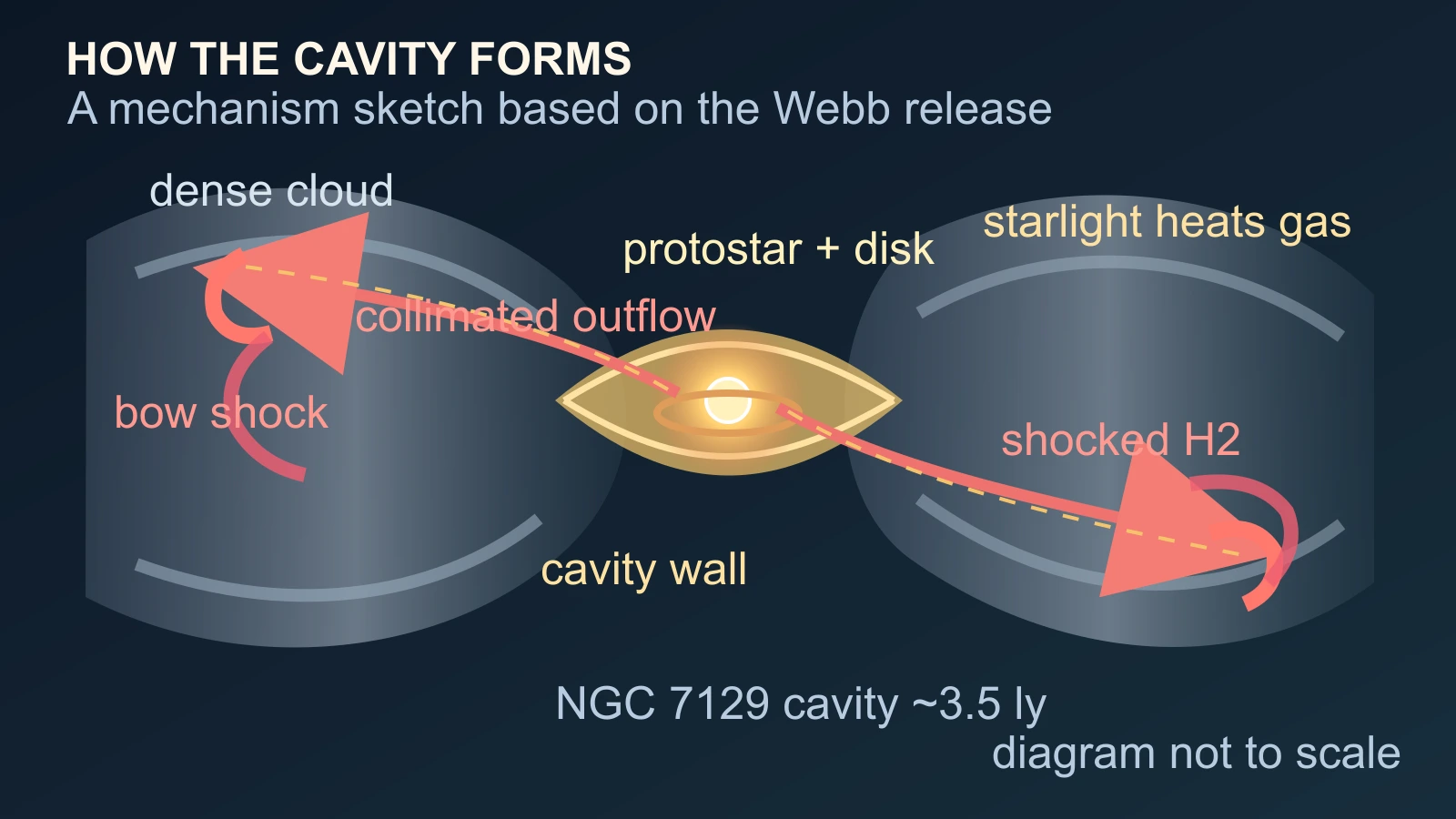
A young star grows by drawing material inward through a disk, but the same early system can also drive material outward. When an outflow runs into the surrounding molecular cloud, the meeting point can shock and heat gas, pushing material aside and lighting up a boundary. Independent JWST observations of five other young protostars show the useful general pattern: collimated jets can sit inside cavities containing warm molecular gas, with narrow molecular shells or bow-shock-accelerated material around them. That study is context for the mechanism, not a direct measurement of NGC 7129.
For NGC 7129, NASA describes the cavity left of the central star as about 3.5 light-years across. The release attributes the cavity to outflows from an earlier stage of the star's life, while the star's light energises the gas so that it glows. In plain language, the outflow is not simply an invisible tunnel: it changes the density, temperature and illumination of the material around it, leaving a boundary Webb can trace.
This is why the image can look like a quiet landscape and a violent process at the same time. The gold cavity records energized gas and the red structures mark shocked molecular material, while dense cloud remains around and between them. The diagram is a physical explanation of the source description, not a claim that the public image resolves every jet speed or the full three-dimensional flow.
Why one stellar nursery cannot prove a universal rule
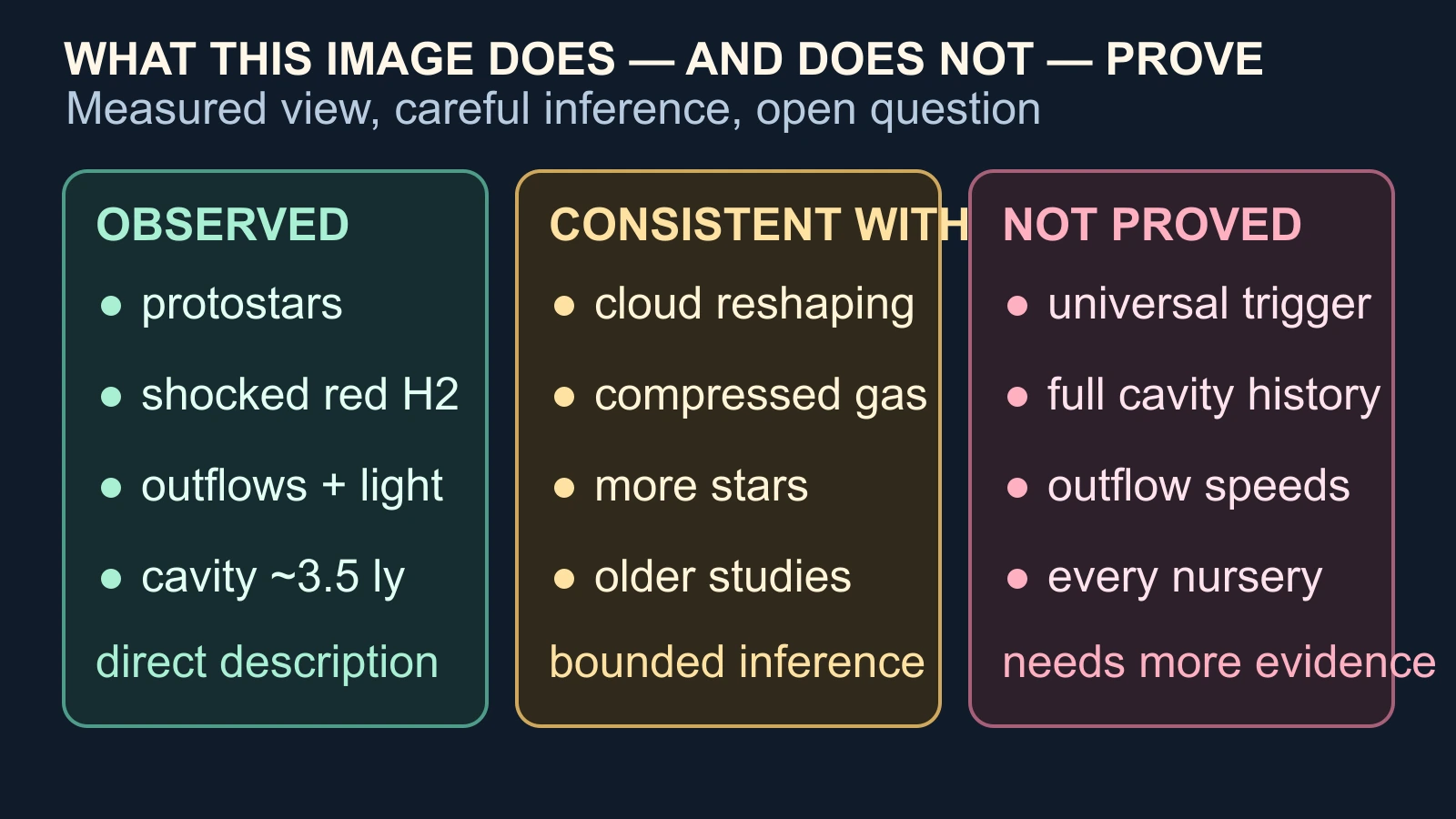
NASA says that although much of the hydrogen is blown away, a large amount is compressed, creating conditions for more stars to form. That is an important consequence to investigate, but a condition is not the same as a counted new star or proof that the outflow triggered one. The image shows a changing environment; it does not settle the future of every compressed clump.
Earlier NGC 7129 research provides both support and caution. An optical survey interpreted the large cavity as being evacuated by the central early-type stars and placed recently formed embedded sources in a ridge of compressed molecular gas. It also described the causal sequence and the possibility of triggered star formation as matters of interpretation rather than a single settled history. That is why this article keeps the current Webb description and the older study's inference in separate lanes.
The careful answer is therefore local and useful: young stars can reshape their birth clouds through outflows, shocks and radiation, and NGC 7129 offers a vivid case where those effects are visible. The image does not establish one universal trigger, every outflow speed, a complete cavity history or what every stellar nursery does. More spectroscopy, kinematics and comparisons across regions would be needed to narrow those questions.
Sources and further reading
- NASA Science: NASA's Webb Captures Commotion From Nebula's Stellar Jets ↗
- NASA Science: NGC 7129 (NIRCam Image) ↗
- arXiv: An Optical Survey of the Partially Embedded Young Cluster in NGC 7129 ↗
- IPAC: Investigating Protostellar Accretion-driven Outflows Across the Mass Spectrum ↗
- NASA: Guidelines for using NASA Images and Media ↗
This article was written for Curiosity Desk. We do not copy other publishers or invent quotes. If a material error is found, we correct it openly.
Read the full standards →One answer should lead to a better question
Bring your curiosity to the group
Curious Minds is our public Facebook community for surprising science, strange history, Australian wildlife and everyday questions. No copied posts, no personal-friend invitations and no link dumping.
- Three self-contained discussion prompts each week
- Sourced answers and honest uncertainty
- Respectful conversation without spam