Why the missing oxygen may still be nearby
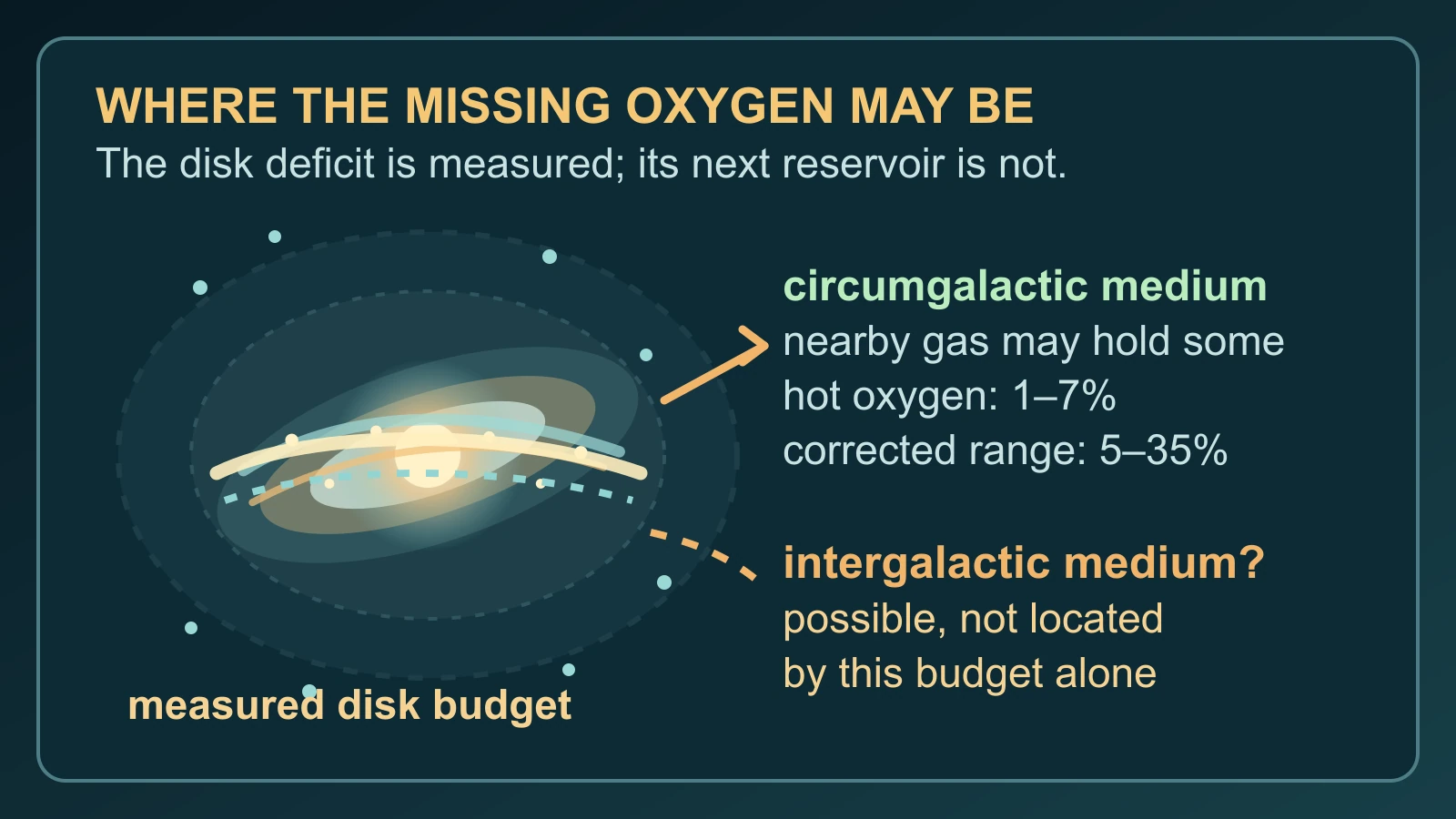
The clearest answer from the new GLOW study is also the most careful one: the oxygen is missing from the galaxies' measured disks, but astronomers have not yet pinned down whether most of it is sitting in the surrounding gas or has travelled farther into intergalactic space. In 37 nearby, gas-rich, star-forming low-mass galaxies, the team estimates that only 4% to 25% of the oxygen made by stars is still retained, with a mean of about 10.7%.
That is an oxygen budget, not a photograph of every atom. The study estimates how much oxygen stellar nucleosynthesis should have produced and compares that amount with oxygen measured or modelled in the galaxies' gas, stars, stellar remnants and dust. The difference is real within that accounting, but the missing part is not automatically a single cloud, a single wind or a directly measured escape fraction.
So the useful question is not simply 'where did it vanish?' Oxygen is still present in the wider baryon cycle. The unresolved question is how much remains bound near each dwarf galaxy, how much was recycled, and how much escaped the galaxy's surroundings altogether.
How massive stars can push oxygen outward
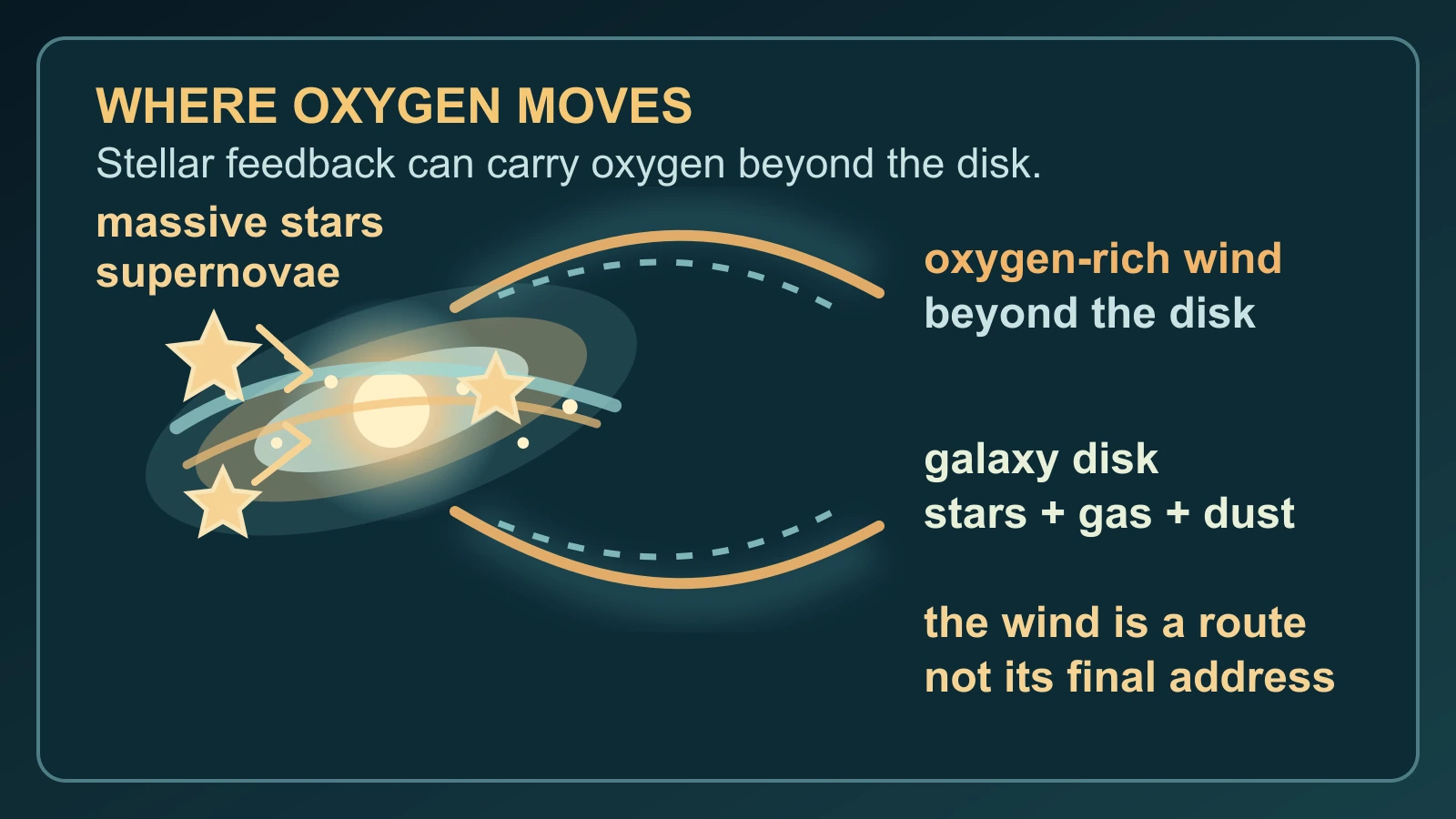
Oxygen is made in stars and released as stars return material to space. In a small galaxy, the energy from massive stars and supernova explosions can drive a galactic wind: a moving flow of gas that carries newly made elements away from the star-forming regions. A low-mass galaxy has a shallower gravitational well than a large spiral, so retaining that enriched material is harder.
The GLOW paper's interpretation is more specific than 'supernovae blow everything away'. The observations are consistent with metals being preferentially expelled in hot-phase winds that are somewhat richer in metals than the surrounding interstellar gas, while other winds regulate the galaxy's gas mass. The authors use a simple model to explore how wind mass loading and inflow can produce the observed retention fractions.
That is an interpretation constrained by the budget, not a time-lapse view of an oxygen plume leaving each galaxy. The study does not claim that one mechanism has been isolated for every target, and its model discussion does not turn the 37 galaxies into a universal rule for all galaxies.
How GLOW built the oxygen budget for 37 galaxies
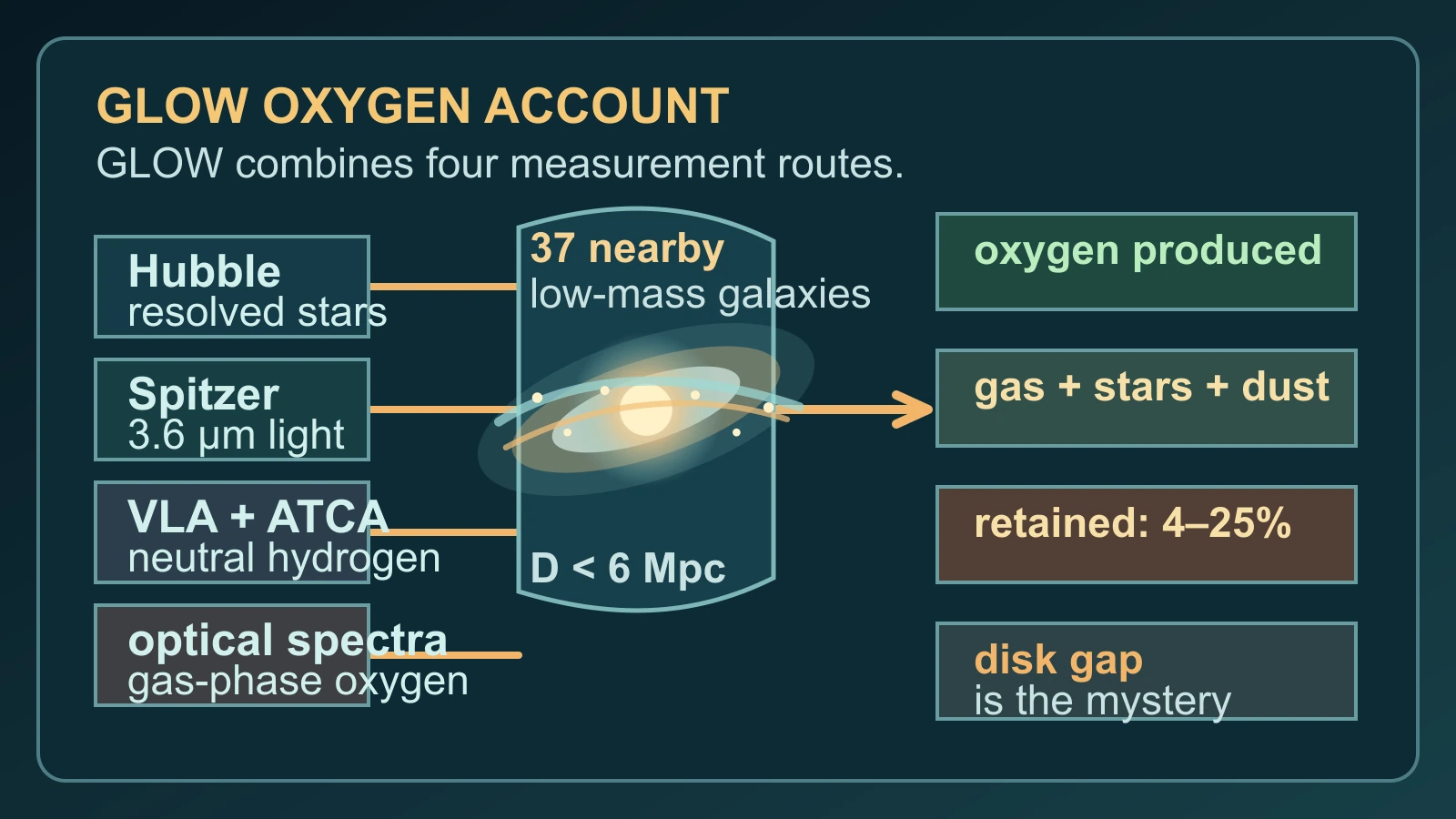
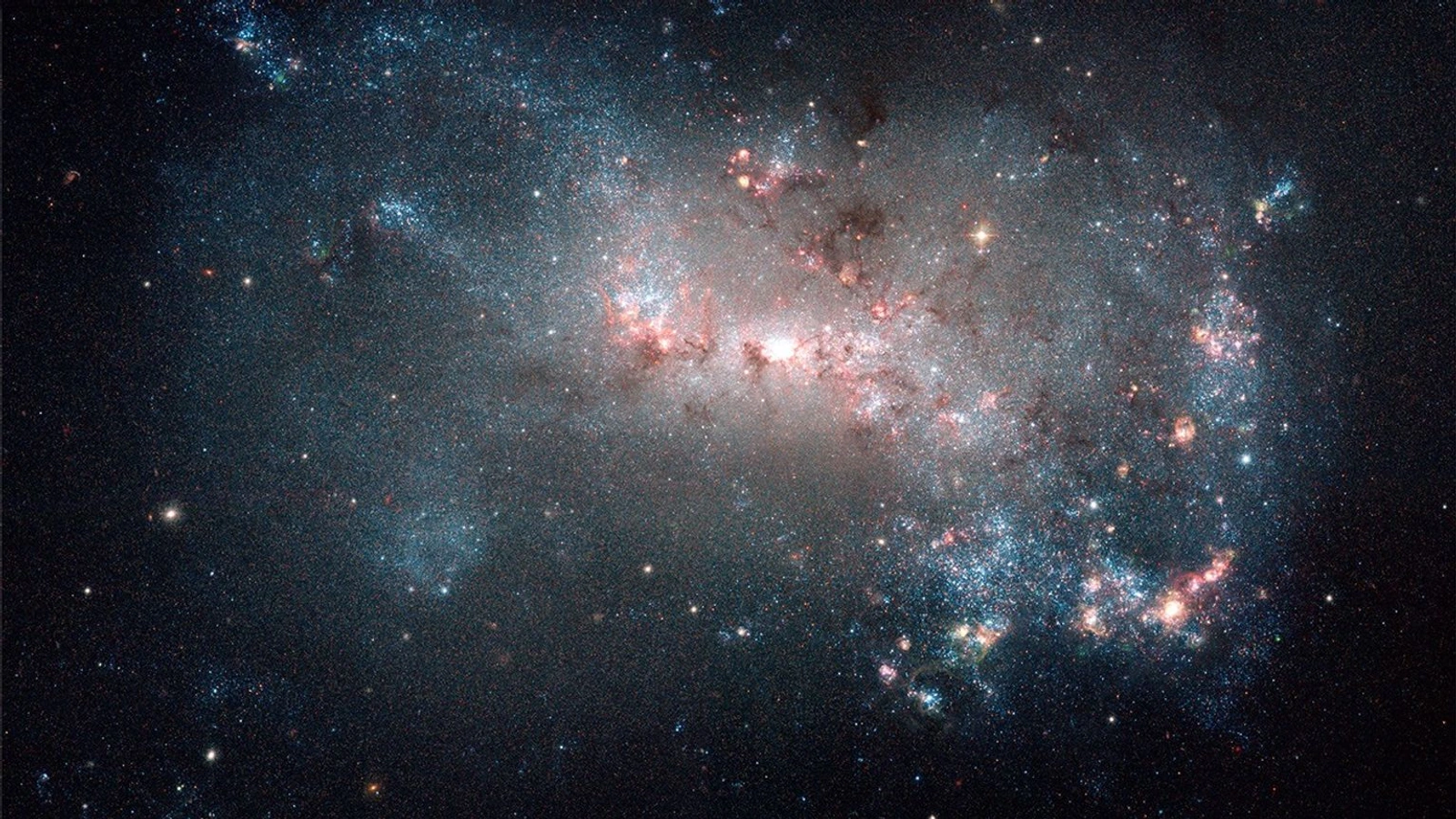
The census depends on several measurements that answer different parts of the same accounting problem. GLOW I assembled a uniform atlas for 37 galaxies within 6 megaparsecs, using resolved Hubble stars, Spitzer 3.6-micron imaging, neutral-hydrogen data from the Very Large Array and Australian Telescope Compact Array, and optical measurements of gas-phase abundances and the local environment.
Resolved stars matter because their colours and brightnesses let the team reconstruct star-formation histories: when the galaxy formed stars and how much stellar material has existed over time. The infrared and hydrogen measurements help estimate stellar and gas masses. Optical spectra provide oxygen abundance in ionised gas. Together, those inputs support an estimate of oxygen produced by stars and the amount still in the disk's gas, stars, remnants and dust.
The sample was chosen to cover low stellar masses where feedback is expected to matter strongly, roughly 10^6.5 to 10^9.5 solar masses, and all 37 are close enough for Hubble to resolve individual stars. That makes the result unusually detailed, but it also defines its boundary: it is a carefully selected nearby sample, not a census of every dwarf galaxy in the Universe.
What the study establishes—and what remains unknown
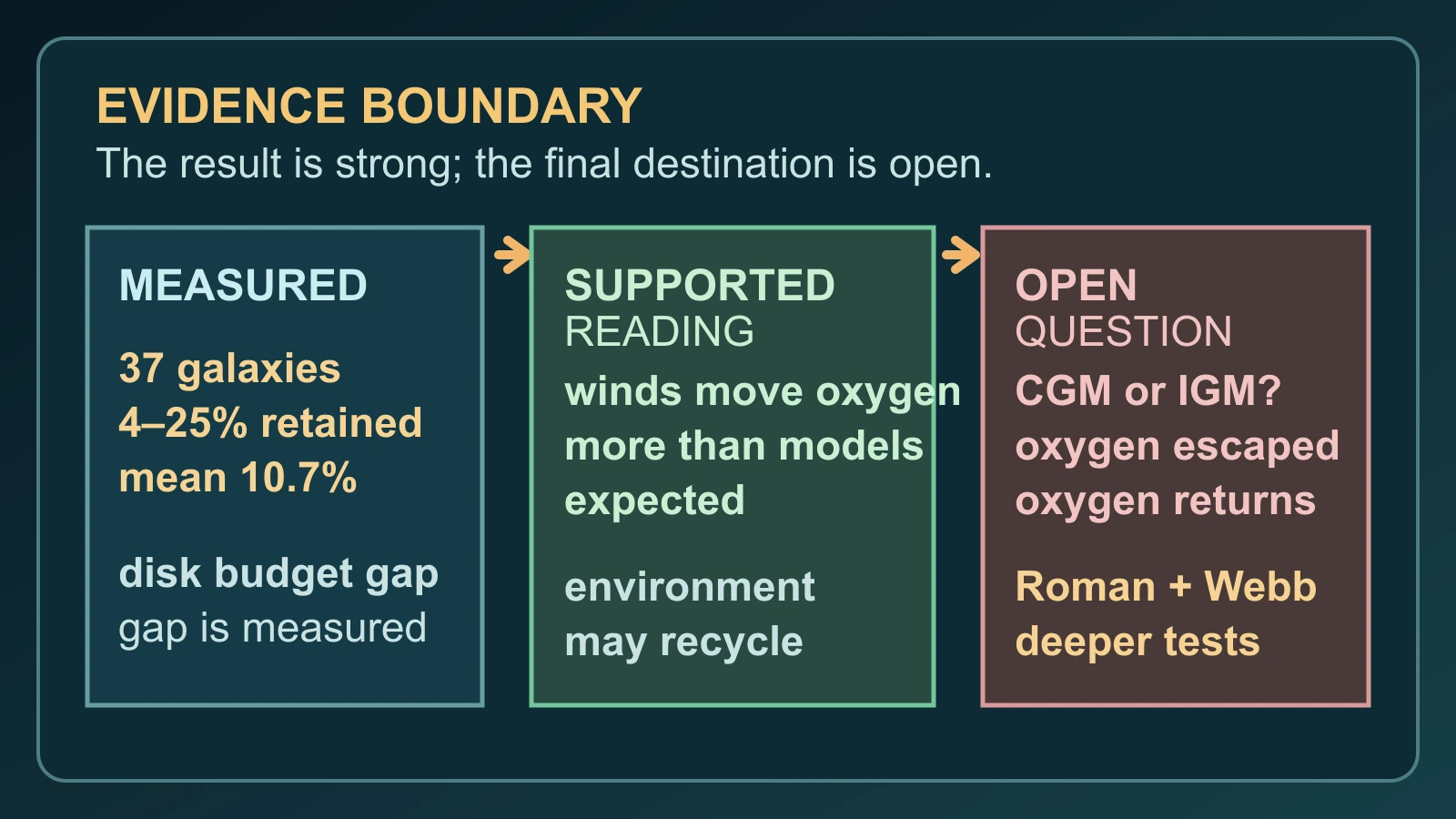
The established result is a low retained oxygen fraction: 4% to 25%, averaging about 10.7%, with most of the retained oxygen in gas rather than stars or dust. The study also finds that the observed retention is lower than many hydrodynamical simulations predict, giving models a sharper test of how feedback and gas accretion work in small galaxies.
The destination is less settled. Existing observations constrain some oxygen in the circumgalactic medium, the extended gas around a galaxy. GLOW II summarises hot-phase estimates of roughly 1% to 7% of the oxygen produced, with broader estimates of about 5% to 35% after accounting for additional ionisation states. Those ranges are literature constraints with substantial uncertainty, not a complete inventory that closes the budget.
Future work can narrow the gap by finding even smaller nearby galaxies with Roman and then studying their stars more deeply with Hubble and Webb. Until those observations and better gas measurements arrive, the honest answer is a map with an unresolved edge: dwarf galaxies lose most of the oxygen their stars make from their disks, but science has not yet assigned every missing atom a final address.
Sources and further reading
- McQuinn et al. — GLOW II: A Census of Oxygen in Low-Mass Galaxies ↗
- McQuinn et al. — GLOW II arXiv full text and abstract ↗
- McQuinn et al. — GLOW I data atlas for 37 nearby low-mass galaxies ↗
- NASA Hubble — NASA’s Hubble Uncovers Case of Missing Oxygen in Nearby Dwarf Galaxies ↗
- NASA — Guidelines for using NASA Images and Media ↗
- Rutgers — Stars Make Oxygen for Small Galaxies. They Lose Most of It. ↗
This article was written for Curiosity Desk. We do not copy other publishers or invent quotes. If a material error is found, we correct it openly.
Read the full standards →One answer should lead to a better question
Bring your curiosity to the group
Curious Minds is our public Facebook community for surprising science, strange history, Australian wildlife and everyday questions. No copied posts, no personal-friend invitations and no link dumping.
- Three self-contained discussion prompts each week
- Sourced answers and honest uncertainty
- Respectful conversation without spam