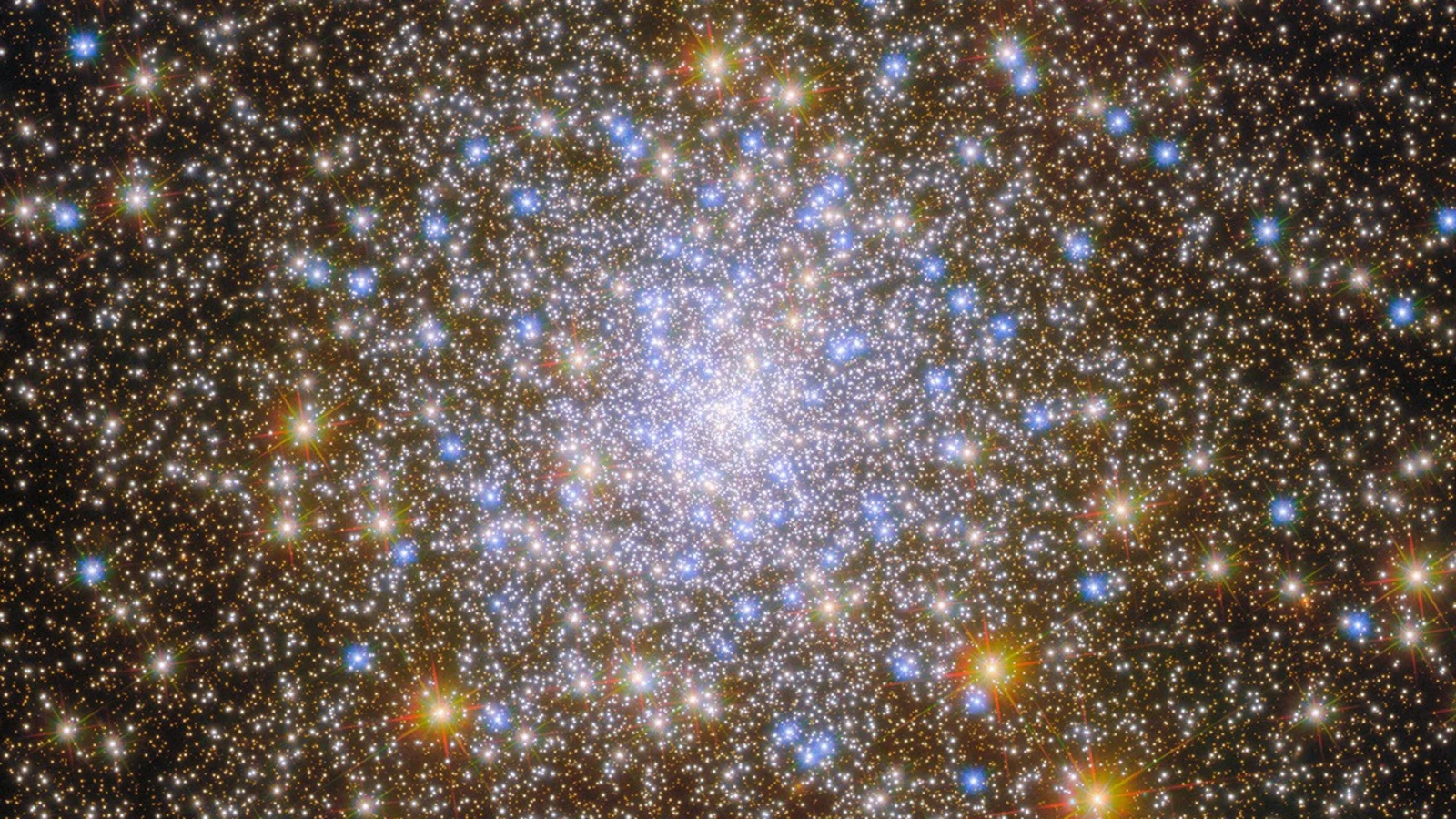
A galaxy's halo keeps a faint assembly record
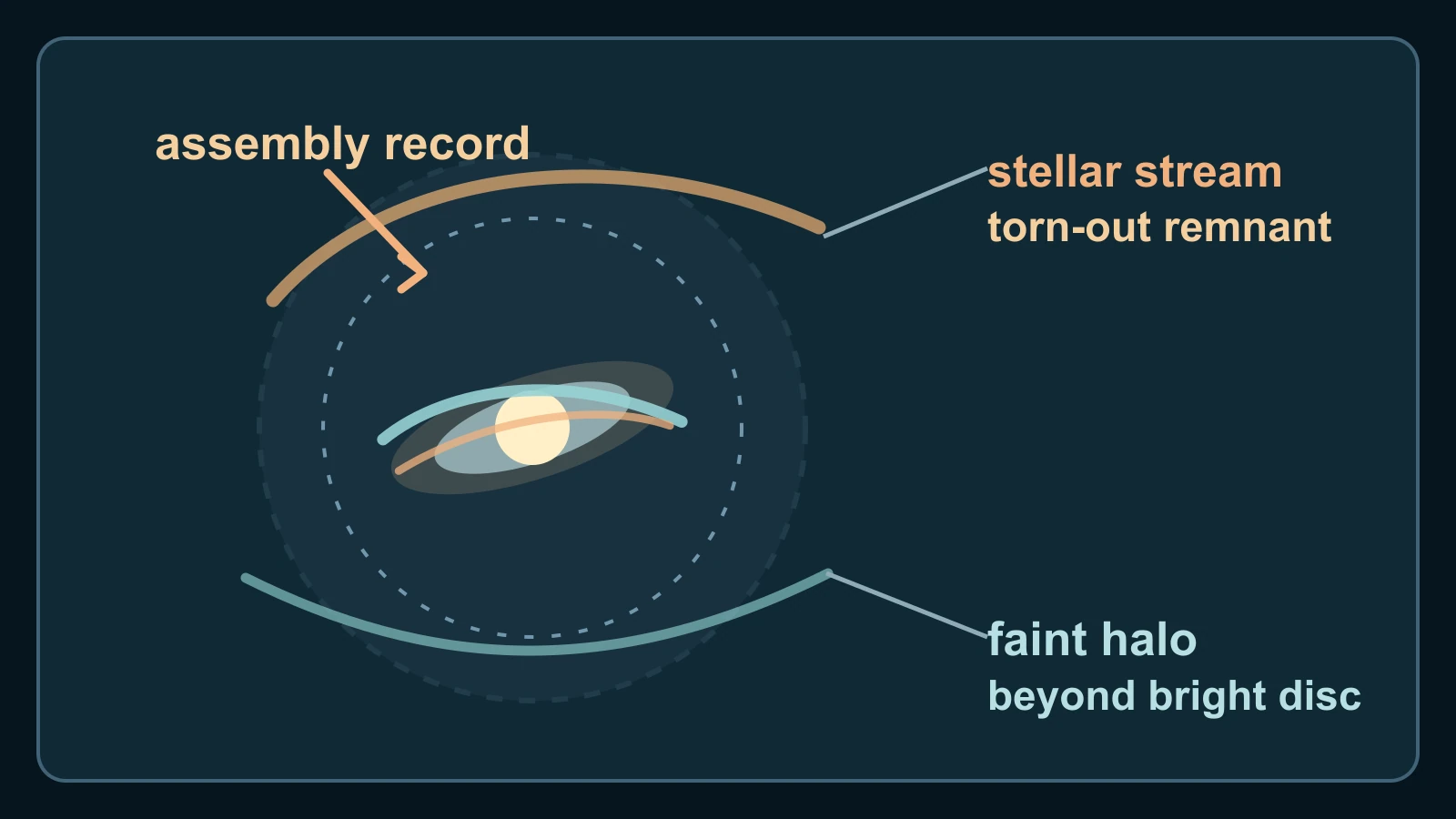
The bright spiral disc is only the part of a galaxy that is easiest to see. ESA describes a much larger halo around a Milky-Way-like galaxy, containing invisible dark matter, hot gas and a diffuse population of stars. Arrakihs is designed to target the faint stellar part of that outer region.
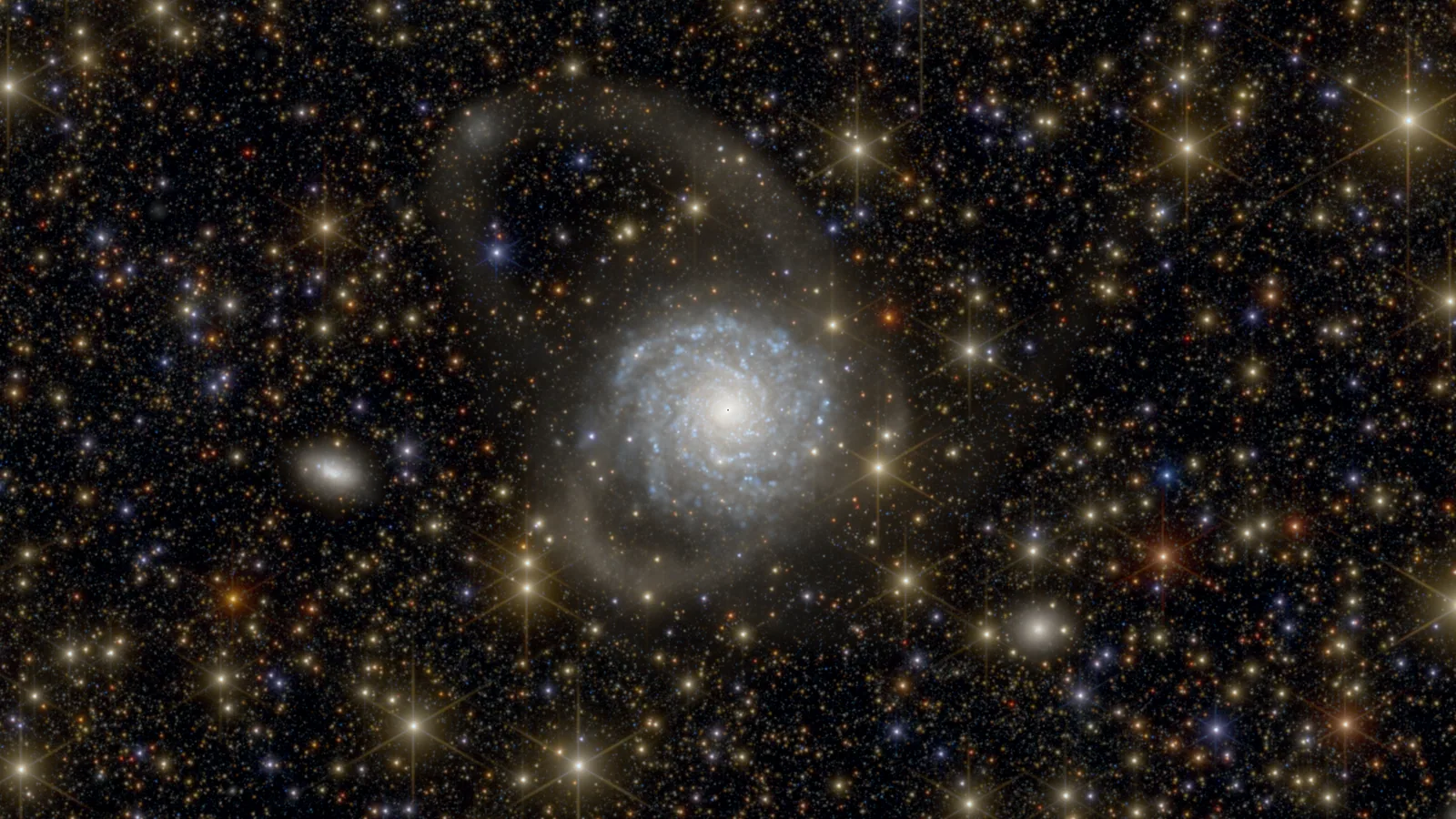
A stellar stream is one of the most useful clues in that faint outskirts. When a smaller galaxy or star cluster is pulled apart by a larger galaxy's gravity, its stars can remain spread along an arc. The shape and distribution of that debris can preserve evidence about earlier accretion events. It is a record to interpret, not a literal replay of the merger.
The ESA mission is therefore asking a population question: do Milky-Way-mass galaxies show similar outer structures, or did their assembly histories vary more than the simplest picture suggests across a broad nearby sample rather than in one exceptional system?
Why low surface brightness is the hard part
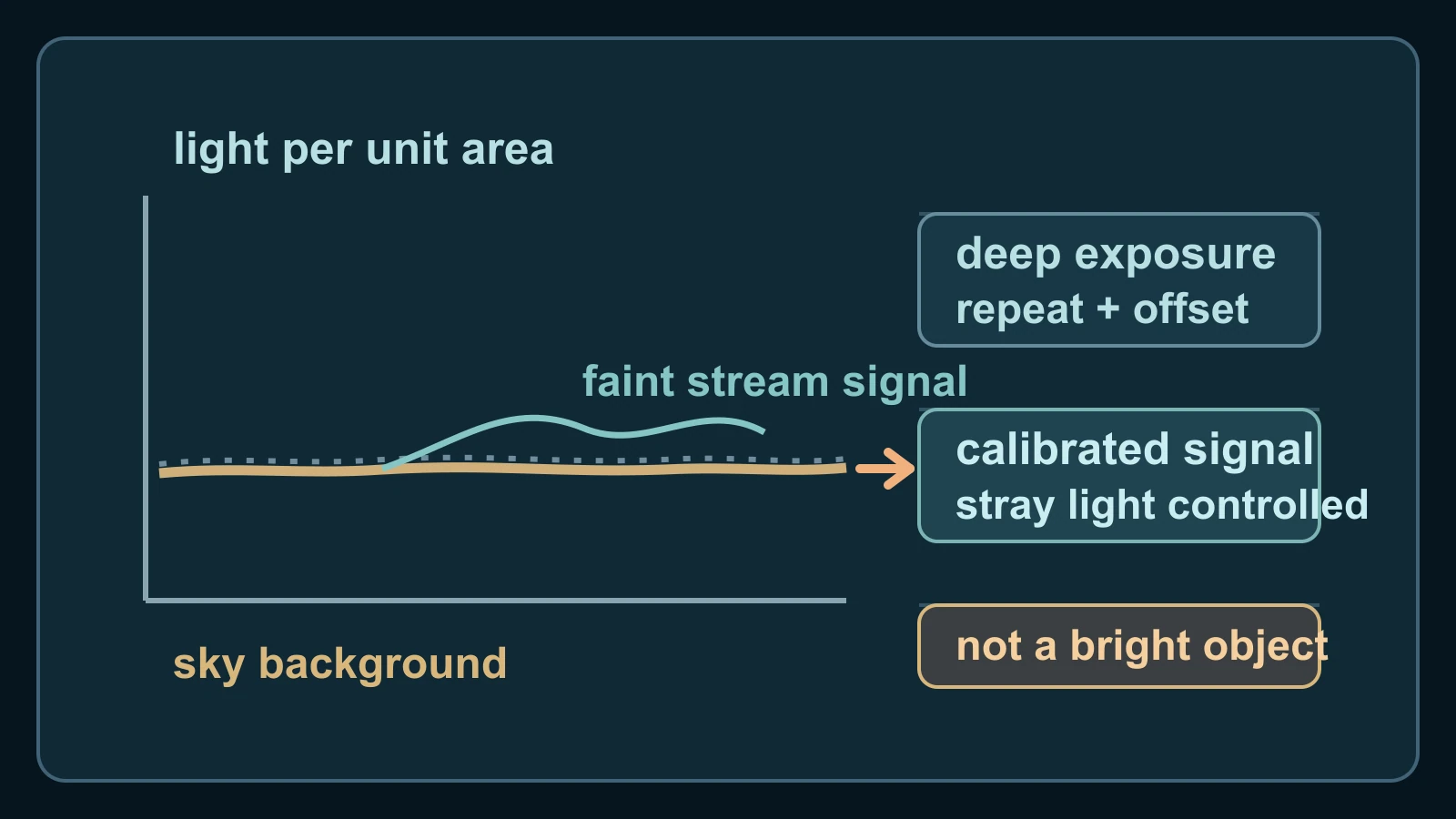
The target is not merely a dim galaxy. Low surface brightness means the light is spread thinly across an area, so the useful signal can sit close to the background from the sky and the instrument. A faint stream may be physically large but still easy to lose in a single exposure or an imperfect background estimate.
The consortium describes a method built around deep, multi-band imaging, repeated visits, small pointing offsets and dithering, followed by data reduction that controls sky subtraction, scattered light and the broad wings of the point-spread function. Those steps are measurement infrastructure: they make a faint structure recoverable without pretending that every glow is a stream.
This is why the planned mission is more than a camera pointed at a pretty galaxy. The scientific result will depend on stable calibration and on distinguishing a real, extended stellar feature from instrumental or environmental structure.
What the four cameras add to the picture
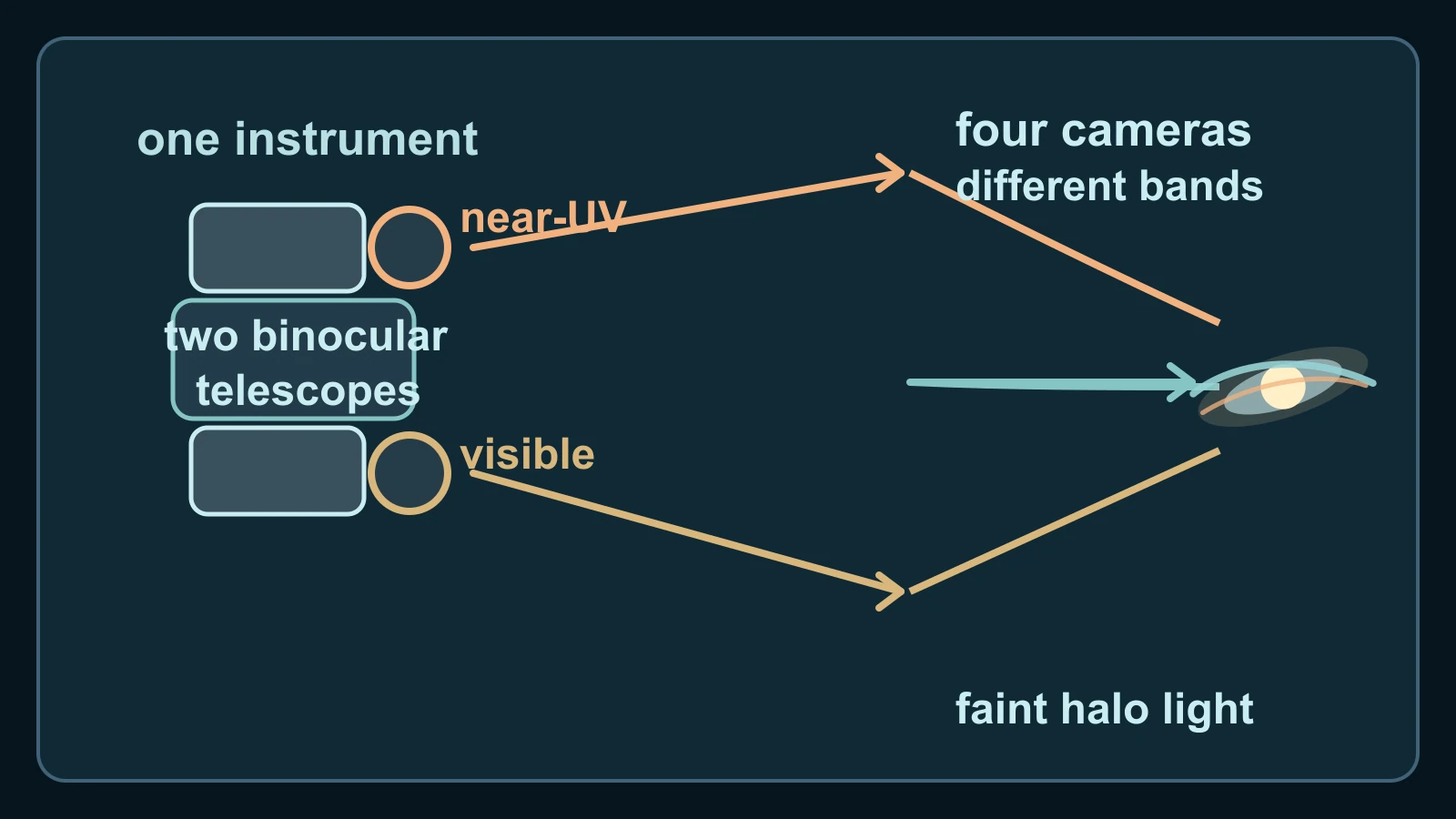
ESA's factsheet describes one instrument made from two binocular telescopes, giving Arrakihs four cameras. They are planned to cover different bands from the near-ultraviolet through visible light and into the near-infrared. The point is not to create a decorative colour picture; it is to collect complementary measurements of the faint light.
Different bands can help researchers compare the appearance and colour of halo structures, while the wide, stable imaging design supplies the spatial context needed to map streams around many targets. The mission material describes a survey of at least 80 galaxies with masses similar to the Milky Way, large enough to look for patterns across a population rather than rely on one spectacular system.
That sample size changes the question from 'can one faint arc be found?' to 'how common are particular kinds of outer structure, and what do their distributions say about galaxy assembly?' The answer will still be limited by the quality of each detection and the models used to interpret it.
What Arrakihs could learn—and what it cannot prove yet
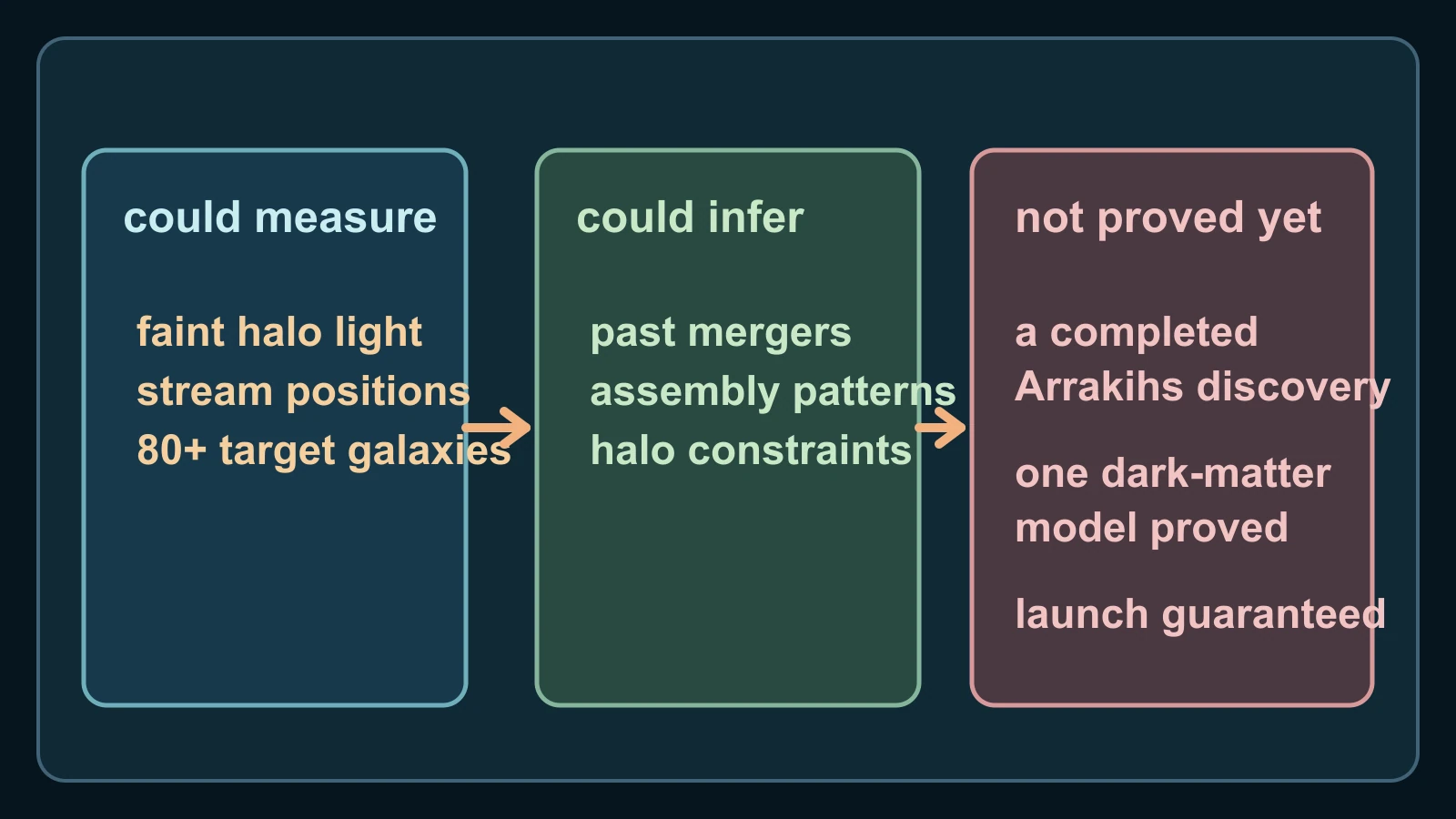
If the mission reaches its planned observations, it could compare halo structure and stellar-stream populations across many nearby Milky-Way-like galaxies. That would give astronomers a stronger basis for testing galaxy-formation models and for asking how much the Milky Way is a typical outcome.
The independent stellar-stream modelling paper supplies an important limit. A stream's projected track can contain information about a host halo, but different combinations of halo and stream properties can look similar in projection. Radial-velocity information can improve some constraints. In other words, the image is evidence for a model-fitting problem, not a direct photograph of dark matter.
And the time boundary matters. ESA says Arrakihs was adopted in June 2026, is in development and is planned for launch in late 2030. The current image is a simulation, not telemetry. Adoption establishes a committed mission programme and a feasibility decision; it does not establish a completed Arrakihs discovery, a guaranteed launch or proof that one dark-matter model is correct.
Sources and further reading
This article was written for Curiosity Desk. We do not copy other publishers or invent quotes. If a material error is found, we correct it openly.
Read the full standards →One answer should lead to a better question
Bring your curiosity to the group
Curious Minds is our public Facebook community for surprising science, strange history, Australian wildlife and everyday questions. No copied posts, no personal-friend invitations and no link dumping.
- Three self-contained discussion prompts each week
- Sourced answers and honest uncertainty
- Respectful conversation without spam