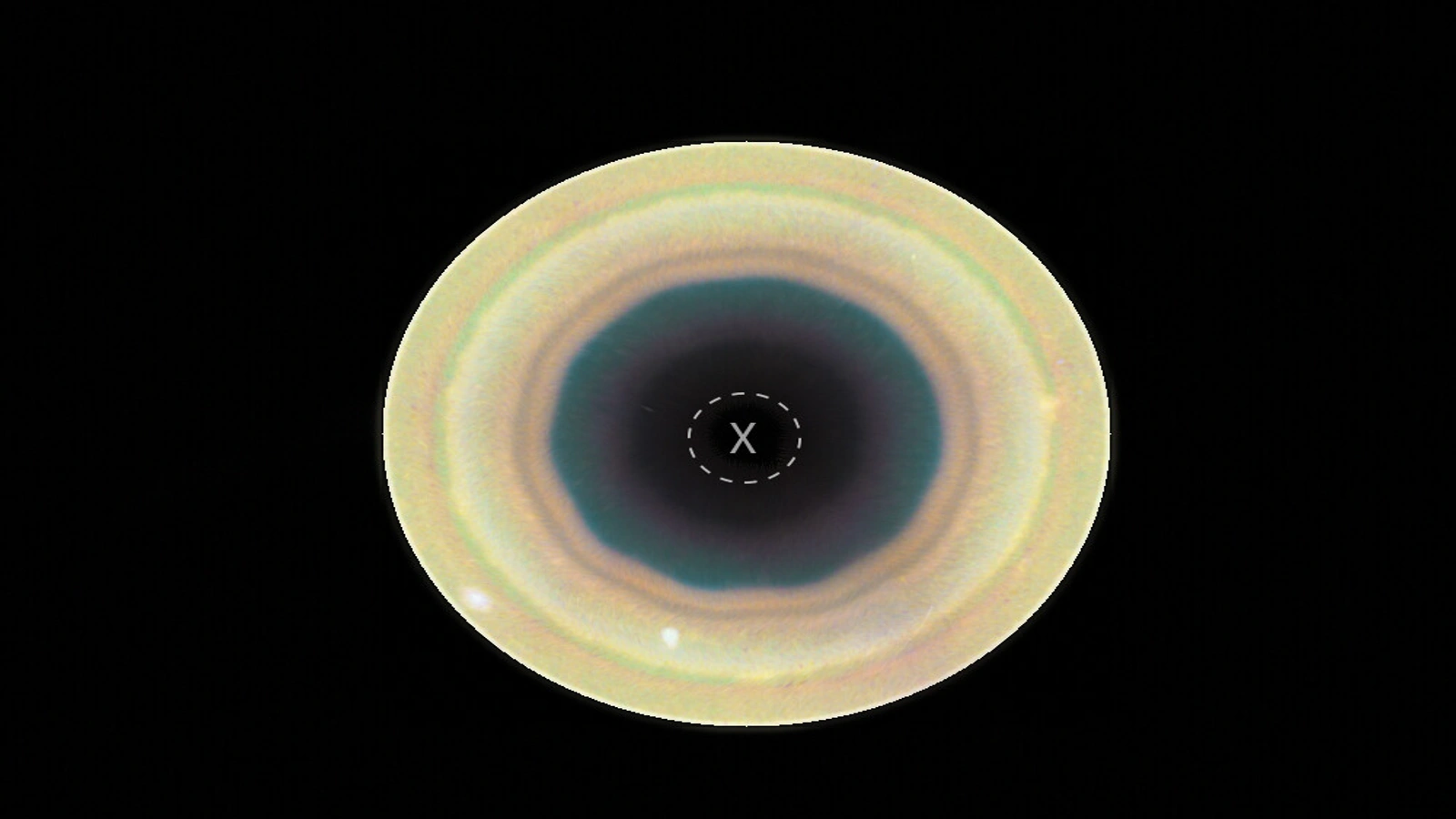
The problem is glare, not the planet's absence
A planet can reflect light while remaining invisible beside its star because the star is overwhelmingly brighter and the two appear close together from Earth. NASA's Roman Space Telescope carries a Coronagraph Instrument designed to suppress that glare inside the telescope, creating the optical equivalent of a small controlled eclipse.
The analogy has a limit. The Moon blocks the Sun before its light enters your eye. Roman's masks sit within a chain of optics after starlight has entered the telescope. Blocking the bright centre is necessary, but diffraction and tiny optical flaws can still scatter enough light across the detector to bury a planet.
Masks redirect the star's central light
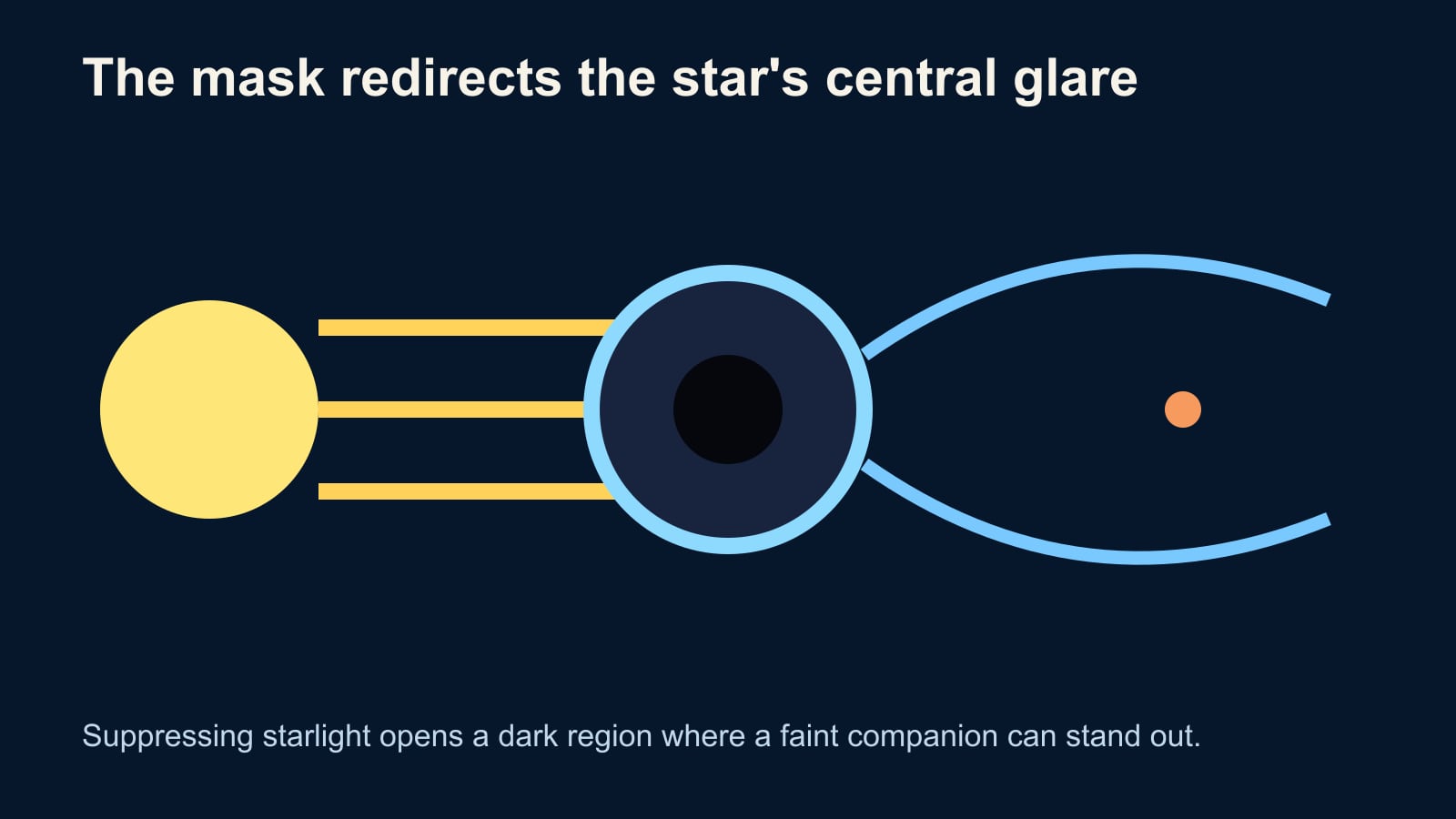
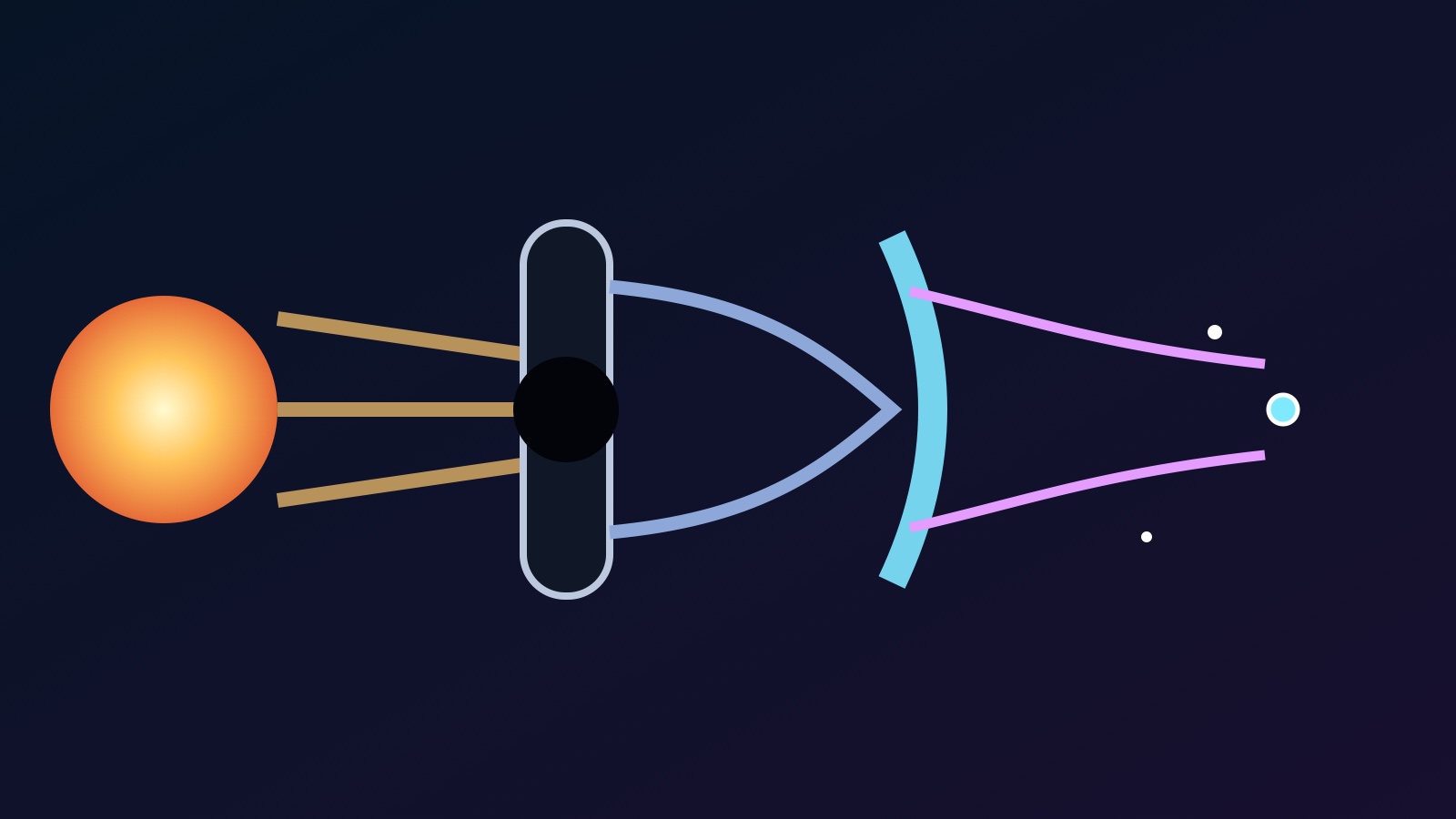
A coronagraph first shapes or blocks the on-axis starlight with carefully designed masks. Additional pupil-plane elements control the diffraction pattern created when a wave passes edges and apertures. The goal is to steer most stellar light away from a chosen dark region of the final image.
A planet slightly off the star's line follows a different path through the optics, so some of its light can reach the detector. That separation is delicate: too aggressive a mask can also remove planet light, while an imperfect pattern leaves stellar residue. Coronagraph design balances suppression, usable field and the smallest angle from the star that can be explored.
Deformable mirrors cancel the light that leaks through
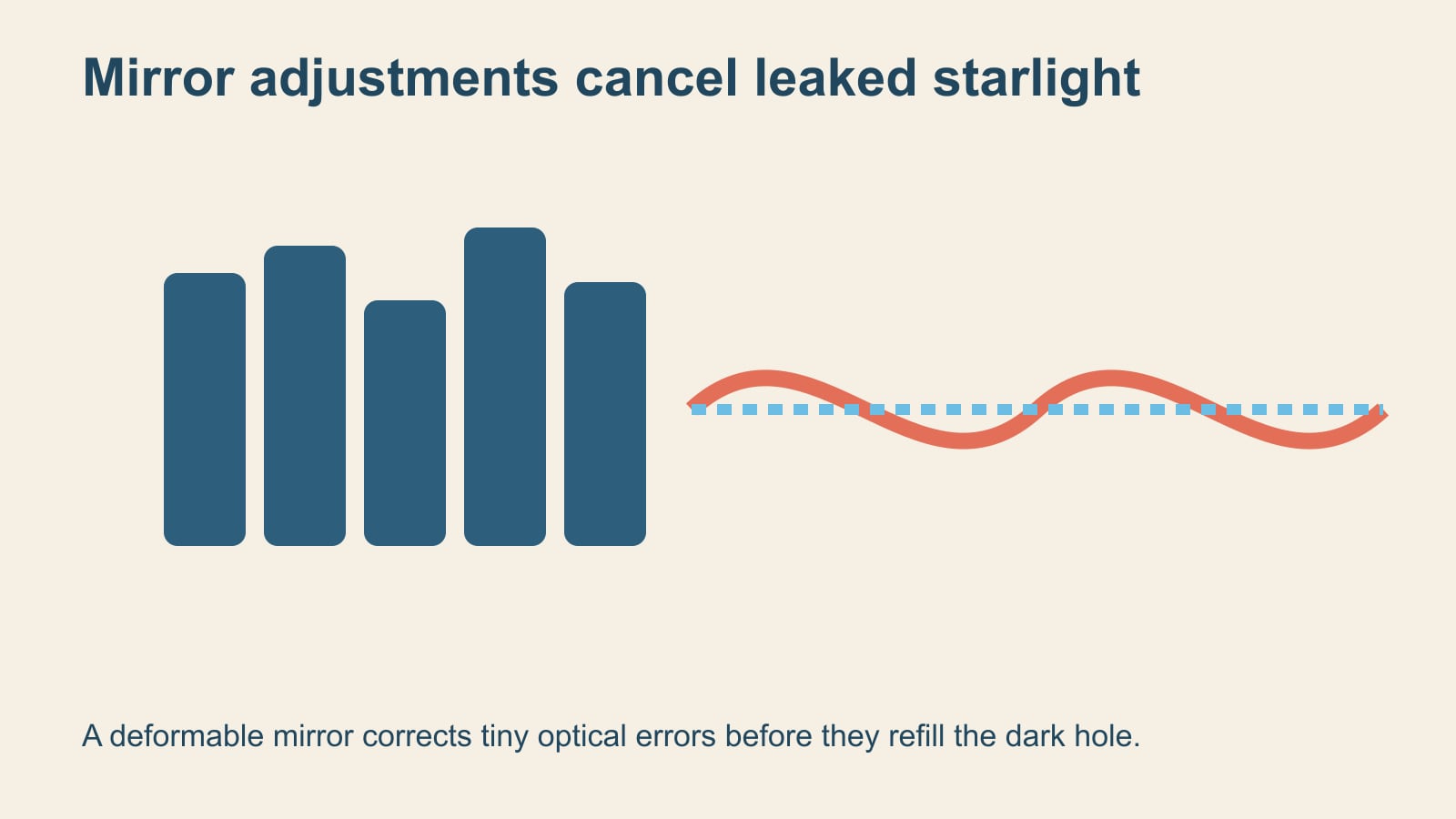
No real telescope is perfectly smooth or motionless. Nanometre-scale surface errors and small changes in alignment distort the incoming wavefront. On the detector those errors appear as speckles that can imitate or overwhelm a faint planet. A static mask cannot correct every changing flaw.
Roman therefore uses two deformable mirrors. Thousands of actuators shift tiny parts of each reflective surface like controlled pistons. By changing the optical path, the system creates corrective waves that interfere destructively with leaked starlight in the target region. This active wavefront control is the key step beyond a passive eclipse disk.
A dark hole is measured, adjusted and measured again
The instrument does not bend a mirror once and assume darkness. It measures the remaining speckle field, calculates a correction and adjusts the mirrors iteratively. The detector and control software work with the masks and mirrors as one feedback system, building a region of very high contrast around the suppressed star.
Post-processing can then compare observations and model residual patterns, but software cannot recover planet light that the optics never separated from glare. The hardware must first deliver a stable, sufficiently dark field. Roman is meant to demonstrate that this demanding active control can work in space, where temperature and pointing still change.
Roman is targeting giant worlds, not promising an Earth twin
NASA describes the Coronagraph Instrument as a technology demonstration. Its planned targets include light from large gaseous exoplanets around nearby Sun-like stars and disks of dust where planetary systems form. The instrument aims to be hundreds of times more capable than previous space coronagraphs in relevant high-contrast performance.
That does not mean Roman will return a photograph of an Earth-like planet. A small rocky world close to a Sun-like star is fainter and demands even stronger suppression, stability and sensitivity. Roman's job is to prove technologies and operating methods that could inform a later observatory designed for that harder search.
The artificial eclipse is really controlled interference
The simple story says a disk hides a star. The complete story follows the light: masks reject the bright core, pupil optics manage diffraction, deformable mirrors counter wavefront errors, a detector measures what remains and algorithms refine the correction. Each stage protects a patch of darkness from a different route by which glare returns.
If a faint point persists in that controlled dark region and follows the expected checks, astronomers can investigate it as planet light rather than a speckle. Roman's tiny eclipse is valuable not because it makes stars vanish, but because it turns unwanted starlight into a measured, adjustable optical problem.
Sources and further reading
This article was written for Curiosity Desk. We do not copy other publishers or invent quotes. If a material error is found, we correct it openly.
Read the full standards →One answer should lead to a better question
Bring your curiosity to the group
Curious Minds is our public Facebook community for surprising science, strange history, Australian wildlife and everyday questions. No copied posts, no personal-friend invitations and no link dumping.
- Three self-contained discussion prompts each week
- Sourced answers and honest uncertainty
- Respectful conversation without spam