The planet announced itself as a pattern, not a clean dot
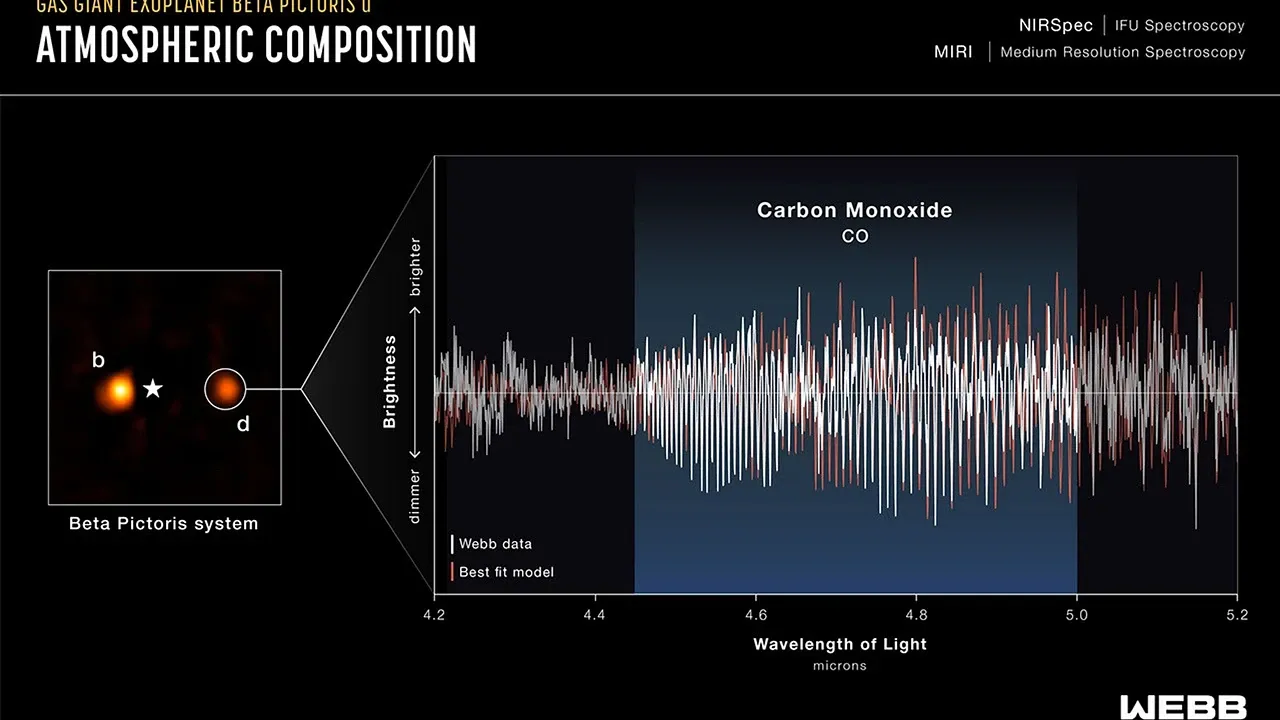
Astronomers were using the James Webb Space Telescope to study the already known planet Beta Pictoris b when another signal appeared where they expected comparatively smooth light scattered by dust. It was not accepted as a planet merely because it looked bright. The decisive clue was a repeating pattern of carbon monoxide absorption in a spectrum taken at that location.
That chemical pattern, together with the object's measured motion and position inside the disk, identified a third giant planet now called Beta Pictoris d. A separate team using the Very Large Telescope and archived Webb images independently found the same world. The discovery is therefore stronger than one surprising blob in one new exposure.
Beta Pictoris was already one of astronomy's busiest young systems
Beta Pictoris is about 63 light-years from Earth and roughly 23 million years old. Its youth matters because the planets and the broad disk of leftover dust and debris are still revealing how one planetary system settles after formation. Two giant planets, Beta Pictoris b and c, were known before the new result.
The system is also difficult to read. Its bright debris disk scatters starlight across the same region where a faint planet can appear. Conventional imaging must distinguish a genuine companion from disk structures, processing artefacts and background objects. Beta Pictoris d remained concealed even though astronomers had repeatedly observed the system.
NIRSpec turned each position into both an image and a spectrum
Webb's Near-Infrared Spectrograph has an Integral Field Unit that collects spatial and spectral information together. Instead of returning only a two-dimensional picture, it produces a data set in which each small part of the scene also carries a spectrum. Astronomers can ask not only what is bright, but which wavelengths are missing or enhanced at each position.
Molecules absorb light in characteristic groups of wavelengths. When the researchers searched the data for the expected signatures of a giant-planet atmosphere, Beta Pictoris d stood out against the smoother scattered light from the debris disk. This technique is often described as molecule mapping because chemistry helps locate the object within the image.
Carbon monoxide supplied the barcode and motion supplied another test
The NIRSpec data contained a distinctive series of carbon monoxide absorption lines. Follow-up observations added evidence for water vapour and methane. Those features matched a cool giant-planet atmosphere far better than reflected light from ordinary dust, so the first observations were already revealing what the object was made of as well as where it was.
The wavelengths also carried a Doppler shift. From that shift, the team estimated radial velocity, the part of the object's motion toward or away from the telescope. Its velocity, location and alignment with the debris disk were consistent with an object orbiting Beta Pictoris rather than a distant contaminant that happened to sit in the same direction.
A second team found the planet hiding in an eleven-year record
An independent analysis detected Beta Pictoris d with the Very Large Telescope's ERIS instrument and then followed its position through archived observations from Webb's NIRCam and the VLT's SPHERE instrument. The measurements span about eleven years, long enough to show motion consistent with a gravitationally bound companion rather than a fixed background source.
That team fitted the three known planets together and estimated an orbital size of about 26 astronomical units, with substantial uncertainty, and a period near 91 years. Its evolutionary models gave a mass of about 2.4 Jupiter masses and a temperature near 600 kelvin. These are model-dependent estimates, not measurements as simple as putting the planet on a scale or touching a thermometer.
The two orbital estimates are not yet identical
The Webb spectroscopy study favours a semi-major axis greater than 30 astronomical units, while the independent imaging analysis reports a best fit near 26 astronomical units with a broad uncertainty range. Both place Beta Pictoris d outside planets b and c and inside the debris disk's inner edge, but the precise orbit is still being refined.
That difference is a useful reminder that a newly announced planet can be secure even while some of its properties remain unsettled. The teams used different data and modelling routes, and only a fraction of a roughly century-long orbit has been observed. Future measurements should narrow the range instead of forcing today's estimates into false agreement.
The missing planet may explain the disk that helped hide it
Before the discovery, astronomers had proposed that an unseen planet could help produce the debris disk's sharply defined inner edge and other structures. The new planet has a mass and location compatible with sculpting that boundary. In that sense, the disk may have carried an indirect clue to the same object whose scattered light made direct detection difficult.
Compatible does not mean that every feature has now been explained by one planet. The system contains three imaged giants, dust, smaller debris and a long dynamical history. Researchers will need better orbital and atmospheric constraints before assigning Beta Pictoris d a complete role in the architecture.
Why the method could matter beyond one young giant
NASA describes Beta Pictoris d as the first directly imaged planet discovered primarily through moderate-resolution spectroscopy. The important advance is the ability to separate an atmosphere's narrow molecular features from complicated surrounding light. A planet does not have to emerge first as an unmistakable isolated point.
That does not mean Webb can now reveal any small Earth-like world hidden in dust. Beta Pictoris d is a young, warm giant in a nearby and intensively studied system. The result instead opens a more careful possibility: in suitable systems, astronomers may find additional faint planets by searching for the chemistry and motion of an atmosphere rather than trusting brightness alone.
Sources and further reading
- NASA Science - Webb discovers Beta Pictoris d through its atmospheric fingerprint ↗
- Gibbs et al. - Discovery of an exterior third planet orbiting Beta Pictoris ↗
- Sutlieff et al. - Direct imaging discovery across an eleven-year baseline ↗
- European Southern Observatory - Independent VLT discovery and archival confirmation ↗
- Max Planck Institute for Astronomy - Orbit, mass and temperature context ↗
This article was written for Curiosity Desk. We do not copy other publishers or invent quotes. If a material error is found, we correct it openly.
Read the full standards →One answer should lead to a better question
Bring your curiosity to the group
Curious Minds is our public Facebook community for surprising science, strange history, Australian wildlife and everyday questions. No copied posts, no personal-friend invitations and no link dumping.
- Three self-contained discussion prompts each week
- Sourced answers and honest uncertainty
- Respectful conversation without spam