One ASCENT tank feeds two propulsion branches
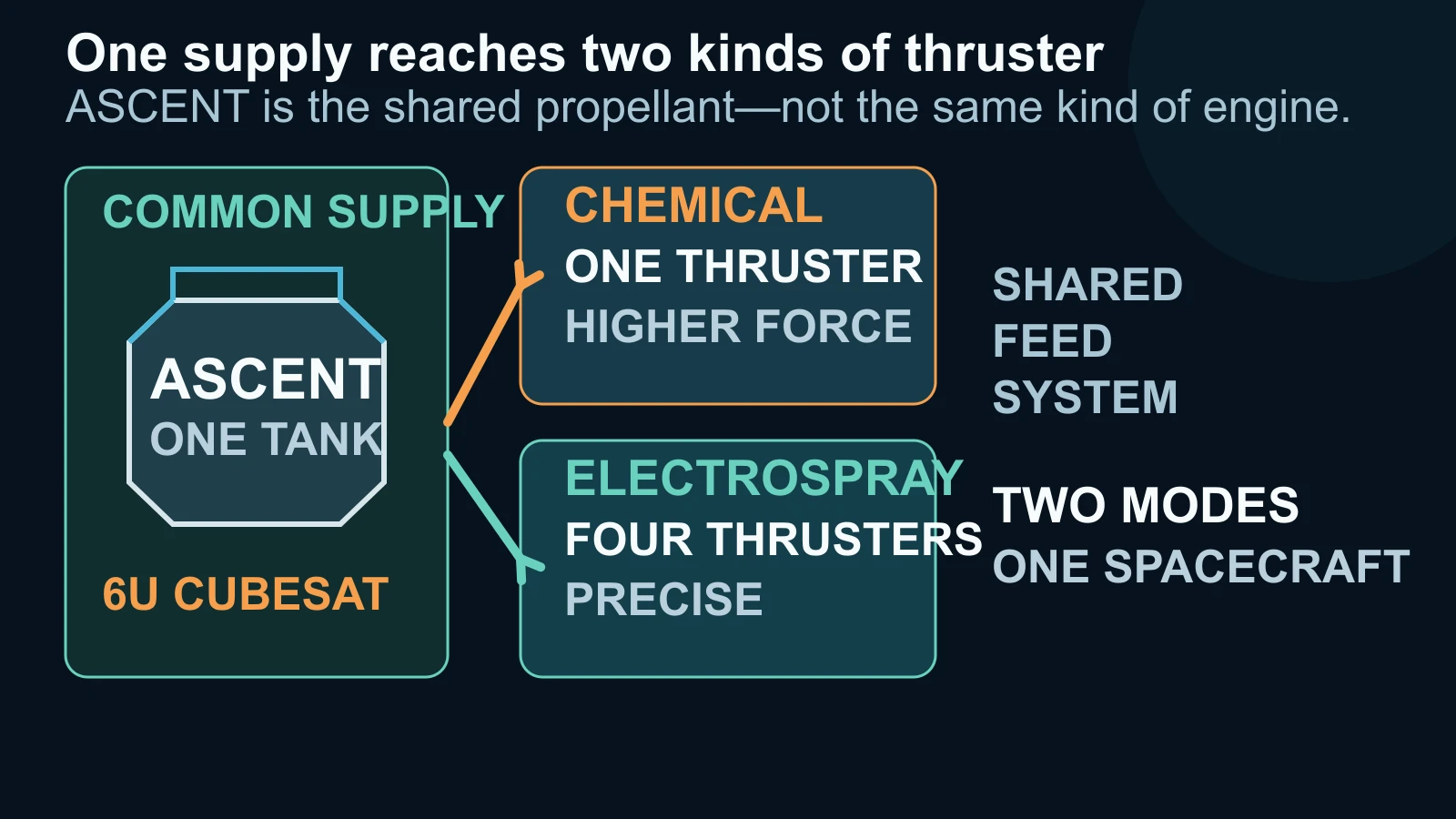
NASA's ASCENT Propulsion Dual Mode CubeSat is built around a simple packing idea: one propellant supply can feed two kinds of engine. The spacecraft carries one chemical thruster for higher-force manoeuvres and four electrospray thrusters for lower-force, more precise work. The shared tank is the common resource; the engines still do different jobs.
The mission's technical architecture calls the fuel ASCENT, formerly known as AF-M315E. NASA describes the spacecraft as a 6U CubeSat, while the current launch record says the same ASCENT supply feeds the chemical and electrospray systems. That is the mechanism behind the headline—not a claim that every small satellite can use one fuel without solving its own plumbing, power and control problems.
This arrangement matters because a small spacecraft has little room for duplicate tanks, valves and feed lines. A shared supply can reduce duplication, but it also makes the interfaces between the chemical system, the electric system and the spacecraft bus part of one flight experiment.
Why chemical and electrospray thrusters do different jobs
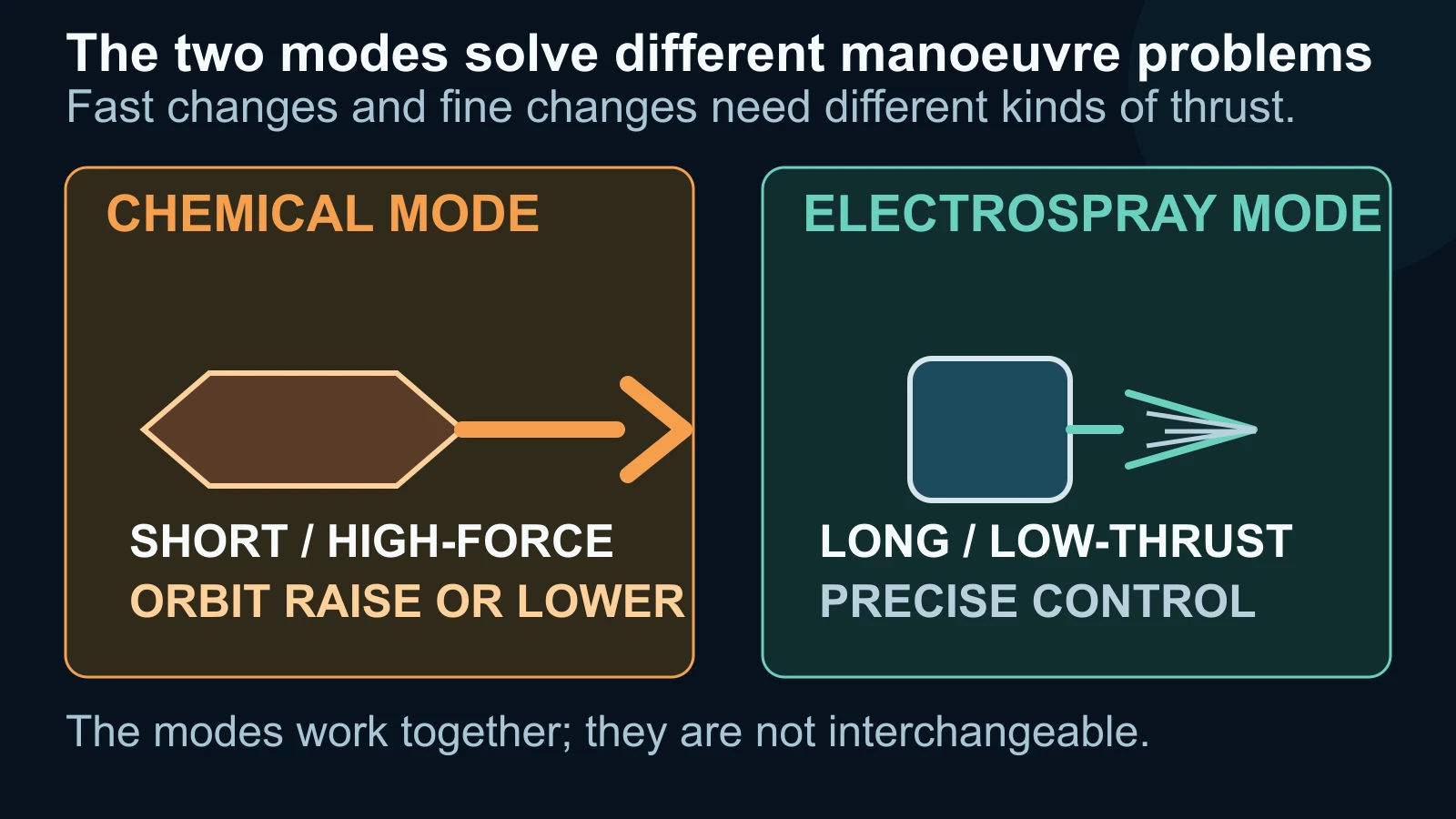
Chemical and electrospray propulsion trade force against efficiency and time. A chemical thruster can deliver a relatively strong, short push, which is useful when an orbit must change quickly. An electrospray thruster produces a much smaller force by accelerating charged material with an electric field, so it is suited to gradual and finely controlled manoeuvres.
Those descriptions are roles, not guarantees. The ASCENT vehicle is designed to switch between the modes so that one spacecraft can make a faster orbital change when it needs one and use gentler electric thrust when a long, precise adjustment is more useful. The four electrospray units are not four replacements for the chemical engine; they are the other half of the test architecture.
The design question is therefore broader than whether one propellant burns. Engineers must show that the shared tank, feed path, valves, electrical system, thruster hardware and flight software can work together without one mode compromising the other.
How an electrospray thruster turns ASCENT into thrust
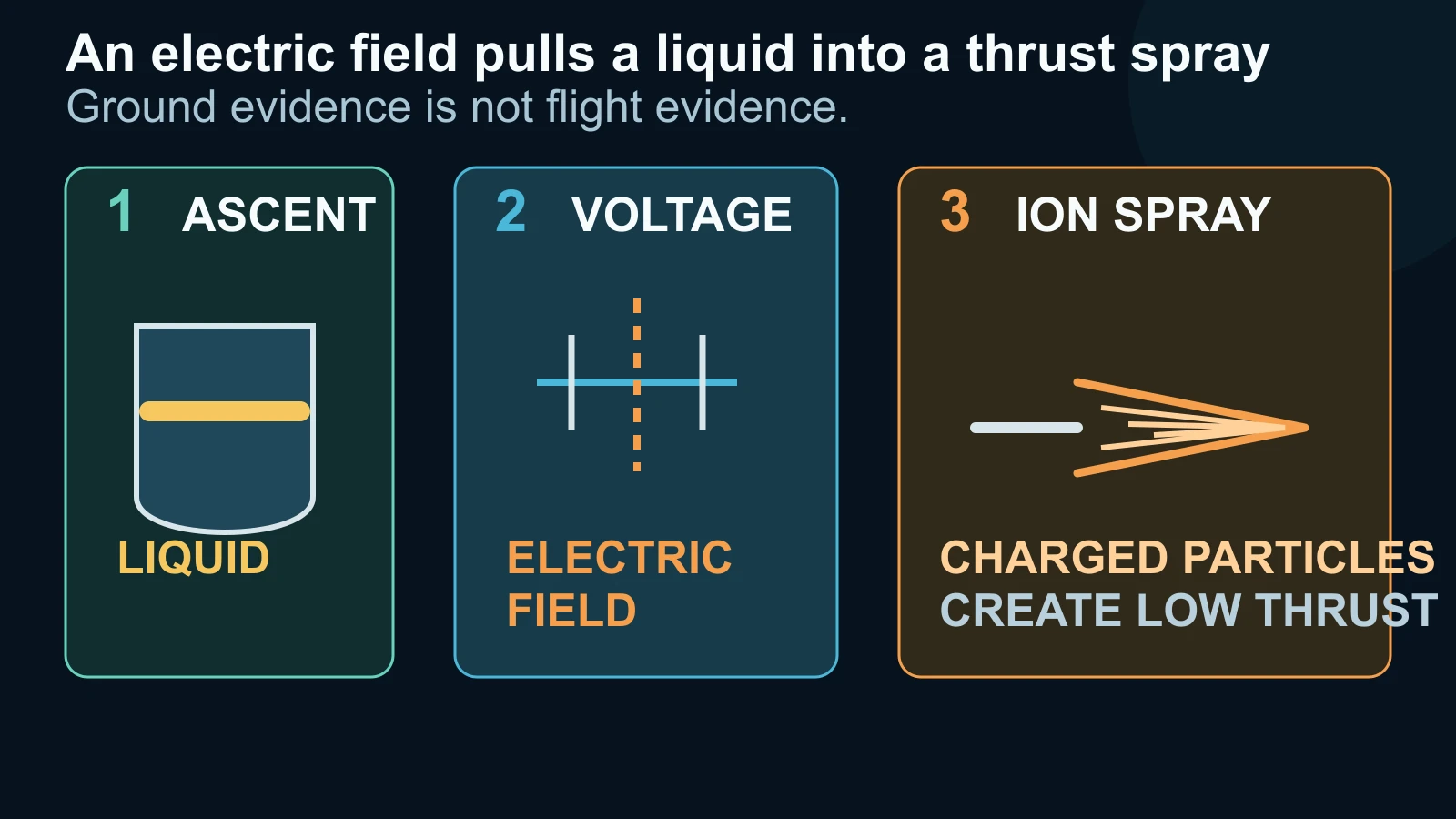
An electrospray thruster does not work by igniting ASCENT like a conventional chemical engine. In the MIT ground study, an applied voltage acted on the liquid propellant so charged particles could be drawn toward an emitter and expelled as a spray. The departing particles carry momentum away from the spacecraft, creating a small reaction force in the opposite direction.
MIT's report is useful because it supplies the laboratory mechanism behind the flight hardware. The researchers measured ASCENT-fuelled electrospray thrusters in a vacuum test setup and found that the propellant could operate the devices; the study also describes the difference between this slow electric control and the short, higher-force job of chemical propulsion.
That ground evidence is not the same as a successful orbital demonstration. A flight system adds launch vibration, thermal changes, propellant management, spacecraft charging, communications and mission operations. The ASCENT CubeSat is valuable precisely because it is meant to test the integrated system in space rather than stop at a laboratory result.
What the launch proves—and what the mission still has to show
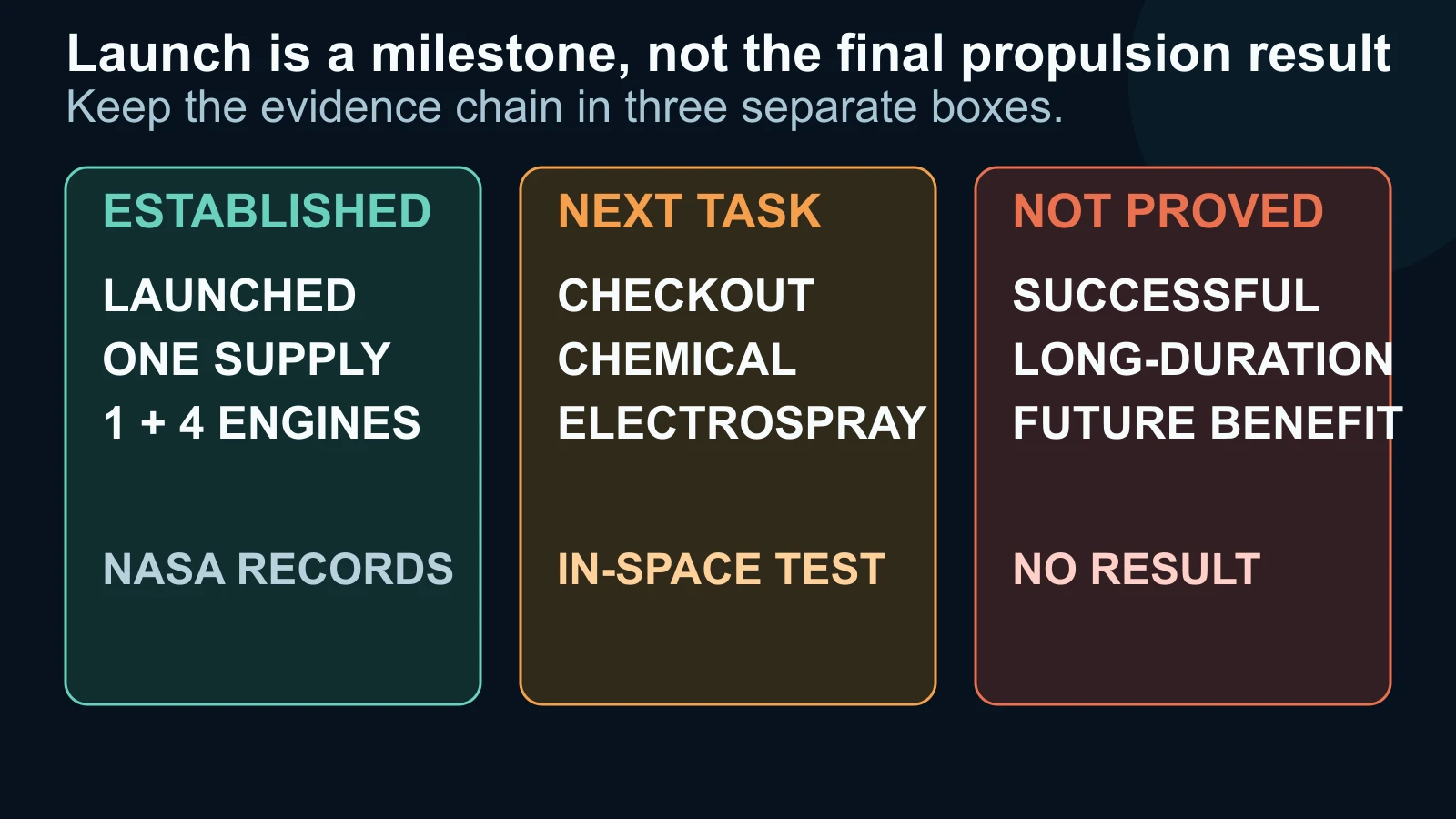
The current evidence establishes that ASCENT launched aboard SpaceX's Transporter-18 rideshare on 1 October 2026. NASA's launch account identifies the common propellant supply and the two propulsion modes, and Georgia Tech's partner account records that the team made first contact after reaching orbit. Those are real milestones, but they are not the same as a completed propulsion sequence.
NASA's pre-launch report described a planned checkout followed by short chemical and electric manoeuvres and then longer orbit-raising and lowering work. The sources reviewed for this package do not report the result of that in-space test. The responsible claim is therefore that the spacecraft is an active technology demonstration with a documented architecture, not that the architecture has already proved itself in orbit.
If the mission later reports successful dual-mode operations, that new evidence could support a separate update about what was actually demonstrated. Until then, the useful answer is narrower: one shared ASCENT supply lets a small spacecraft carry two complementary propulsion modes, while the flight evidence still has to show how well the complete system performs.
Sources and further reading
- NASA — SmallSats Launch to Advance Science, Technology, Orbital Operations ↗
- NASA — Tests Dual Mode Propulsion CubeSat Ahead of Launch ↗
- NASA Technical Reports Server — Mission Architecture for the Green Propulsion Dual Mode Mission ↗
- MIT News — New propulsion system could make tiny satellites both fast and fuel-efficient ↗
- Georgia Tech — Students to Fly NASA Spacecraft from Campus Mission Control ↗
- NASA — Transporter-18 SmallSats Encapsulation ↗
- NASA — Guidelines for using NASA Images and Media ↗
This article was written for Curiosity Desk. We do not copy other publishers or invent quotes. If a material error is found, we correct it openly.
Read the full standards →One answer should lead to a better question
Bring your curiosity to the group
Curious Minds is our public Facebook community for surprising science, strange history, Australian wildlife and everyday questions. No copied posts, no personal-friend invitations and no link dumping.
- Three self-contained discussion prompts each week
- Sourced answers and honest uncertainty
- Respectful conversation without spam