One selection, three different measurement jobs
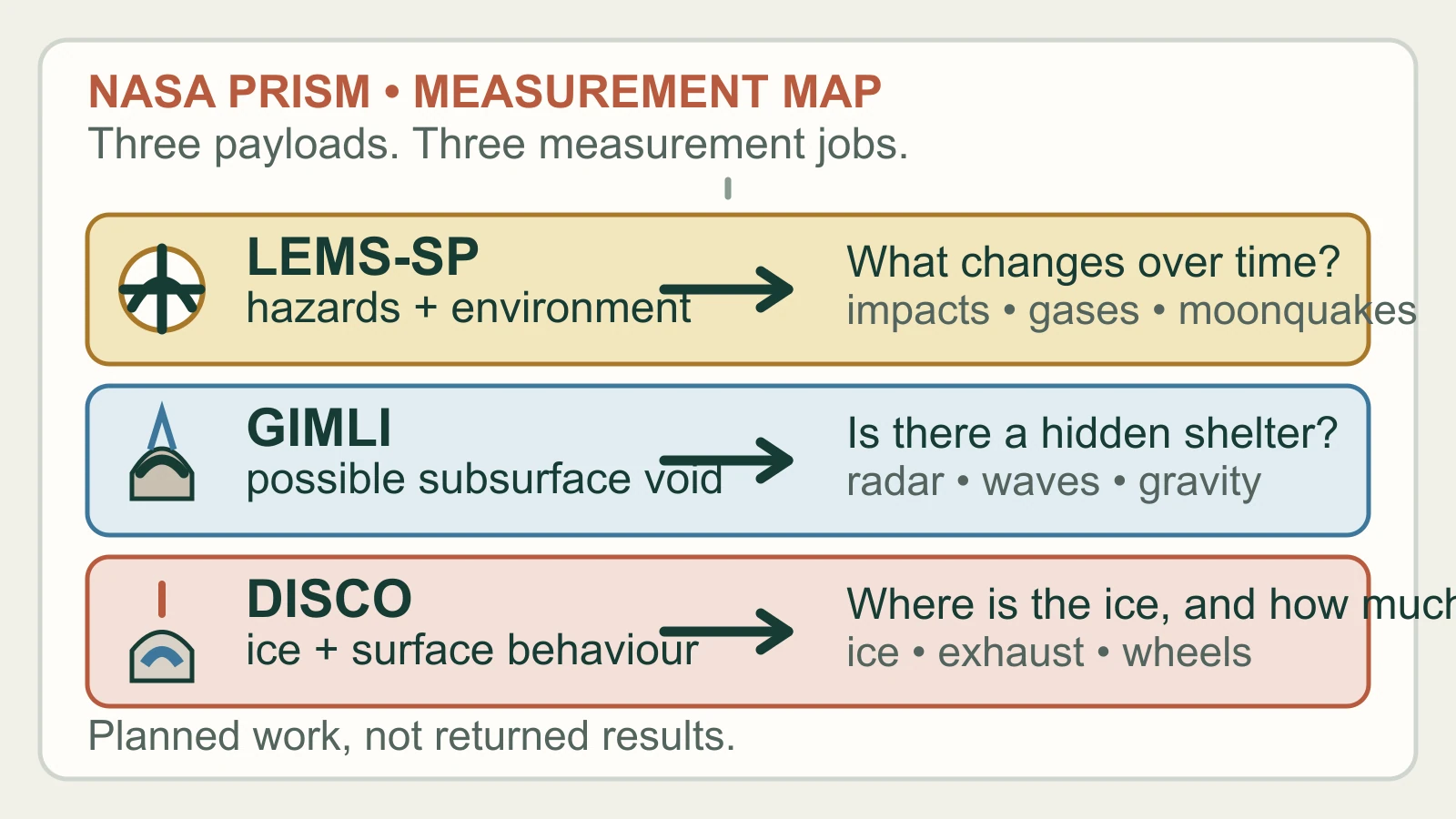
NASA's September 30, 2026 release says the agency selected three science investigations through its Payloads and Research Investigations on the Surface of the Moon, or PRISM, programme. The payloads are intended to fly to the lunar surface through Commercial Lunar Payload Services: LEMS-SP, GIMLI and DISCO. NASA's Moon Base reference page places this kind of robotic investigation inside a phased programme that is meant to build knowledge before future long-term human operations.
The three names are easy to blend together, but their jobs are different. LEMS-SP is the environmental watcher: it is intended to record hazards and changes around the surface. GIMLI is the subsurface question: at Marius Hills Pit, it would test whether a natural opening leads into a larger underground void. DISCO is the cold-trap measurement: it would make direct on-ground measurements of hidden ice and study how surface operations behave there.
That makes the selection more useful than a list of mission acronyms. It is a sequence of questions a future surface operation would need to ask: what is happening around a lander, is there a naturally protected space nearby, and where is the ice that instruments can actually measure? The important qualifier is time. The current sources describe selected investigations and intended measurements, not observations already returned from the Moon.
How LEMS-SP would watch for lunar hazards
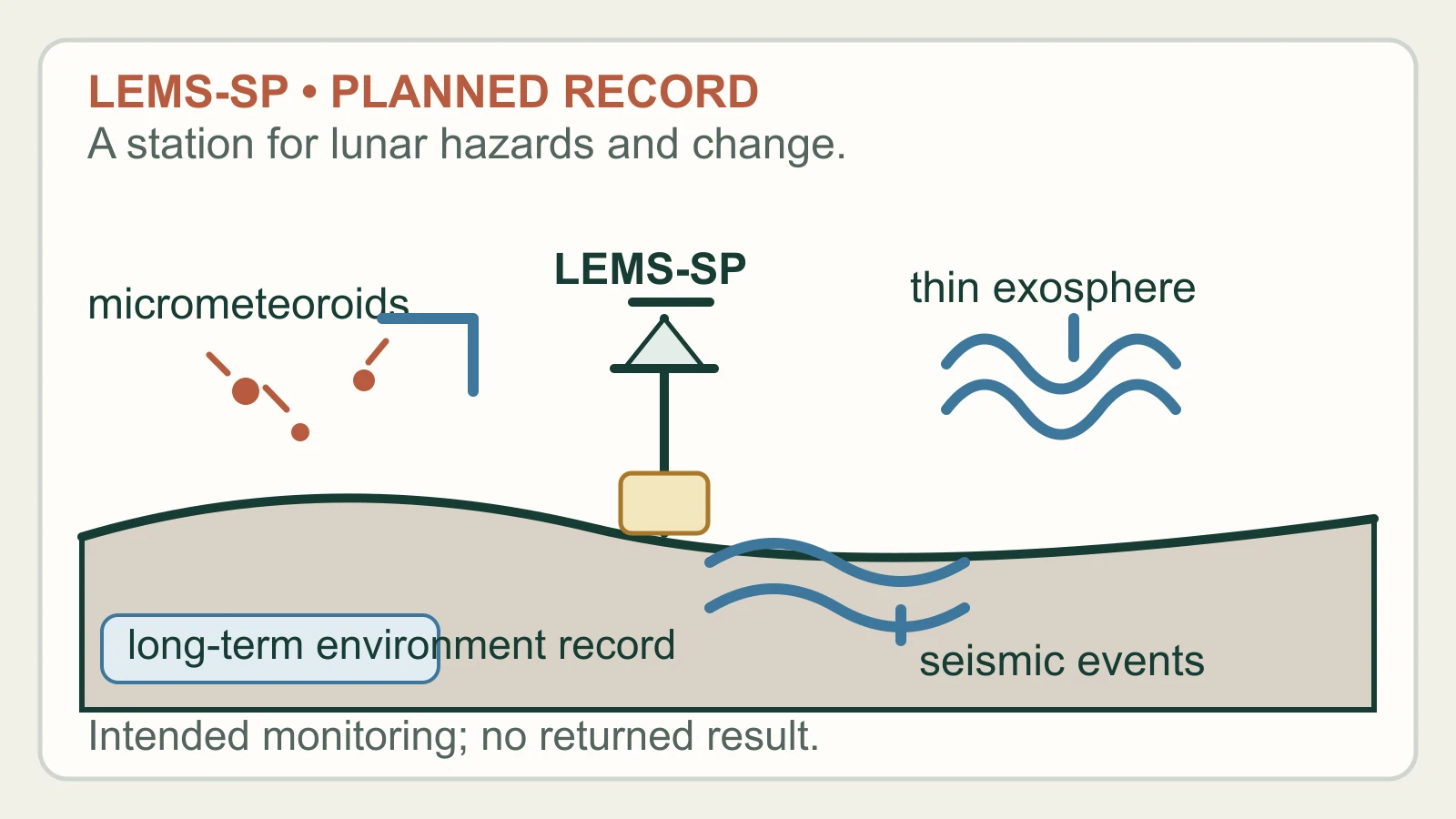
NASA describes LEMS-SP as a planned long-term environmental and hazard station. The release says it would monitor falling micrometeoroids and volatiles in the Moon's thin exosphere, while a short-period seismometer would detect seismic events. NASA says a station of this kind could help build hazard assessments for future surface activity; that is a future use of the record, not a result that LEMS-SP has already produced.
The measurement logic is a change from a single snapshot to a local record. An impact, a trace of gas or a seismic signal would be an event with a time and a place, and repeated observations could show whether the environment is quiet, intermittent or disturbed. The diagram is deliberately simple: the checked NASA source establishes the signal categories, but it does not provide a returned time series or a performance result for the station.
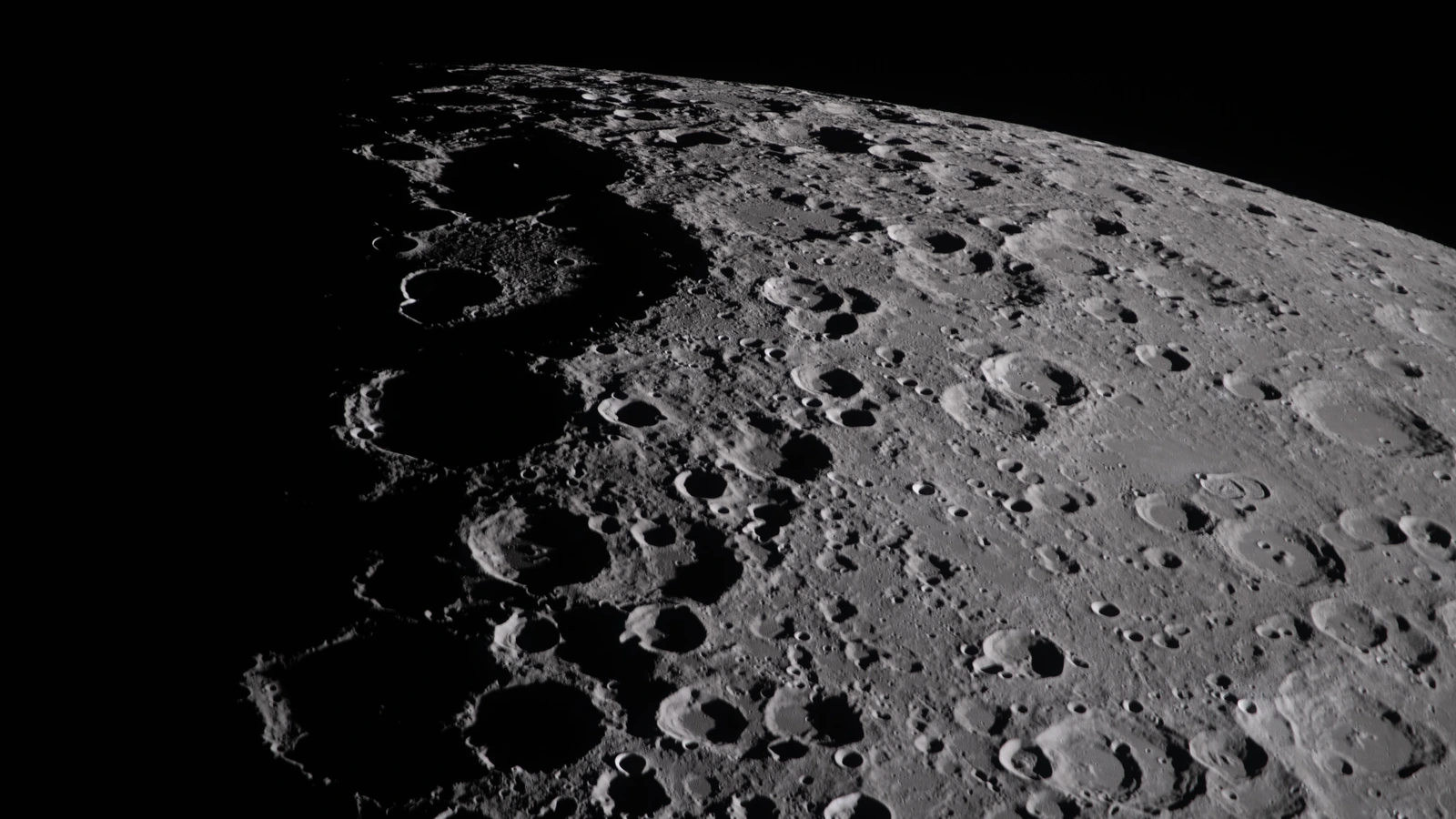
NASA's lunar South Pole reference page explains why this context matters. Persistent shadow, rugged terrain and dust create operating challenges, so a future base needs knowledge of the environment in which hardware and people would work. LEMS-SP could add that knowledge if it is delivered and operates as planned; the package does not turn that possibility into a guarantee.
How GIMLI would test the Moon for a hidden void
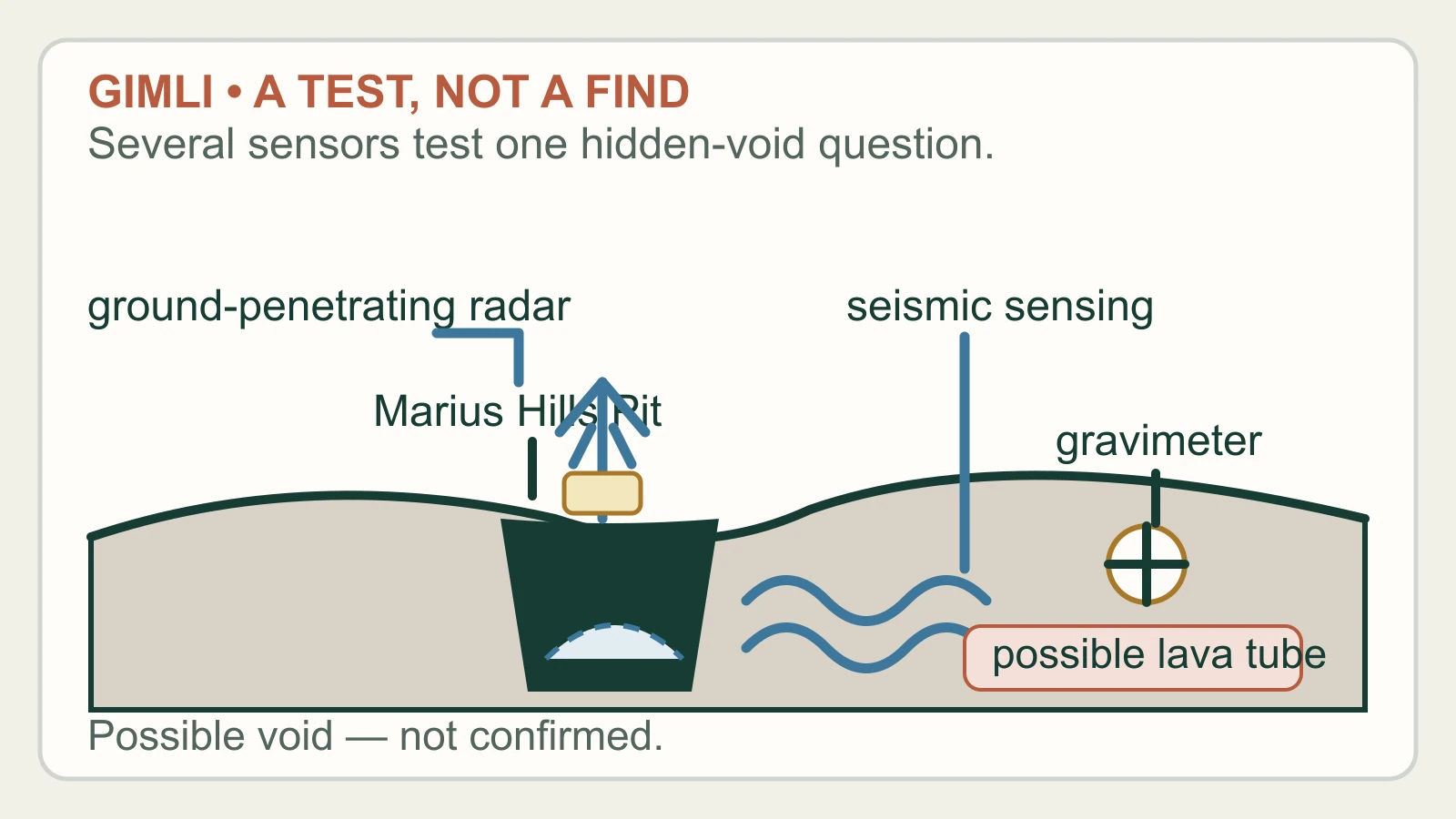
GIMLI asks a more dramatic question at Marius Hills Pit: does the pit open into a large underground lava tube? NASA describes the possible natural spaces as a reason to investigate, not as a confirmed shelter. The location also matters. Marius Hills is the test site named in the current GIMLI material; it should not be silently recast as a Moon Base South Pole result.
The Planetary Science Institute says the payload team plans to combine ground-penetrating radar, seismic sensors, a gravimeter and cameras. Those methods look at different consequences of what lies below: radar can send energy into the ground, seismic measurements can record how waves travel, gravity can reveal a mass distribution that differs from surrounding rock, and cameras can document the pit itself. The combined evidence could strengthen or weaken the case for a void, but no single sketch or sensor label proves that a tube exists.
A negative result would still be information. If the measurements do not support a large accessible void, they could still improve understanding of the pit and the volcanic history that made it. That is why the honest headline is a test, not a find: the checked sources establish a planned investigation, while the existence, size, stability and usefulness of any lava tube remain open.
How DISCO would measure ice and surface behaviour
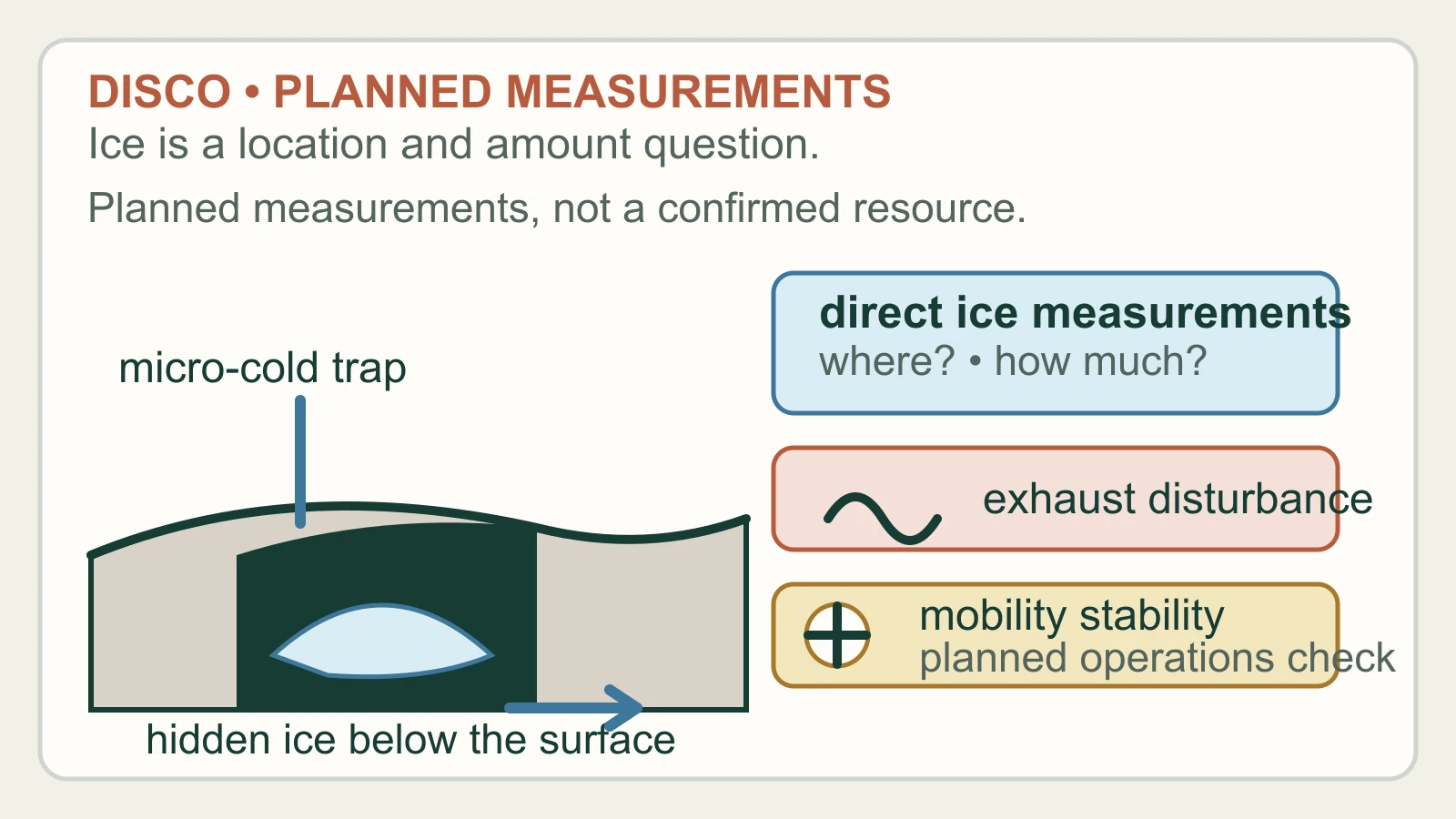
DISCO is aimed at lunar micro-cold traps, places where the combination of shadow and temperature can preserve hidden volatiles. NASA's current release describes it as the first investigation intended to make direct on-ground measurements of ice hidden in those traps. The immediate questions are concrete: where does the ice exist, how much is present, and what does the surface do when a spacecraft operates nearby?
NASA also says DISCO would study rocket-exhaust disturbance and mobility stability. Those are not side notes. A measurement of ice is more useful to a future operation when the operation can understand whether exhaust changes the surface or whether a vehicle can move and remain stable in the same cold, shadowed terrain. The package keeps the three questions together without claiming a method, depth or resource quantity that the checked release does not state.
Taken together, the three payloads would make a future landing site more legible: LEMS-SP would add environmental context, GIMLI would test one possible natural shelter, and DISCO would measure a resource and the conditions around it. None of that means the Moon Base already has a safe shelter, a usable ice supply or a completed hazard model. The selected investigations are the next evidence-gathering step, not the evidence itself.
Sources and further reading
- NASA — NASA Adds New Science Investigations for Moon Base ↗
- NASA — Moon Base ↗
- NASA — The Lunar South Pole Region ↗
- Planetary Science Institute — PSI-led team selected for NASA PRISM program ↗
- NASA — Guidelines for using NASA Images and Media ↗
- NASA — Moon Base Media Resources ↗
- NASA Science — Artemis II Preliminary Lunar Science Report ↗
This article was written for Curiosity Desk. We do not copy other publishers or invent quotes. If a material error is found, we correct it openly.
Read the full standards →One answer should lead to a better question
Bring your curiosity to the group
Curious Minds is our public Facebook community for surprising science, strange history, Australian wildlife and everyday questions. No copied posts, no personal-friend invitations and no link dumping.
- Three self-contained discussion prompts each week
- Sourced answers and honest uncertainty
- Respectful conversation without spam