Why the eight-year route is part of the solution
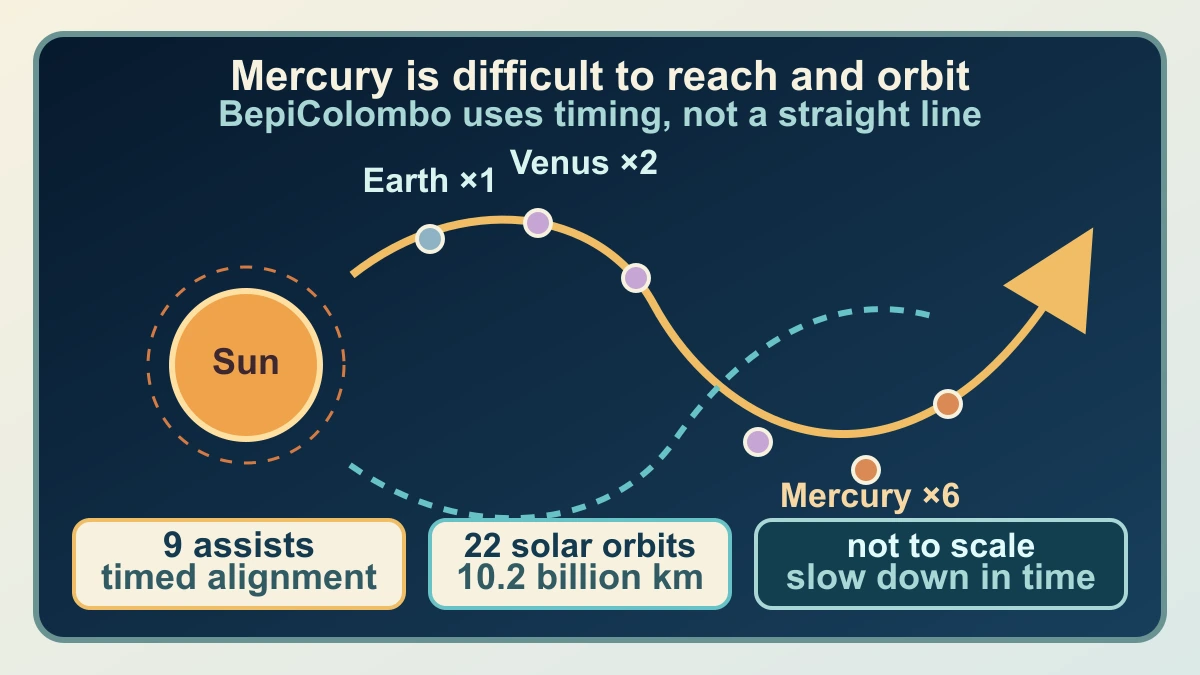
Mercury is close to the Sun and moves quickly around it, so arriving there is not simply a matter of pointing a rocket at the planet. A spacecraft must lose enough orbital energy to be captured rather than sweep past. BepiColombo's route uses solar-electric propulsion and repeated gravity assists at Earth, Venus and Mercury. ESA's factsheet records nine flybys, 22 orbits and about 10.2 billion kilometres travelled: the long path is part of the braking strategy.
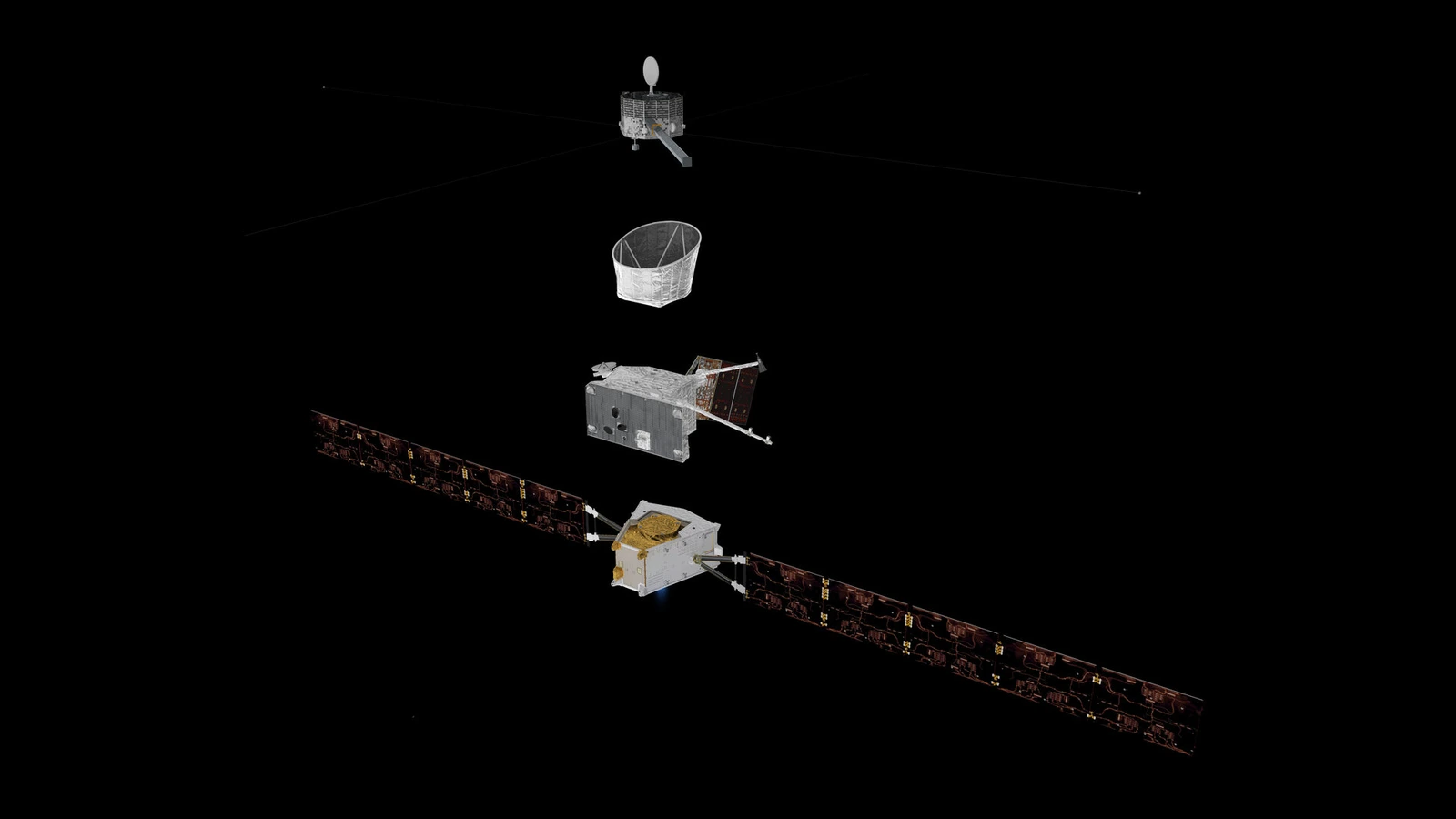
The spacecraft also has to survive an unusually bright and hot environment while it performs that long cruise. ESA and JAXA describe a composite vehicle carrying two orbiters: ESA's Mercury Planetary Orbiter, or MPO, and JAXA's Mio. Mio's high-apocentre mission design and the spacecraft's sunshields and tilted solar arrays help manage a setting where sunlight is roughly ten times stronger than near Earth. The engineering problem is therefore both navigation and heat management.
During most of the cruise, the Mercury Transfer Module, or MTM, supplies solar-electric propulsion and carries the two science spacecraft. That arrangement is useful while the vehicle is travelling between planets, but it is not the final science configuration. As the planned arrival phase begins, the transfer module is separated and the remaining spacecraft use their own propulsion and a sequence of carefully timed manoeuvres to turn a fast flyby into a stable Mercury orbit.
How the composite spacecraft becomes two Mercury orbiters
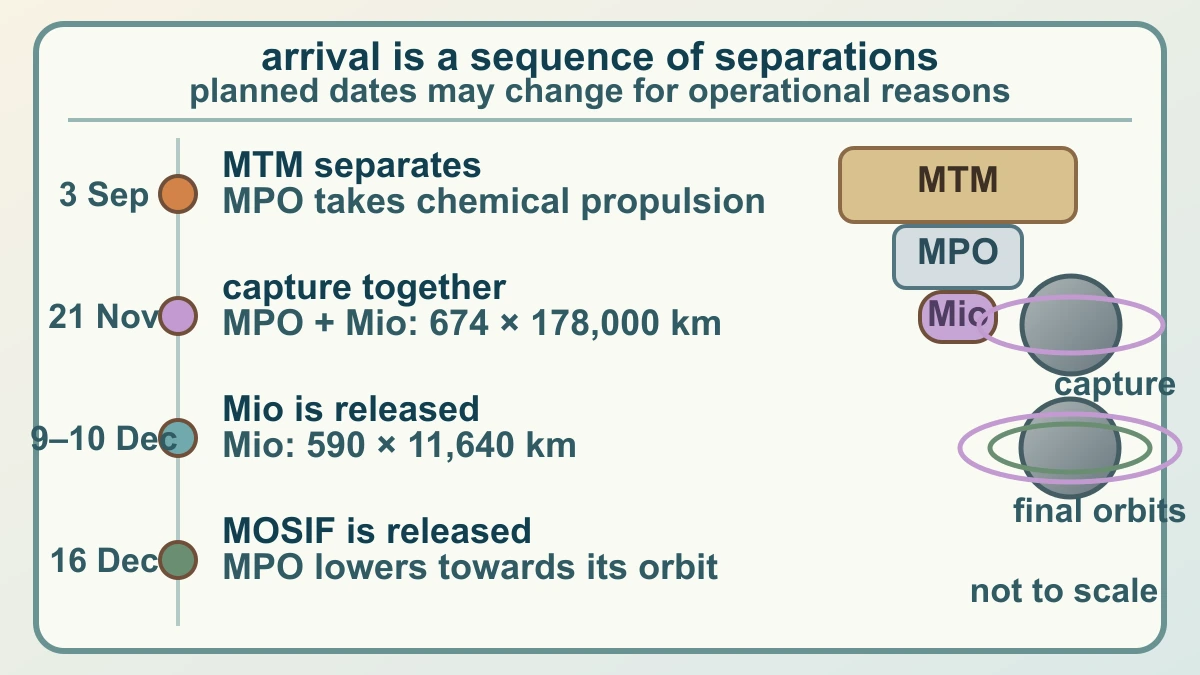
ESA's current arrival timeline turns the word ‘arrival’ into several different events. The planned sequence begins with MTM separation on 3 September 2026. On 21 November, the joined MPO-and-Mio spacecraft is scheduled to be captured by Mercury into an orbit measuring about 674 by 178,000 kilometres. Mio is then planned for release on 9–10 December into an approximately 590 by 11,640 kilometre orbit, while the supporting structures are released and MPO is lowered toward its own working orbit.
Those different orbits are not a sign that one spacecraft has gone wrong. They reflect different jobs and different thermal and viewing requirements. Mio, the JAXA-led Mercury Magnetospheric Orbiter, is designed for a more extended elliptical orbit that gives it a broad view of Mercury's space environment. MPO is designed for a lower polar orbit, where its instruments can study the planet's surface, interior and exosphere from closer range. The two spacecraft need to be separated because the composite cruise configuration cannot serve both science missions forever.
The same timeline places MOSIF release and MPO orbit-lowering in December, a final MPO orbit near 480 by 1,500 kilometres in March 2027, and the start of science operations in April 2027. ESA's operations account describes the arrival phase as six months with 16 burn manoeuvres, rehearsed in simulations that include an anomaly and a rescheduled burn. Each step changes the conditions for the next one; there is no single switch that makes the mission operational.
What the arrival plan does—and does not yet prove
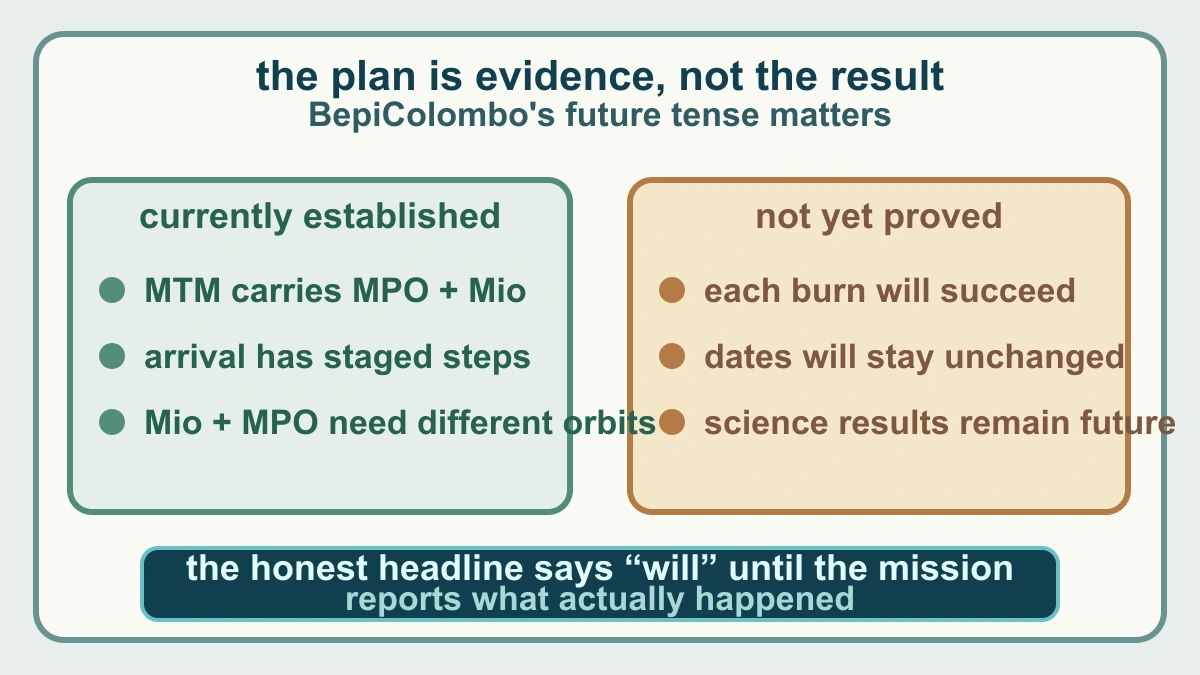
The important distinction is between a documented plan and an observed outcome. ESA's factsheet and timeline establish how the mission is designed, which module is expected to separate, which orbit each spacecraft is intended to reach and when science operations are planned to begin. They do not yet establish that the future burns will happen on schedule, that capture will succeed, or that either orbiter will return the planned measurements.
The operations team is already practising the order and contingencies, which is evidence about preparation rather than a completed flight result. In its account of the arrival simulations, ESA describes a simulated anomaly that forced the team to abort and reschedule a manoeuvre. That example shows why the article keeps dates in the future tense: even a carefully rehearsed sequence remains subject to telemetry, navigation, spacecraft health and decisions made during the real arrival phase.
When the milestones occur, the evidence boundary will move one step at a time. A confirmed MTM separation will establish that one planned transition happened; a confirmed Mercury capture will establish that the joint spacecraft entered orbit; confirmed releases and orbit measurements will establish the two-orbiter configuration. Only later instrument commissioning and science operations can show whether the mission is producing the intended data. The current answer is therefore a map of how BepiColombo is meant to arrive, not a claim that it has arrived.
Sources and further reading
- ESA: BepiColombo arrival media kit ↗
- ESA: BepiColombo factsheet ↗
- ESA: BepiColombo mission overview ↗
- ESA: BepiColombo arrival timeline ↗
- ESA: Inside BepiColombo's arrival simulations ↗
- ESA: BepiColombo turns off solar electric propulsion ↗
- JAXA: Mio mission overview ↗
- ESA: BepiColombo next milestone media invitation ↗
- ESA: BepiColombo exploded view image record ↗
This article was written for Curiosity Desk. We do not copy other publishers or invent quotes. If a material error is found, we correct it openly.
Read the full standards →One answer should lead to a better question
Bring your curiosity to the group
Curious Minds is our public Facebook community for surprising science, strange history, Australian wildlife and everyday questions. No copied posts, no personal-friend invitations and no link dumping.
- Three self-contained discussion prompts each week
- Sourced answers and honest uncertainty
- Respectful conversation without spam