Six separated receivers share one measurement
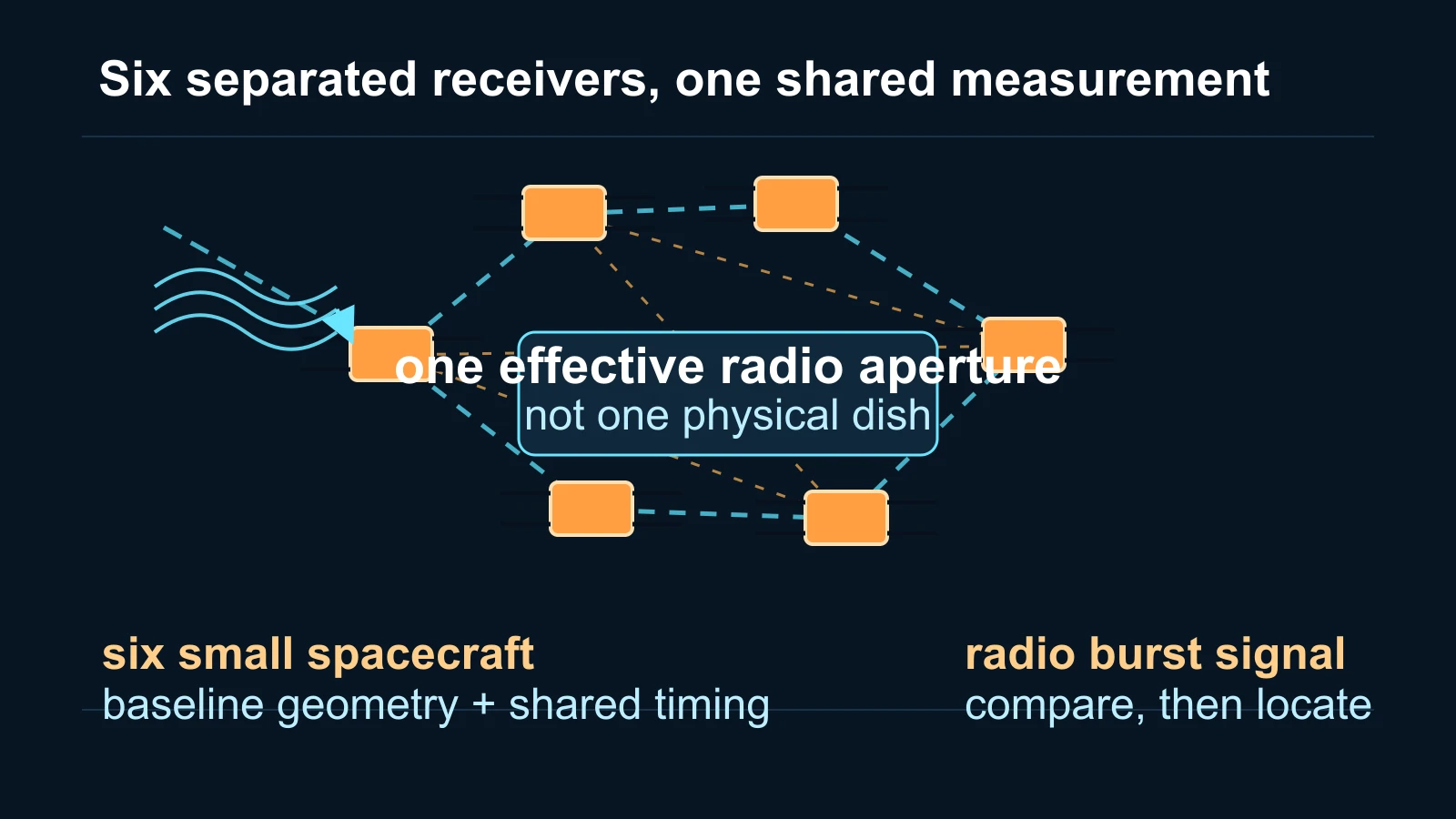
SunRISE is designed to make six small spacecraft behave like one low-frequency radio telescope. Each spacecraft receives the same solar radio activity from a slightly different position; the mission then combines those measurements with spacecraft position and timing information. The result is an effective aperture spread across the formation, not one giant physical dish.
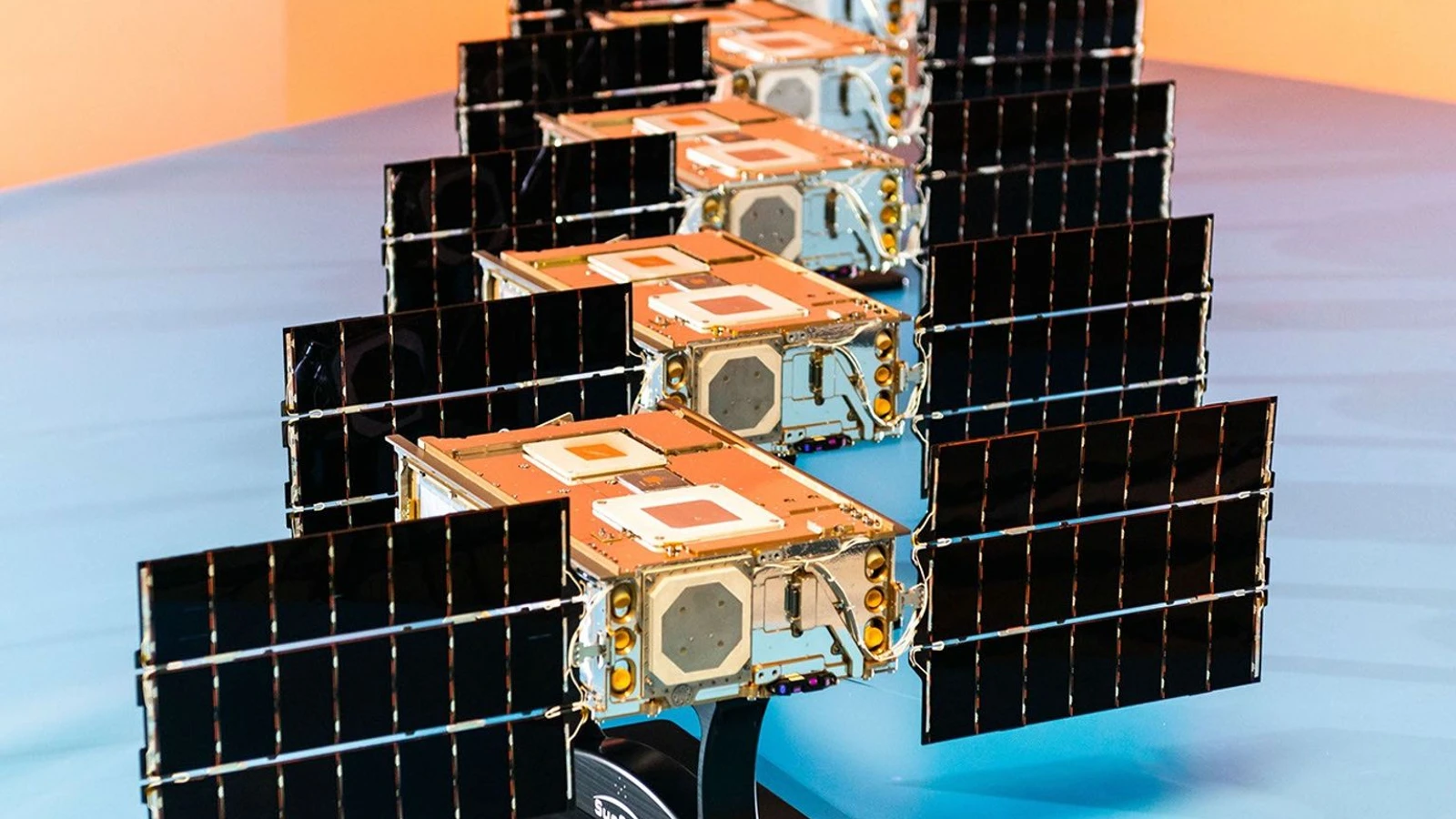
NASA describes the spacecraft as six identical 6U SmallSats flying in a passive formation, about 10 kilometres apart. Each deploys four radio antennas. The 2022 SunRISE mission record adds an important boundary: the architecture relies on position knowledge and substantial ground processing, rather than active control that forces the spacecraft into a rigid shape.
That arrangement is the answer to the headline puzzle. A separated array can use the relationships between signals at different receivers to infer structure and direction that one small antenna could not resolve alone. SunRISE is planned to apply that method to solar radio bursts, not to take an ordinary optical photograph of the Sun.
Why the target radio band must be above Earth's ionosphere
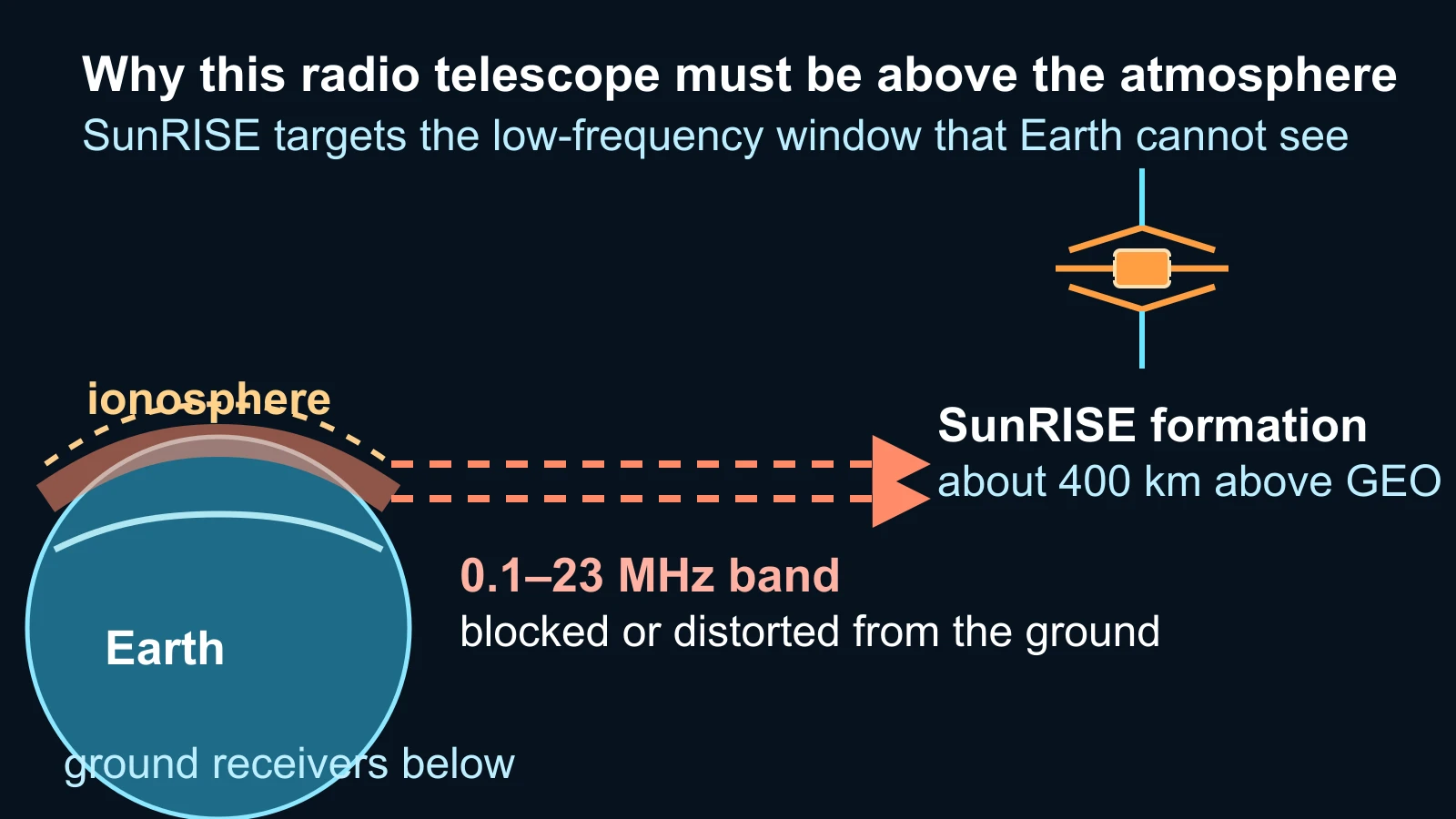
SunRISE targets radio waves from roughly 0.1 to 23 megahertz. NASA's Small Spacecraft Community of Practice describes this part of the spectrum as blocked by Earth's ionosphere, so a ground-based receiver cannot simply look through the atmosphere and recover the same view.
The planned formation therefore flies in a supersynchronous geosynchronous orbit, around 400 kilometres or more above geosynchronous orbit. NASA's current mission page lists SunRISE as a future mission with a mid-2027 launch target, while the technical record explains why the high orbit helps: it keeps the observatory above the atmosphere and reduces interference from Earth-based radio sources.
The altitude is not a dramatic destination chosen for its own sake. It is part of the instrument. Put the receivers where the ionosphere is no longer hiding the target band, then use their separation to recover information about where the solar emission came from.
How timing differences can locate a solar radio burst
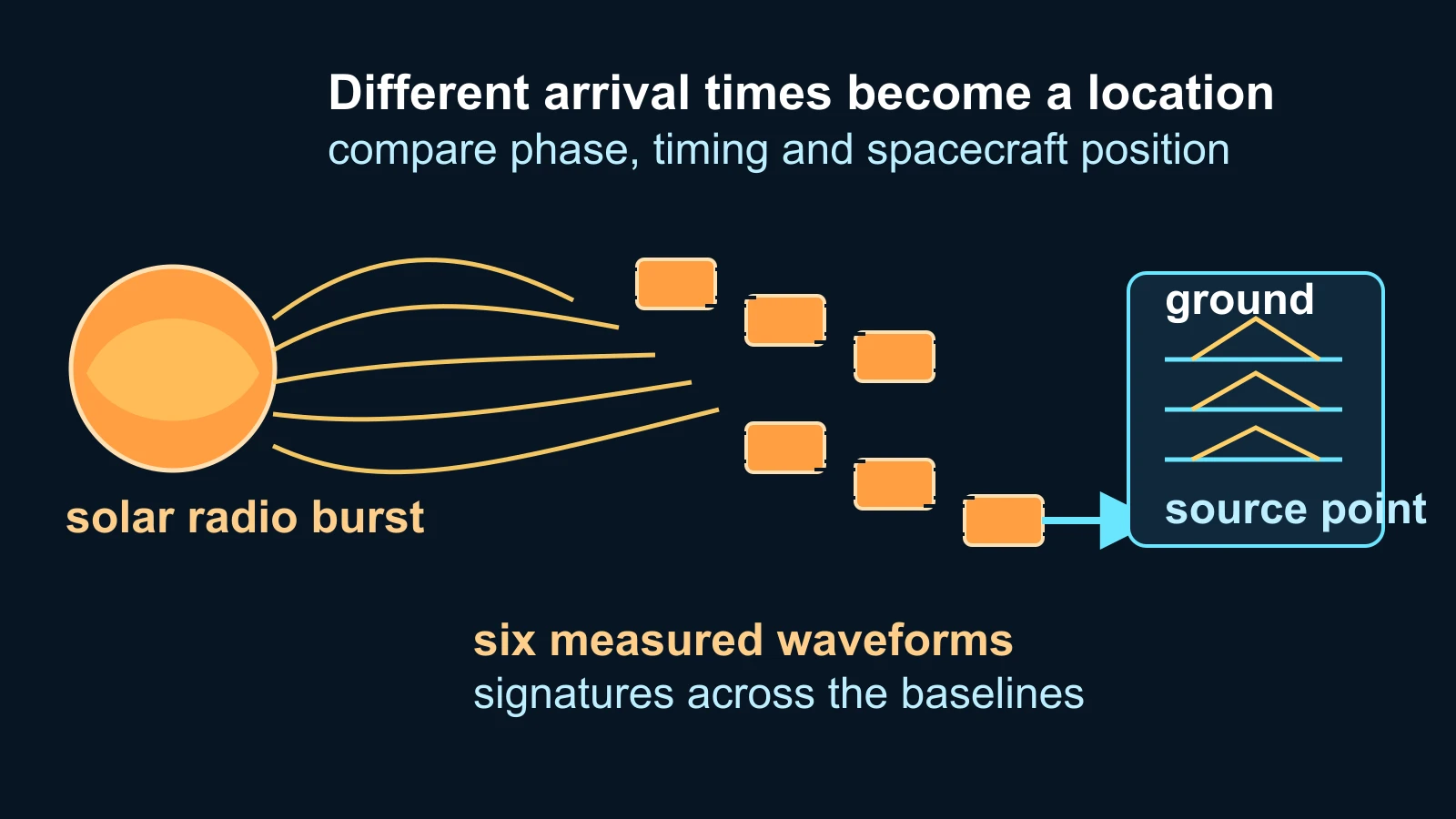
A burst does not reach every separated spacecraft from exactly the same direction or at exactly the same instant. The six receivers record related wave patterns. Comparing their timing and phase relationships, while tracking the spacecraft positions, gives the ground system the geometry needed to estimate the source direction and make an image of the radio emission.
This is the practical meaning of interferometry in SunRISE. The mission paper describes a dedicated low-radio-frequency interferometer that will localize heliospheric radio emissions, with modest onboard processing coupled to significant processing on the ground. The array is useful because the relationships between receivers carry information about direction and structure.
NASA links that localisation to solar energetic particles. Radio bursts arrive before the particles associated with the same broad solar activity, so knowing where the radio burst originated could improve understanding of how particles are accelerated and transported. That is a scientific and space-weather motivation—not evidence that SunRISE has already issued a warning.
What SunRISE has established—and what remains future work
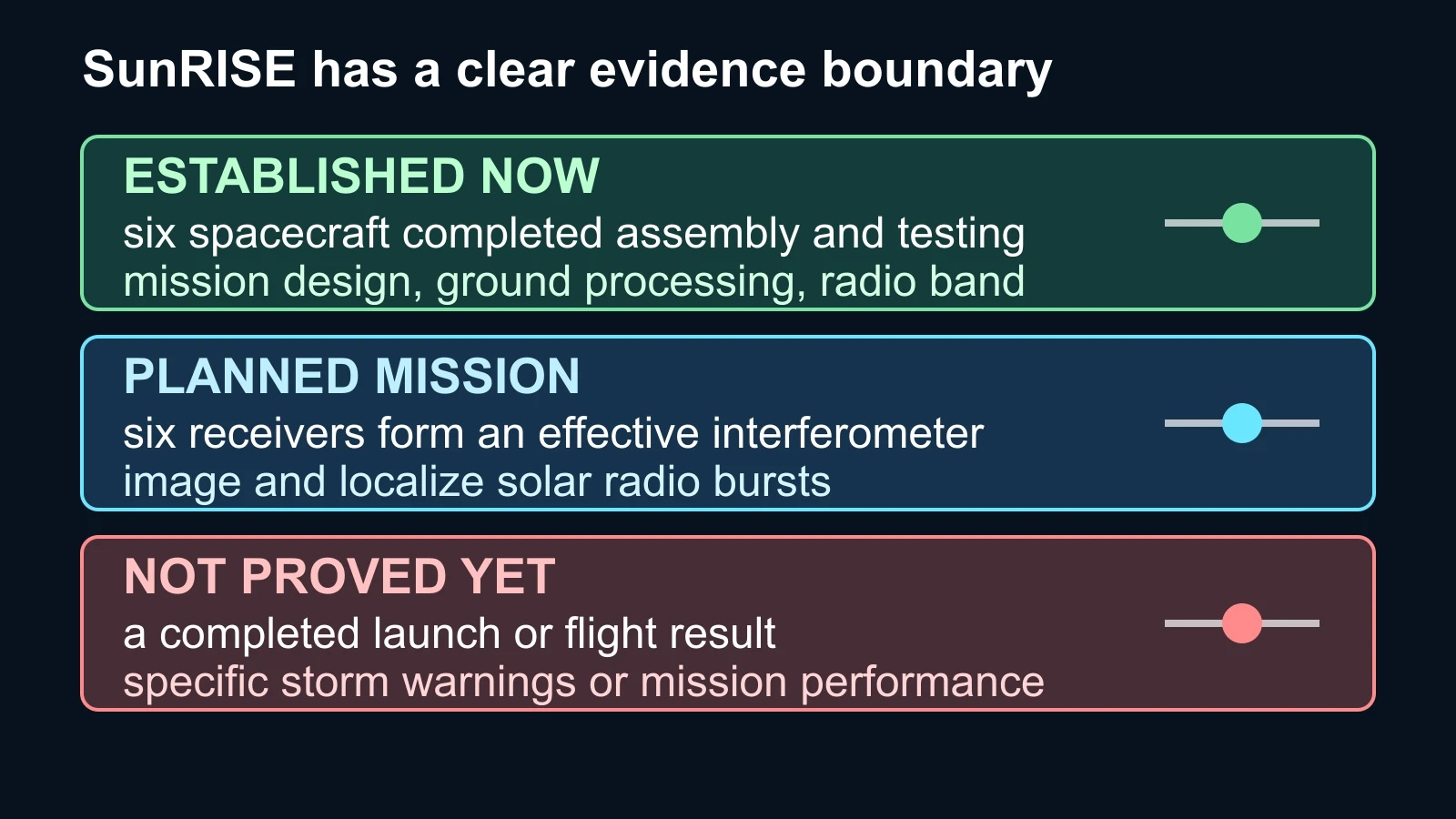
The solid evidence today is narrower than the mission's promise. NASA's Photojournal records the six completed spacecraft together at Utah State University's Space Dynamics Laboratory in November 2023. NASA's October 2026 update says the units completed assembly and testing and will be stored until shipment to Florida shortly before launch.
The planned mission could map and localize solar radio bursts in a frequency window that Earth cannot observe directly. Those measurements could add evidence about particle acceleration near solar eruptions and help scientists understand the path from a radio signal to a later particle event.
What has not happened in the evidence reviewed here is equally important: SunRISE has not launched, returned flight data or demonstrated warning accuracy. The mid-2027 date is a current target, not a completed event. The spacecraft photograph proves completed ground hardware; it does not prove an operating six-satellite radio telescope. That boundary keeps a mission design from being mistaken for a measurement result.
Sources and further reading
- NASA Science — SunRISE mission ↗
- NASA Science — NASA's SunRISE Mission Targets No Earlier Than Mid-2027 Launch ↗
- NASA Small Spacecraft Community of Practice — Lessons Learned from the SunRISE Mission ↗
- NASA Science Photojournal — Completed SunRISE SmallSats Pictured Together ↗
- CaltechAUTHORS — The Sun Radio Interferometer Space Experiment (SunRISE) Mission ↗
- NASA — Guidelines for using NASA Images and Media ↗
This article was written for Curiosity Desk. We do not copy other publishers or invent quotes. If a material error is found, we correct it openly.
Read the full standards →One answer should lead to a better question
Bring your curiosity to the group
Curious Minds is our public Facebook community for surprising science, strange history, Australian wildlife and everyday questions. No copied posts, no personal-friend invitations and no link dumping.
- Three self-contained discussion prompts each week
- Sourced answers and honest uncertainty
- Respectful conversation without spam