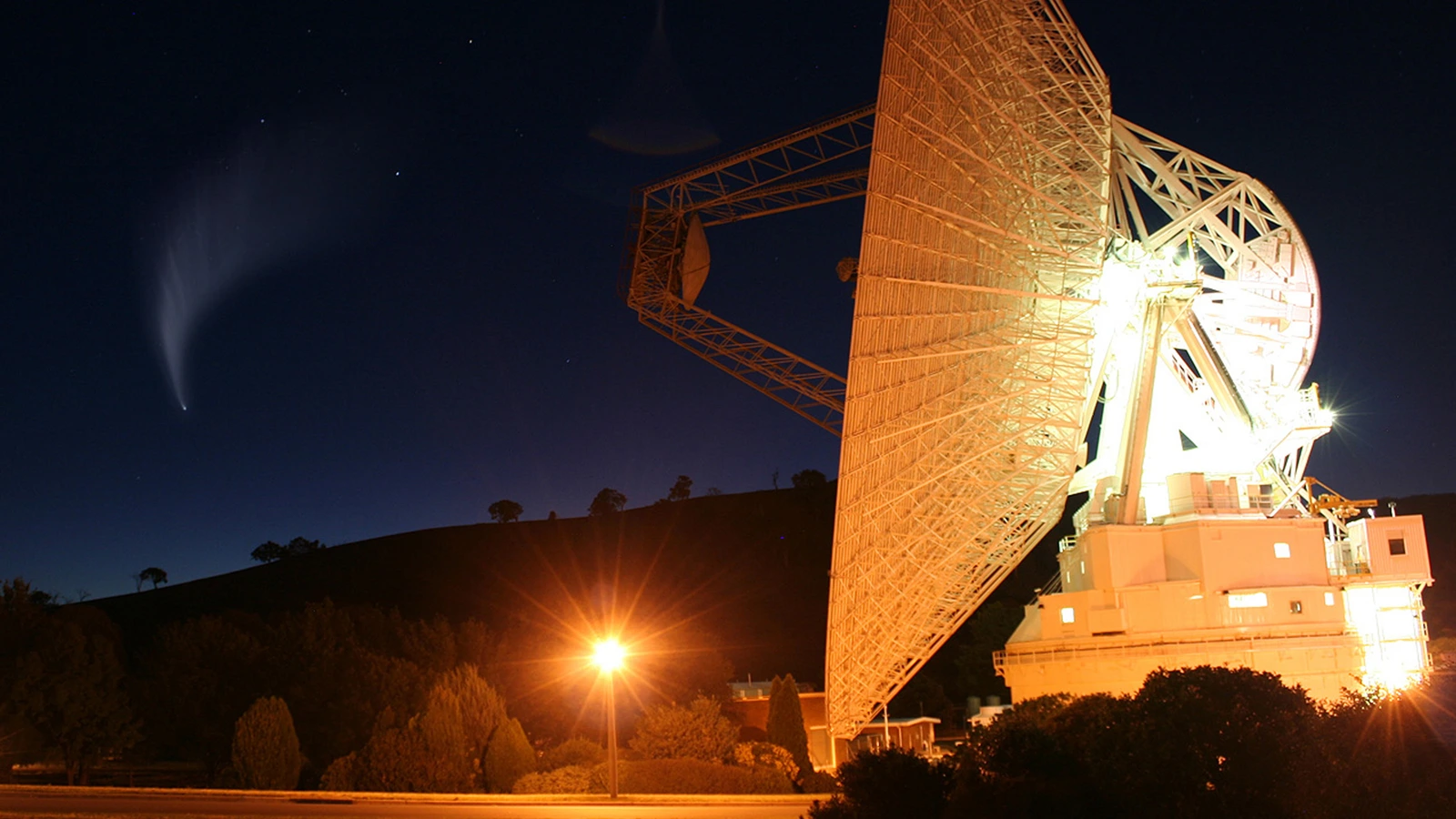
The optics focus a flash into a measured position
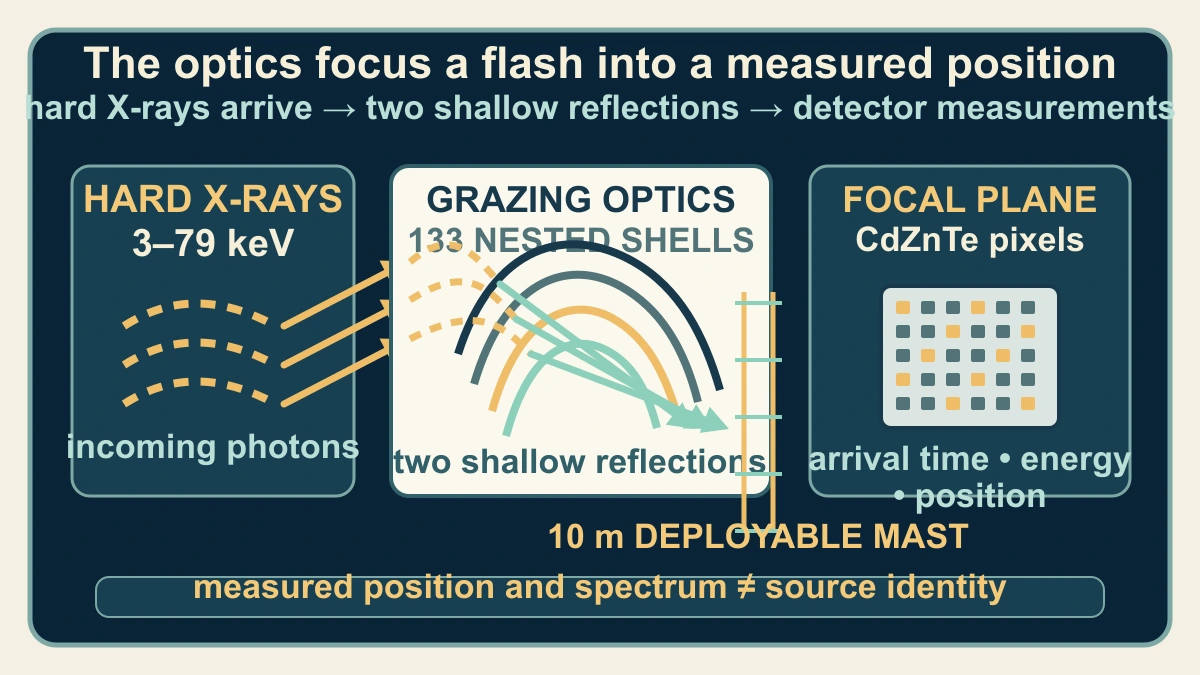
NuSTAR could spot the flash because it is built to focus high-energy X-rays, measure their energies and arrival times, and place the incoming signal on a sky map. That answers the first half of the mystery. A telescope can record a brief event as a time, spectrum and position even when the catalogue contains no already-known object at that position. Detection is a measurement; identification is a later comparison.
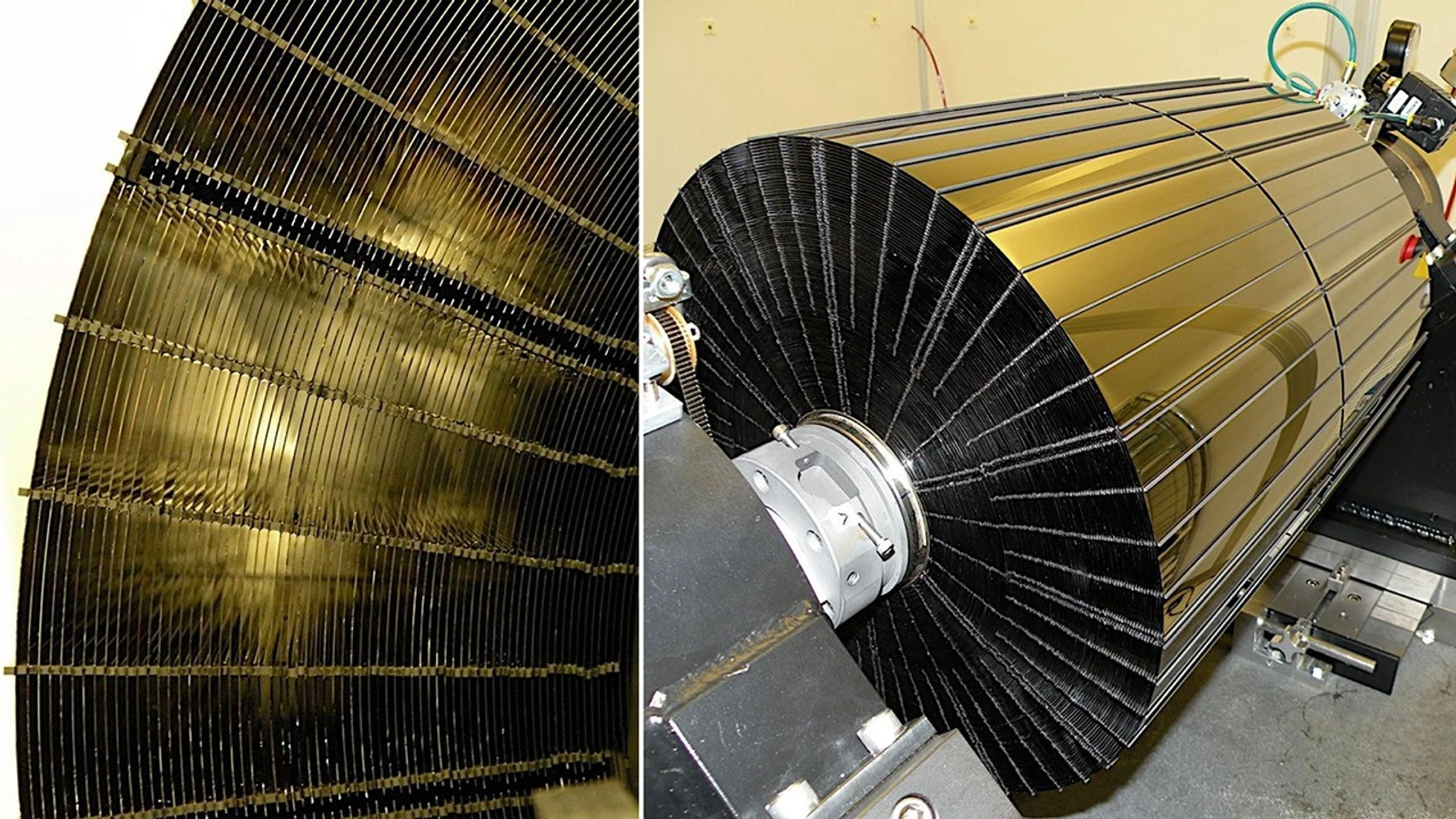
The mission's optics use grazing incidence: X-rays arrive at shallow angles so they can reflect from specially shaped surfaces instead of passing through an ordinary lens. NuSTAR nests many mirror shells inside one another, using the shells' geometry to make two reflections and steer the hard-X-ray photons toward a focal plane. NASA and Caltech describe this as a focusing hard-X-ray observatory, not simply a detector that counts an unexplained glow.
The distance between the optics and detectors matters too. NuSTAR's deployable mast creates the long focal length that the shallow-angle mirrors need, and laser metrology tracks the alignment well enough for the data to be reconstructed as an image. At the focal plane, cadmium zinc telluride detector pixels record where and when an event arrives and how much energy it carries. Those three measurements give scientists a constrained piece of sky and a physical description of the signal.
For NuSTAR 260828, the honest picture is therefore an instrument chain rather than a dramatic photograph of a blast. Photons entered the telescope, the optics concentrated them, the detectors recorded the event and analysts reported a transient at a coordinate. None of those steps supplies a name automatically. The same measured position still has to be checked against catalogues, other observations and plausible source classes before anyone can say what produced the flash.
An alert can be precise without naming its source
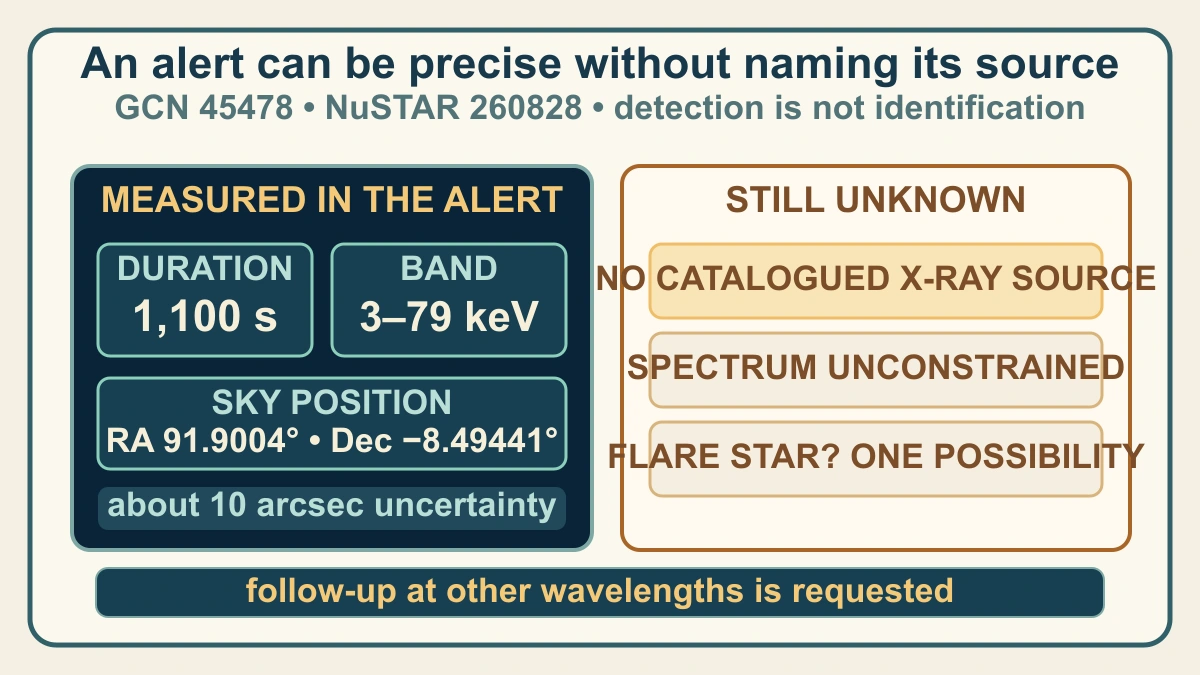
NASA GCN Circular 45478 reports that NuSTAR detected the event on August 28, 2026, at 18:39:29.6 UTC and that the hard-X-ray transient lasted about 1,100 seconds. The alert gives a position of right ascension 91.9004 degrees and declination minus 8.49441 degrees, with an uncertainty of roughly 10 arcseconds. It also reports a 3–79 keV flux estimate and a power-law fit, but the uncertainty on that fit is large.
That is a surprisingly useful result even though it is not an identification. A position with an uncertainty region lets researchers ask which known objects, if any, occupy the same patch of sky. A duration and an energy band let them compare the event with observations made at other times and wavelengths. But the alert specifically says that no X-ray source is catalogued at the reported position despite multiple Swift observations. No catalogue match means the existing records do not name a counterpart there; it does not mean that no physical source exists.
The broader fast-transient paper cited by the alert shows why this separation matters. Its authors searched a large NuSTAR archive in roughly 1,000-second slices, combined data from the mission's focal-plane modules, checked backgrounds and cross-matched candidate positions with Swift, XMM-Newton, Chandra and eROSITA catalogues. That study found five candidates in its search and demonstrates a method for finding short events. It is valuable context for the workflow, not a published identity for this particular alert.
The current circular also keeps its interpretation open. It describes the spectrum as soft but unconstrained, notes that the position is near the Galactic plane and says a flare star cannot be ruled out. That wording is not a diagnosis hidden in cautious language; it is a list of what the available evidence allows. The alert asks for follow-up at other wavelengths because the next observation, rather than a more confident headline, is what could narrow the possibilities.
Follow-up is what turns a flash into an identity
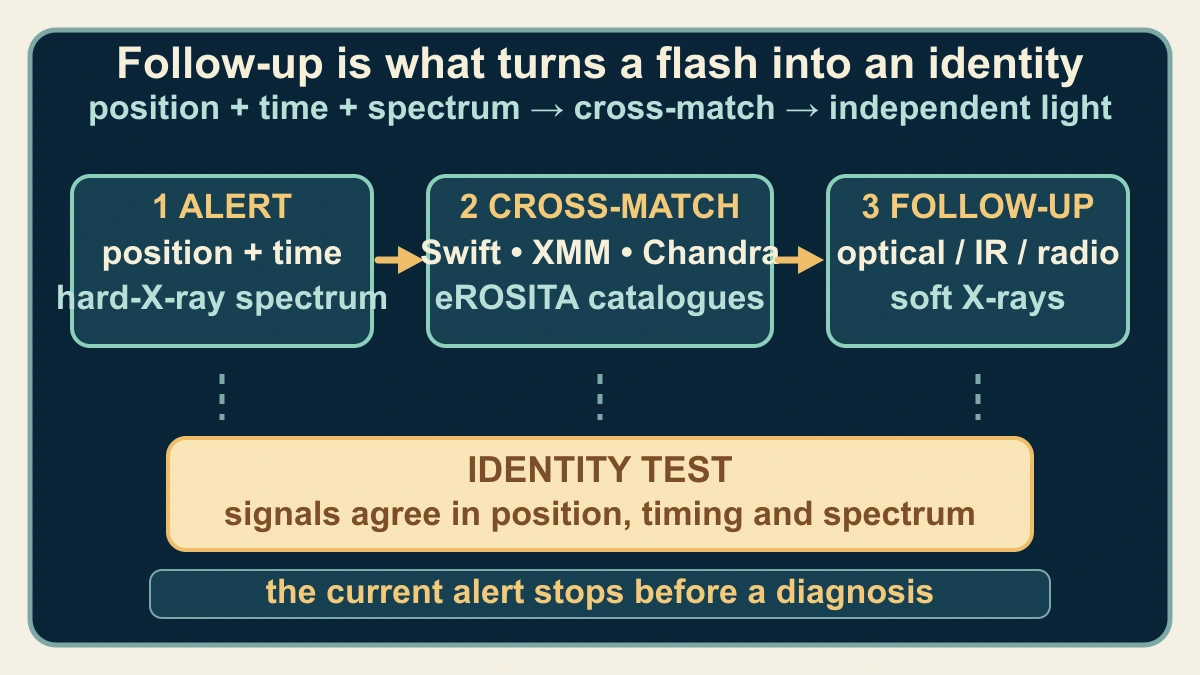
The next step is to treat the alert as a coordinate-and-time packet that other instruments can test. Researchers can compare its uncertainty region with existing Swift, XMM-Newton, Chandra and eROSITA catalogues, then look for a variable optical, infrared or radio object whose timing and position make sense. New soft-X-ray observations could show whether the event has a related lower-energy counterpart. Each comparison can reduce the list of explanations, but none should be described as a result until the observation and analysis exist.
A flare star is one possibility in the circular, so a useful follow-up would need more than a star that happens to lie nearby. Coordinated timing, a compatible change in brightness, an appropriate spectrum and a position consistent with the uncertainty region could make that explanation stronger. If those signals do not agree, the candidate remains unresolved. The same logic applies to any other proposed class: a name becomes persuasive only when independent evidence connects it to this event rather than to a coincidence on the sky.
This is why the missing catalogue source is an informative gap rather than an empty result. A catalogue is a memory of earlier observations, with limits set by wavelength, sensitivity, timing and coverage. A short hard-X-ray flash can appear in a new observation before a counterpart is recorded in another band. The scientific task is then to build a shared account from the position, time, energy distribution and follow-up light, while preserving the uncertainty at every step.
The current sources establish a real transient detection, an approximate sky position, an energy range, a duration, an uncertain spectral fit, no catalogued X-ray counterpart at that position and a request for multiwavelength follow-up. They do not establish a newly born object, an explosion, a flare-star diagnosis, a gamma-ray burst, a distance, a luminosity or a completed identification. NuSTAR has caught the flash; the evidence needed to say what made it remains the next door to open.
Sources and further reading
- NASA GCN Circular 45478: NuSTAR 260828, a 1100s hard X-ray transient ↗
- NASA GCN JSON record for Circular 45478 ↗
- NuSTAR Observatory: optics, detectors and mast overview ↗
- NuSTAR: State-of-the-art X-ray Detectors ↗
- NuSTAR: Deployable Mast ↗
- NASA HEASARC NuSTAR Observatory Guide ↗
- Fast X-ray transients in NuSTAR data — arXiv:2601.14375 ↗
- CaltechAUTHORS record: Fast X-Ray Transients in NuSTAR Data ↗
- NASA Science Photojournal: NuSTAR's Russian Doll-like Mirrors ↗
- NASA Images and Media Guidelines ↗
This article was written for Curiosity Desk. We do not copy other publishers or invent quotes. If a material error is found, we correct it openly.
Read the full standards →One answer should lead to a better question
Bring your curiosity to the group
Curious Minds is our public Facebook community for surprising science, strange history, Australian wildlife and everyday questions. No copied posts, no personal-friend invitations and no link dumping.
- Three self-contained discussion prompts each week
- Sourced answers and honest uncertainty
- Respectful conversation without spam