Why the antenna matters even when the ISS is still connected
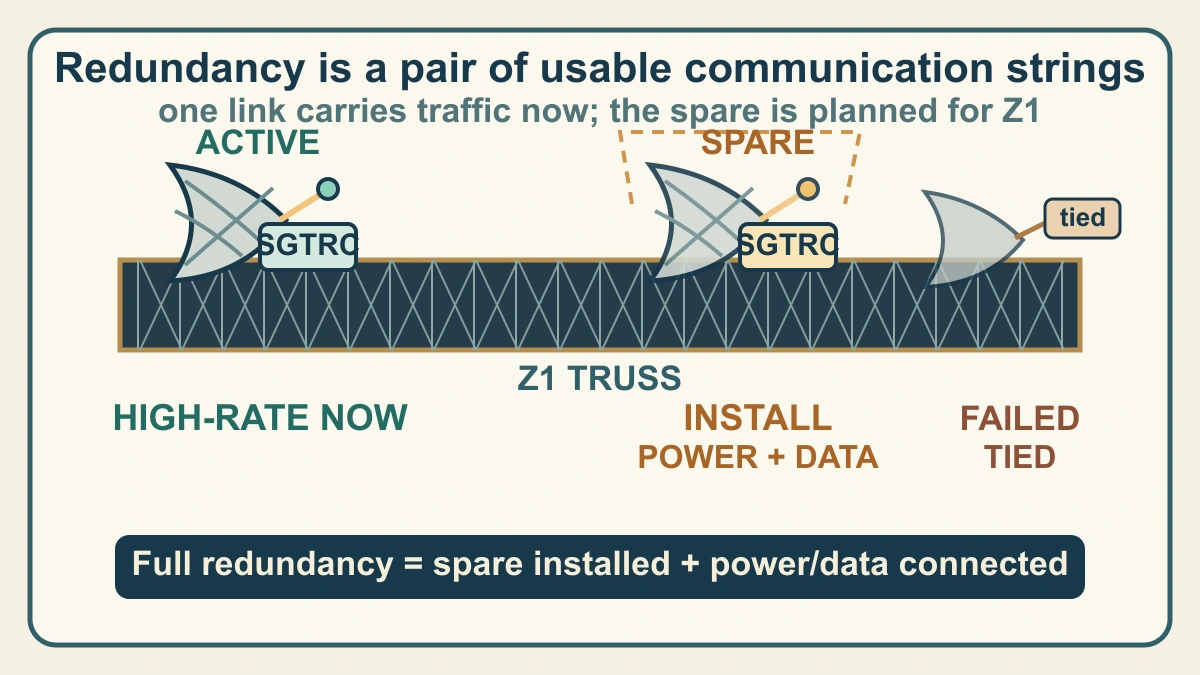
The short answer is that the International Space Station was not left without communications when one Space-to-Ground Antenna failed. NASA reported after the August 18, 2026 spacewalk that a fully functional SGANT remained in service. The reason to replace the failed unit is redundancy: the station can keep using a high-rate communications path while restoring a second prepared path for the work and data that flow between orbit and Earth.
SGANT is not the whole communications system. It is an external part of the station's Ku-band space-to-ground antenna group. The antenna and its control hardware point the radio link toward NASA's Tracking and Data Relay Satellites, or TDRS. Those satellites sit high above Earth and relay signals between spacecraft and ground antennas. NASA describes the ISS as using this relay architecture for near-continuous communications, including the high-rate data that supports mission operations, science and video.
There is another important limit to the word redundancy. NASA's station communications overview describes a separate very-high-frequency network that can provide voice-only emergency communications. That backup is not equivalent to the high-rate Ku-band path used for large data flows. Restoring the spare SGANT therefore does not mean rescuing an otherwise silent station; it means rebuilding the communications margin that lets the station keep its normal high-rate services if one string is unavailable. The repair is operationally valuable without being a claim that every communications mode depends on this one antenna.
How a Space-to-Ground signal reaches Houston
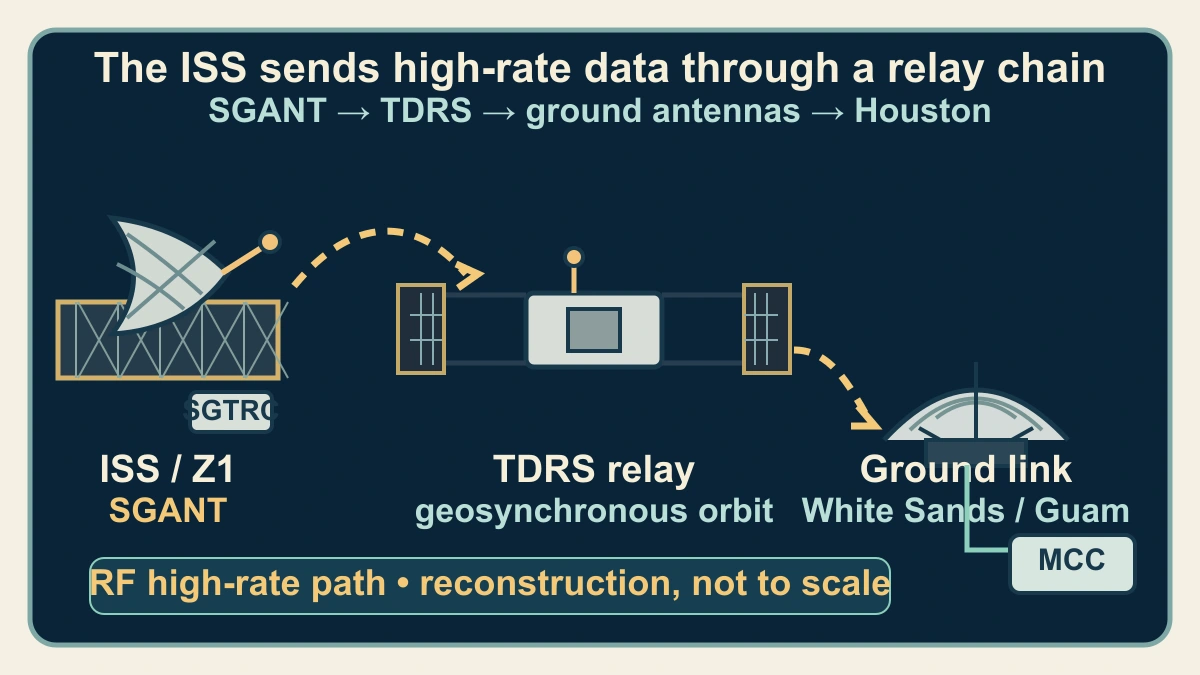
A useful way to picture the system is as a chain with four different jobs. First, the station's external SGANT and associated transmitter/receiver controller handle the radio-frequency link at the spacecraft. Second, a TDRS relay satellite receives and retransmits the signal. Third, ground antennas at NASA's Space Network sites receive the relay. Finally, terrestrial networks carry the data to Mission Control in Houston and other NASA centres. The direction reverses when controllers send commands or other information back to the station.
NASA's technical documentation describes the Ku-band antenna group as more than a dish: it includes the Space-to-Ground Antenna, the Space-to-Ground Transmitter/Receiver Controller and the boom assembly. A NASA engineering paper also documents a redundant Ku-band group positioned on the Z1 truss, with the spare assembly designed to become available if the prime string failed. The reconstruction is not a wiring diagram or a scale drawing; it shows the documented relationships that matter for this repair: external antenna, control electronics, relay satellite and ground segment.
The high-rate path matters because the station is a laboratory, not only a crew habitat. NASA's 2019 data-rate account describes the ISS communications system as a radio-frequency link through TDRS and ground antennas and records a 600-megabit-per-second capability after network upgrades. That number describes the system upgrade, not the throughput of this single repair. The safe claim is narrower: the SGANT work concerns the station's high-rate space-to-ground service, while the ground network and relay satellites complete the route to the people and systems that use the data.
Why a stuck bolt can change a spacewalk plan
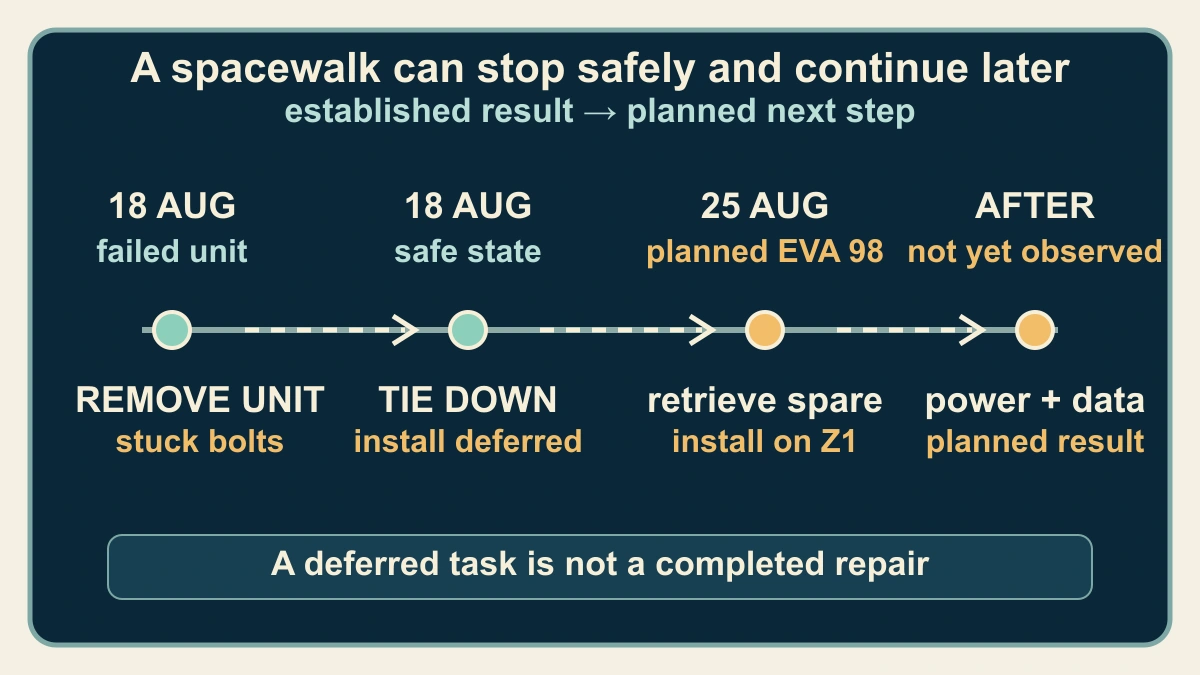
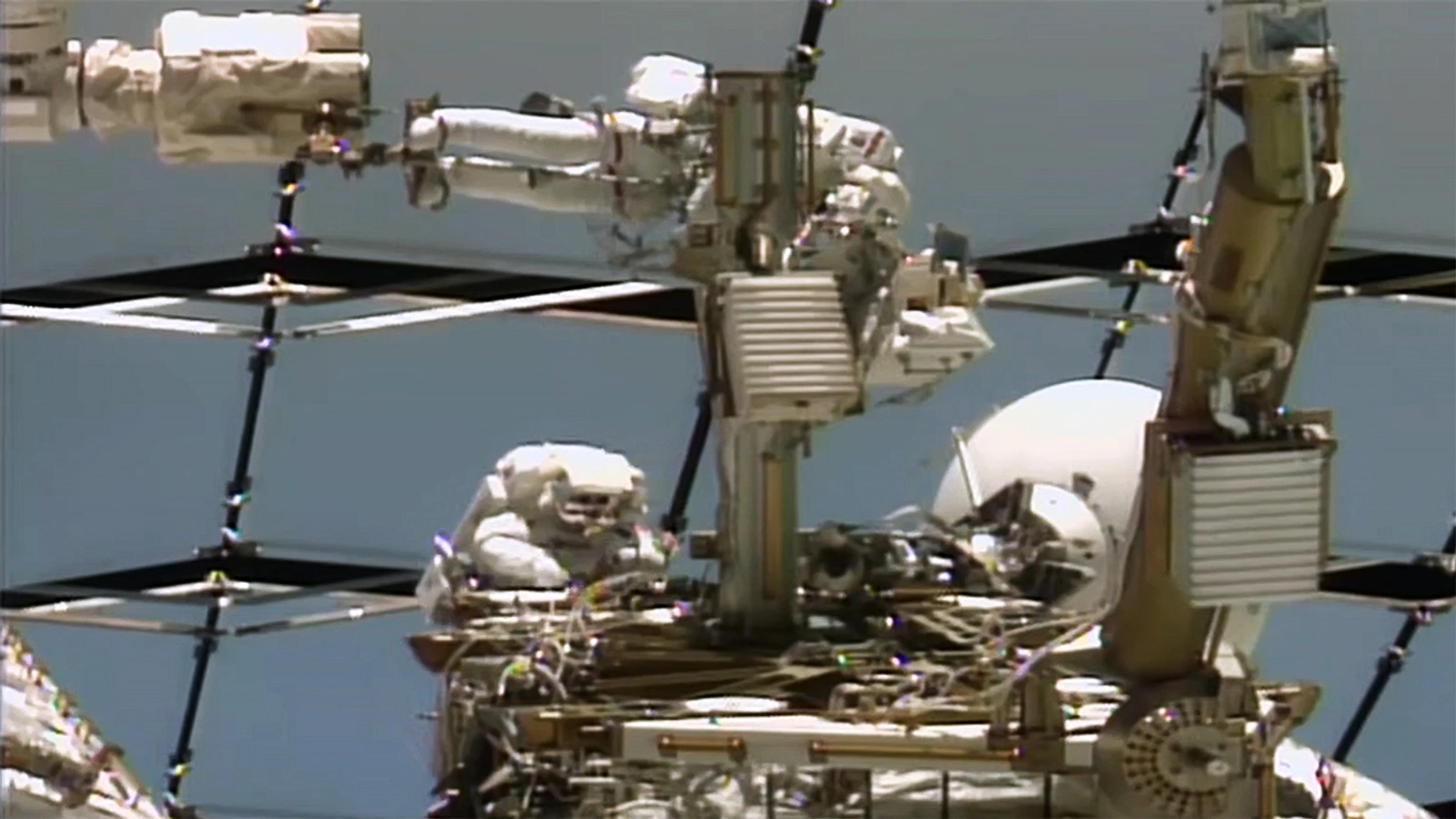
The first EVA shows why a repair plan is also a decision system. On August 18, NASA and ESA astronauts Anil Menon and Sophie Adenot spent 6 hours and 23 minutes outside the station. They removed the failed Space-to-Ground Antenna 2, but stuck bolts and electrical connectors took longer than expected. Instead of rushing the remaining installation work, mission control changed the objectives: the failed unit was secured with a long-duration tie-down on the station's truss, and the spare installation was deferred.
NASA's August 20 plan for U.S. Spacewalk 98 described the next step in future tense. Menon was to use Canadarm2 to retrieve the spare antenna released by Adenot, move it to the Z1 truss above Unity, and make the electrical and data connections needed to activate high-speed transmissions with mission control. ESA's matching mission description said the purpose was to restore full redundancy. Those are the intended sequence and operational purpose, not proof that the installation had already happened.
At the package check time, the evidence boundary therefore has two parts. Established: one failed SGANT had been removed and tied down, one fully functional SGANT remained, and the August 25 replacement plan had been published by NASA and ESA. Planned: installing the spare, completing the connections and restoring full redundancy. Not proved: the final hardware state, activation telemetry, the exact time any connection was completed or whether later tasks changed the plan. A deferred task is not a failed mission, but a planned task is not a completed repair either.
Sources and further reading
- NASA: NASA, ESA Astronauts Wrap Up Station Spacewalk ↗
- NASA: Spacewalk Preps Continue to Finish Antenna Installation Job Next Week ↗
- ESA: Sophie Adenot's second spacewalk, just one week after her first ↗
- NASA: Exploration and Space Communications — Near Space Network ↗
- NASA: The International Space Station: 20 Years of Communications Excellence ↗
- NASA: Data Rate Increase on the International Space Station Supports Future Exploration ↗
- NASA: International Space Station Guide — Communications ↗
- NASA NTRS: ISS Ku-Band Antenna Group and on-orbit spares ↗
- NASA: Images and Media Usage Guidelines ↗
This article was written for Curiosity Desk. We do not copy other publishers or invent quotes. If a material error is found, we correct it openly.
Read the full standards →One answer should lead to a better question
Bring your curiosity to the group
Curious Minds is our public Facebook community for surprising science, strange history, Australian wildlife and everyday questions. No copied posts, no personal-friend invitations and no link dumping.
- Three self-contained discussion prompts each week
- Sourced answers and honest uncertainty
- Respectful conversation without spam