Why Titan permits planned flight
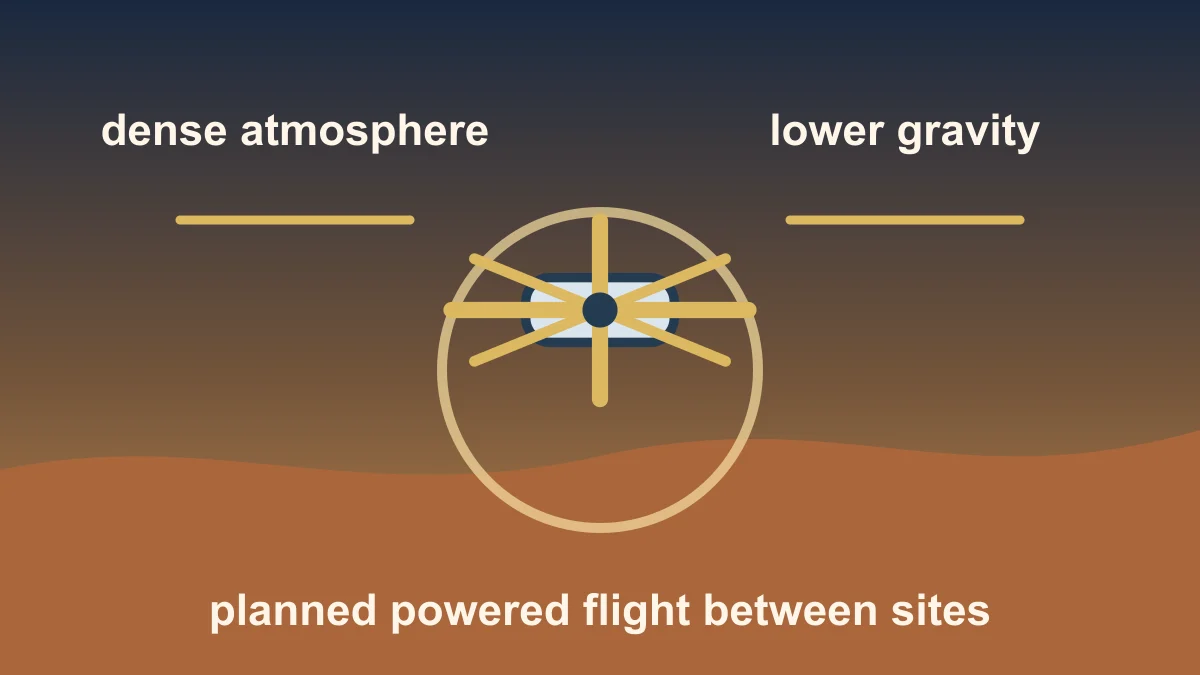
The short answer is that NASA plans Dragonfly as a rotorcraft because flying could connect Titan landscapes that a fixed lander or rover would reach only slowly, if at all. Titan is Saturn's largest moon, and NASA says it has a substantial atmosphere as well as a surface with dunes, rivers, lakes and seas made from hydrocarbons. Dragonfly is listed as a future mission: launch is no earlier than July 2028 and arrival is listed for late 2034. That schedule matters because the most interesting part of the story—actual flying above Titan—has not happened. What exists now is a spacecraft being built and tested for a carefully stated purpose.
NASA's technical explanation gives the physical reason a rotorcraft is being planned. Titan's dense, calm atmosphere and lower gravity make flight a useful way to travel over rough or sandy terrain. Dragonfly would use eight sets of coaxial rotor blades and a radioisotope power system, not solar panels, because sunlight at Titan is weak. These details do not guarantee any future flight will work exactly as designed. They explain the mission design: a vehicle that can lift off, land and move again could carry instruments to locations separated by kilometres instead of treating one landing spot as the whole moon.
Moving between sites changes the comparison
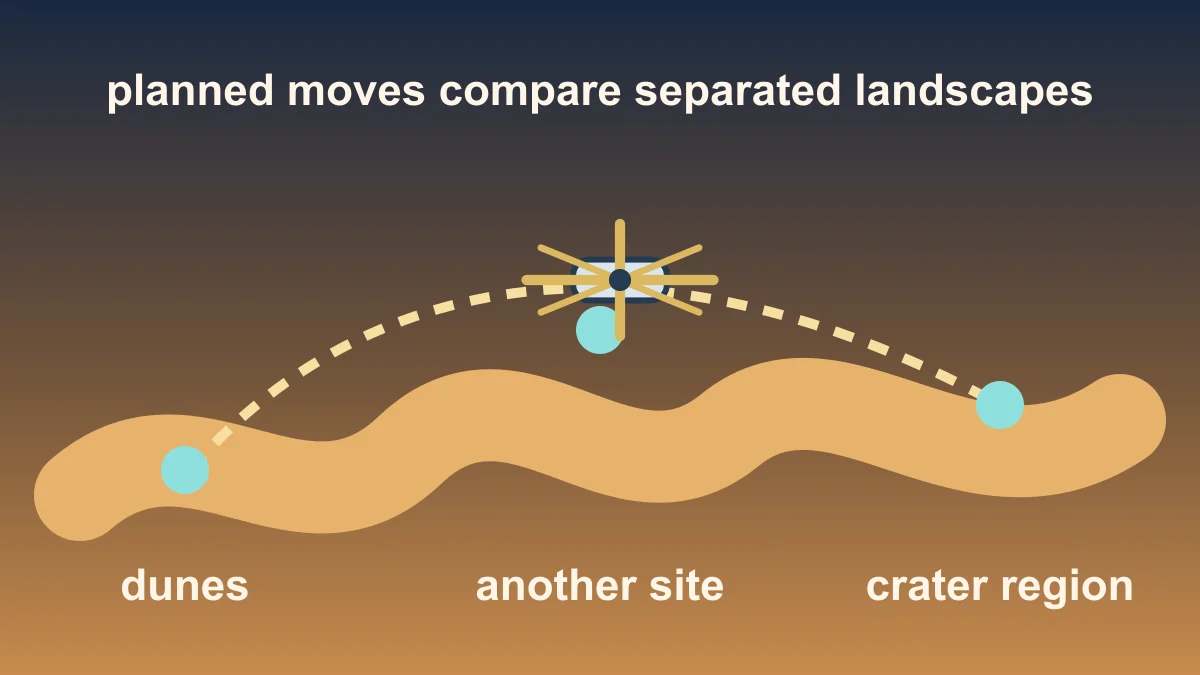
NASA says Dragonfly could visit roughly 20 to 30 sites during a primary mission lasting more than three years, travelling about 70 miles, or 115 kilometres, from its initial landing site. The valuable part is not distance for its own sake. Separated sites can preserve different surface materials, landforms and local conditions across a varied planetary environment. A measurement at one dune, for example, can be compared with one at a crater region or another kind of terrain. That makes it easier to ask whether a chemical or geological feature belongs to one local setting or appears across more than one setting. It is a planned comparison strategy, not a result about Titan's chemistry.
The planned instrument set shows what those comparisons could involve. NASA lists a mass spectrometer for chemical components, a gamma-ray and neutron spectrometer for surface composition, cameras for landforms, a drill for collecting material, and a geophysics and meteorology package. Together, those tools could connect a site's material, terrain and local environment. But an instrument description is not a data release. No Dragonfly sample has been collected, no Titan landing site has been visited by this rotorcraft, and no instrument has established whether any particular compound or setting is common, rare, biologically relevant or evidence of life.
A developed spacecraft is not a Titan result
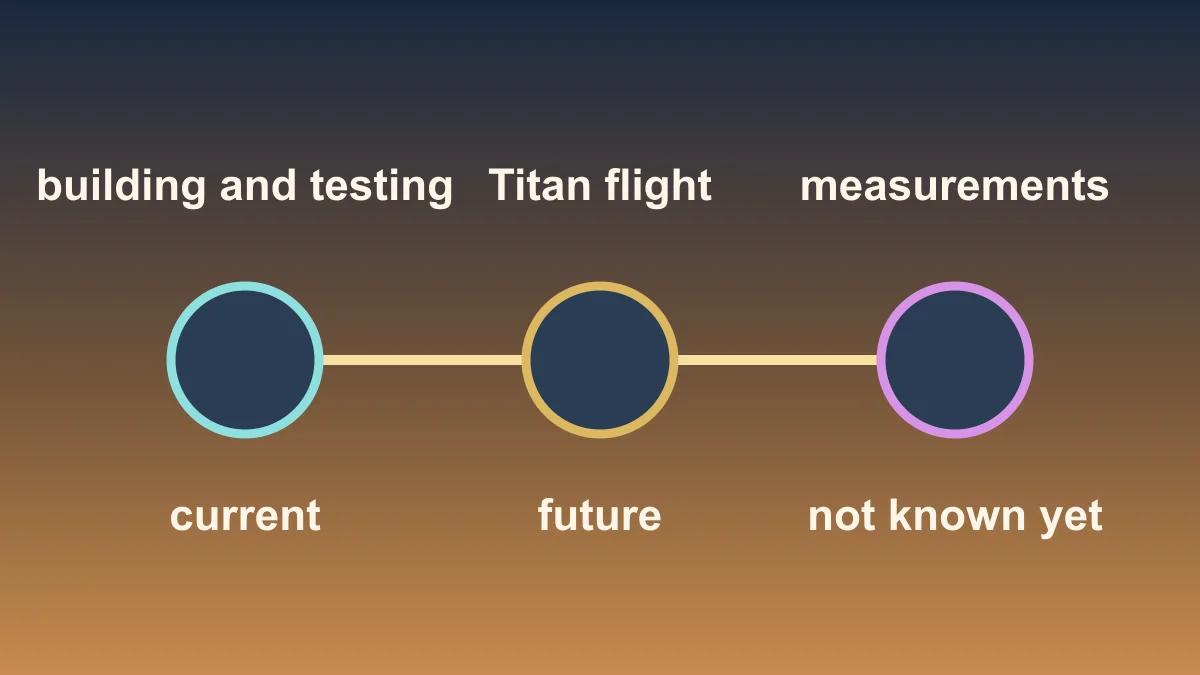
NASA's current development updates are real evidence of progress, but they are not a shortcut to future conclusions. The agency reports rotor testing in Titan-like conditions, delivered instrument components and completed tests of parts of the flight system and communications equipment. That supports a modest present-tense statement: engineers are building and testing Dragonfly. It does not support statements that Dragonfly is already on Titan, has performed a flight, has mapped a landscape or has assessed the moon's habitability. Even an eventual arrival would be only the start of a new evidence stage, with its own data, uncertainties and reviews.
This distinction is especially important when the mission is described alongside life-related language. NASA says Dragonfly will investigate Titan's habitability and the chemistry that came before biology; it does not frame the mission as a completed life-detection experiment. The established facts are the future mission plan, the stated travel method, the planned instruments and the reported development work. Arrival, flight performance, samples, site comparisons and science conclusions remain uncertain because they have not occurred. The genuine curiosity is already strong: if the design reaches Titan as planned, a flying laboratory could compare places that otherwise remain far apart—without pretending that any scientific answer is already in hand.
Sources and further reading
This article was written for Curiosity Desk. We do not copy other publishers or invent quotes. If a material error is found, we correct it openly.
Read the full standards →One answer should lead to a better question
Bring your curiosity to the group
Curious Minds is our public Facebook community for surprising science, strange history, Australian wildlife and everyday questions. No copied posts, no personal-friend invitations and no link dumping.
- Three self-contained discussion prompts each week
- Sourced answers and honest uncertainty
- Respectful conversation without spam