The vortex starts with a patch of overheated ground
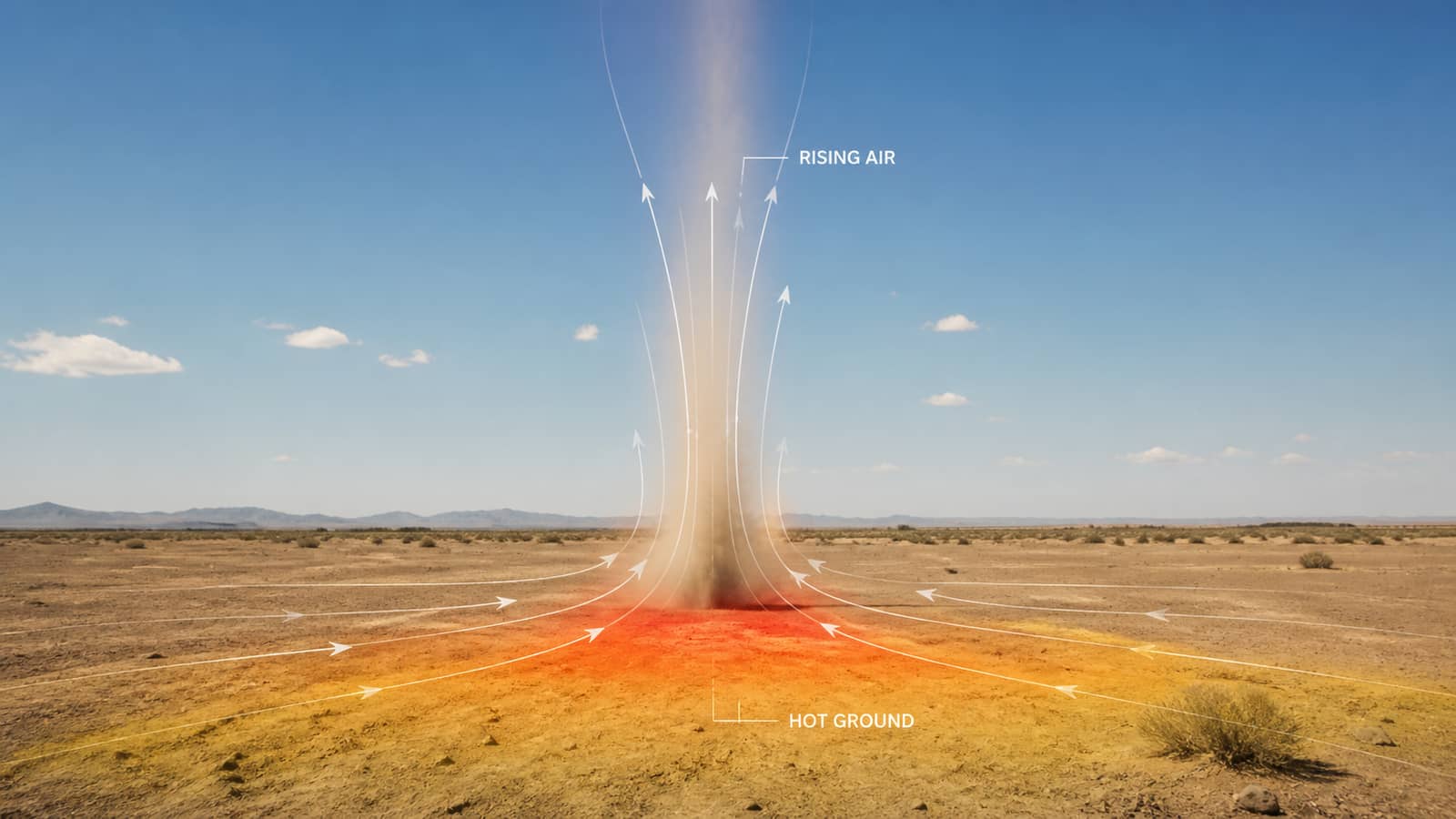
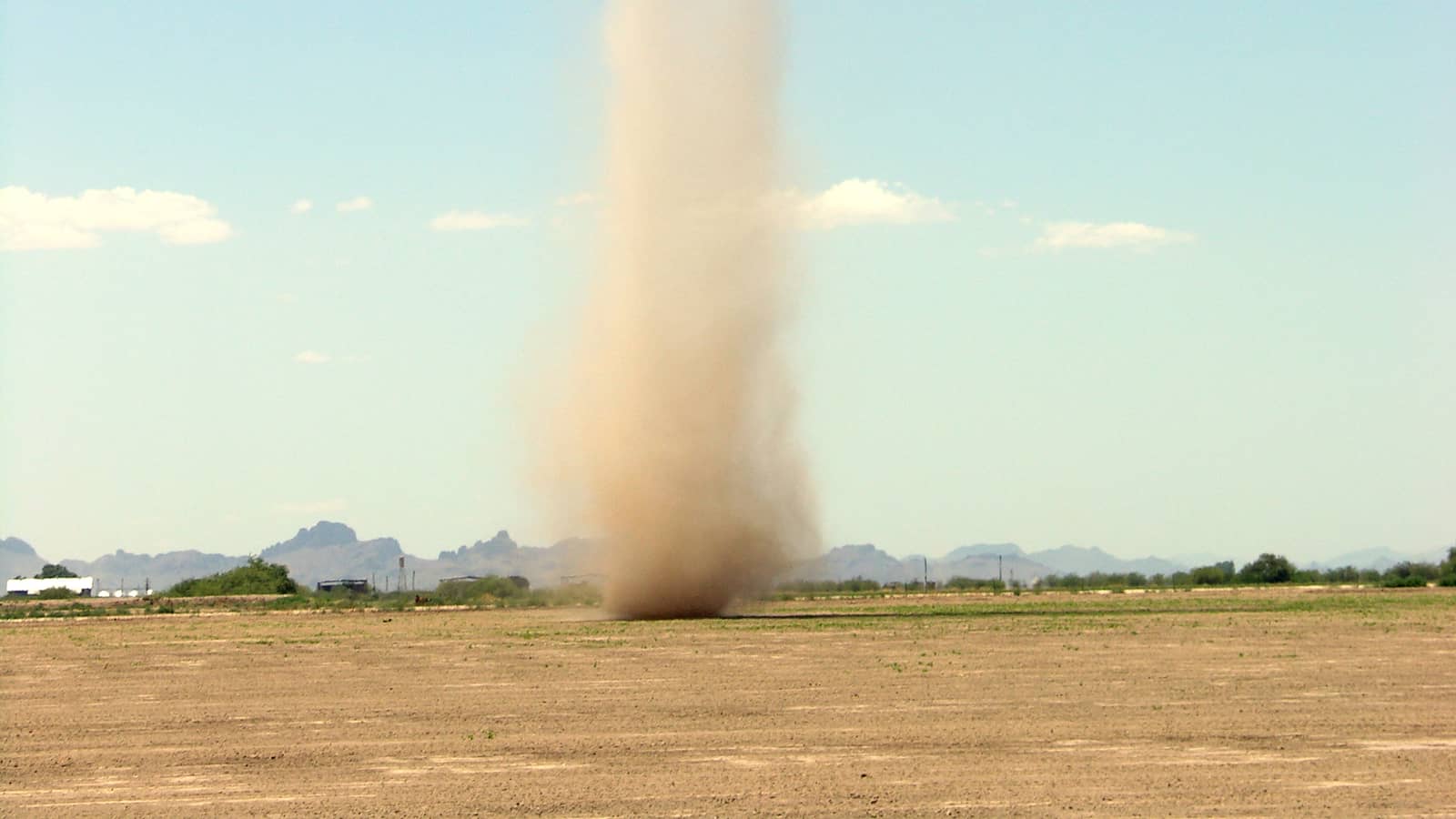
A dust devil often appears in weather that looks too calm to make anything dramatic: strong sunshine, dry ground, light winds and little cloud. The quiet sky is part of the setup. Sunlight heats the surface, and some materials warm faster than their surroundings. Bare soil beside vegetation, asphalt beside dirt or a sheltered patch can create a pocket of air that is much warmer than air only a short distance away.
Warm air is less dense than cooler air around it, so the pocket begins to rise. If the near-surface atmosphere is unstable—temperature falls quickly enough with height—the rising parcel stays buoyant and accelerates upward. Cooler air flows inward near the ground to replace it. This produces a compact convective circulation, a miniature version of the heat-driven motion that builds thermals, but concentrated over a small surface contrast.
Dust is not required for the air to rise. It is a tracer. As inflowing wind sweeps across dry ground, loose dirt, leaves or grit enter the circulation and draw the otherwise invisible airflow for us. A vortex over clean pavement could be moving without displaying the classic brown column. What we name after dust is fundamentally a rotating column of air.
A small sideways spin is stretched upright and tightened
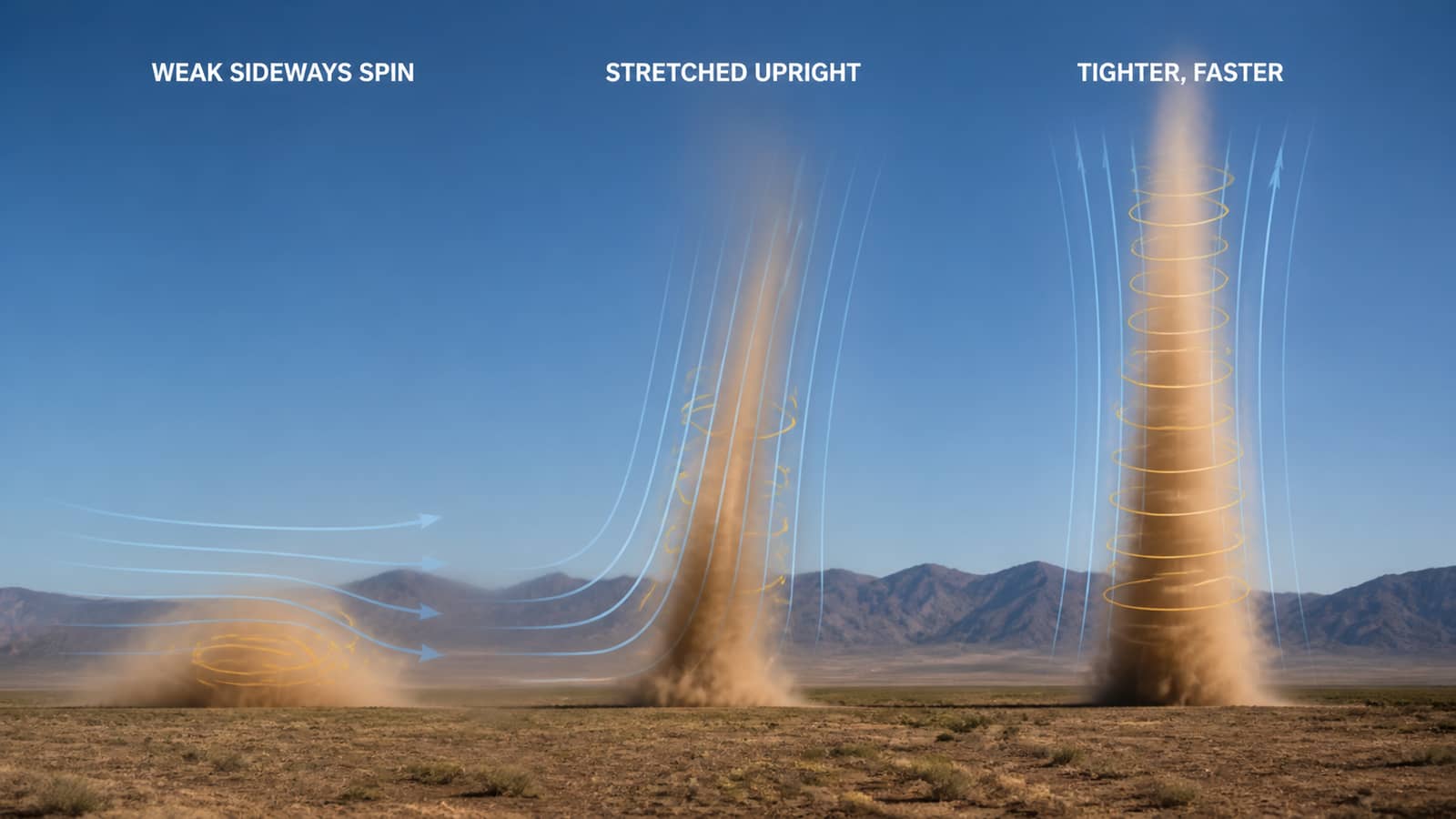
The rising plume rarely begins with perfectly symmetrical inflow. Small wind differences around obstacles, boundaries between surfaces or passing eddies give the air some initial rotation. As that rotating air is pulled inward and upward, its radius shrinks. Like a skater drawing in their arms, the circulation can spin faster as it narrows, although the atmosphere is messier than the classroom analogy.
The updraft stretches the rotation into a vertical column. Pressure becomes slightly lower near the centre, encouraging more near-surface air to flow inward. A self-reinforcing loop briefly develops: heating drives ascent, ascent concentrates rotation, and the rotating inflow gathers more warm air and visible debris. National Weather Service guidance notes that strong surface heating and boundaries between surface types are common formation settings.
This origin separates a dust devil from a tornado. A tornado is connected to a convective cloud and usually to a thunderstorm's organised rotation. A dust devil grows from surface heating beneath fair-weather skies and is not attached to a storm cloud. Both rotate, but sharing a shape does not mean sharing an engine, scale or forecast context.
The column dies when its heat supply or structure breaks
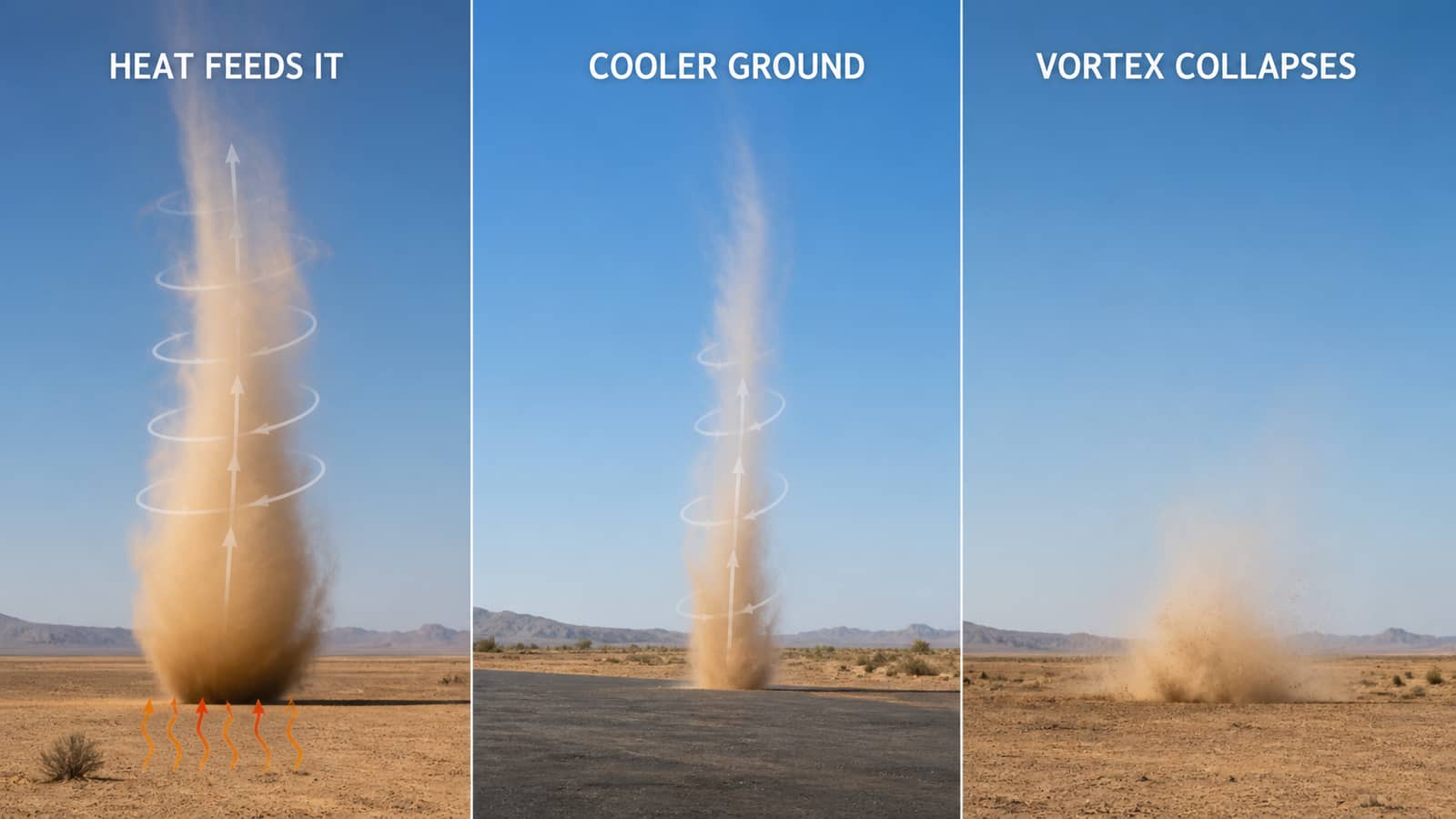
A dust devil persists only while the small heat engine remains aligned. If it drifts from hot bare ground over a cooler surface, the buoyant supply weakens. A stronger gust can tilt or shred the column. Passing cloud can reduce solar heating. Once inward flow and ascent no longer reinforce the spin, friction and mixing disperse the circulation and the dust falls out.
Most dust devils are brief and much weaker than tornadoes, but small does not mean harmless. A compact vortex can lift unsecured objects and create a sharp local wind change. The relevant response is ordinary distance and awareness, not tornado mythology: do not chase or step into a rotating debris column, and secure light objects during hot, dry, gust-prone conditions.
The most revealing moment is often its disappearance. The dirt column can collapse almost as quickly as it formed because no large storm is feeding it from above. A dust devil is a temporary agreement between surface heat, buoyancy, inflow and spin. Break any part of that agreement and the visible whirlwind returns to ordinary, invisible turbulence.
Its path can look erratic because the vortex is both spinning and being carried by the surrounding wind. The column may lean, wander across a field or abruptly strengthen when it reaches another hot patch. That motion does not mean the whirl has chosen a target; it reflects changing inflow and surface temperature beneath a small moving circulation. Following the heat source explains the behaviour more reliably than following the dust cloud alone.
Dust devils are useful natural demonstrations because each visible feature corresponds to a hidden process. Dirt spiralling inward marks near-ground inflow. A narrowing column marks concentrated rotation. Debris lifting marks upward motion. The fading top marks mixing with surrounding air. Read in that order, the spectacle becomes a compact lesson in convection: sunlight creates a temperature contrast, and the atmosphere spends that contrast by moving heat upward.
Sources and further reading
This article was written for Curiosity Desk. We do not copy other publishers or invent quotes. If a material error is found, we correct it openly.
Read the full standards →One answer should lead to a better question
Bring your curiosity to the group
Curious Minds is our public Facebook community for surprising science, strange history, Australian wildlife and everyday questions. No copied posts, no personal-friend invitations and no link dumping.
- Three self-contained discussion prompts each week
- Sourced answers and honest uncertainty
- Respectful conversation without spam