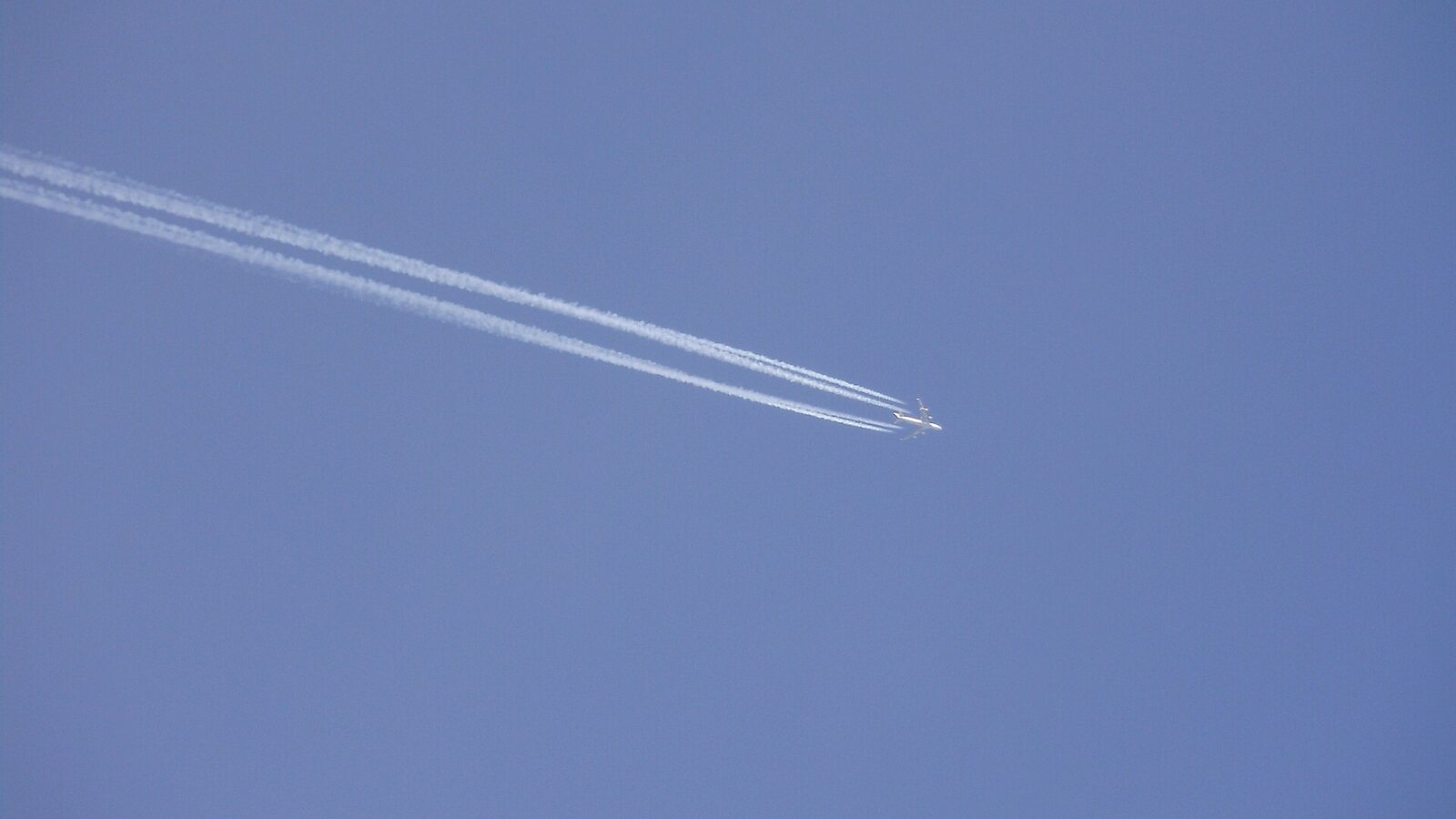
The white line is a cloud assembled behind an engine
A jet engine burns fuel and produces water vapour among its exhaust products. At cruising altitude the surrounding air can be colder than minus 40 degrees. When the hot, moist exhaust mixes turbulently with that cold air, water condenses and freezes around tiny particles, producing a line of ice crystals visible from the ground.
That makes a contrail a human-triggered cloud, not smoke lingering unchanged from the engine. The aircraft supplies water, particles and a rapid mixing zone. Whether the newborn ice crystals survive after that first moment depends mainly on the temperature and moisture of the air the aircraft has entered.
Dry upper air erases the crystals; ice-rich air feeds them
Air can be unsaturated with respect to liquid water yet contain enough vapour for ice crystals to persist. In dry air the new crystals lose water by sublimation and the line disappears quickly. In ice-supersaturated air, vapour can deposit onto the crystals, allowing the trail to remain and sometimes grow.
This is why persistence is not a timer built into a particular aircraft. Two flights at different heights, or the same climbing aircraft crossing layers, can meet different humidity. The Federal Aviation Administration describes contrails as most common and persistent when excess atmospheric moisture is available. The surrounding sky supplies the future of the line.
A broken trail can draw the boundaries of invisible air
Upper-air moisture is not spread evenly. A jet may move between a moist layer that supports ice and a drier layer that destroys it. From the ground the resulting contrail can look switched on and off, even though the engines continue operating normally. The gaps reveal changes in the atmosphere rather than changes in a spray system.
Wind then stretches and shears surviving trails. A narrow line can widen, lose its sharp edges and become difficult to distinguish from natural cirrus. The National Weather Service notes that persistent contrails can spread across the sky at the level where they formed. What begins as a flight path can end as part of the cloud field.
Persistence is evidence of humidity, not secret ingredients
A long-lasting line can feel more suspicious than one that fades because ordinary exhaust seems as though it should disperse. That intuition misses the phase change. Once exhaust water becomes ice, the relevant question is whether surrounding vapour maintains the crystals. Natural cirrus survives through the same environmental support.
The line's duration, breaks and spread therefore do not demonstrate that unusual chemicals were added. They are expected outcomes of cold temperature, ice supersaturation and wind. Composition questions can be tested through atmospheric sampling and engine-emissions research, but visual persistence alone cannot identify an undisclosed substance.
Contrails can affect climate, but every white line is not equal
Persistent contrails and the cirrus they create can change Earth's energy balance by reflecting some incoming sunlight and reducing some outgoing infrared heat. The net effect depends on place, time, cloud properties and what natural cloud would otherwise have existed. Researchers continue measuring how routes and atmospheric conditions shape the total impact.
The mechanism is established without making every consequence simple. A short trail in dry air and a broad overnight contrail cirrus deck do not have the same effect. The useful first step is to read the sky correctly: an aircraft made the initial crystals, while a hidden pocket of cold, moist air decided whether they disappeared or became weather.
A trail can reveal a moist layer that no ground instrument can see directly
A persistent line offers a rough visual clue that the flight crossed cold air sufficiently moist with respect to ice. Pilots and forecasters still rely on proper observations and models, not one photograph, because a contrail samples only a narrow path at one height and time. Conditions a short distance away may be different.
That limitation makes the trail more interesting, not less. The white line is a temporary tracer placed into otherwise transparent air. Its breaks, spread and disappearance allow the atmosphere to draw some of its hidden structure, while also reminding the observer that a visible cloud is only one slice through a moving three-dimensional humidity field.
Sources and further reading
This article was written for Curiosity Desk. We do not copy other publishers or invent quotes. If a material error is found, we correct it openly.
Read the full standards →One answer should lead to a better question
Bring your curiosity to the group
Curious Minds is our public Facebook community for surprising science, strange history, Australian wildlife and everyday questions. No copied posts, no personal-friend invitations and no link dumping.
- Three self-contained discussion prompts each week
- Sourced answers and honest uncertainty
- Respectful conversation without spam