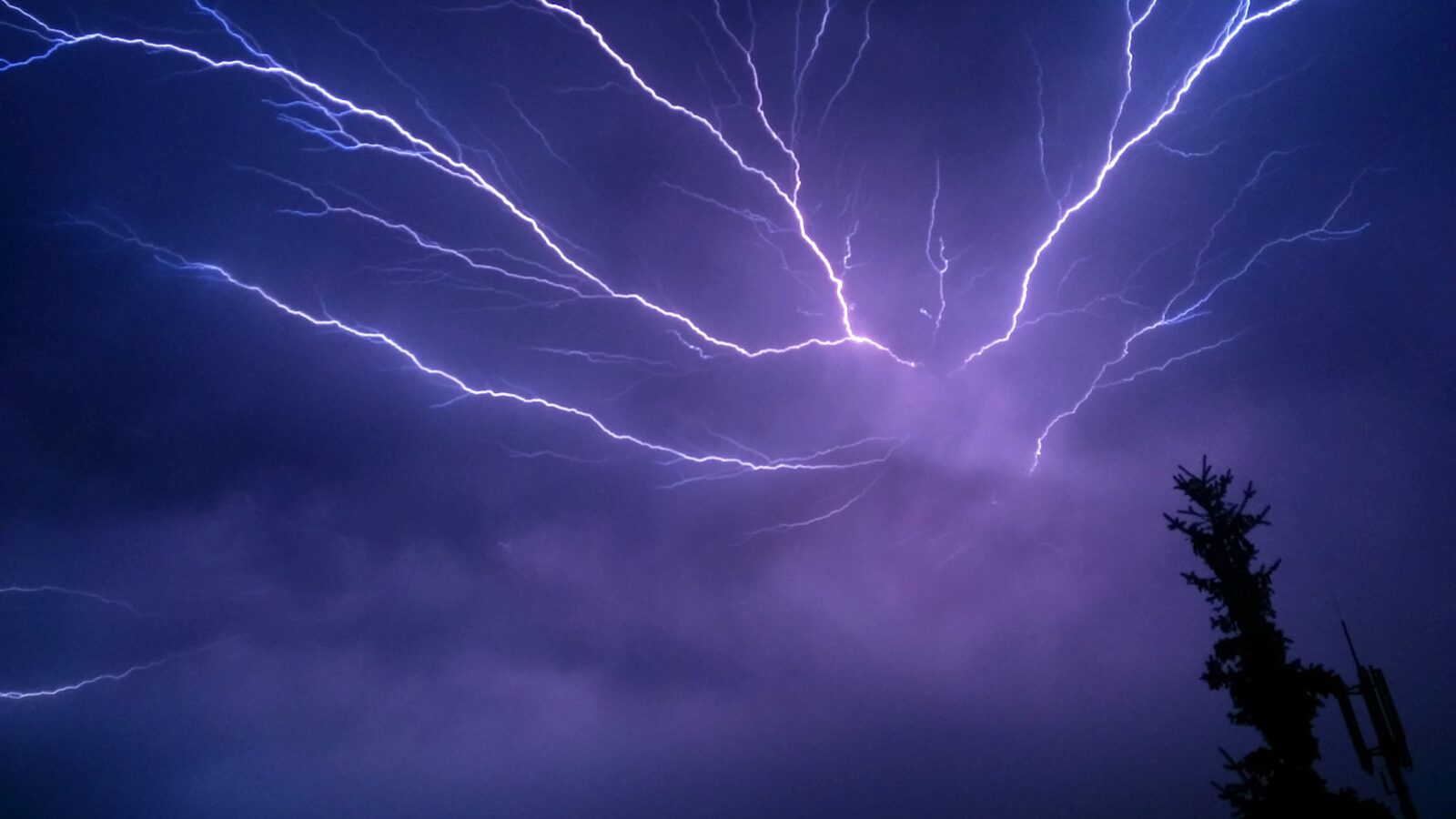
A lightning channel heats faster than the air can move aside
Lightning is an electrical discharge through a channel that may branch and stretch for kilometres. The current transfers energy to the surrounding air extraordinarily quickly. The US National Weather Service says the channel can briefly heat air to about 50,000 degrees Fahrenheit, roughly 27,800 degrees Celsius, far hotter than the Sun's visible surface.
The important fact is not merely the peak temperature. It is the speed. Air cannot drift away gently while the channel heats, so it expands violently and compresses the air beyond it. Very close to the channel that disturbance begins as a shock wave. As it travels and weakens, it becomes the pressure variation our ears recognise as thunder.
The flash is one event, but the sound has a long route
A photograph flattens lightning into a bright line, but the channel occupies three-dimensional space. One segment may be much closer to you than another. Light from the whole flash arrives so quickly that human timing treats it as immediate. Sound travels far more slowly, so thunder from the nearest segment reaches you first and the rest follows.
That staggered arrival builds the roll. Branches, bends and echoes add paths of different lengths, while the atmosphere absorbs higher frequencies more efficiently over distance. A nearby flash preserves a sharp tearing crack. Farther away, the higher components fade and overlapping low-frequency arrivals merge into the familiar rumble.
Counting seconds measures travel time, not storm intensity
Because light outruns sound so decisively, the gap between flash and thunder can estimate distance. The National Weather Service gives the practical US rule of about five seconds per mile. Its metric equivalent is about three seconds per kilometre, so dividing the seconds by three gives kilometres.
The estimate is approximate because wind, temperature layers and channel geometry alter the route. It also does not make waiting outside safe. If thunder is audible, the storm is close enough for lightning to be a hazard. Counting is useful for understanding sound delay only from an appropriate safe place, not for deciding how long to remain exposed.
A long rumble does not mean lightning stayed on for that long
The electrical discharge may be brief even when its thunder occupies many seconds. Each part of the channel launches a pressure disturbance at almost the same time, but the disturbances take different times to reach the listener. The atmosphere is effectively delivering a time-separated acoustic map of a shape too fast and bright to inspect directly.
Terrain and buildings can lengthen the experience by reflecting sound. Temperature can also bend sound paths because sound speed changes with air conditions. Those effects modify what reaches one listener, but the source remains the rapid heating and expansion around the lightning channel—not clouds colliding and not the bolt striking the ground like a giant hammer.
The warning arrives after the dangerous event has already crossed the sky
Thunder is delayed evidence. By the time it reaches you, the flash that produced it is over, but the storm remains capable of producing another discharge. That is why hearing thunder carries more practical meaning than its loudness. A quiet rumble can come from a dangerous flash whose high frequencies were lost over distance.
The complete sequence is simple and strange: electric charge breaks down the insulating air, current superheats a narrow crooked channel, the channel forces air outward, and the resulting pressure wave reaches the listener in pieces. The flash seems to vanish instantly. Its geometry keeps arriving through sound.
One listener hears only one acoustic view of the same flash
People separated by several kilometres can hear the same lightning channel differently because the nearest branch, terrain and atmospheric path change with position. A sharp crack for one observer may arrive as a softer roll for another. Neither recording alone contains a complete picture of the discharge's three-dimensional shape.
Networks of microphones can compare arrival times more systematically, just as lightning sensors compare electromagnetic signals. For an ordinary listener, the changing sound is already evidence that thunder is travelling information. The sky has converted the shape of an electrical channel into a sequence that distance edits before it reaches each pair of ears.
Sources and further reading
This article was written for Curiosity Desk. We do not copy other publishers or invent quotes. If a material error is found, we correct it openly.
Read the full standards →One answer should lead to a better question
Bring your curiosity to the group
Curious Minds is our public Facebook community for surprising science, strange history, Australian wildlife and everyday questions. No copied posts, no personal-friend invitations and no link dumping.
- Three self-contained discussion prompts each week
- Sourced answers and honest uncertainty
- Respectful conversation without spam