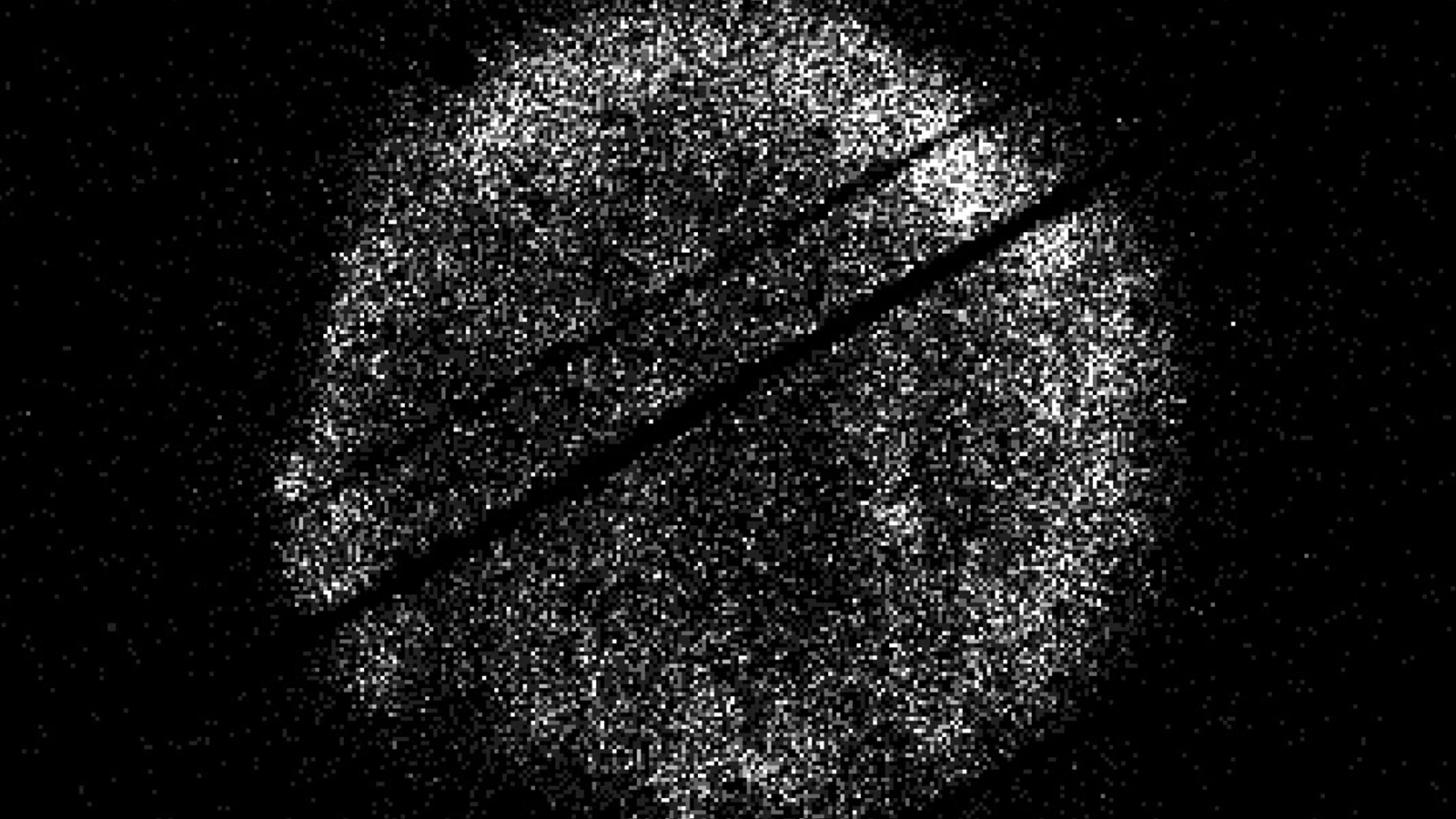
The image shows patterns, not a pond
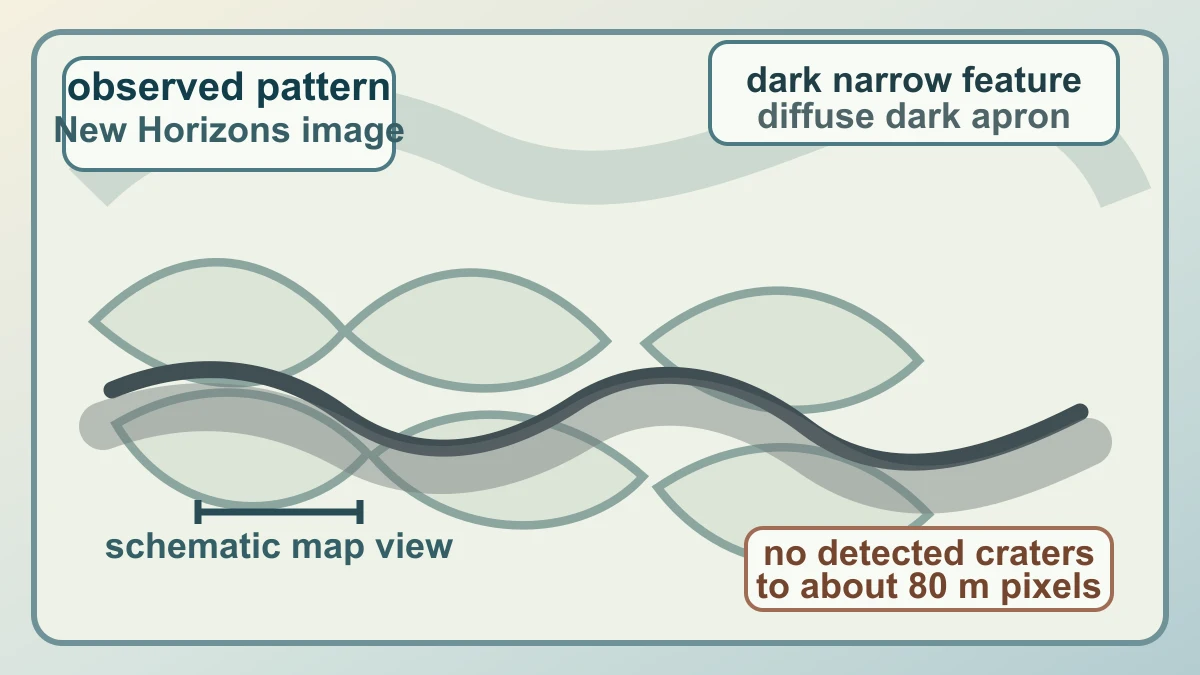
The careful answer is that scientists have evidence for a surface process that may involve liquid nitrogen, not a photograph of liquid sitting on Pluto. NASA's August 2026 update describes new analysis of New Horizons imagery as evidence that liquid nitrogen could be reaching the surface through cracks near the northern edge of Sputnik Planitia. The underlying Planetary Science Journal paper uses more cautious language: it hypothesizes that the patterns may record liquid nitrogen flowing from beneath the glacier and briefly spreading before freezing. That distinction is the key to reading the result without turning an interpretation into a direct observation.
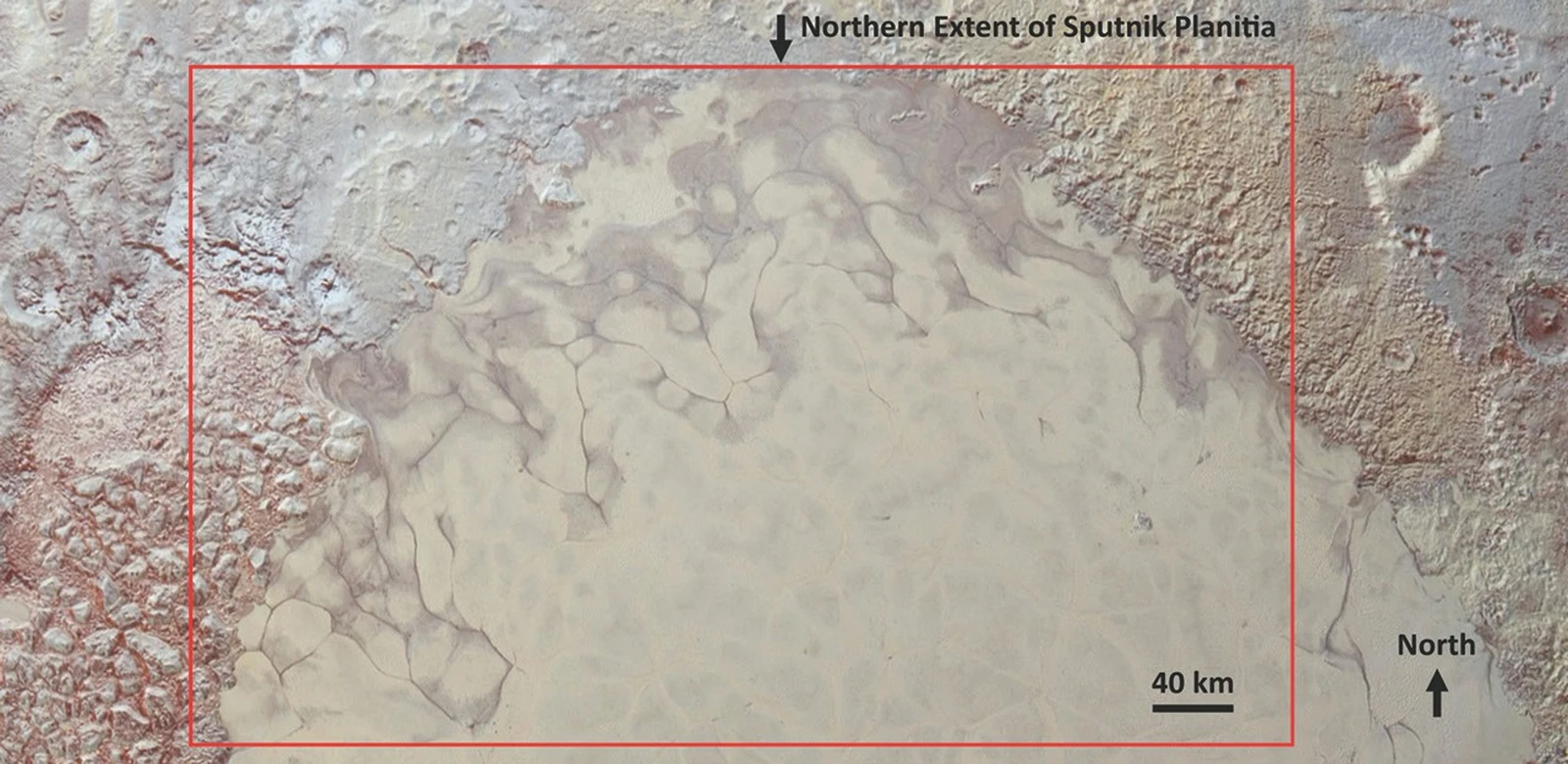
What the spacecraft supplied was a detailed view of a young, nitrogen-rich ice plain. The paper describes polygonal convection cells, sharp dark narrow features that often follow cell boundaries, and wider diffuse dark aprons around many of those features. New Horizons images also show no detected impact craters in Sputnik Planitia down to roughly 80-metre pixels, which supports the idea that the surface is geologically young or continually renewed. These are observations and inferences about surface age and shape. None is, by itself, a sample confirming that liquid nitrogen was present at the moment of the flyby. The image is powerful because it preserves relationships across a large landscape: where the dark features sit, how wide their surrounding zones are, and how those zones meet the cellular ice. Those relationships are the clues a process model has to explain.
Why researchers consider liquid nitrogen
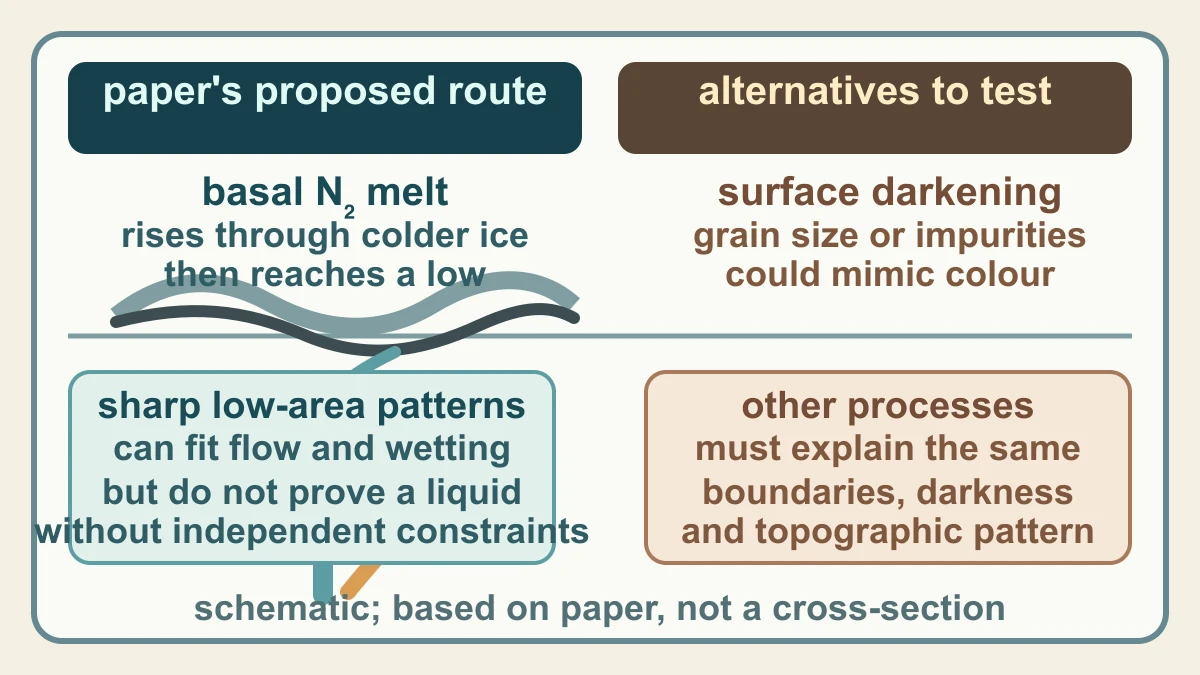
The proposed mechanism starts below the visible surface. Pluto is cold enough that ordinary rain of liquid nitrogen from the atmosphere is not the suggested route. Instead, the paper considers whether nitrogen ice at depth could partially melt, rise through a crack or conduit, reach the surface and flow toward a low area before freezing. A liquid or slushy flow could alter the ice's light-scattering properties, carry dark material, or fill shallow topographic lows. In that model, a dark line and its broader apron are a frozen record of how material moved, not a standing pool that New Horizons directly watched.
The reason the pattern matters is that several details need to fit together at once: the features are unusually dark, their boundaries can be sharp, and they tend to occupy the low or marginal parts of convection cells. The paper argues that a liquid process can reproduce that combination more naturally than some surface-only alternatives. But it also discusses other ways to darken ice, including grain-size changes, impurities, sublimation and the possibility that albedo patterns reflect unseen bottom topography. A useful scientific explanation therefore asks whether each competing process can reproduce the same geometry, contrast and distribution—not merely whether one liquid scenario sounds physically possible. That is a stronger standard than matching a single dark patch: the explanation must account for the feature's shape, its neighbouring apron, its position in the cell and the absence of an easier rival mechanism.
What the evidence does—and does not—establish
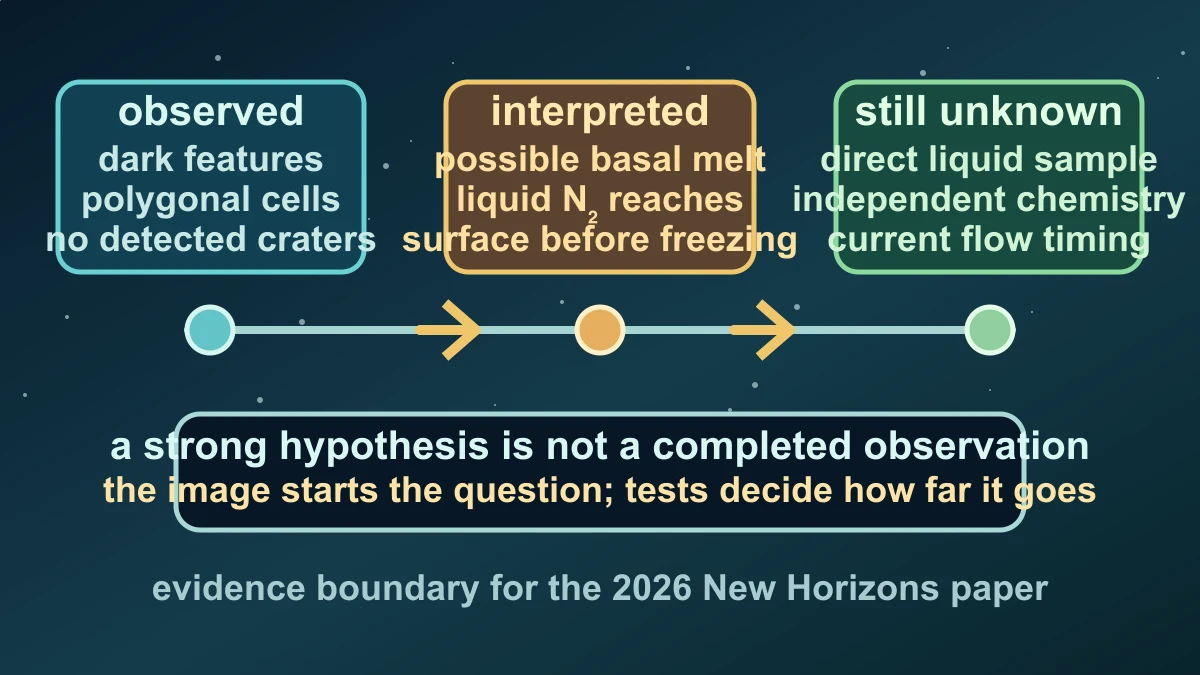
The current record supports a bounded claim: New Horizons imagery contains surface patterns that the authors interpret as possible evidence of recent liquid-nitrogen flow, and their paper develops physical conditions under which basal melt could reach and move across the surface. NASA's summary is consistent with that reading, while also making clear that the finding is about liquid nitrogen and not liquid water. It does not establish that Pluto is habitable, that a subsurface ocean is erupting onto the surface, or that a current flow event was directly observed.
What would strengthen the case would be independent evidence that ties the dark features to the predicted material, texture, chemistry or geometry while ruling out the competing explanations. That could include better-resolved or repeat observations, compositional constraints that match transported nitrogen-ice or impurities, and models that survive uncertainty in Pluto's thermal and material properties. The 2026 paper does not supply all of those measurements; it sets out a testable interpretation of an unusual landscape. The trustworthy conclusion is therefore neither ‘Pluto has surface lakes’ nor ‘nothing was found.’ It is that a specific image pattern has opened a serious, still-unsettled question about how nitrogen ice moves on the dwarf planet. Future evidence would need to narrow the gap between a visually suggestive morphology and a material diagnosis, while keeping the chronology honest: the New Horizons flyby supplied the image, and the new study supplies the interpretation.
Sources and further reading
This article was written for Curiosity Desk. We do not copy other publishers or invent quotes. If a material error is found, we correct it openly.
Read the full standards →One answer should lead to a better question
Bring your curiosity to the group
Curious Minds is our public Facebook community for surprising science, strange history, Australian wildlife and everyday questions. No copied posts, no personal-friend invitations and no link dumping.
- Three self-contained discussion prompts each week
- Sourced answers and honest uncertainty
- Respectful conversation without spam