Where marsh carbon is stored
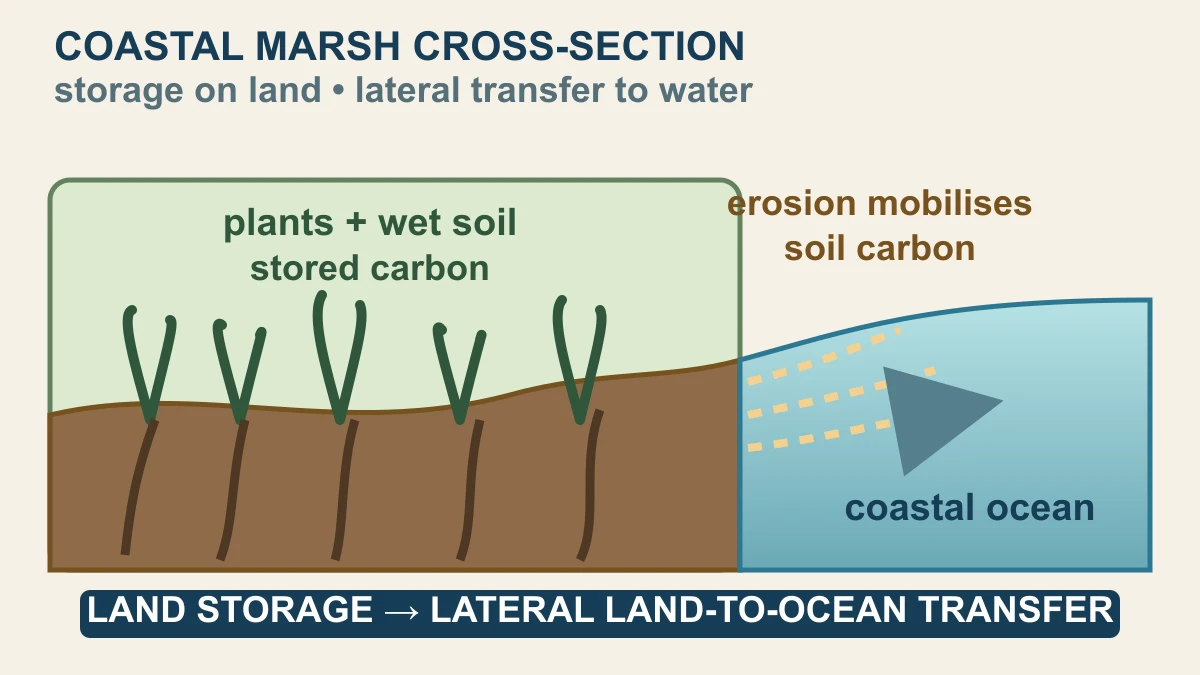
The short answer is that a coastal marsh can hold organic carbon in its living vegetation and wet soil, and erosion can move some of that stored material sideways into the coastal ocean. That changes where the carbon is and how scientists account for it. It does not, by itself, show that the same amount was released directly into the atmosphere. The central distinction is location: land storage, lateral transfer and air emission are related parts of a carbon cycle, not interchangeable labels.
NASA's current report puts the measurement in a defined place and time. The study followed marsh change from Texas to Maine along the U.S. Gulf Coast and Eastern Seaboard, using observations from 1985 through 2022. Coastal wetlands are shaped by storms, rising seas and human development, so the shoreline is not a fixed boundary around a permanent carbon store. A storm can tear out vegetation, a rising waterline can submerge a marsh edge, and gradual erosion can remove soil even when the change is less visually dramatic.
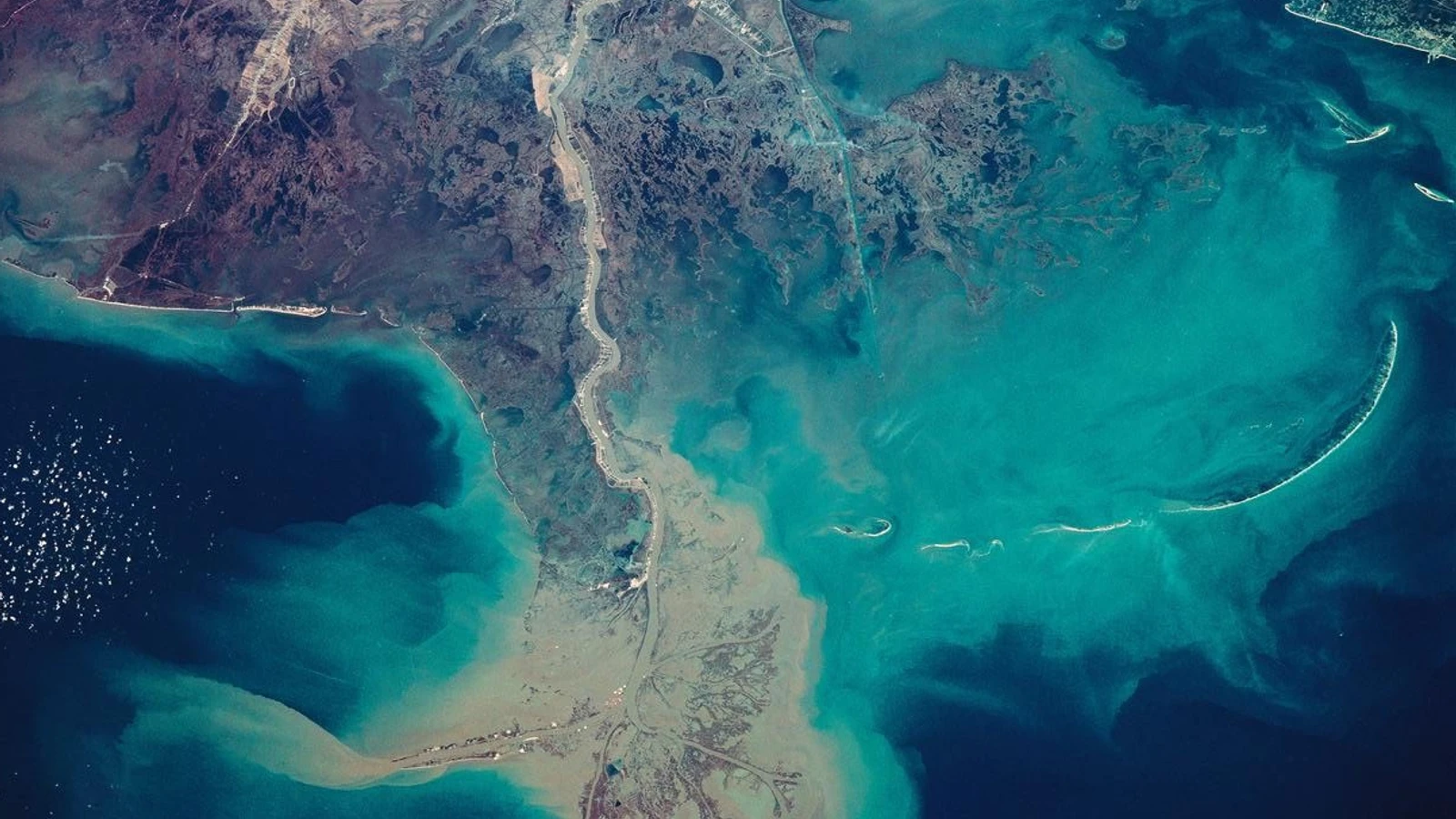
The hero image is a NASA photograph of the Mississippi River Delta taken by a space shuttle astronaut in January 1985. It is a documentary view of the landscape at one moment, not the study's complete time series and not a direct picture of carbon moving through the water. The useful question is what measurements can add to that view: which marsh areas changed, how much soil depth was displaced, how much carbon that soil contained, and how new marsh growth offset part of the loss.
How satellites and lidar reveal erosion
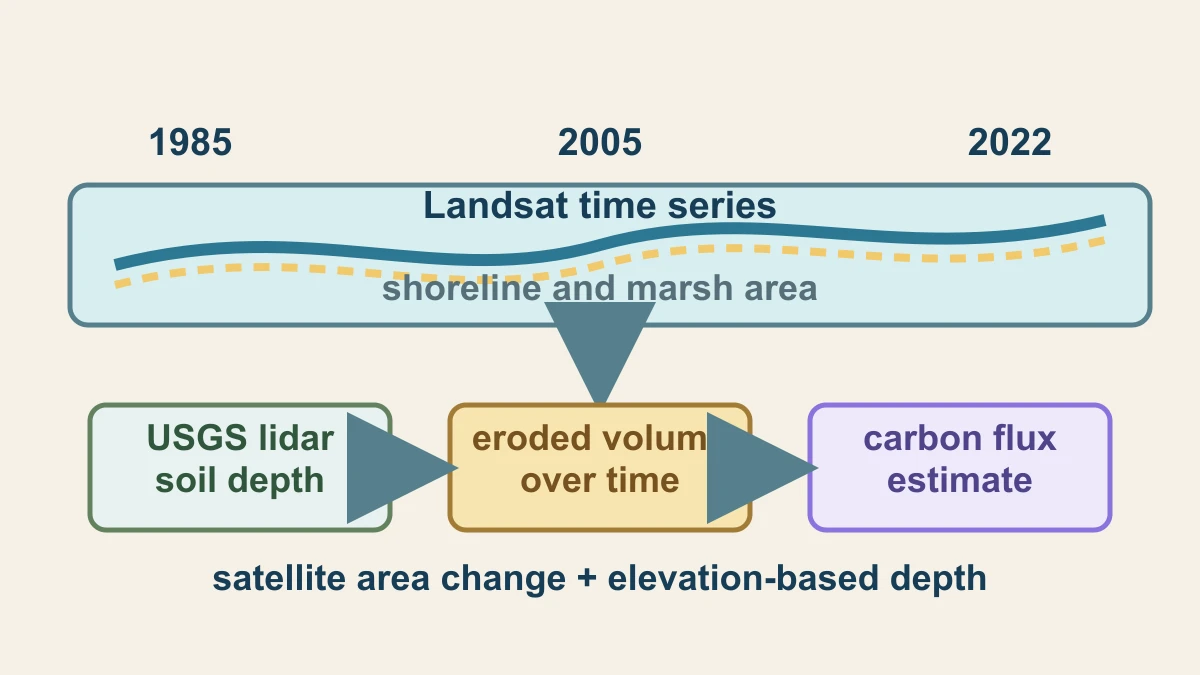
The study combines two kinds of evidence that answer different parts of the problem. Long-term Landsat observations show where wetland and marsh area changed across repeated satellite scenes. Elevation-based data from the U.S. Geological Survey help estimate the depth of soil affected by erosion. Together, those observations turn a changing outline into an estimate of eroded volume rather than relying on a single photograph or a visual impression of a retreating shoreline.
The underlying NASA Goddard Institute for Space Studies abstract describes the method as a combination of long-term satellite observations of wetland change and elevation-based estimates of eroded soil depth. It accounts for abrupt and gradual marsh erosion from 1985 to 2022, then compares the carbon mobilised by erosion with carbon burial in newly formed marshes. In other words, the calculation follows both sides of the accounting problem: carbon leaving older marsh and carbon being stored by new growth.
For the U.S. Atlantic and Gulf coasts, the study estimates that erosion mobilised 0.66 teragrams of carbon per year. A teragram is one trillion grams, but the unit is less important than the pathway: this is a lateral transfer of organic carbon, not a direct atmospheric measurement. The abstract gives a 68% confidence interval of 0.46 to 0.91 teragrams of carbon per year, a reminder that the number is an estimate with substantial uncertainty rather than a perfectly counted annual stream.
The rate also varies across places and years. NASA's report highlights increased erosion in the Mississippi River Delta after Hurricanes Katrina in 2005 and Ida in 2021, when storms uprooted and submerged miles of coastal vegetation. The Gulf region moved more coastal carbon than the entire Eastern Seaboard in the study's comparison. That pattern is a reason to preserve geography and time windows in the claim: a national average can hide very different local histories.
Why moving carbon is not the same as emitting it
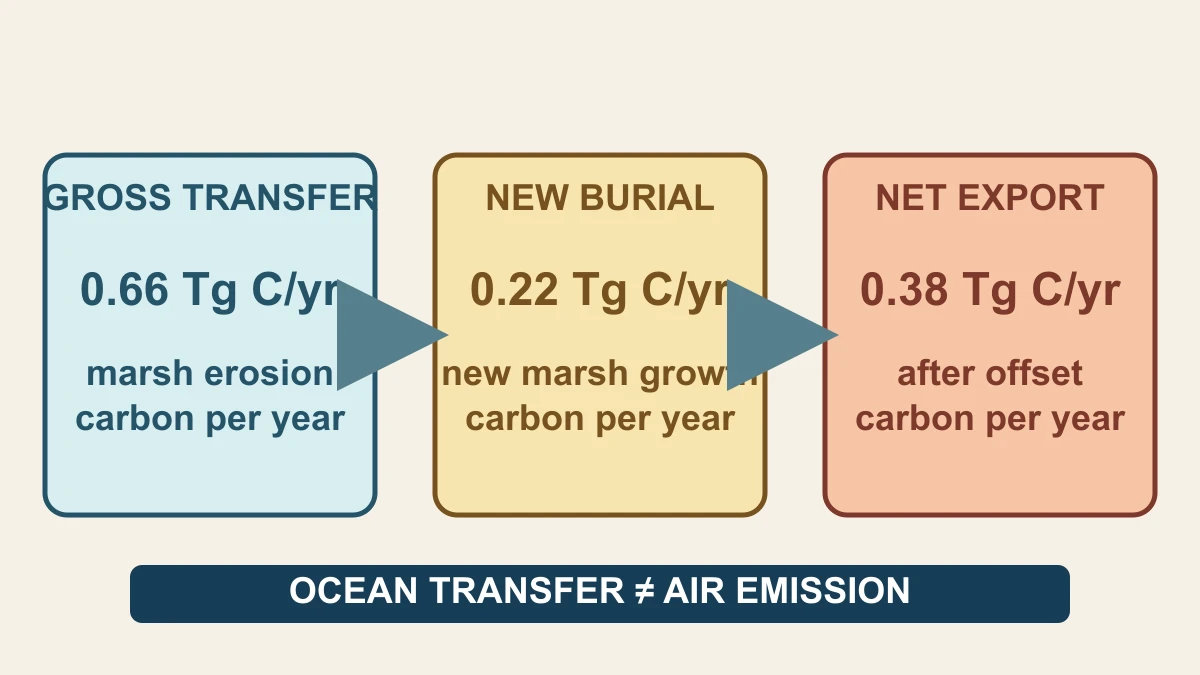
The next number is the offset. New marsh growth buried an estimated 0.22 teragrams of carbon per year, with a 68% confidence interval of 0.09 to 0.59 teragrams. Subtracting that burial from the gross erosion transfer gives a net export of about 0.38 teragrams of carbon per year. Gross transfer, new burial and net export therefore describe different stages of the same accounting exercise; they should not be collapsed into one dramatic figure.
NASA states the key boundary plainly: most carbon displaced by marsh erosion is not emitted directly into the atmosphere but enters the ocean. That does not make the ocean a final black box or prove that no later exchange with the atmosphere can occur. It means the study measures and models a land-to-sea pathway that is traditionally difficult to represent because shorelines keep changing under sea-level rise, wind, tides and marine life. Better coastal carbon models need that lateral movement included.
What is established is specific. The study uses satellite and elevation evidence to estimate carbon mobilised by erosion along the U.S. Atlantic and Gulf coasts over 1985–2022; it finds erosion exports more carbon than new marsh burial offsets; and it identifies lateral transfer as an important part of coastal carbon cycling. What is not proved by the headline number is an equal amount of direct air pollution, a global total for every marsh on Earth, or a single climate effect caused by one year's erosion. The careful conclusion is that losing a marsh can move carbon out of land storage and into coastal water—and that the fate of that carbon needs to remain visible in the accounting.
Sources and further reading
- NASA — NASA-Supported Study Tracks Carbon Cost of Coastal Erosion ↗
- NASA GISS — Net lateral carbon loss from eroding US Atlantic and Gulf Coast marshes ↗
- NASA Goddard Institute for Space Studies ↗
- NASA — NASA Scientists Map Global Salt Marsh Losses and Their Carbon Impact ↗
- NASA — Guidelines for using NASA Images and Media ↗
This article was written for Curiosity Desk. We do not copy other publishers or invent quotes. If a material error is found, we correct it openly.
Read the full standards →One answer should lead to a better question
Bring your curiosity to the group
Curious Minds is our public Facebook community for surprising science, strange history, Australian wildlife and everyday questions. No copied posts, no personal-friend invitations and no link dumping.
- Three self-contained discussion prompts each week
- Sourced answers and honest uncertainty
- Respectful conversation without spam