Power, heat and propulsion are different jobs
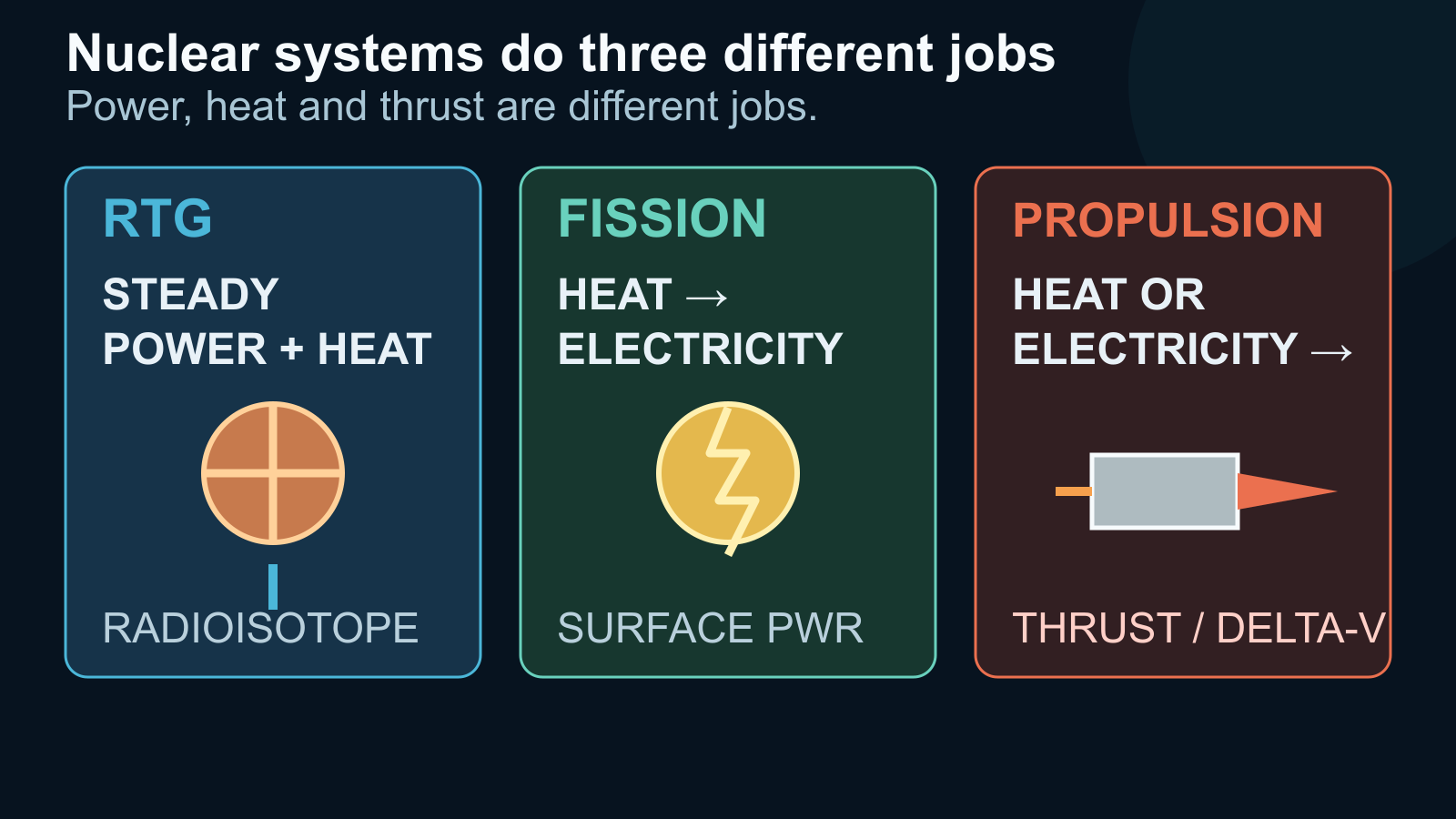
Nuclear power in space is not one magic engine. It is a family of systems that can supply electricity, keep hardware warm or turn heat into thrust. That distinction matters because a rover's radioisotope generator, a lunar fission power plant and a nuclear-electric propulsion stage solve different problems.
The common advantage is independence from changing sunlight. A radioisotope system can keep producing heat and electricity far from the Sun; a fission system can provide a larger, controllable heat source for power conversion or propulsion. But the energy source does not erase the rest of the spacecraft: radiators, shielding, propellant, control electronics and launch-safety procedures still determine what a mission can do.
So the defensible answer to the headline is conditional. Nuclear systems could let spacecraft operate longer or carry more power into difficult environments, and they could support propulsion methods with different thrust and efficiency trade-offs. NASA's current programme records those capabilities as development goals and demonstrations—not as a universal shortcut to any destination.
How radioisotope systems keep spacecraft alive
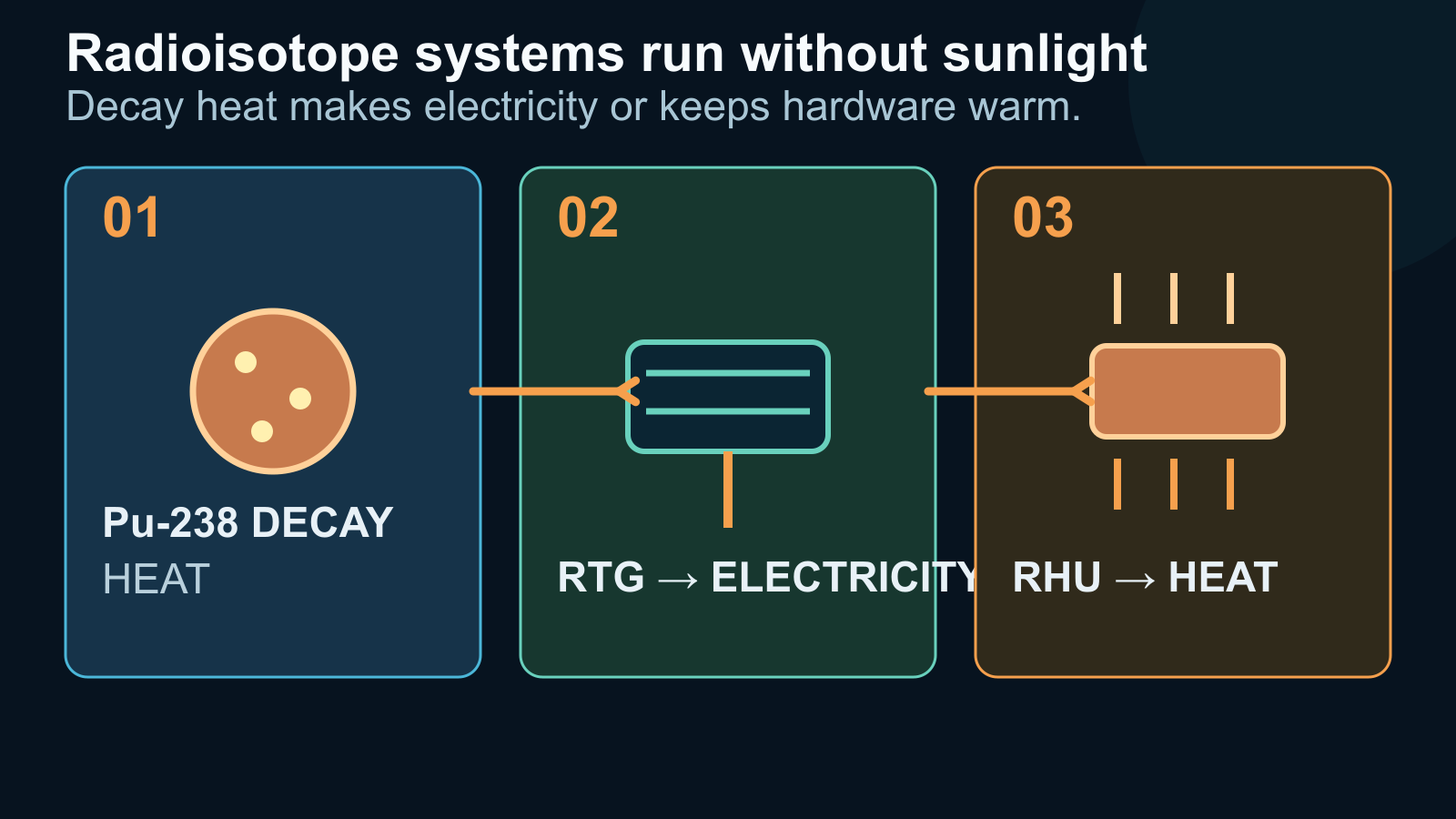
Radioisotope power systems are the most established nuclear technology in NASA's spaceflight record. An RTG converts heat from the natural radioactive decay of plutonium-238 into electricity with thermocouples, while a radioisotope heater unit uses a smaller heat source to keep structures and instruments above damaging temperatures. Neither system needs a reactor to be switched on in orbit.
That steady output is useful when sunlight is weak, intermittent or blocked by a dusty environment. NASA describes MMRTGs powering the Curiosity and Perseverance rovers and RPS units supporting missions across the solar system. The system produces modest power compared with a large fission reactor, but it can operate for years without refuelling and also supplies heat that a cold spacecraft would otherwise need to create separately.
An RTG is therefore not a nuclear propulsion engine. It can power a spacecraft's computers, instruments and communications, but the article must not turn that electricity into an implied high-thrust capability. The next step toward larger power levels is a different engineering route: fission heat converted into electricity, with the additional mass, thermal management and safety work that entails.
How fission can turn heat into electricity or thrust
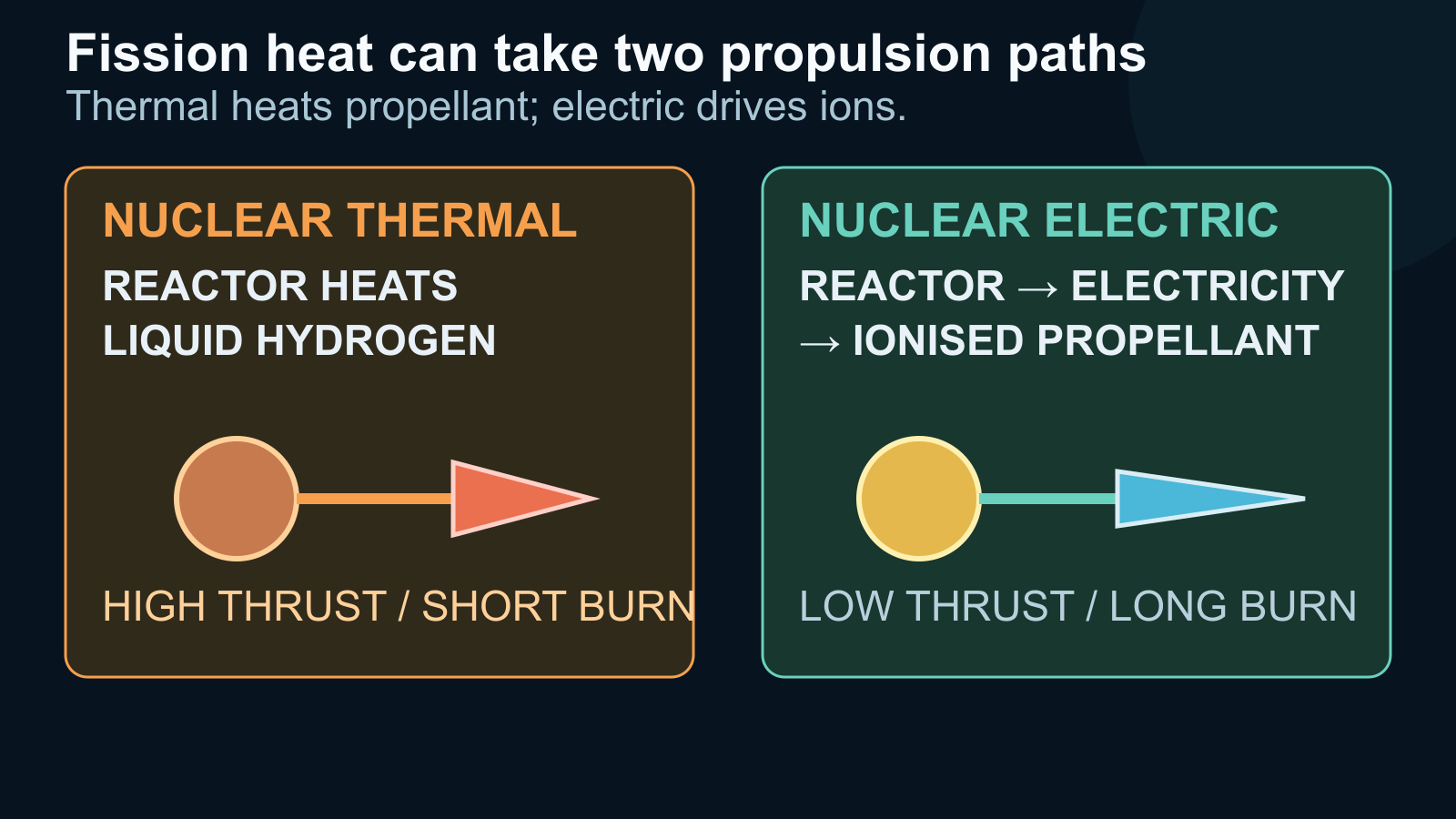
NASA describes two fission-based propulsion paths. In nuclear-thermal propulsion, a reactor heats a liquid propellant directly; the hot gas expands through a nozzle and produces relatively high thrust with better propellant efficiency than a chemical rocket. In nuclear-electric propulsion, the reactor's heat first becomes electricity, and that electricity powers a thruster that ionises and accelerates propellant.
The trade-off is not simply fast versus slow. Nuclear thermal is attractive when a mission needs a stronger push for a major manoeuvre. Nuclear electric provides lower thrust but can keep accelerating for much longer, using propellant efficiently. A real mission would also need power conversion, heat rejection, propellant storage, guidance, communications and a safety case that fits the launch and operating environment.
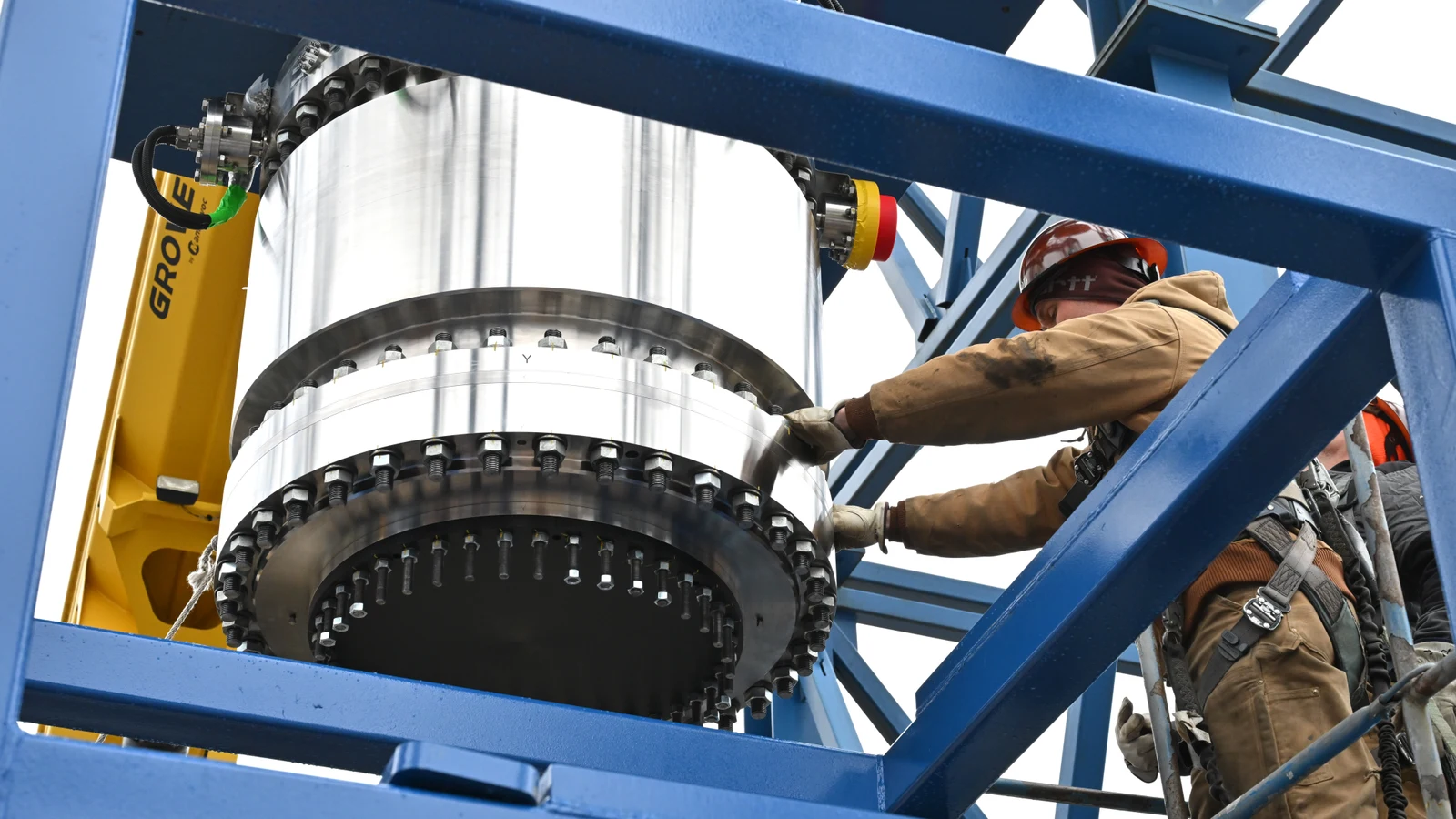
NASA's 2026 test record is a useful boundary: the agency describes a full-scale, non-nuclear, flight-like engineering development unit used for cold-flow testing of nuclear-thermal propulsion. That is meaningful hardware and fluid-flow evidence, but it is not a reactor operating in space. Likewise, a propulsion concept's calculated efficiency is not a measured trip time or a guarantee that every deep-space mission would benefit.
What NASA's current programme establishes—and what it does not prove
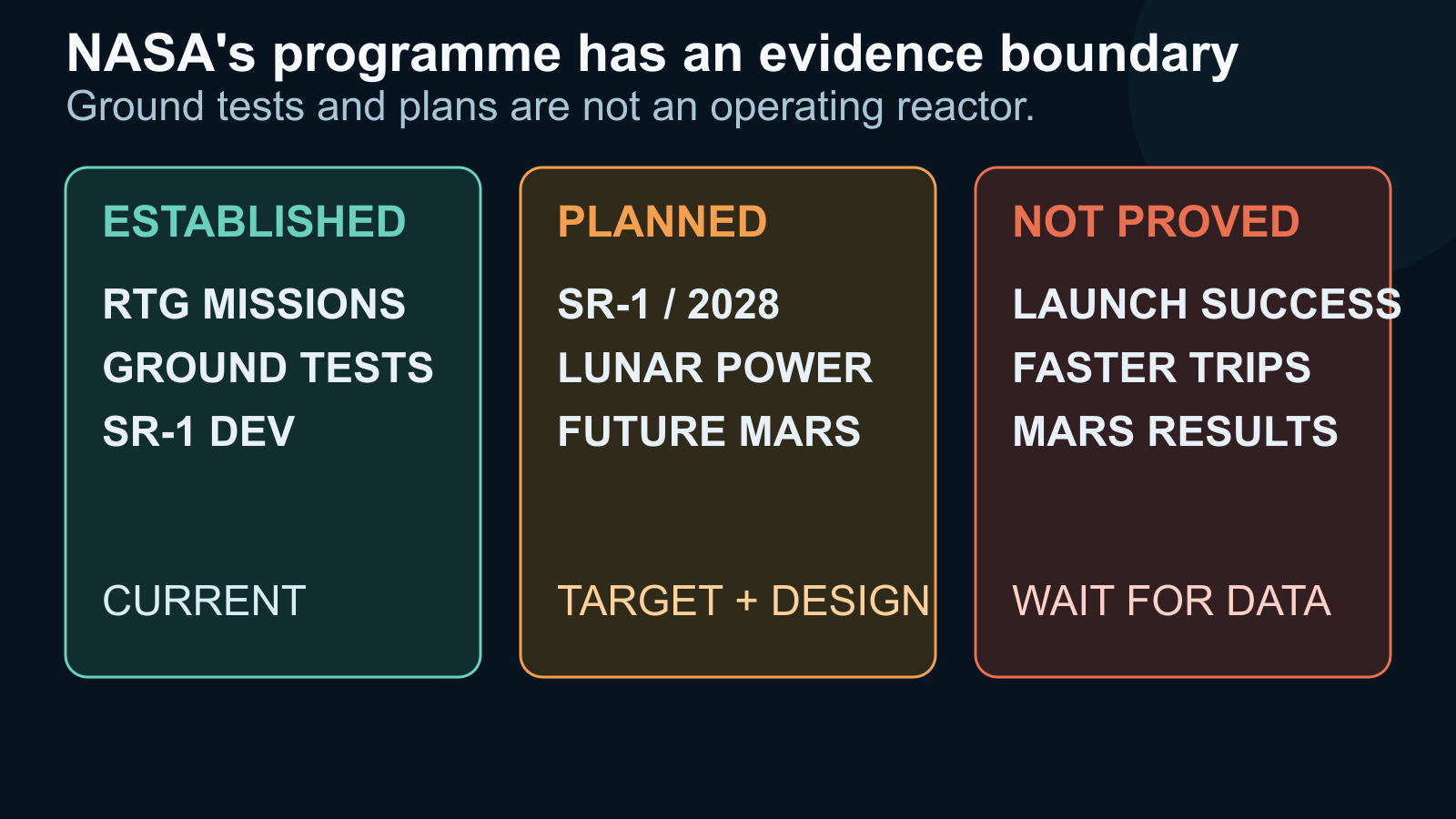
NASA and the Department of Energy's October 2026 memorandum establishes a framework for collaboration across research, fuel production, testing, launch integration and operations. NASA's current SR-1 Freedom record describes a planned late-2028 mission intended to demonstrate nuclear-electric propulsion beyond Earth orbit. Its reactor is designed to remain inactive until the spacecraft has left Earth orbit, and the agency describes safety reviews and regulatory compliance as part of the development.
NASA also describes a 10-kilowatt-class fission surface-power system for the Moon as a design, fabrication and test effort, building on the earlier KRUSTY ground experiment. These are important programme commitments and technical milestones. They do not establish that a reactor has launched, that SR-1 will meet its target date, that a lunar base will operate through darkness or that a future Mars mission will be faster, cheaper or more capable.
The honest frontier story is the chain between those states. Ground tests can reduce uncertainty; a flight demonstration can show how a system behaves in space; later missions can establish operational value. Until those steps occur, nuclear power and propulsion are best described as a set of evidence-backed routes with different jobs, promising trade-offs and a very clear boundary around what has not yet been proved.
Sources and further reading
- NASA — Nuclear-Powered Exploration Memorandum announcement ↗
- NASA — Space Nuclear Propulsion ↗
- NASA Science — Radioisotope Power Systems technology overview ↗
- NASA — Fission Surface Power ↗
- NASA Glenn — SR-1 Freedom nuclear power module progress ↗
- NASA — Testing advances space nuclear propulsion capabilities ↗
- NASA Office of Safety and Mission Assurance — Nuclear Flight Safety ↗
- NASA Images and Media Guidelines ↗
This article was written for Curiosity Desk. We do not copy other publishers or invent quotes. If a material error is found, we correct it openly.
Read the full standards →One answer should lead to a better question
Bring your curiosity to the group
Curious Minds is our public Facebook community for surprising science, strange history, Australian wildlife and everyday questions. No copied posts, no personal-friend invitations and no link dumping.
- Three self-contained discussion prompts each week
- Sourced answers and honest uncertainty
- Respectful conversation without spam