Two spacecraft turn one pass into a time comparison
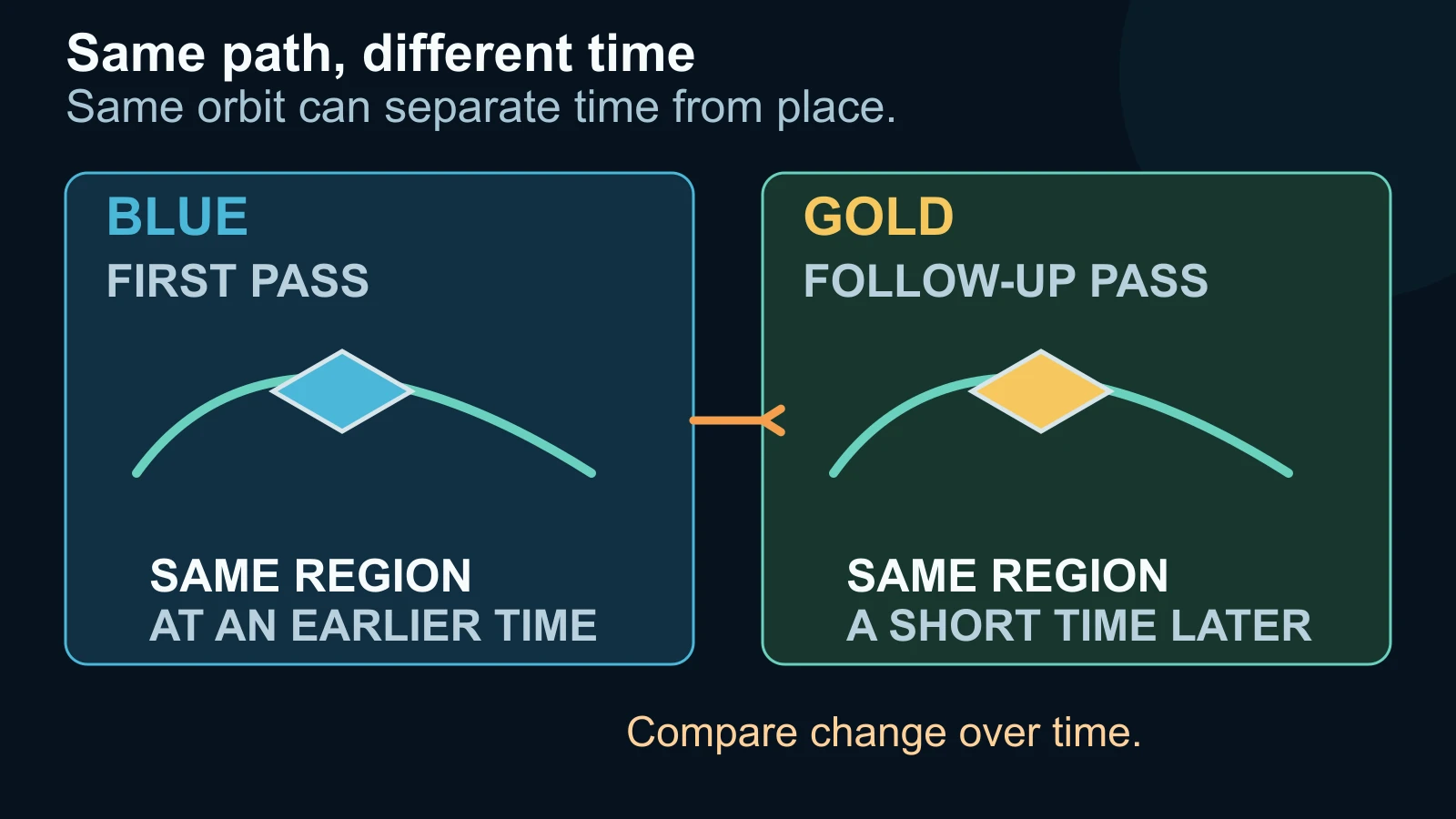
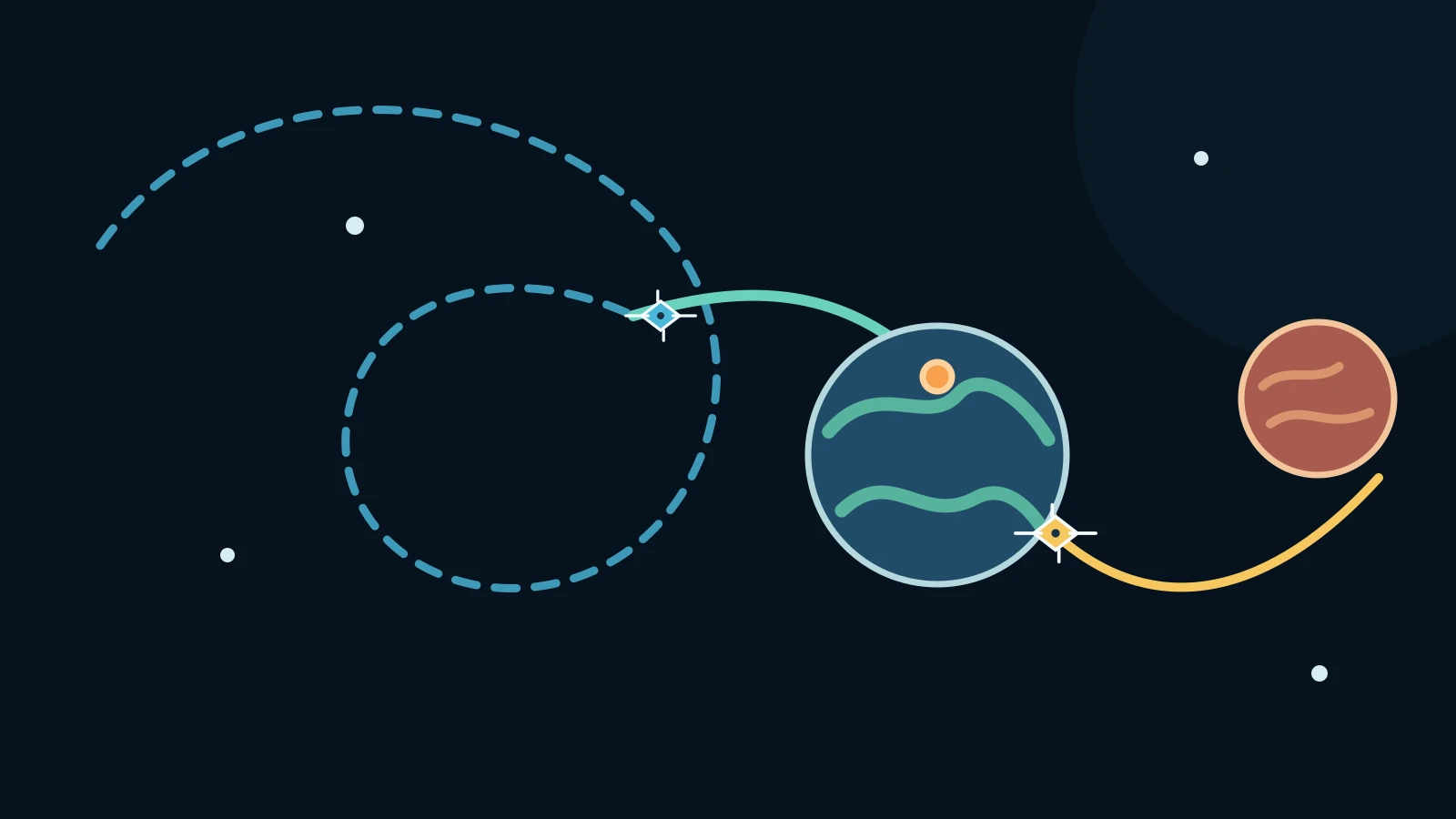
ESCAPADE's central trick is to fly two matching spacecraft instead of asking one spacecraft to explain every change on its own. In the first planned Mars campaign, Blue and Gold will follow nearly the same orbit, one behind the other. When the second spacecraft crosses a region shortly after the first, the pair can compare a later reading with an earlier reading from nearly the same path.
That comparison helps separate two effects that are easy to confuse. A measurement can change because the space environment itself changed, or because a spacecraft moved into a different part of it. A short-delay repeat pass does not solve that problem by magic, but it gives scientists a controlled time comparison that a lone orbiter cannot provide in the same way.
NASA describes the first formation as a string of pearls, with the follow distance varied over the campaign. The useful result is not simply two copies of the same number. It is a pair of measurements whose timing and location can be placed into a physical model of Mars' magnetic environment.
What the instruments measure around Mars
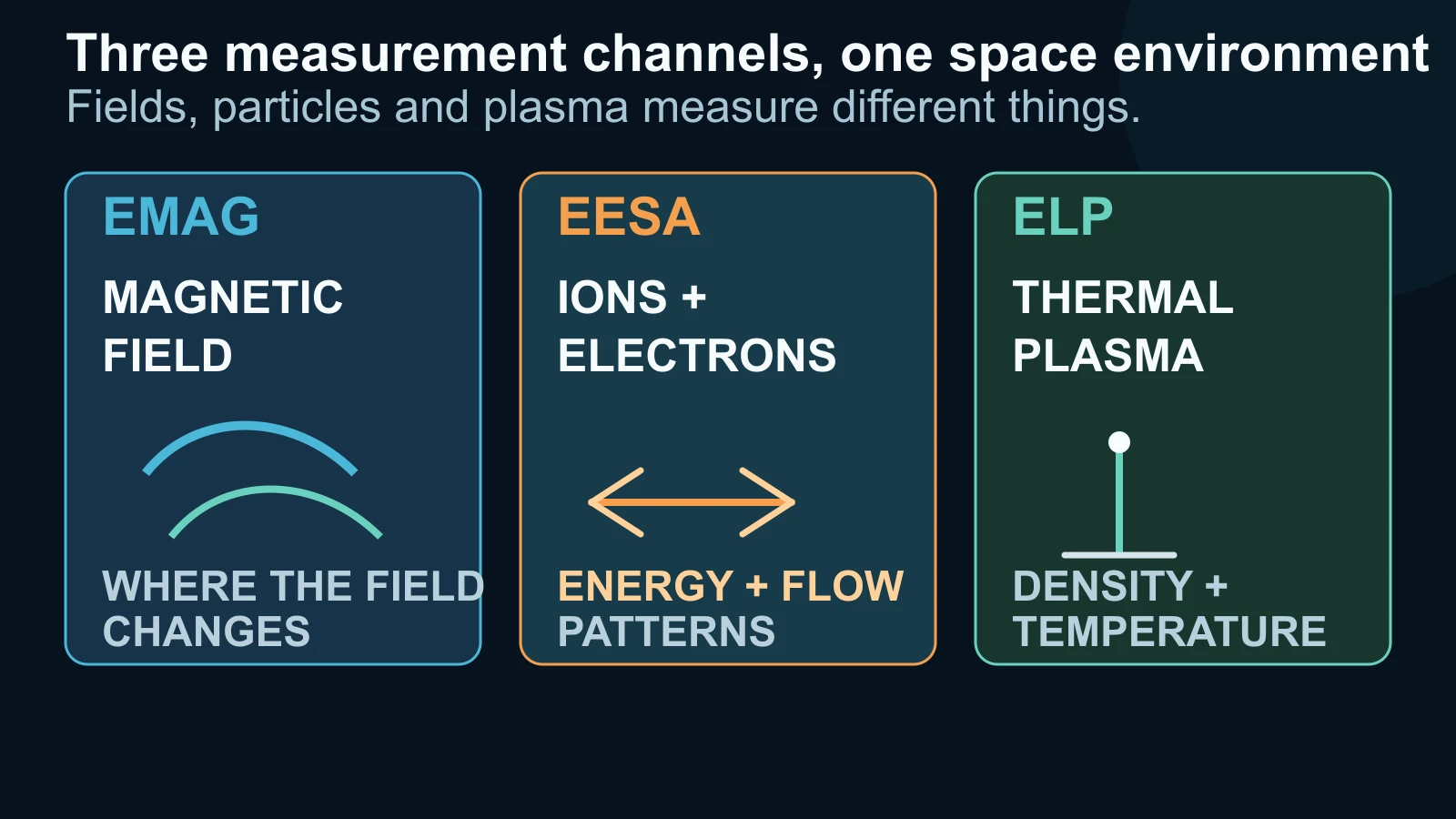
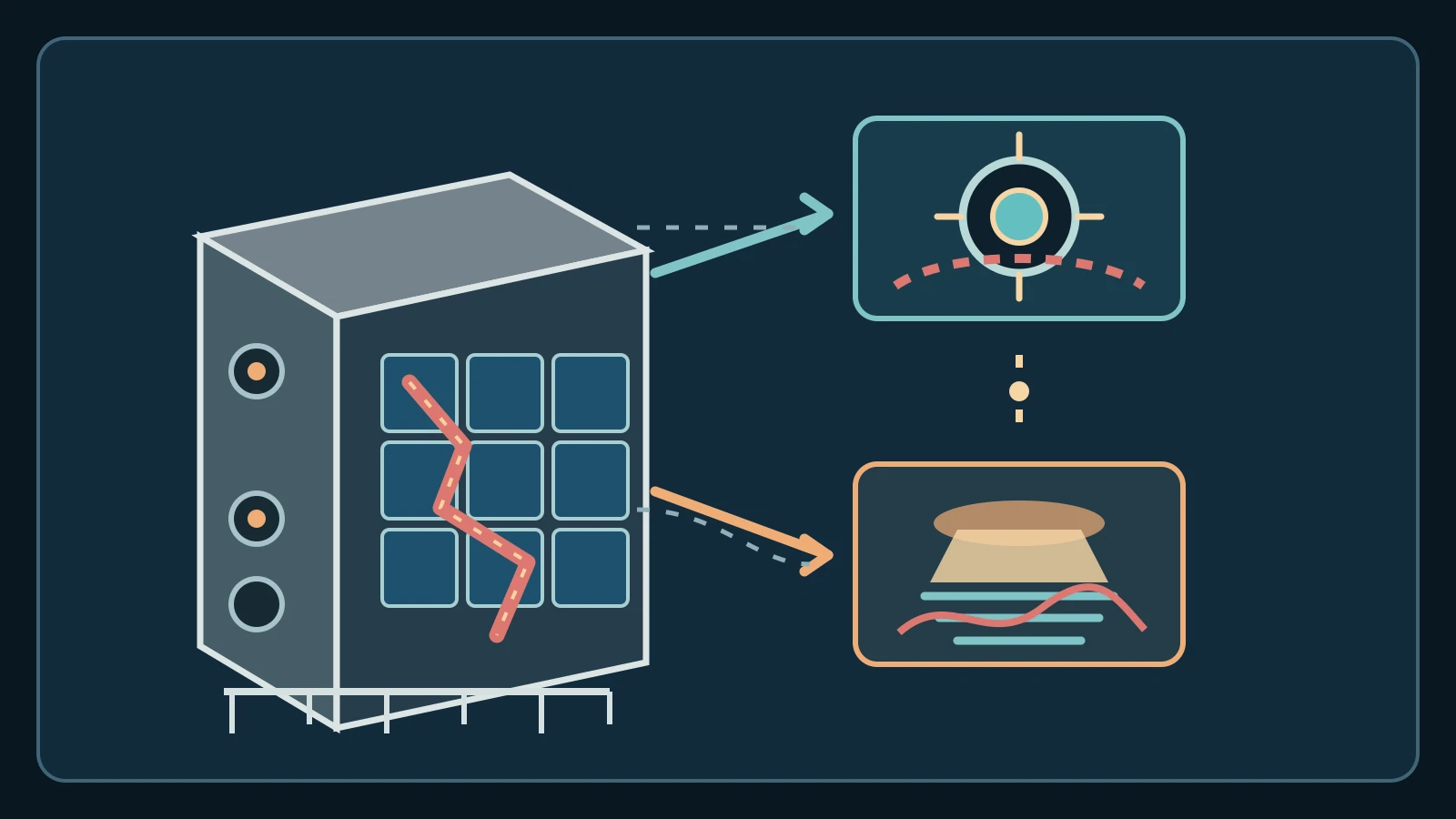
The twin spacecraft carry complementary plasma instruments. EMAG measures the ambient magnetic field from the end of a two-metre boom. EESA separates the behaviour of suprathermal ions and electrons, while the ELP probes the thermal plasma around the spacecraft. Together, those channels describe the fields, particles and local plasma conditions that shape the Martian space environment.
Each measurement answers a different part of the question. A magnetometer tells scientists how the field is oriented and how strong it is. An electrostatic analyser samples the energy and direction of particles. A Langmuir probe helps characterise the lower-energy plasma. The point is not that one instrument photographs atmospheric escape; it is that the combined readings can reveal how energy and particles move through the regions where escape occurs.
NASA also lists visible and infrared cameras as student instruments. Those cameras add context about the spacecraft's surroundings and Mars observations, but the core space-weather explanation rests on synchronised fields and plasma measurements that can be compared across both spacecraft and their planned formations.
Same orbit versus complementary orbits
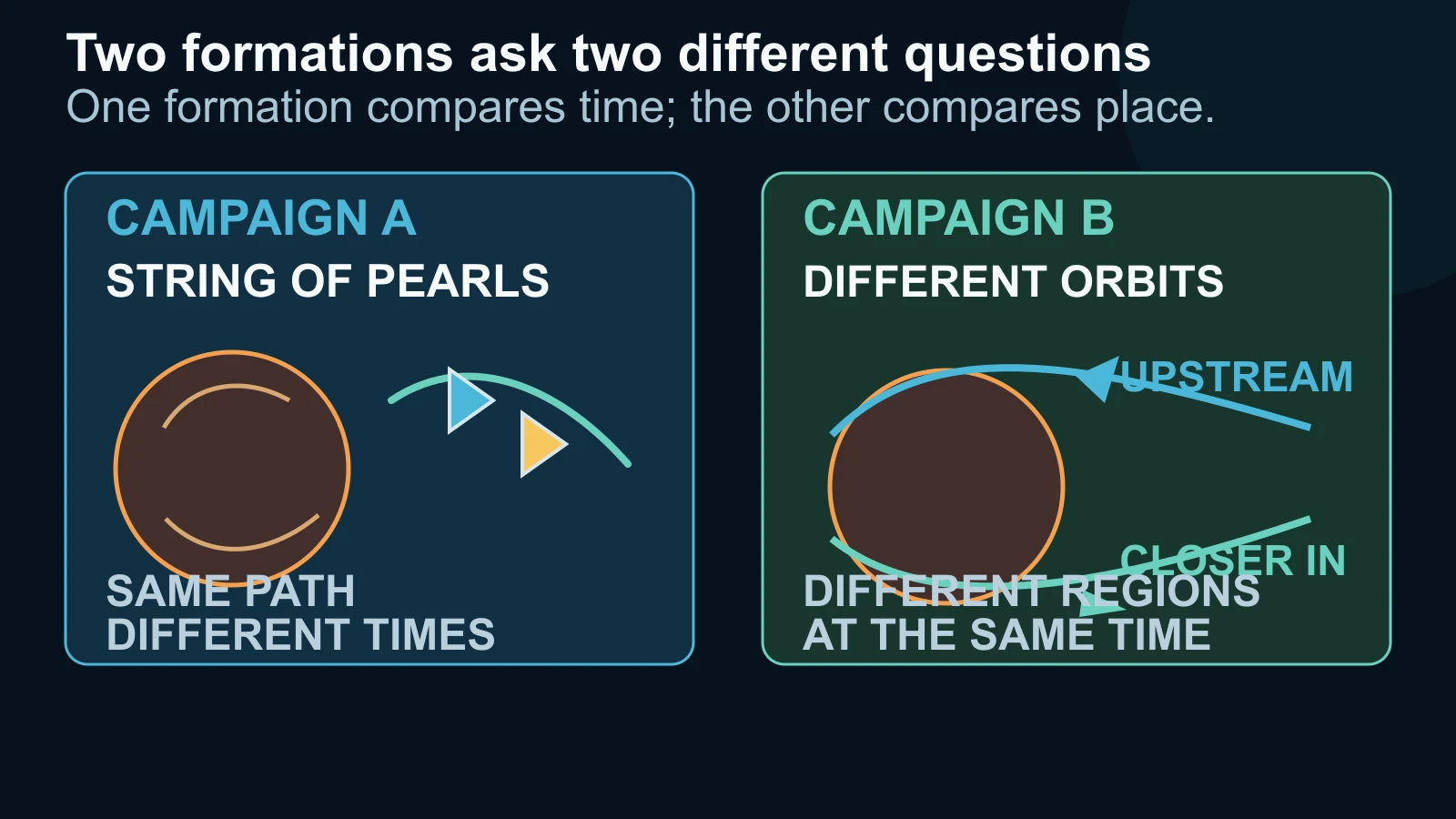
The second planned campaign changes the geometry. Instead of following one another through nearly the same path, the two spacecraft will occupy different orbits: one can sample the incoming solar wind farther from Mars while the other measures the planet's response closer in. The pair then observes different parts of the system at the same time.
That is a different comparison from the first campaign. Campaign A is strongest for asking whether a region changed over a short interval. Campaign B is designed to put a possible driver and response into view together, so scientists can compare solar-wind conditions with the magnetic and plasma environment nearer Mars.
The formations are planned science strategies, not completed discoveries. Orbit insertion, orbit adjustment, instrument pointing, calibration and the actual solar-wind conditions will determine what the data can support. ESCAPADE can improve the evidence for a process without making every proposed explanation true.
What ESCAPADE has shown—and what Mars science still awaits
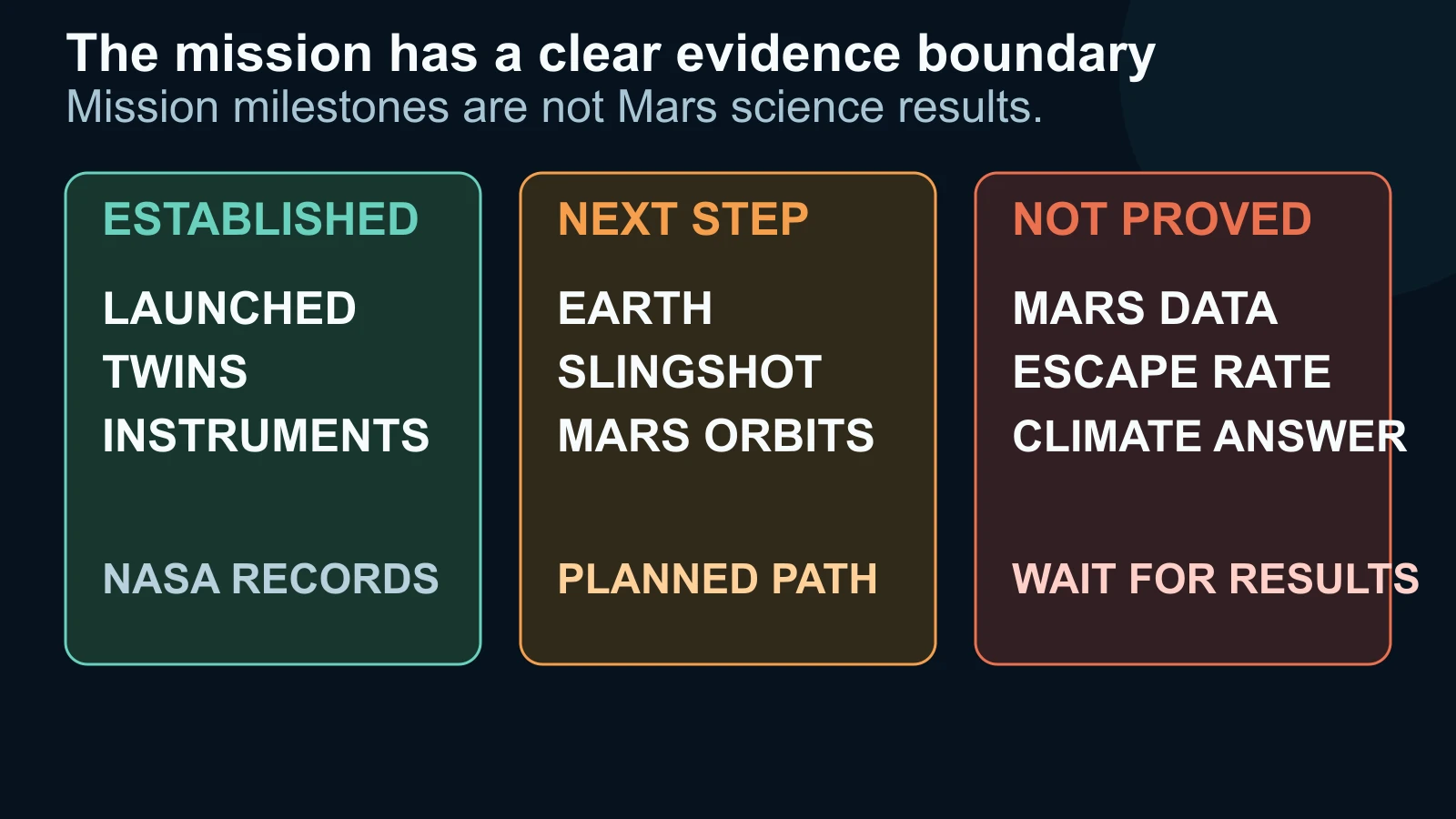
The current evidence establishes that ESCAPADE launched on 13 November 2025 and that NASA reported all of its science instruments operating by 25 February 2026. The spacecraft were still using a long Earth-proximity or loiter trajectory while waiting for the next useful Earth–Mars alignment. Those are important mission milestones, but they are not Mars-orbit measurements.
NASA's current plan has the spacecraft return near Earth for a gravity assist in November 2026, cruise to Mars and arrive in September 2027. The mission page places the final transition into nearly matching science orbits around mid-2028. Dates and formations can change; the result that matters is the returned, calibrated data.
So the honest answer to the headline is a method, not a result. ESCAPADE will compare the same region at different times, then compare different regions at the same time, using magnetic-field and plasma instruments that make the interaction measurable. What it has not yet shown is how much atmosphere Mars is losing in any particular event, or which complete climate-history explanation the future data will support.
Sources and further reading
- NASA Science — ESCAPADE mission ↗
- NASA Science — ESCAPADE Ready to Study Space Weather from Earth to Mars ↗
- JPL/NASA — ESCAPE, PLASMA AND ACCELERATION DYNAMICS EXPLORERS mission-design paper ↗
- ESCAPADE — Instruments ↗
- ESCAPADE — EMAG magnetometer ↗
- ESCAPADE — EESA electrostatic analyzers ↗
- ESCAPADE — ELP Langmuir probe ↗
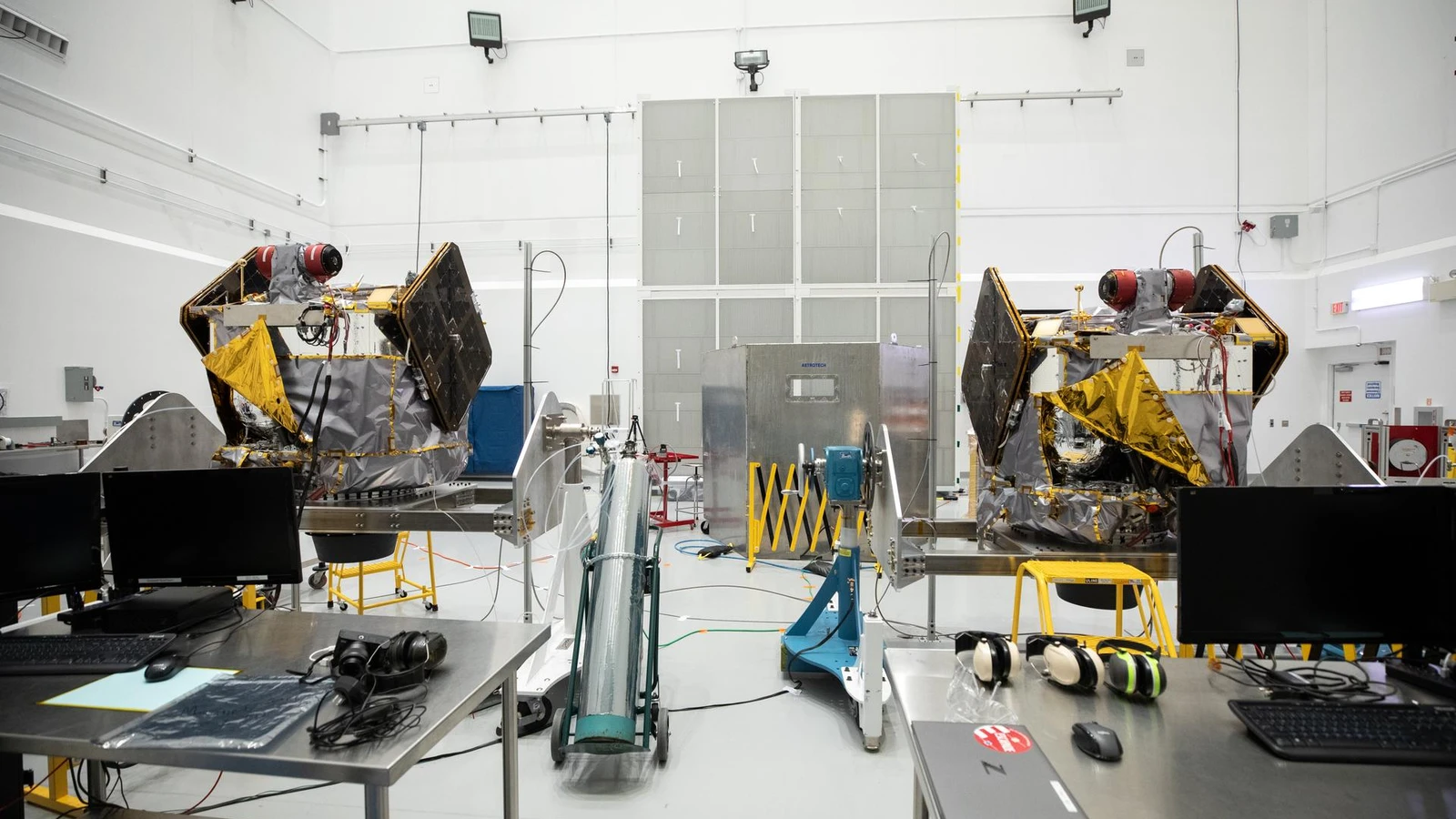
- NASA Image and Video Library — ESCAPADE Unboxed at Astrotech ↗
- NASA Images and Media Guidelines ↗
This article was written for Curiosity Desk. We do not copy other publishers or invent quotes. If a material error is found, we correct it openly.
Read the full standards →One answer should lead to a better question
Bring your curiosity to the group
Curious Minds is our public Facebook community for surprising science, strange history, Australian wildlife and everyday questions. No copied posts, no personal-friend invitations and no link dumping.
- Three self-contained discussion prompts each week
- Sourced answers and honest uncertainty
- Respectful conversation without spam