The Florida invasion at a glance
What scientists can say with confidence
- Origin
- The exotic-pet trade, followed by intentional or accidental releases
- Breeding population confirmed
- Everglades National Park in 2000
- Established core
- Much of southern Florida and the Greater Everglades ecosystem
- Known prey
- At least 76 prey species identified in digestive-tract records reviewed by USGS
- Why counts are uncertain
- Pythons are cryptic, sparsely detected and spread through difficult wetland habitat
- Current outlook
- Landscape-scale eradication is not possible with existing tools, according to the USGS synthesis
- Risk to people
- Low, but not zero; wild snakes should never be approached or handled
- Report in Florida
- Use IveGot1.org or call 1-888-IVE-GOT1
The confirmed range is a best professional estimate. It is not a fence around every python, and isolated records do not automatically mark a self-sustaining population.
The map has a solid centre and a blurry edge
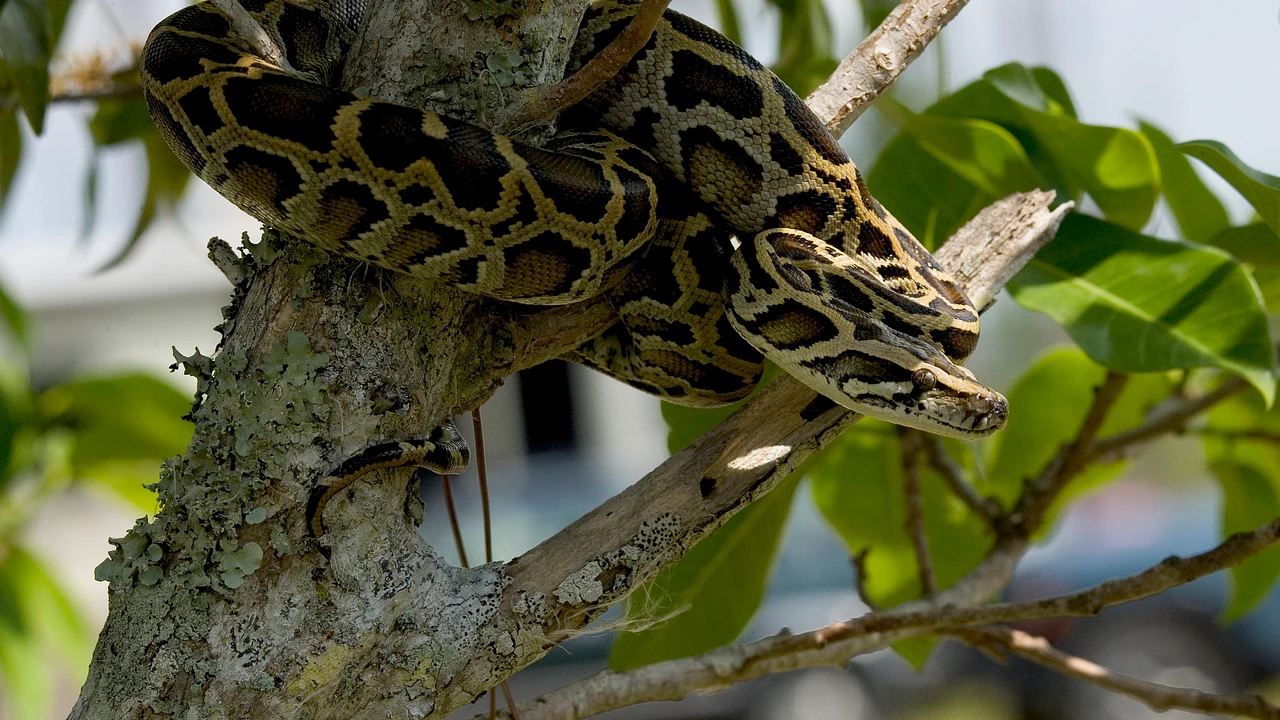
Burmese pythons are no longer occasional escaped pets in Florida. A reproducing population was confirmed in Everglades National Park in 2000, and the snakes are now established across much of the Greater Everglades and southern Florida. That core finding is supported by decades of captures, nests, tracking and field observations.
The outer boundary is less certain. A python can travel, be released or appear far from the main population without proving that a breeding group exists around that sighting. Scientists therefore describe an estimated invasion front rather than drawing one exact line. The most responsible answer to how far the snakes have spread must separate the established core, the estimated front and isolated records.
A giant snake can still be almost invisible
Burmese pythons can grow to extraordinary lengths, yet size does not make them easy to survey. Their brown pattern breaks up the outline of the body among water, sawgrass, roots and leaf litter. They may remain still for long periods, travel through vegetation that is difficult for people to enter and spend time where even experienced observers have a poor view.
That creates a detection problem. A field team can search a place, see no python and still be unable to conclude that none are present. When an animal is rare at an invasion front, the chance of missing it becomes even higher. Each blank survey result contains less information than it would for a loud, brightly coloured or easily trapped species.
Nobody has a reliable total population number
Online estimates are often repeated as if Florida's pythons had been counted from the air. They have not. A reliable estimate would require researchers to know the relationship between the snakes they detect and the much larger number they miss across a vast, changing wetland. The very traits that make the invasion difficult to control also make that relationship difficult to calculate.
Removal totals are useful records of effort, but they are not a census. More captures can mean more snakes, more trained searchers, better access, different weather or a larger programme. Fewer captures can mean fewer snakes or simply worse detection. Without accounting for effort and detectability, a capture count cannot reveal the population hiding behind it.
Environmental DNA can find a trace, not draw the whole range
One promising method looks for environmental DNA, or eDNA. Animals shed tiny biological traces into their surroundings. Researchers can collect water, test it for Burmese-python genetic material and use a positive result as evidence that a python may have recently occupied the connected environment.
The method is not a magic snake radar. A python may shed too little DNA, the sample may miss the right patch of water and substances in the Everglades can interfere with detection. Water also moves, so a trace does not provide the same information as a captured animal at a precise point. USGS research treats eDNA as another useful line of evidence, particularly around canals and waterways, not a complete substitute for field surveys.
Twenty years of transmitters reveal what ordinary searches miss
Radio telemetry lets researchers follow an individual that has already been captured and fitted with a transmitter. A USGS dataset released in June 2026 brings together work from 2005 through 2024 involving 305 transmitter implantations in 142 wild adult Burmese pythons in southern Florida. The project gives scientists repeated information about movement, habitat use and breeding behaviour that a chance sighting cannot provide.
The implants were retained in 98.7 percent of the documented cases, with expulsion recorded in 1.3 percent. That detail matters because a lost transmitter can look like a motionless snake. Long-running telemetry also explains why one tagged animal can be more informative than many unverified reports: it shows where the snake actually travels over time rather than where someone happened to notice it once.
The pet trade is the origin; the hurricane story is not settled history
Burmese pythons reached Florida through the exotic-pet trade. Captive snakes were intentionally or accidentally released, and enough survived to reproduce. Hurricane Andrew is often presented online as the single moment that created the invasion by destroying an animal facility in 1992.
USGS scientists describe that hurricane explanation as debated rather than proven. The first presumed Burmese python in Everglades National Park was recorded in 1979, well before Andrew. A storm may have released some captive animals, but the available evidence does not reduce decades of pet ownership, escapes and releases to one dramatic event.
The ecological damage is measured in missing mammals
Burmese pythons eat a wide range of birds, mammals and reptiles. A major USGS scientific synthesis reported 76 prey species identified from digestive tracts. Their ability to take many kinds of prey helps the snakes survive in different parts of the wetland and means the effect is not limited to one vulnerable animal.
Research has linked the python expansion in the Everglades with severe declines in several mammal populations. Correlation alone must be handled carefully because wetlands change for many reasons, but diet evidence, field patterns and experimental work point in the same direction: invasive python predation is an important ecosystem pressure. Removing one predator can also change food webs in ways that spread beyond the prey it directly consumes.
A male python can become an unwilling field guide
One targeted technique is sometimes called the Judas-snake approach. Researchers fit an adult male with a transmitter and follow him during the breeding season. If he leads them to a female, removing that female may prevent a large clutch of eggs and provide access to other snakes gathered in the same area.
The method is clever, but it is labour-intensive. A tagged male must first be found, captured, examined, implanted, released and tracked. It works best as a targeted tool rather than a landscape-wide answer. Detector dogs, visual searches, traps, public reports and other technologies each add information, but none currently finds every python.
Why complete eradication is not a realistic current promise
The 2023 USGS synthesis concluded that eradication across the invaded landscape is not possible with existing tools. That is not the same as saying removal is pointless. Programmes can protect sensitive locations, remove breeding animals, test better detection methods and slow expansion while researchers learn which combinations deliver the greatest ecological benefit.
A credible control goal must match the geography. Eliminating a newly found pocket near an invasion front is a different problem from finding every snake across the Greater Everglades. Public challenges can train participants and remove animals, but the result should be measured as targeted control and useful effort, not proof that a short event has solved the population problem.
Canals may be pathways as well as places to look
Florida's canals connect habitats that would otherwise be separated by roads, farms and developed land. USGS researchers are studying whether these waterways act as movement corridors and whether water sampling can help detect snakes near the edge of the known range.
Climate and habitat still limit where a population can establish, and a python found beside a canal has not necessarily travelled the entire waterway. The important point is that invasion maps cannot be interpreted only as snakes crawling over dry ground. Wetland connections, human transport and new releases can all complicate the direction and speed of spread.
The risk to people is low, but distance still matters
USGS has assessed the risk of an unprovoked Burmese-python attack on people in the Everglades as low, though not zero. These are powerful wild constrictors, and a low statistical risk is not an invitation to approach, corner or handle one. The National Park Service advises visitors to remain roughly 15 to 20 feet away.
A visitor who sees a python should note the location from a safe distance and report it rather than attempting a dramatic capture. Florida's reporting system is IveGot1.org, with the phone number 1-888-IVE-GOT1. Accurate photographs and locations can help managers, but personal safety, road safety and park rules come first.
The honest answer is a range of certainty
Florida's Burmese-python story is sometimes told as a choice between panic and denial. The evidence supports neither. The snakes have caused serious ecological damage and are established across a very large southern-Florida landscape. At the same time, a photograph from a new county is not enough to declare that the entire state now has a breeding population.
Scientists are improving the picture by combining captures, telemetry, eDNA, reproductive evidence and public reports. The map will keep changing as those lines of evidence accumulate. For now, the key mystery is not how a large snake could be overlooked once. It is how an animal that is so difficult to detect can be measured and controlled across millions of connected acres.
Sources and further reading
- USGS: Burmese pythons in Florida, a synthesis of biology, impacts and management tools ↗
- USGS: Comprehensive review of Burmese python science and management ↗
- USGS: Environmental DNA surveys for Burmese pythons ↗
- USGS: Twenty years of transmitter observations in wild adult Burmese pythons ↗
- National Park Service: Burmese pythons in Everglades National Park ↗
- National Park Service: The first recorded python in Everglades National Park ↗
- USGS: Burmese pythons pose little risk to people in the Everglades ↗
This article was written for Curiosity Desk. We do not copy other publishers or invent quotes. If a material error is found, we correct it openly.
Read the full standards →One answer should lead to a better question
Bring your curiosity to the group
Curious Minds is our public Facebook community for surprising science, strange history, Australian wildlife and everyday questions. No copied posts, no personal-friend invitations and no link dumping.
- Three self-contained discussion prompts each week
- Sourced answers and honest uncertainty
- Respectful conversation without spam