What the alert system had to predict
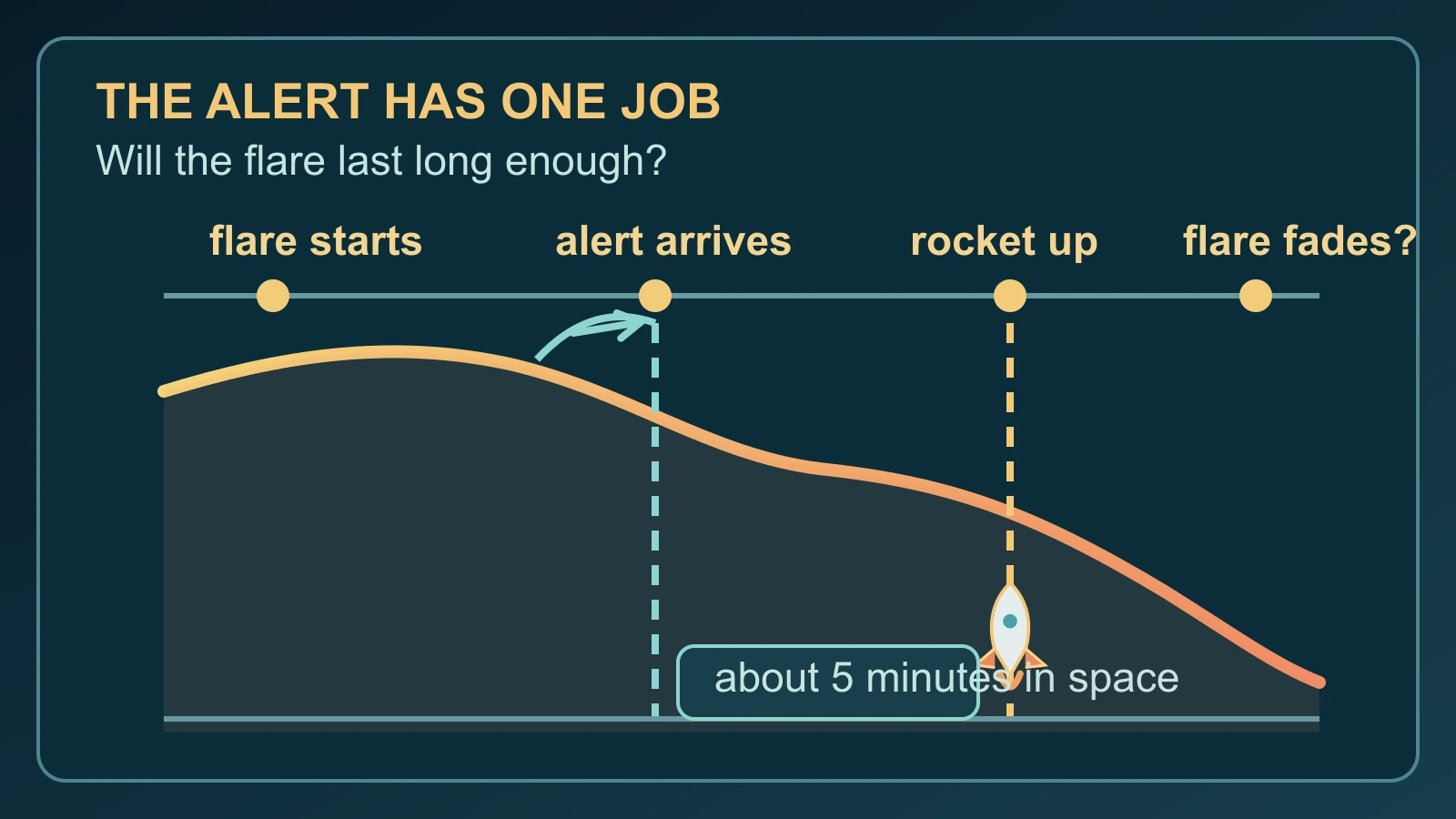
A sounding rocket can reach space quickly, but its useful observing window is brief: NASA says the flight has about five minutes before the rocket falls back through the atmosphere. A normal flare alert can say that a flare has started; it cannot necessarily say whether that flare will still be visible when the payload is above the atmosphere.
That is the gap this system was built to close. The primary paper describes a real-time early alert system that uses low-latency solar measurements to establish when a large flare is imminent, estimate its remaining duration and identify its location. Those are launch-decision inputs, not a promise that every flare can be forecast perfectly.
The first operational test was NASA's April 2024 coordinated campaign at Poker Flat in Alaska. FOXSI-4 and Hi-C Flare used the alert to trigger a launch toward a long-duration M-class flare, giving the teams a chance to observe an event while it was still in progress.
How X-ray and ultraviolet observations locate and time a flare
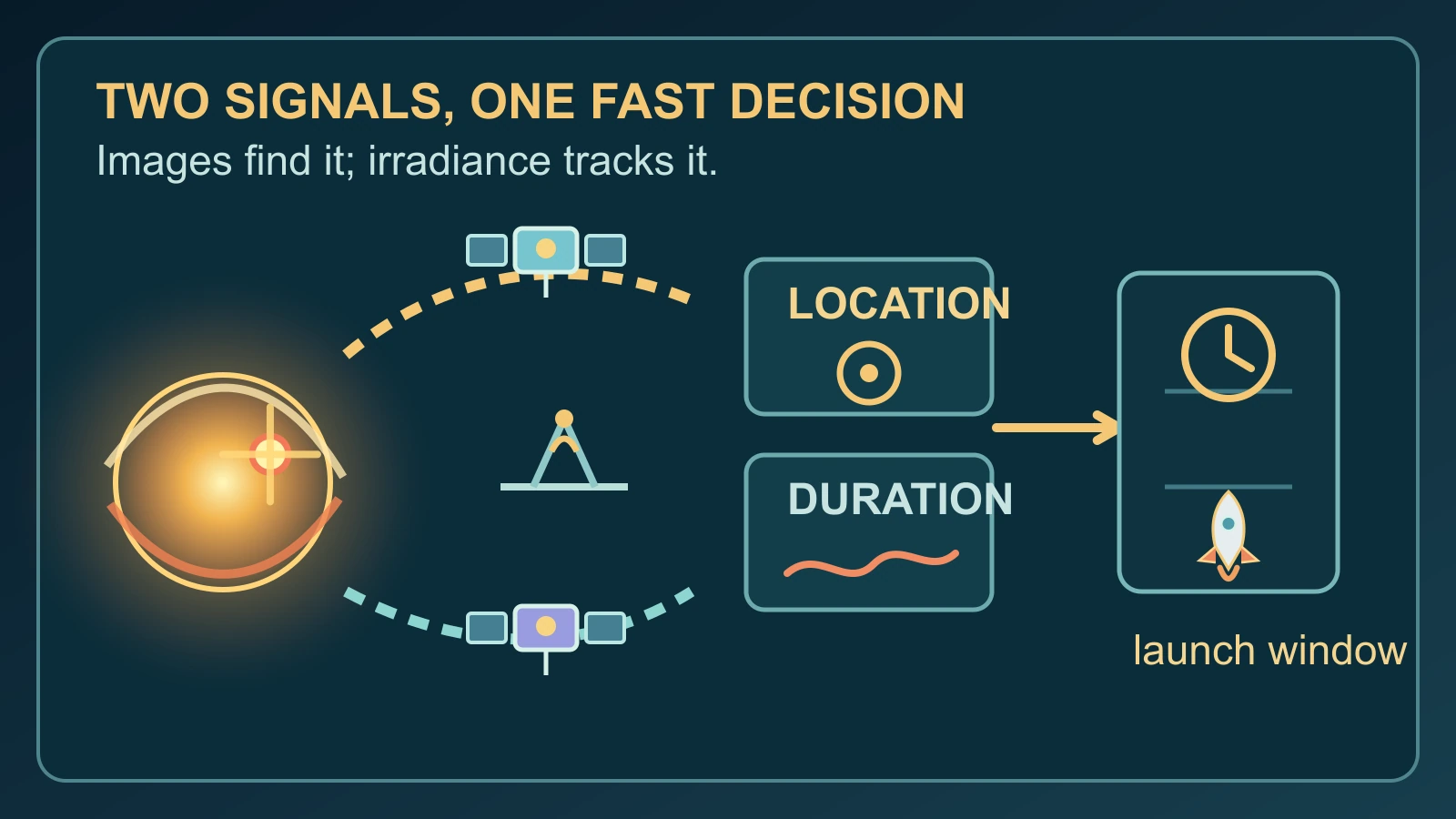
The alert combines two kinds of early evidence. Solar imaging helps identify where an active region is producing the flare, while X-ray and ultraviolet measurements show how the region's light is changing. NASA says the system draws on NASA's Solar Dynamics Observatory, NOAA's GOES satellites and ground-based observatories.
That combination matters because location and lifetime answer different questions. The location tells a rocket team what part of the Sun its instrument should point toward. The changing X-ray and ultraviolet signal helps estimate whether the flare is likely to persist long enough for the flight to catch it. The system turns those streams into a fast operational nowcast rather than waiting for a complete scientific reconstruction after the event.
The instruments are not interchangeable. NASA describes SDO as a mission that monitors the Sun's interior, atmosphere, magnetic field and energy output. NOAA's GOES-R EXIS documentation describes XRS and EUVS measurements used to monitor solar flares and irradiance. Those pages provide context for the inputs; the paper is the source for the alert system's campaign-specific implementation.
Why a five-minute rocket flight makes the timing problem difficult
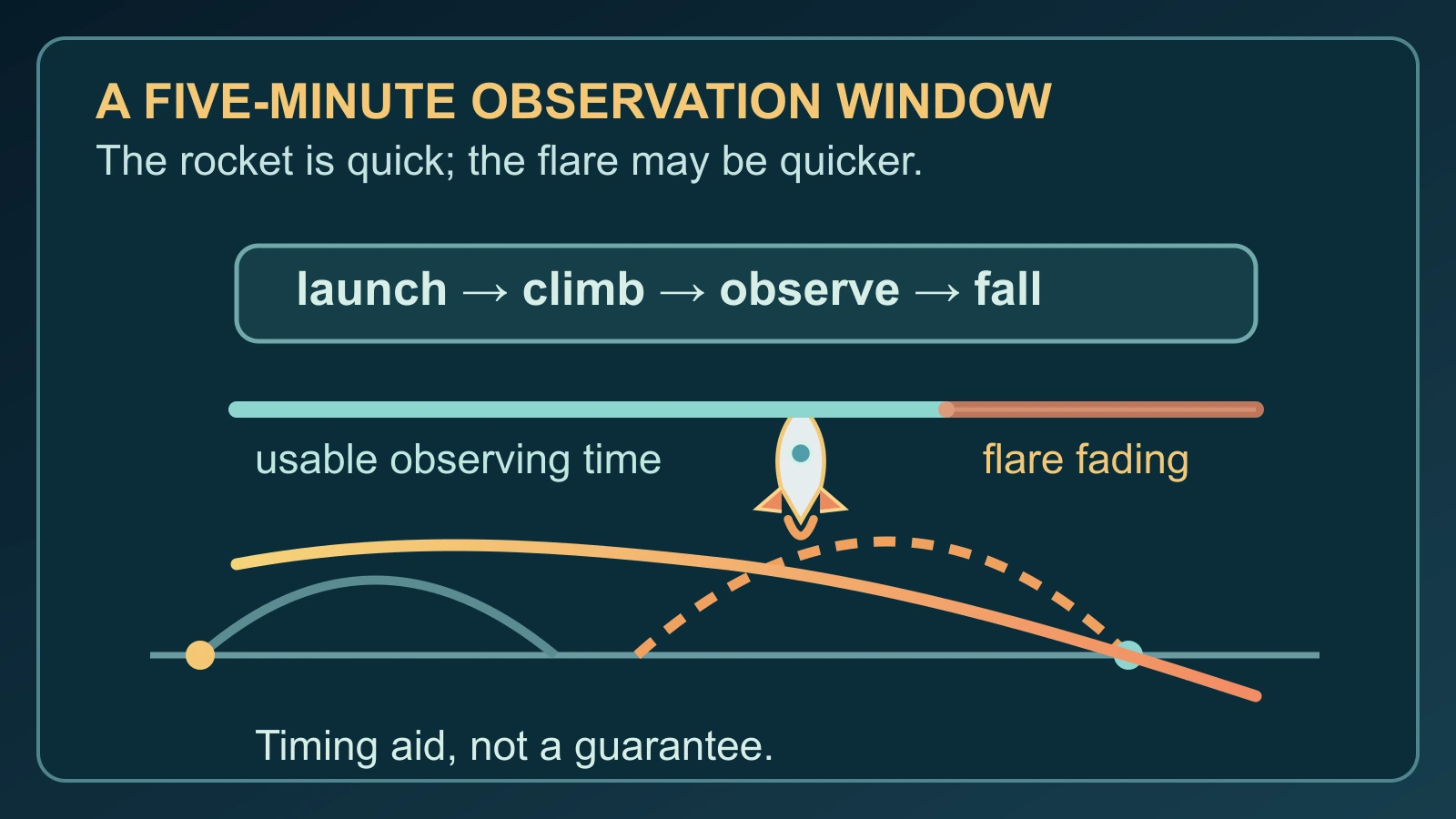
The launch decision is a race between two clocks: the rocket's climb to its observing position and the flare's changing light. Launch too early and the target may not yet be bright enough; launch too late and the flare may fade before the instrument is ready. A useful alert therefore has to be early enough to act on but specific enough to avoid treating every brightening as a viable target.
NASA reports that the system helped coordinate two Alaska launches in April 2024 and that an enhanced version supported a May 2026 FOXSI-5 flight. The later flight successfully observed three small solar flares. These are demonstrations that the timing workflow worked for those campaigns, not a guarantee that a future launch will always succeed.
The important boundary is operational. The alert informs a human rocket team when the expected location and remaining lifetime make a launch worth attempting. It does not replace range safety, payload readiness, weather checks or the scientific judgement required to decide whether the short flight will answer the intended question.
What the demonstrations show and what they do not prove
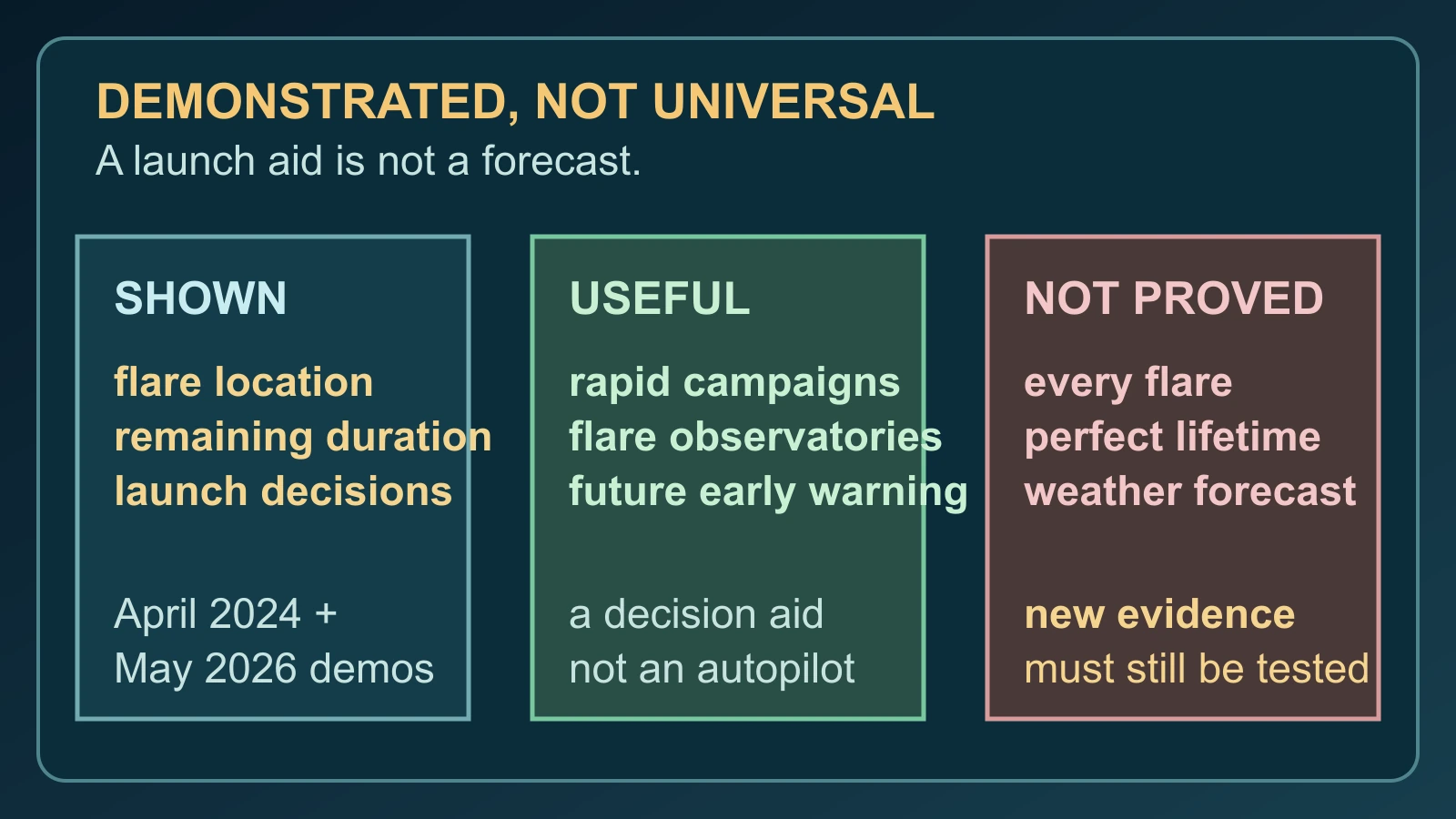
The demonstrated result is narrow but useful: a low-latency flare alert can support a sounding-rocket campaign by estimating where a flare is and how long it may last, then giving the team time to decide whether to launch. The April 2024 campaign validated the approach in operation, and the May 2026 FOXSI-5 flight extended it to three observed flares.
The evidence does not establish a universal flare-duration predictor. Solar flares vary, the system's performance depends on the available measurements and the campaign's operating conditions, and a forecast of remaining lifetime is not the same thing as a guaranteed observation. The paper's contribution is a tested workflow and the lessons needed to improve future monitoring systems.
NASA says the same early warning could support future rocket campaigns, solar observatories and space-weather forecasting. That is a plausible direction for continued work, not an operational forecast claim. The honest takeaway is that the team learned how to turn the Sun's first signals into a better-timed experiment while keeping the uncertainty visible.
Sources and further reading
- The Astrophysical Journal — Real-time Early Flare Alert System for the First Sounding Rocket Solar Flare Campaign ↗
- NASA Science — Solar Flare Alert System Helps NASA Rocket Team Decide When to Launch ↗
- NASA Science — Solar Dynamics Observatory ↗
- NOAA NESDIS — Extreme Ultraviolet and X-ray Irradiance Sensors (EXIS) ↗
This article was written for Curiosity Desk. We do not copy other publishers or invent quotes. If a material error is found, we correct it openly.
Read the full standards →One answer should lead to a better question
Bring your curiosity to the group
Curious Minds is our public Facebook community for surprising science, strange history, Australian wildlife and everyday questions. No copied posts, no personal-friend invitations and no link dumping.
- Three self-contained discussion prompts each week
- Sourced answers and honest uncertainty
- Respectful conversation without spam