How a cargo spacecraft became the test platform
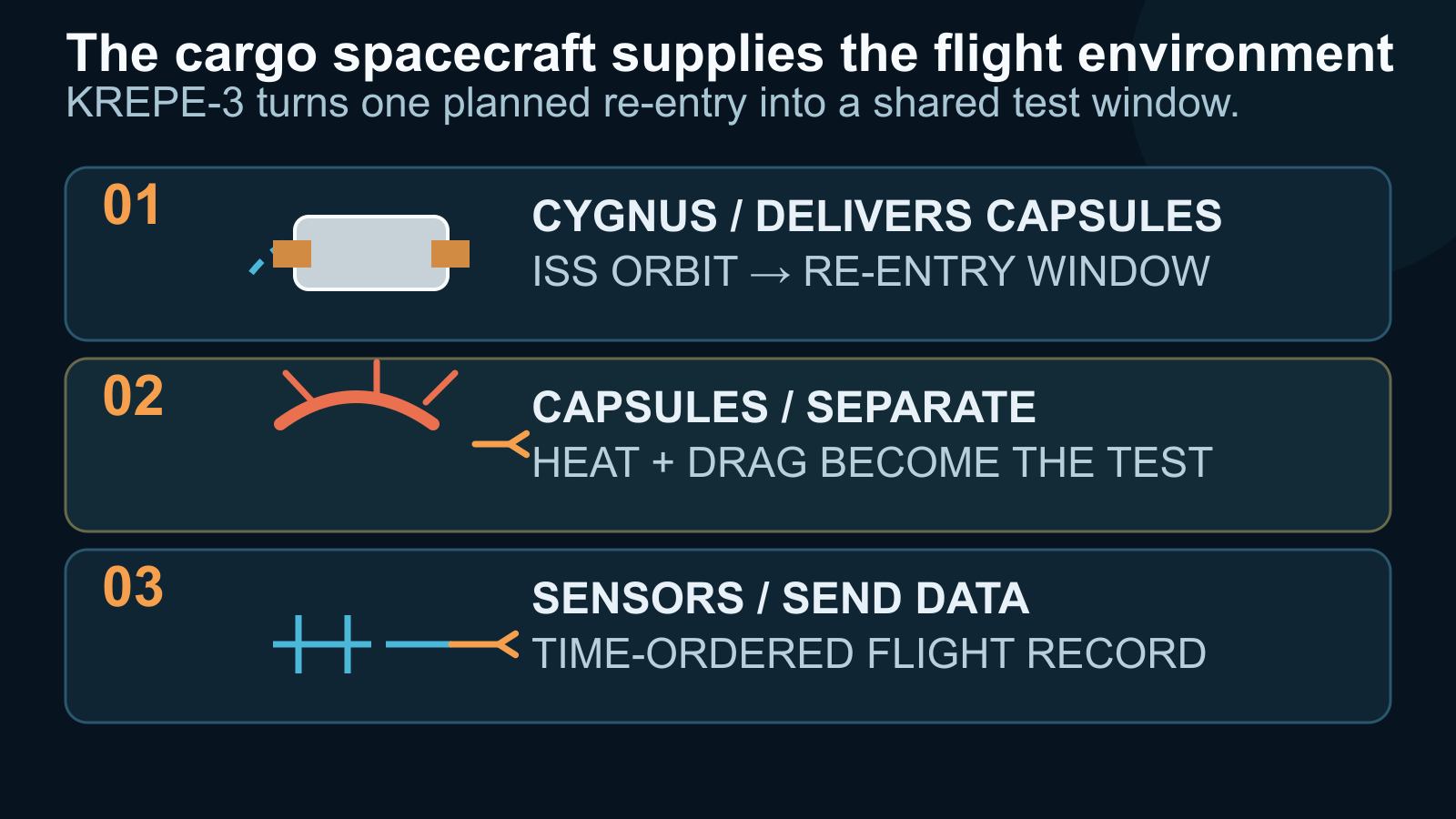
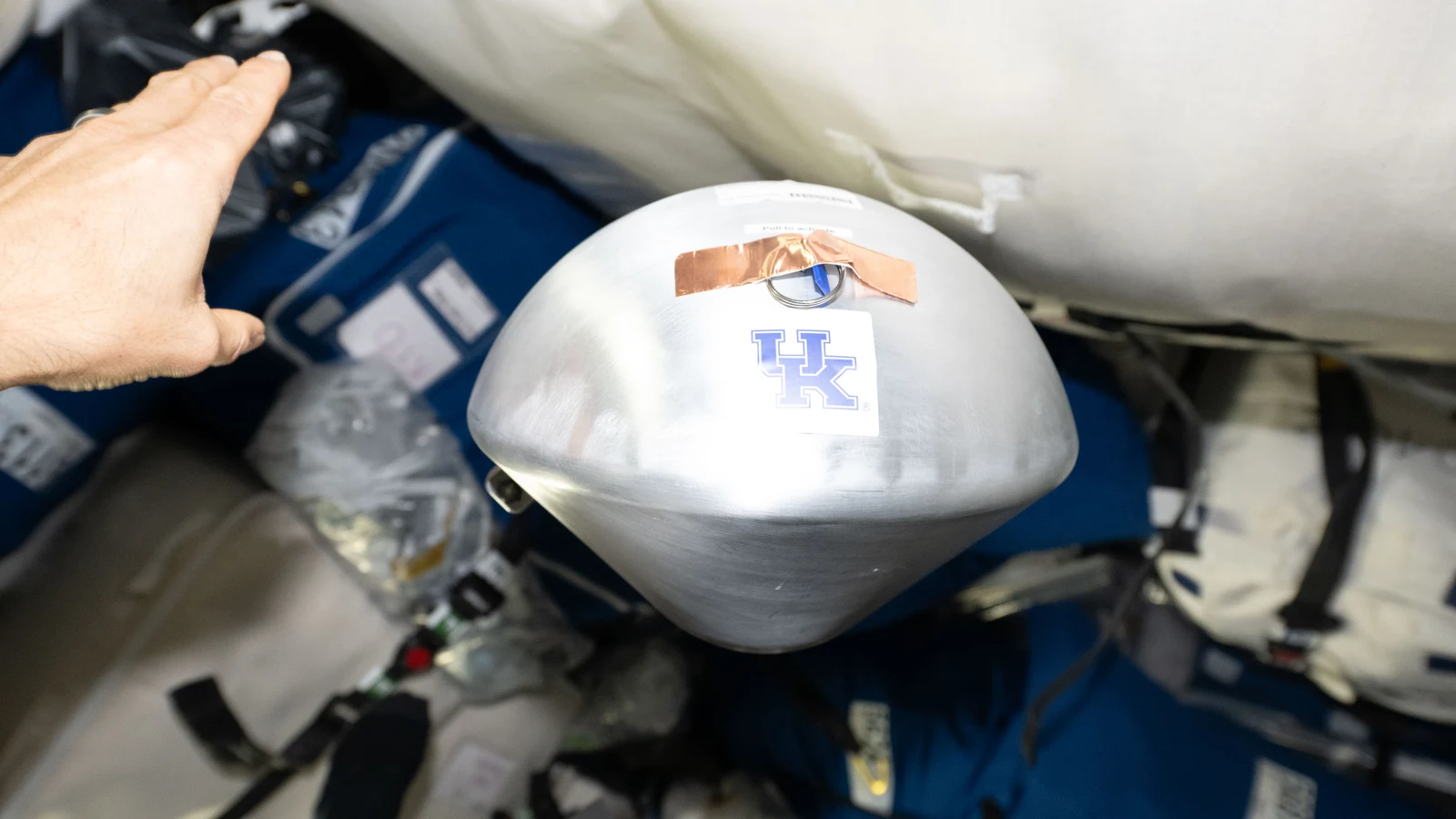
KREPE-3 made a cargo spacecraft's planned destruction useful twice: Cygnus NG-24 delivered the experiment to the International Space Station, then its atmospheric re-entry supplied the high-speed flight environment that ordinary ground tests cannot reproduce completely. University of Kentucky records say the mission carried twelve research capsules, and the University of Stuttgart's partner account says Cygnus released them during re-entry on 12 October 2026.
The capsules were not passengers returning intact inside the cargo vehicle. They were independent test articles designed to separate as Cygnus broke up, expose their thermal-protection systems to the entry flow and send measurements outward. That arrangement turns the last stage of a resupply mission into a shared test window without requiring a dedicated full-size spacecraft for every material experiment.
The important boundary is in the wording: the flight tests heat-shield systems and measurement methods under real atmospheric conditions. It does not mean that every material aboard is ready for a crewed vehicle, or that a later mission will perform exactly as this one did.
What the capsules measured as they fell
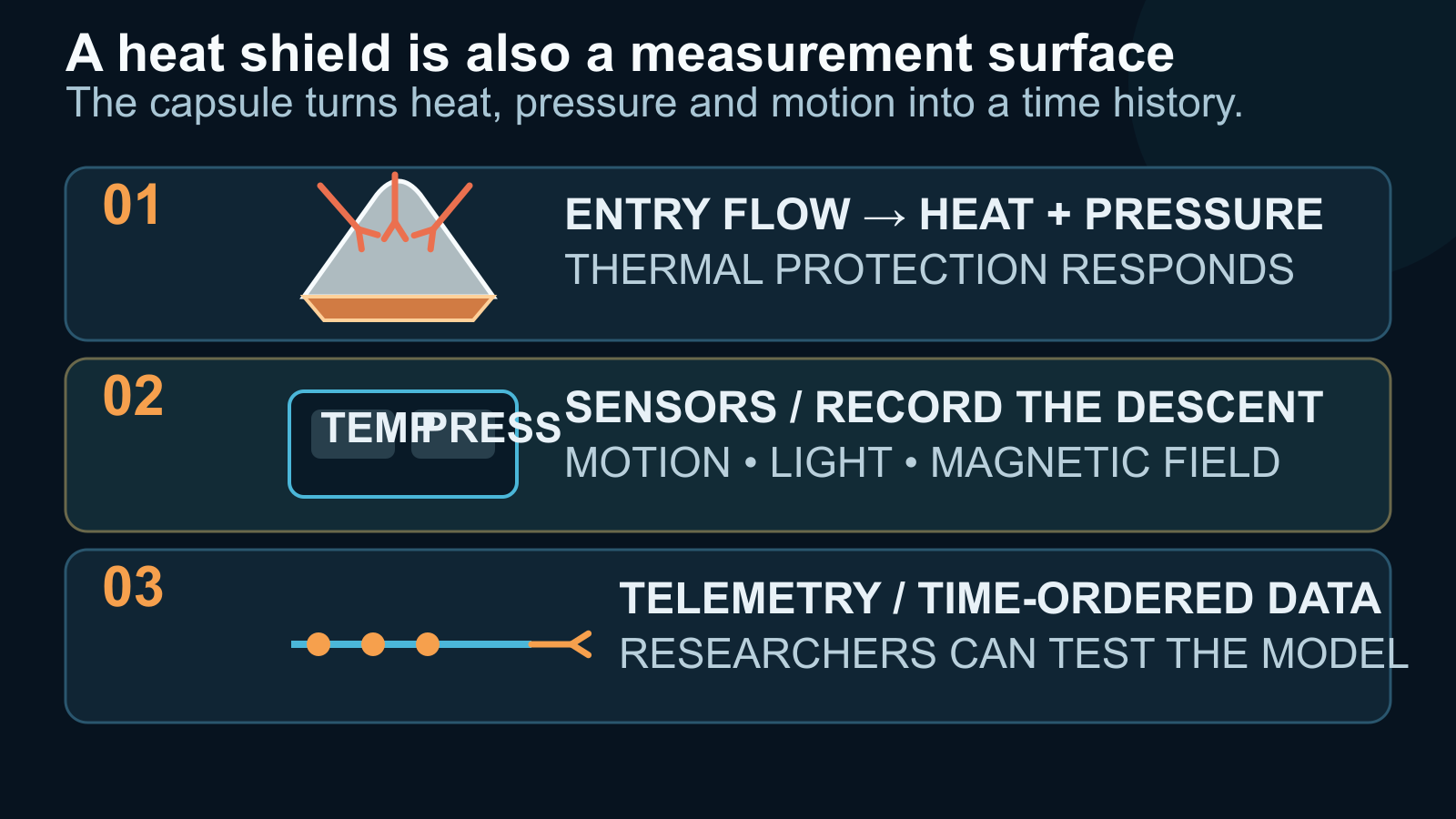
A heat shield is not judged only by whether a capsule appears to survive. During entry, the surrounding flow changes the surface temperature and pressure while drag and aerodynamic forces change the capsule's motion. KREPE-3's NASA account lists sensors for temperature, pressure, motion, magnetic field and light; the earlier KREPE-2 record provides context for the project’s use of heat-shield and flight-data measurements.
Those sensors turn a short, violent descent into a sequence that can be compared with models. A temperature trace can show when the surface experienced a changing thermal load. Pressure and motion data help describe the flight state around that response. Optical or spectral observations from outside the capsule can add another view of the hot flow, as the University of Stuttgart describes for its KRACO participation.
The telemetry matters because the research question is about behaviour through time. A single before-and-after inspection cannot show which condition came first, how long it lasted or whether a model predicted the turning point. Packets transmitted during the descent preserve that order for later analysis.
Why KREPE-3 compares materials and shapes side by side
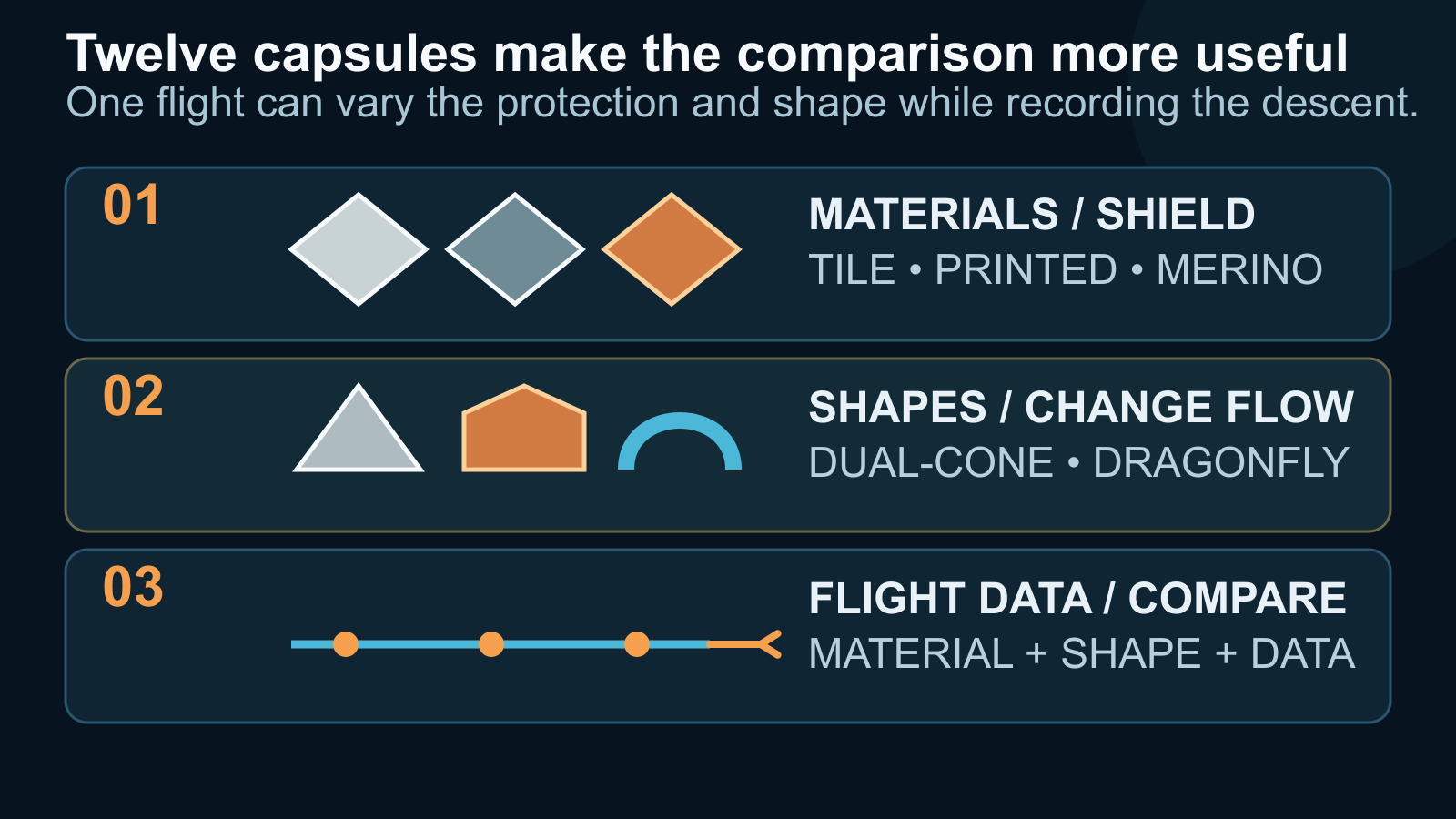
KREPE-3 varied more than one part of the test article. NASA describes a 3-D-printed heat shield, carbon-and-phenolic MERINO coverings, a dual-cone configuration, a Dragonfly-like aeroshell and a deployable design among the capsule concepts. The University of Kentucky's 2026 technical record also describes multiple thermal-protection systems, new geometries and updated avionics.
Changing the material asks how a protective layer responds to the entry environment. Changing the shape asks how the same environment moves around the vehicle, affects stability and changes the loads reaching the surface. Keeping the experiments within one mission makes those questions more comparable than a collection of unrelated laboratory tests, even though each capsule still has its own geometry and measurement limits.
That is why a material name alone is not the result. The useful comparison joins the material, the shape, the sensor record and the entry conditions. A model can then be checked against flight data, while researchers keep separate which differences came from the protective material and which came from the capsule design.
What the flight establishes—and what remains open
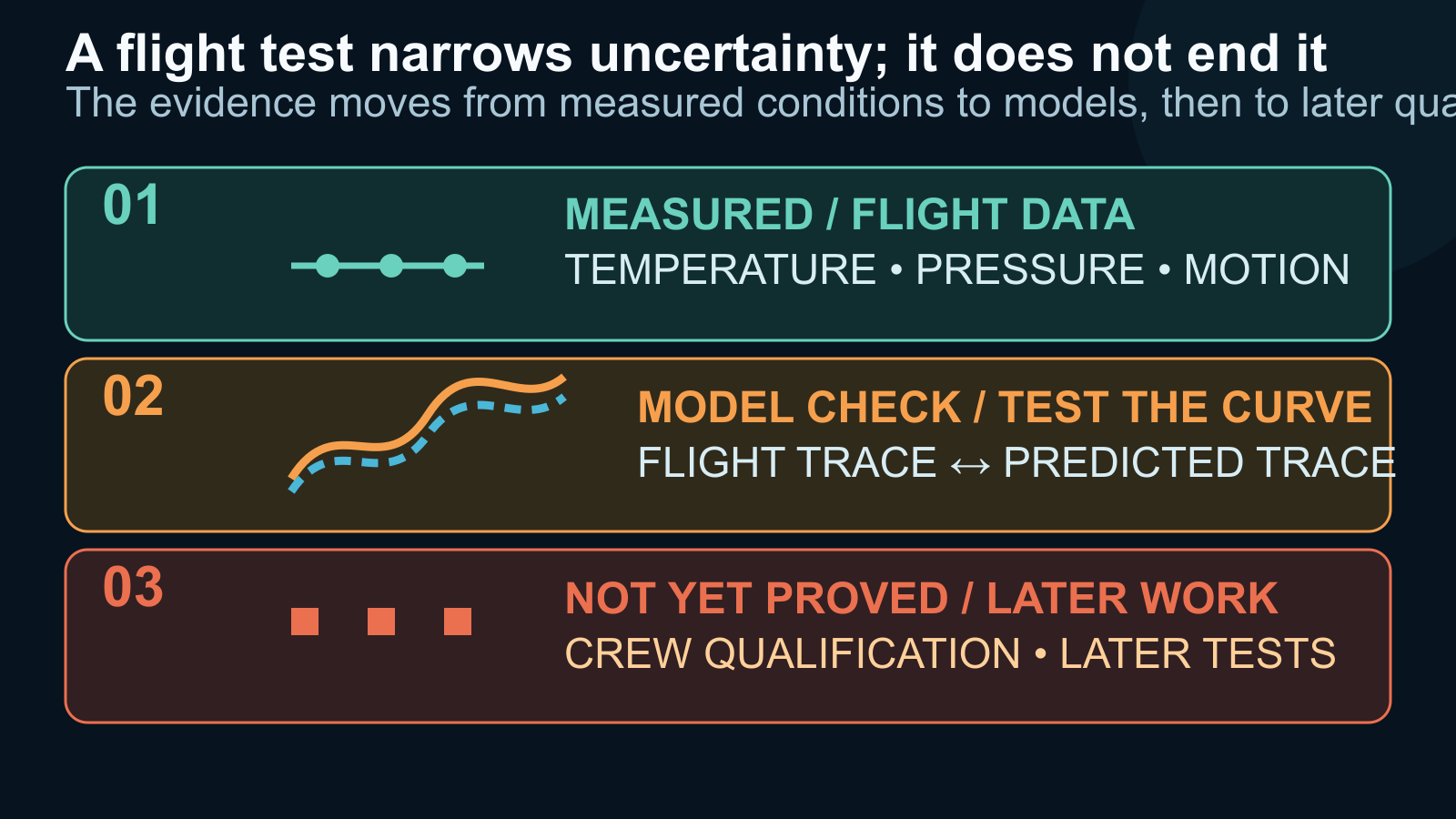
The October sources establish a real flight event, a twelve-capsule test design and partner observations. They do not, in the records checked for this package, publish a final league table that says one KREPE-3 heat shield won. The University of Stuttgart describes the data as a way to understand and predict thermal stress more reliably; the University of Kentucky technical record describes the mission design and verification completed before flight.
The immediate result is therefore a better constrained engineering problem: measured temperatures, pressures, motion and optical signals can be compared with calculations and used to improve the next model or test. That can reveal where a simulation is strong, where a material behaves differently than expected or which instrument needs a better design.
Crew qualification is a later claim with a higher burden. It would require a specific vehicle, safety analysis, qualification programme and evidence that extends beyond this set of small experimental capsules. KREPE-3 can add valuable flight evidence to that chain, but it cannot complete the chain on its own.
Sources and further reading
- NASA Ames — NASA Demonstrates Next-Generation Heat Shield Technologies ↗
- University of Kentucky — KREPE-3 Space Capsule Re-entry Data Watch Party ↗
- University of Stuttgart — KRACO participates in the KREPE-3 observation mission ↗
- University of Kentucky Research — Overview of Third Hypersonic KRUPS Flight ↗
- NASA — Student-Built Capsules Endure Heat of Re-entry for NASA Science ↗
- University of Kentucky — 2026 Pigman College of Engineering Faculty Awards ↗
- NASA — Guidelines for using NASA Images and Media ↗
This article was written for Curiosity Desk. We do not copy other publishers or invent quotes. If a material error is found, we correct it openly.
Read the full standards →One answer should lead to a better question
Bring your curiosity to the group
Curious Minds is our public Facebook community for surprising science, strange history, Australian wildlife and everyday questions. No copied posts, no personal-friend invitations and no link dumping.
- Three self-contained discussion prompts each week
- Sourced answers and honest uncertainty
- Respectful conversation without spam