Why Lucy has reached a region, not an asteroid
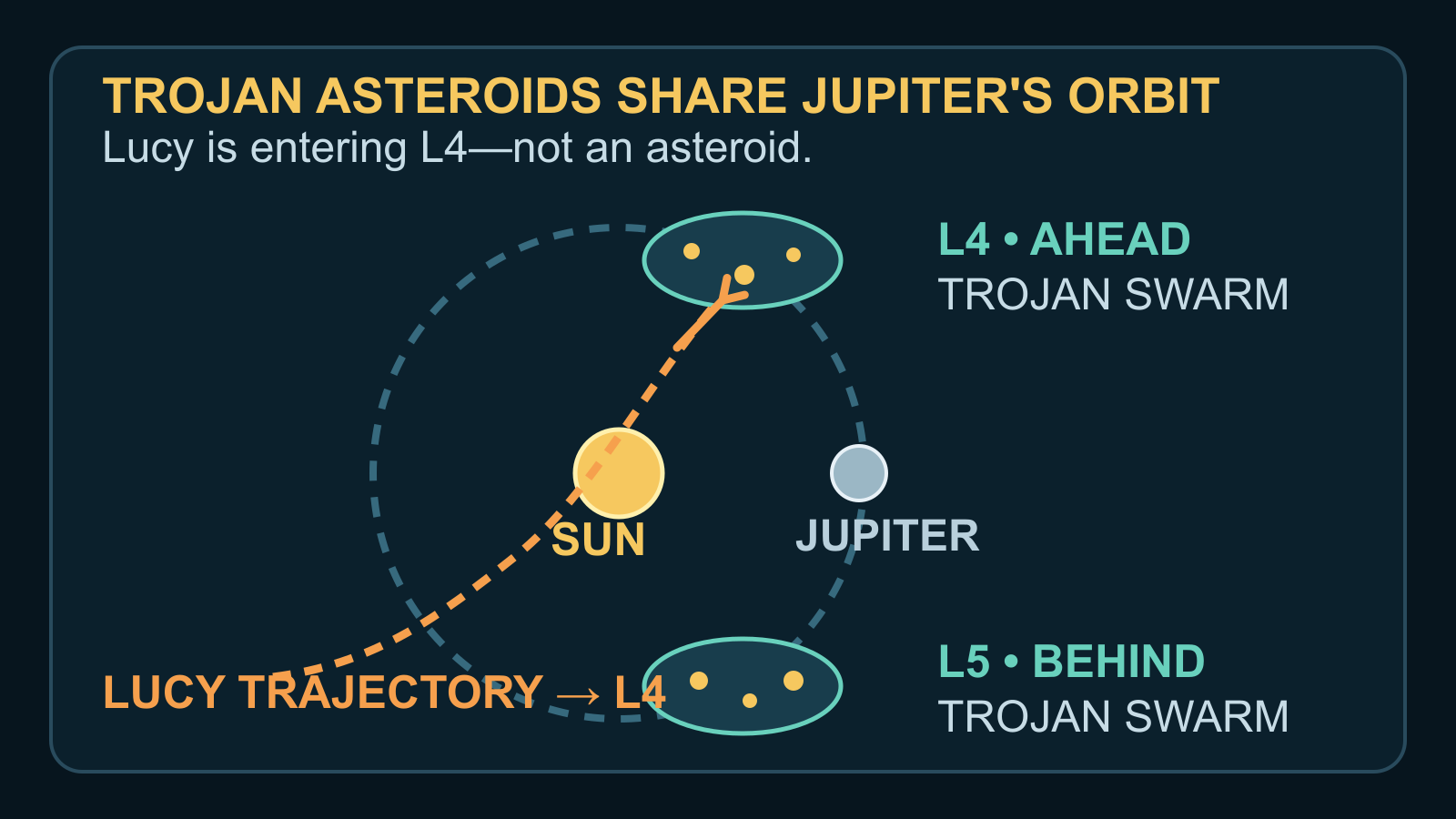
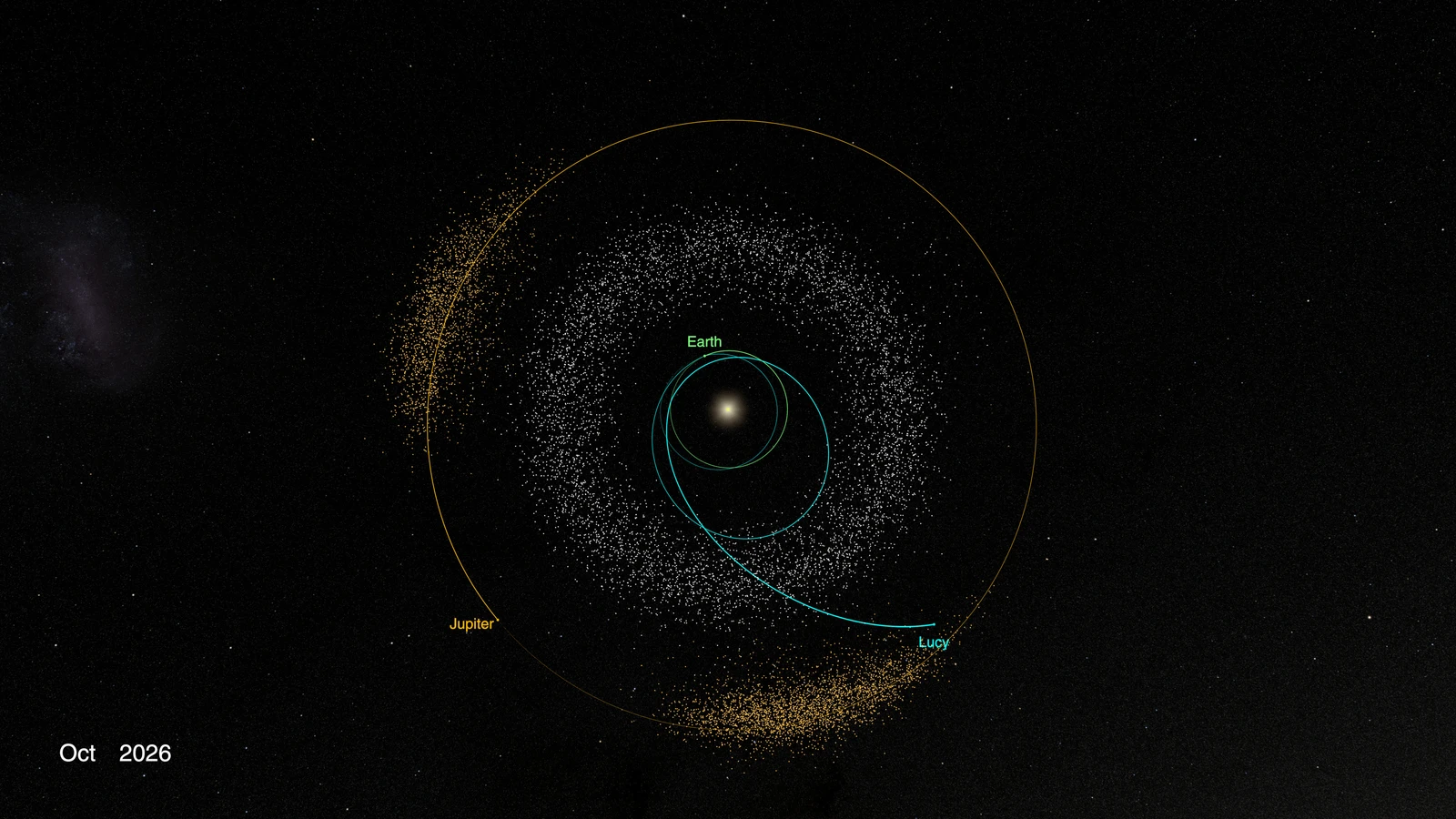
NASA says Lucy has now entered the broad region around Jupiter's L4 Lagrange point after travelling more than 2.2 billion miles. That is a meaningful mission milestone, but it is not the same as reaching an asteroid: the Trojan bodies are scattered through a huge orbital neighbourhood, and the first close encounter is still planned for Eurybates on 11 August 2027.
L4 is one of two stable regions associated with Jupiter's orbit. The group ahead of Jupiter is called the leading swarm; the trailing group gathers around L5. The asteroids are not sitting next to Jupiter—their average separation from the planet is about the same as the distance between Jupiter and the Sun—so Lucy's arrival is better understood as entering the right orbital lane than pulling up beside a target.
That geometry explains why the mission needs a sequence of flybys. Lucy will cross the L4 targets first, return near Earth for another gravity assist in 2030, and then head toward the L5 pair Patroclus and Menoetius for a planned 2033 encounter.
What Lucy will measure during a fast flyby
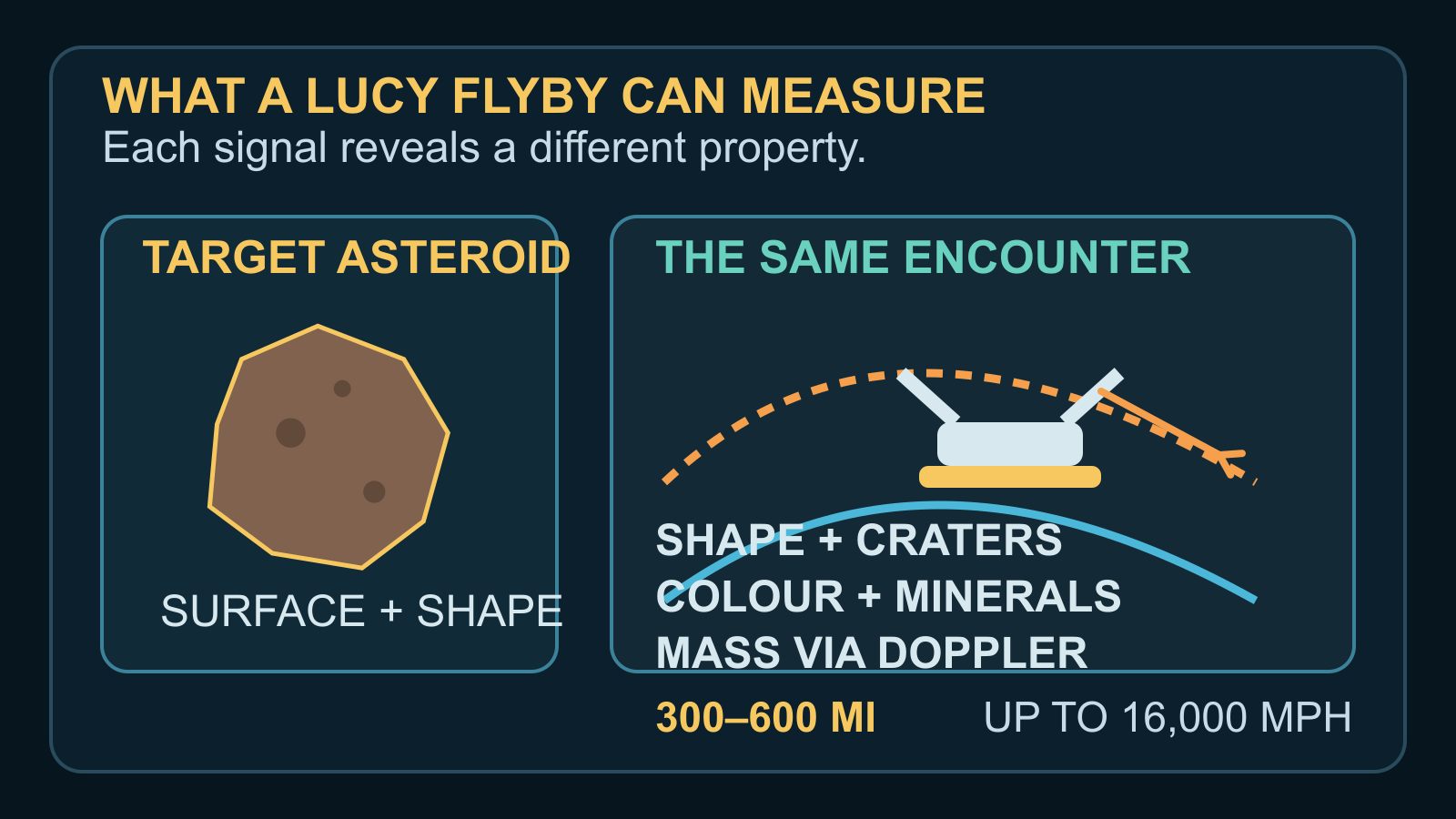
Lucy is designed as a fast scout, not an asteroid lander. During a close approach its cameras will map shape, craters and reflectivity; visible and infrared instruments will examine colour, minerals, ices and other surface materials; and radio tracking can use the spacecraft's Doppler shift to estimate a target's mass. Together, those measurements can reveal how a body is built without Lucy having to stop and orbit it.
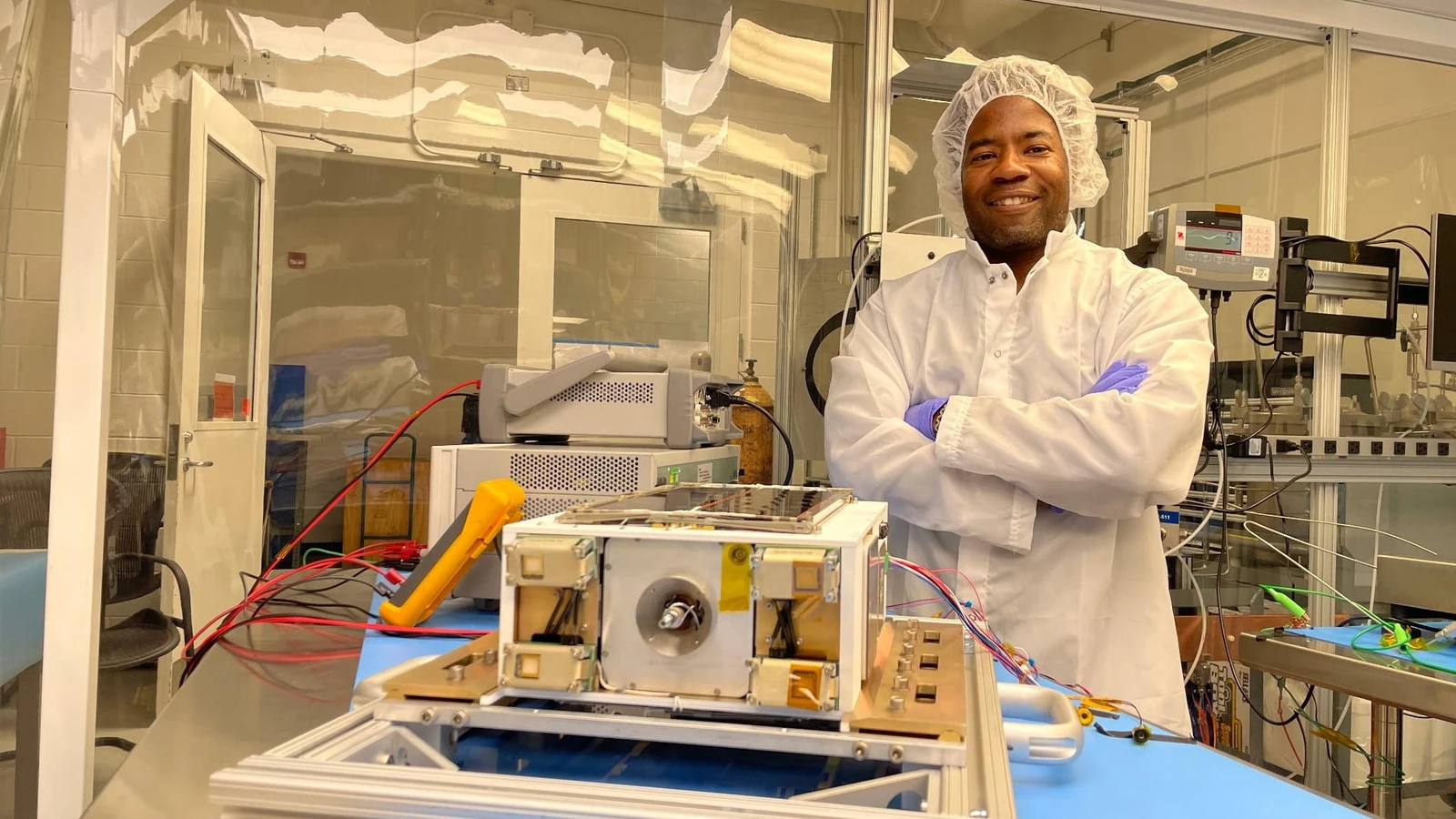
The first Trojan flybys are planned at speeds of up to about 16,000 miles per hour, with closest approaches roughly 300 to 600 miles from the targets. NASA's 2026 camera tests used the distant targets as preparation for the changing illumination Lucy will see when it approaches from a different direction than Earth-based telescopes do.
The result will not be one magical picture. It will be a bundle of observations—surface maps, spectra, thermal information, shapes, moons or rings if present, and mass estimates—that can be compared across several Trojan asteroids.
Why different Trojans can preserve different histories
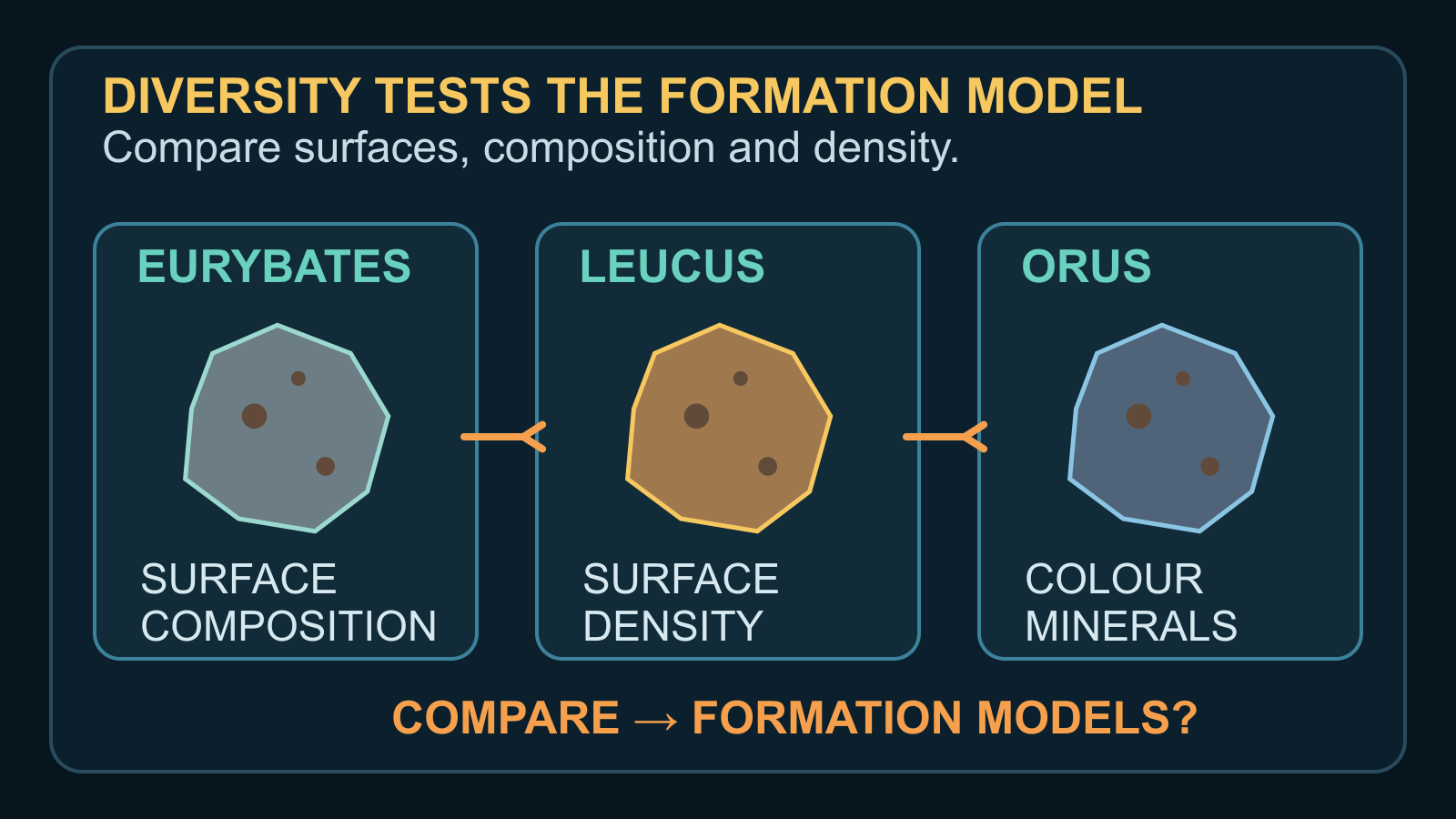
The reason to visit several Trojans is that they do not all look chemically alike. NASA describes the population as surprisingly diverse and says that difference may mean the bodies formed in different parts of the outer Solar System before being moved into their present orbits as the planets evolved.
That is a model to test, not a settled travel history for every asteroid. A composition measurement can tell scientists what materials are exposed at a surface; a shape, crater record, density or satellite can add clues about collisions and internal structure. The comparison becomes more informative when the same kinds of measurements are made across targets that now share the Trojan swarms.
If the target families show patterns that match one formation-and-transport model better than another, Lucy can help refine the story of how the giant planets assembled and rearranged the young Solar System. It cannot turn a plausible origin hypothesis into a photograph of the past.
What the mission can—and cannot—prove
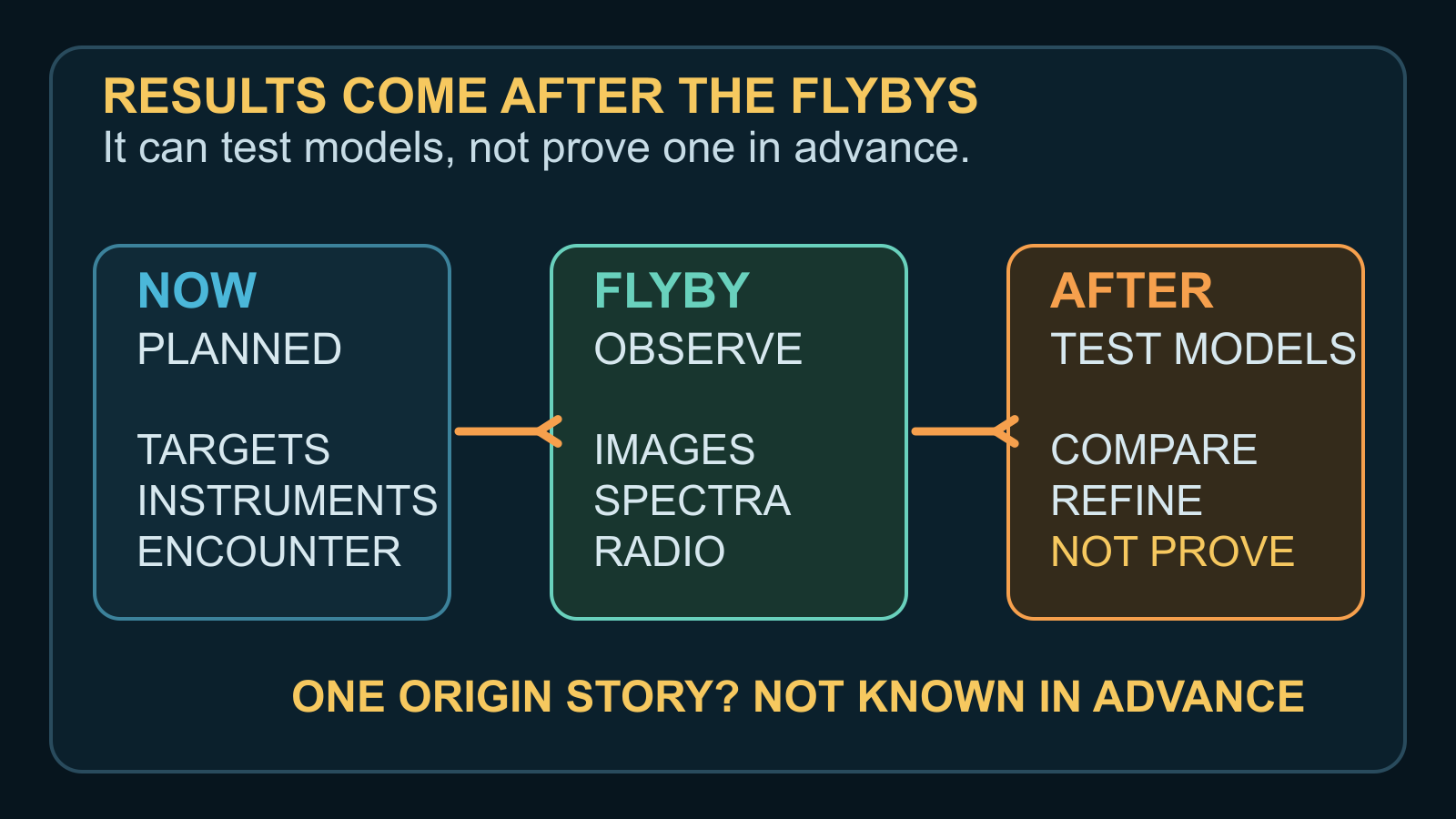
As of the current NASA milestone, Lucy has reached the L4 region and its instruments are operating as expected. The detailed Trojan results promised by the mission are still ahead: the team is finalising encounter plans, and the first Trojan flyby will not happen until 2027.
That timing sets the article's evidence boundary. We can say what Lucy is built to measure, why the targets matter and which hypotheses the measurements could test. We cannot say that Lucy has already found a particular mineral, confirmed a common birthplace or proved how the Trojans were captured.
The strongest answer is therefore conditional: Lucy will read the early Solar System by comparing several ancient-looking bodies with the same toolkit. The more their surfaces, interiors and orbits differ—or agree—the more sharply scientists can narrow the models. The mission's payoff is a better-tested history, not a prewritten origin story.
Sources and further reading
- NASA Science — NASA’s Lucy Reaches Trojan Asteroid Region 5 Years After Launch ↗
- NASA Science — Lucy’s Science ↗
- NASA Science — NASA’s Lucy Begins Camera Tests Ahead of 2027 Trojan Flybys ↗
- NASA Science — Lucy Mission Frequently Asked Questions ↗
- NASA Scientific Visualization Studio — Lucy Mission Trajectory with Jupiter Trojans and Main Belt Asteroids ↗
- NASA Brand Center — Images and Media Usage Guidelines ↗
This article was written for Curiosity Desk. We do not copy other publishers or invent quotes. If a material error is found, we correct it openly.
Read the full standards →One answer should lead to a better question
Bring your curiosity to the group
Curious Minds is our public Facebook community for surprising science, strange history, Australian wildlife and everyday questions. No copied posts, no personal-friend invitations and no link dumping.
- Three self-contained discussion prompts each week
- Sourced answers and honest uncertainty
- Respectful conversation without spam