Why visible light can miss a near-Earth object
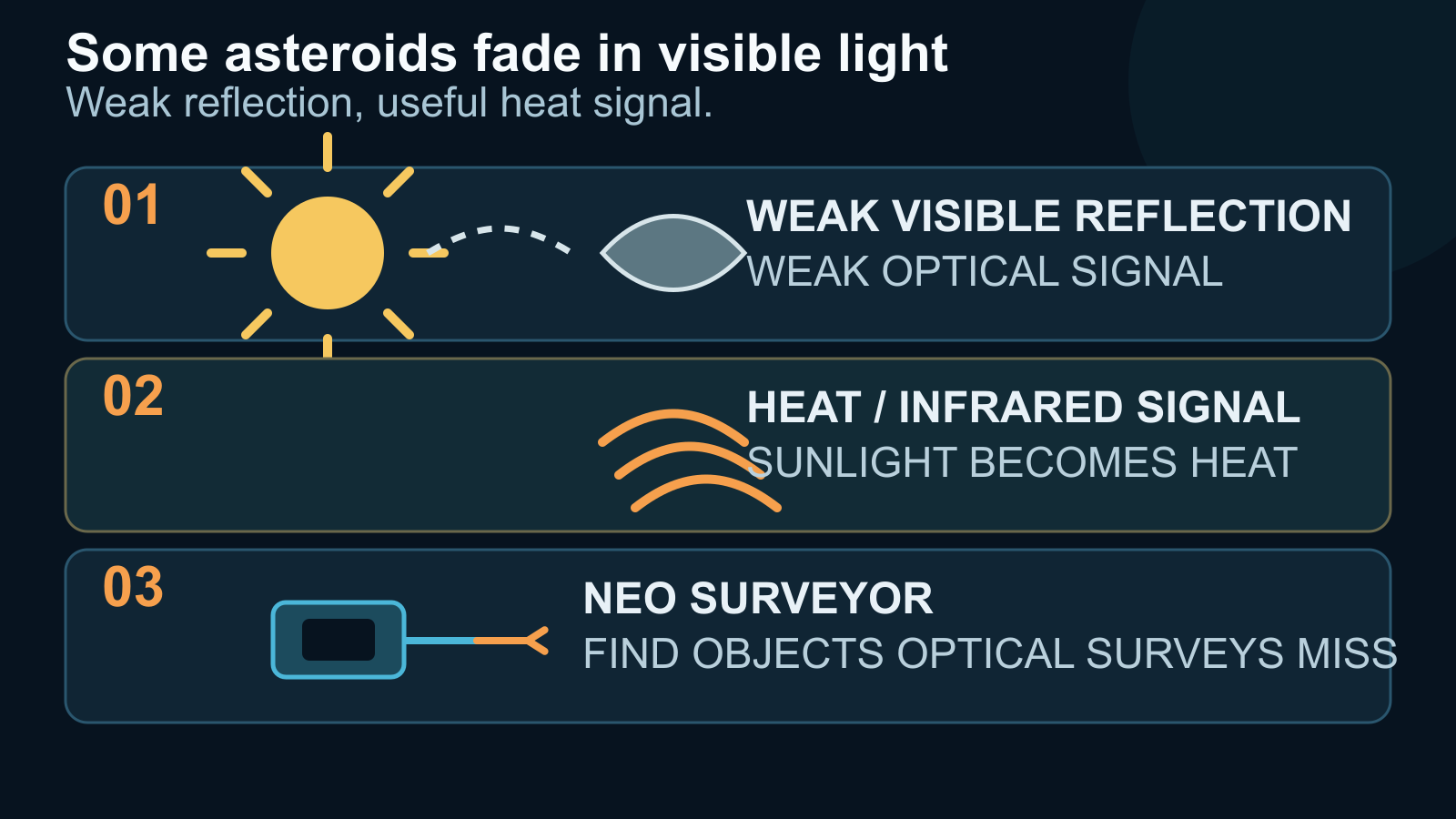
NEO Surveyor is designed to find some near-Earth objects that are easy to overlook in visible light. A dark asteroid is not necessarily black or dangerous; it is an object that reflects relatively little of the sunlight falling on it. That weak reflection can make a small body harder for optical surveys to separate from the background, especially when it approaches from a direction crowded by sunlight.
The planned telescope uses a different clue. Sunlight warms an asteroid or comet, and the surface re-radiates part of that energy as infrared light. NASA says NEO Surveyor's heat-sensitive detectors will track objects that do not reflect much visible light, while also searching geometries near the Sun's glare that larger ground-based optical observatories can miss.
That is the honest answer to the headline: infrared does not make every asteroid visible, and it does not make a hazard decision by itself. It gives a future survey another way to find and measure objects whose reflected-light signal is weak or whose position is awkward for ground telescopes.
How two infrared bands make heat useful
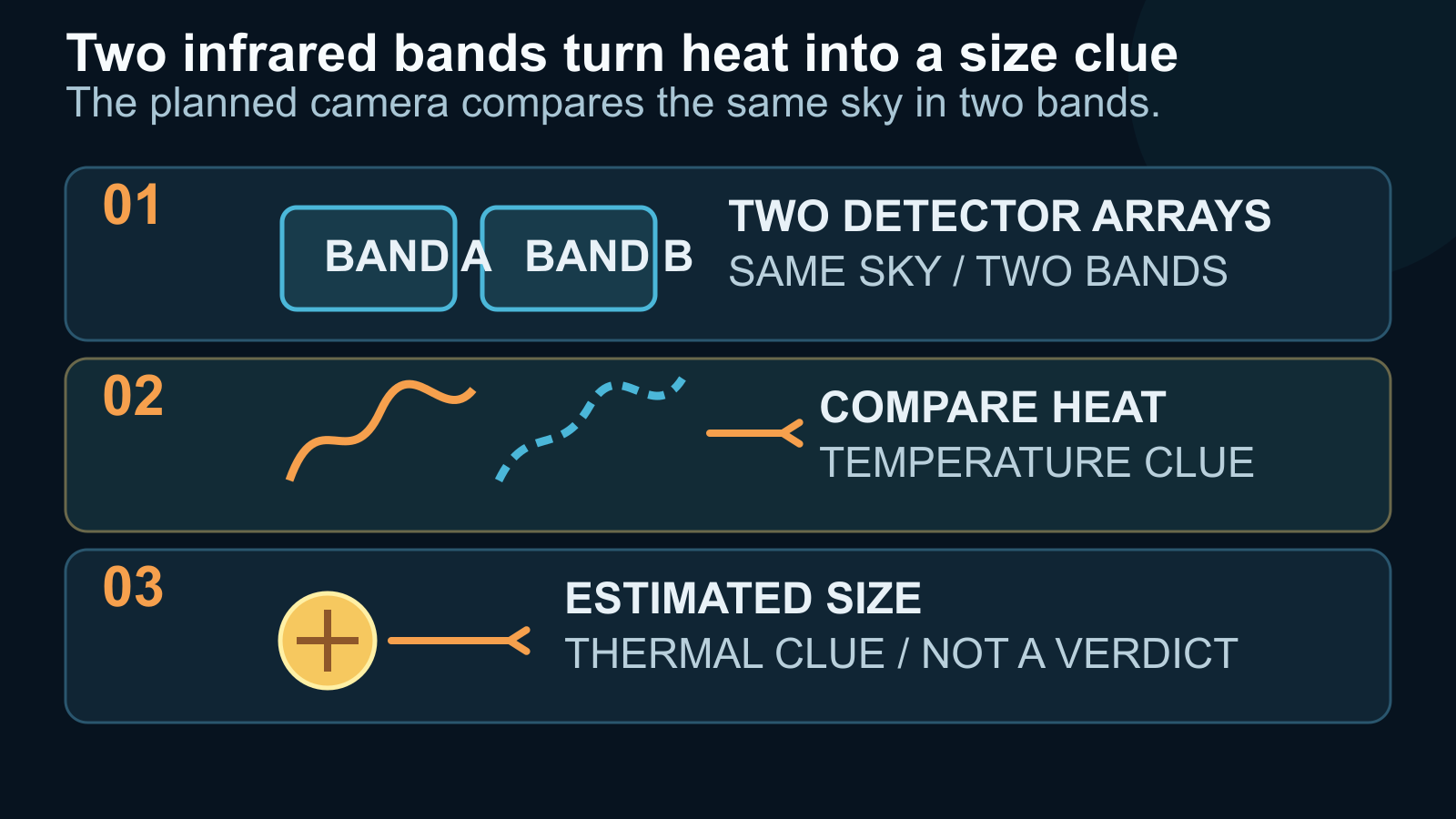
NEO Surveyor's instrument is a 50-centimetre telescope with two heat-sensing infrared wavelengths. NASA's October 2026 mission report describes two detector arrays that each create a 16-megapixel mosaic of the sky. Looking at the same part of the sky through both bands lets the science team compare the heat signal rather than relying on how bright an object looks in visible light.
That comparison is useful because temperature helps constrain size. A small, warmer object and a larger, cooler object can produce different combinations of infrared measurements, so the two-band record gives the team more information than a single brightness value. The inference is still an estimate shaped by the object, the observing geometry and the models used to interpret the data.
The mission is also designed to repeat observations so that a moving point of light becomes a track through space. NASA's mission records describe a five-year baseline survey intended to improve measurements of near-Earth-object size, composition, shape, rotation and orbit. Those are mission goals, not observations already returned from NEO Surveyor.
Why the sunshade is part of the telescope
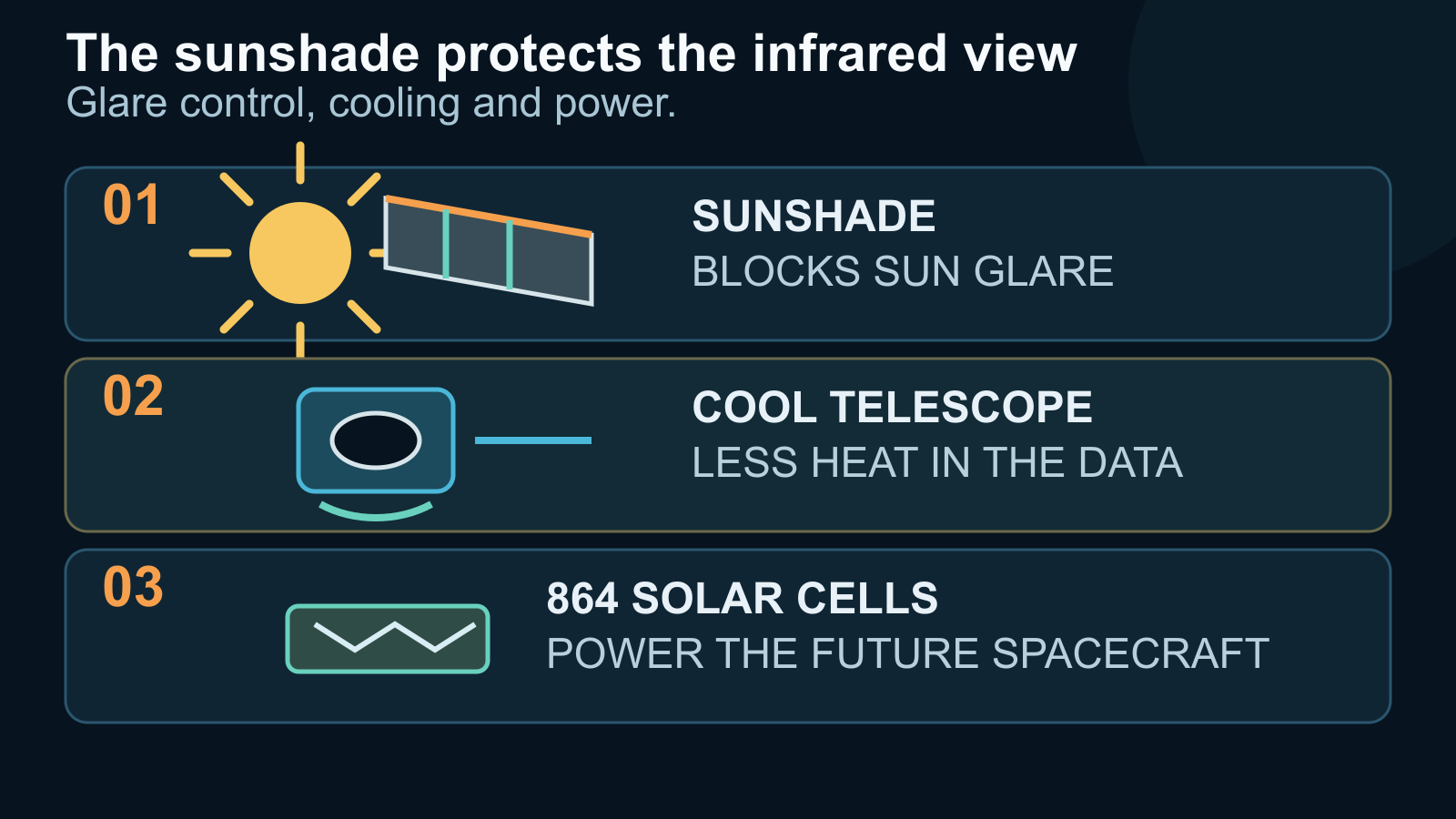
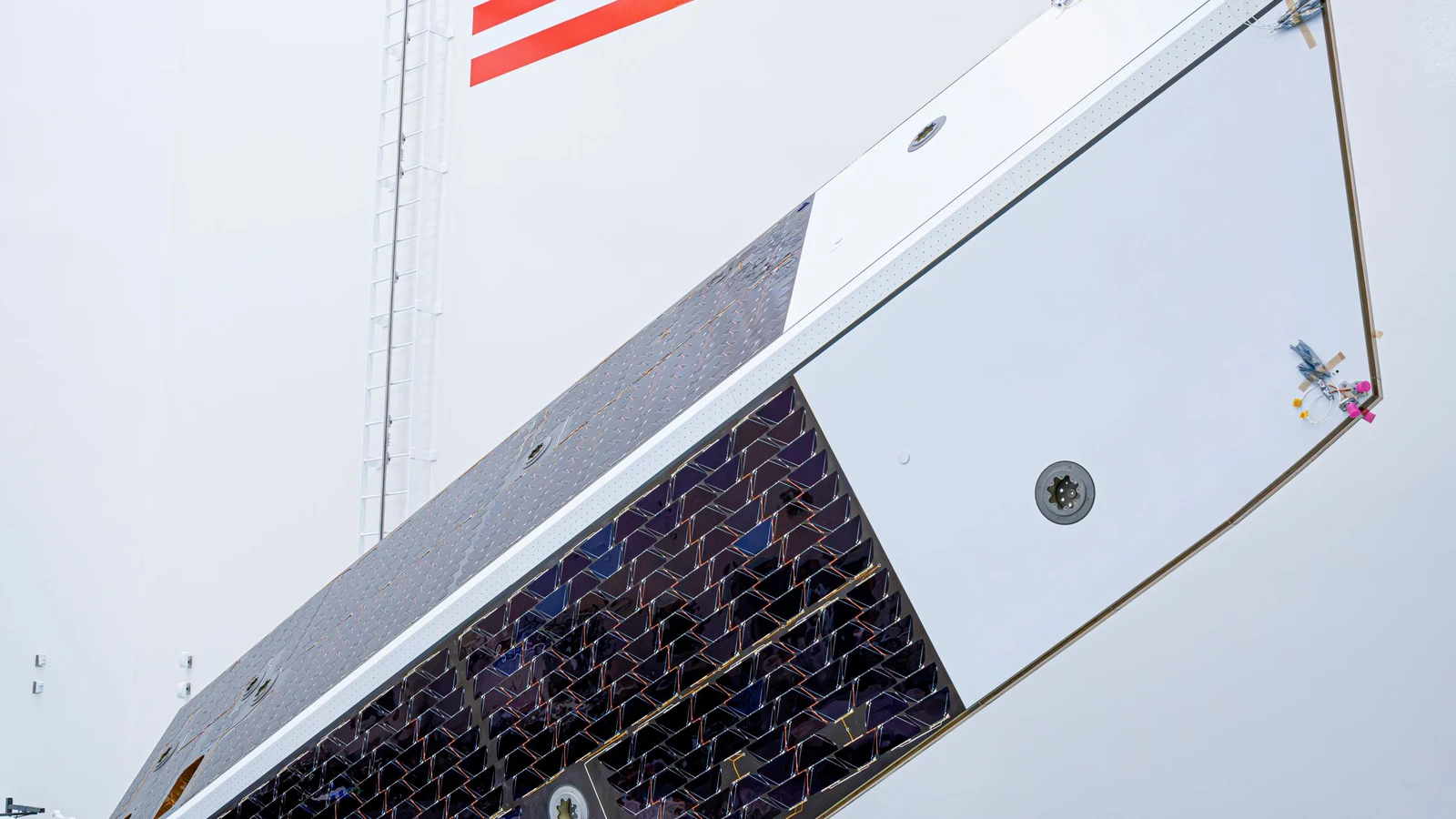
The large sunshade is not just a solar panel support or a visual signature. NASA describes it as a structure whose main job is to block the Sun's glare from the telescope while keeping the infrared instrument cool. That matters because the telescope is trying to measure faint heat from asteroids and comets; unwanted heat and stray sunlight would compete with the signal it was built to detect.
The October 2026 update says the sunshade stands about 20 feet, or 6 metres, tall and has two panels joined at a 23.5-degree angle. The panels carry 864 interconnected solar cells that can produce up to 2 kilowatts, supplying the spacecraft's systems. The same structure therefore supports the viewing geometry, the thermal environment and the power budget.
This is why NEO Surveyor's method is a whole-spacecraft problem. The detectors, the telescope, the sunshade, the software and the observing strategy have to work together. A detector that senses infrared light is only useful if the spacecraft can keep its own heat under control and point the instrument toward the parts of the sky that optical surveys struggle to search.
What NEO Surveyor can—and cannot—prove
NEO Surveyor is still a future mission. NASA's current mission page gives a launch date no earlier than September 2027, and the latest hardware report describes continued development and integration rather than a completed survey. The clean-room photograph used here shows the real sunshade before launch; it is not an image of an asteroid, an in-space telescope or returned mission data.
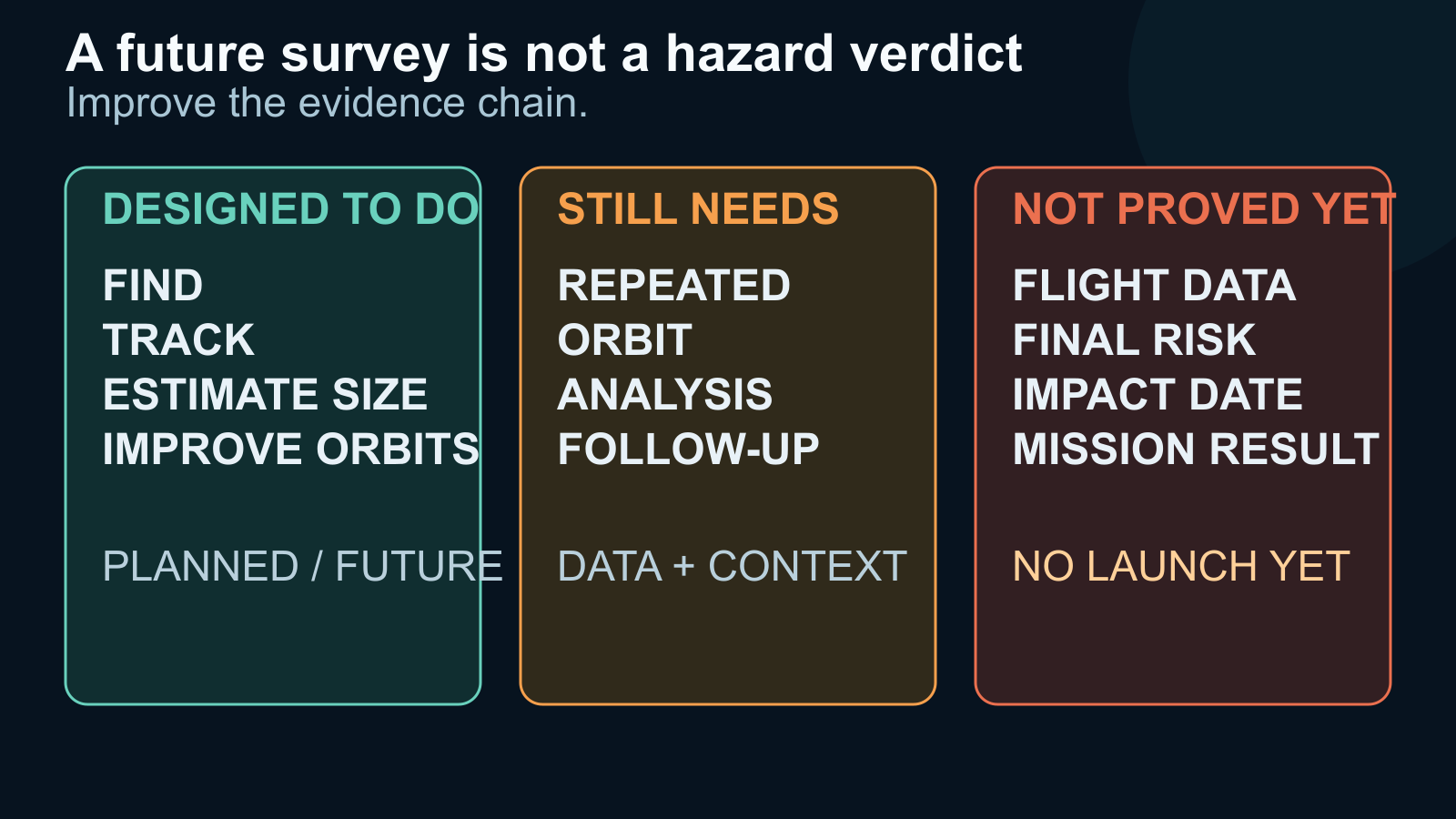
After launch, the planned measurements could help identify objects, estimate their sizes, refine their orbits and improve scientists' understanding of their physical properties. NASA's mission records describe a five-year baseline survey aimed at making progress toward finding large near-Earth objects, including a design goal of at least two-thirds of those larger than 140 metres. A goal is not a guarantee, and it cannot be counted as a result before the survey operates.
Finally, detecting an object is not the same as proving that it will hit Earth. Impact risk depends on repeated observations, orbit determination, uncertainty analysis and future tracking. NEO Surveyor is designed to strengthen that evidence chain by finding hard-to-see objects earlier and measuring them more usefully; it is not a machine that turns one infrared detection into a final hazard verdict.
Sources and further reading
This article was written for Curiosity Desk. We do not copy other publishers or invent quotes. If a material error is found, we correct it openly.
Read the full standards →One answer should lead to a better question
Bring your curiosity to the group
Curious Minds is our public Facebook community for surprising science, strange history, Australian wildlife and everyday questions. No copied posts, no personal-friend invitations and no link dumping.
- Three self-contained discussion prompts each week
- Sourced answers and honest uncertainty
- Respectful conversation without spam