Why one comet needs several viewpoints
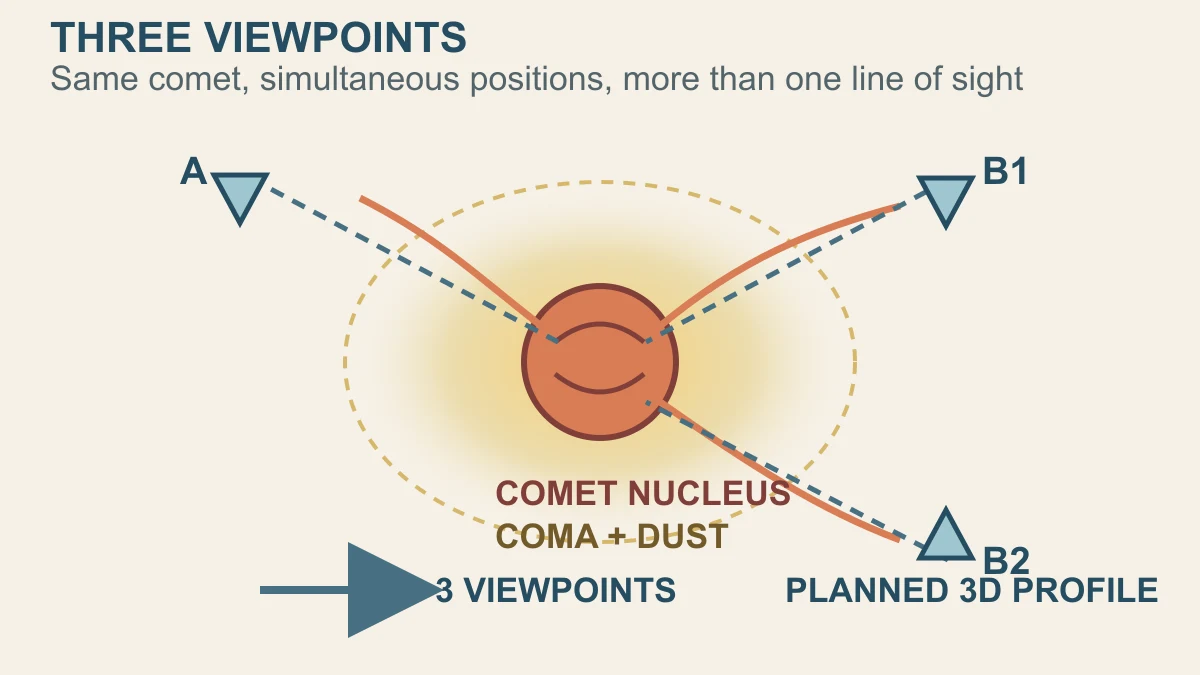
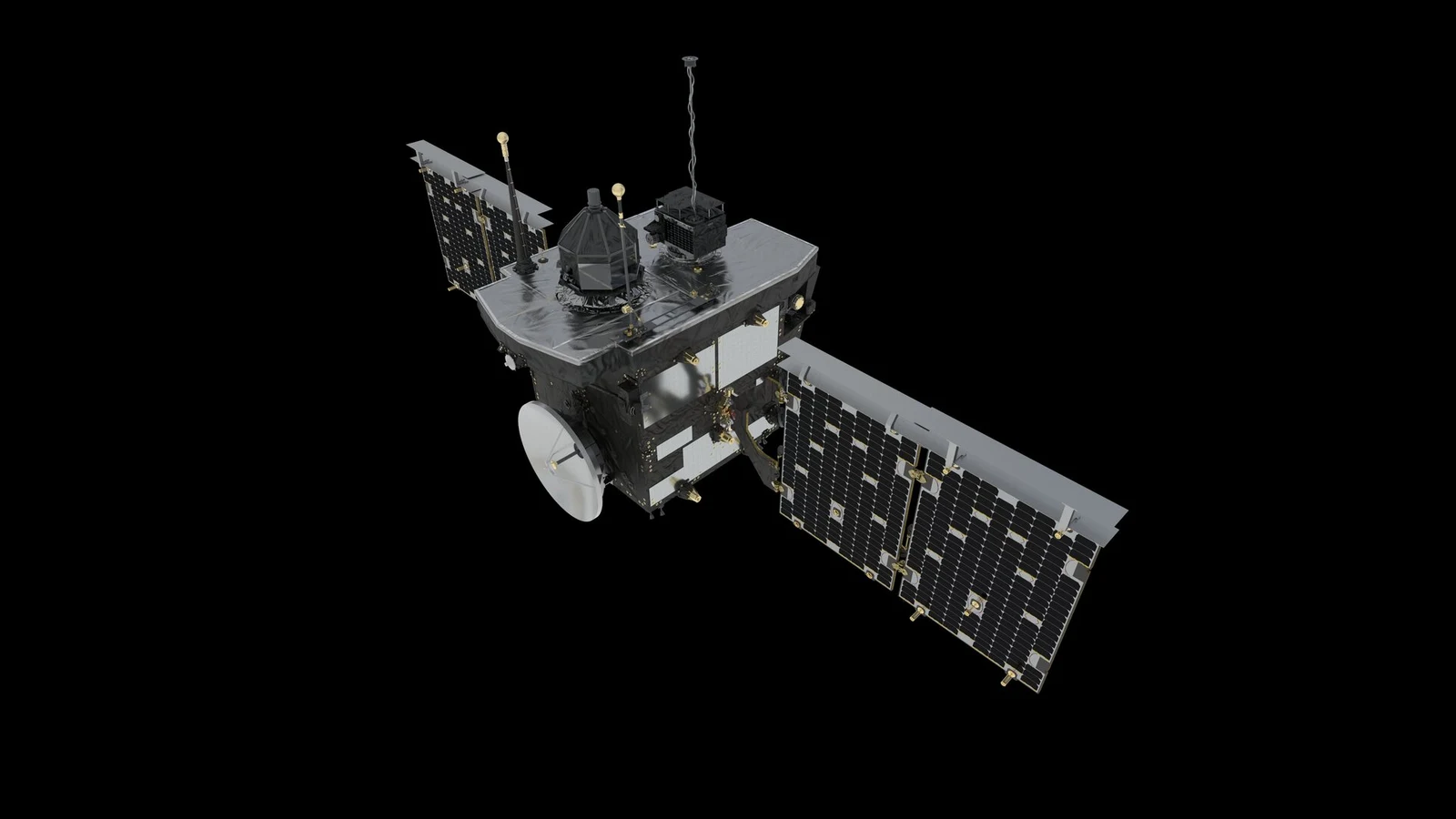
ESA's Comet Interceptor is designed around a simple measurement problem: a comet is a three-dimensional object, but a single spacecraft sees it from one moving line of sight at a time. The mission therefore combines a primary spacecraft with two probes. ESA says the three modules will travel as a unit after waiting near the Sun-Earth Lagrange point L2, then separate shortly before the flyby so they can observe the target from different positions at the same time.
Those positions are not just three cameras pointed at the same spectacle. Each spacecraft has a different location, viewing angle and complementary payload. When images and other readings share a time reference, researchers can compare what each line of sight sees in the nucleus, the hazy coma and the dust around it. That geometry provides depth information that is difficult to recover from one viewpoint, especially when jets, shadows and changing activity overlap in a two-dimensional image.
The design is also conditional. ESA plans to park the spacecraft until a suitable long-period comet or possibly an interstellar object is identified. The current factsheet describes a future target and a planned flyby, not a named comet that has already been mapped. The useful answer today is therefore how the observation is meant to work: simultaneous positions turn a fast pass into multiple constraints on shape, environment and motion, while the actual 3D profile remains future evidence.
How cameras, spectrometers and dust-field sensors divide the work
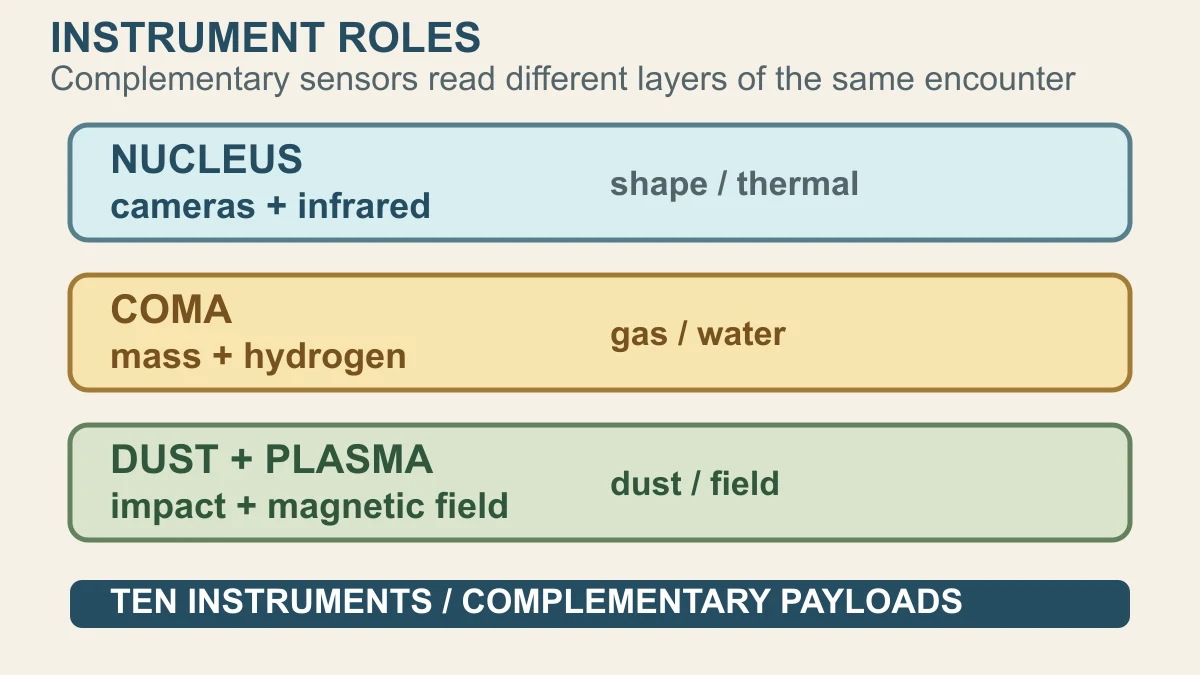
The nucleus is the solid source of the activity, so several cameras and an infrared sensor are aimed at its shape, surface and thermal or chemical properties. ESA describes the high-resolution Comet Camera and the Modular InfraRed Molecules and Ices Sensor on Spacecraft A, supported by cameras on Probes B1 and B2. Those instruments would view the nucleus from complementary directions, increasing the surface fraction that a single flyby can investigate.
The coma is the expanding envelope of gas and dust around an active comet. A mass analyser can capture neutral atoms, molecules and small ice particles to estimate their mass and chemical make-up, while the Hydrogen Imager is designed to use ultraviolet light from hydrogen to monitor water production from farther away. These are different questions from surface imaging: one asks what material is present and how dense it is, another asks how activity changes as the spacecraft approaches and passes the target.
The outer environment adds dust and plasma. ESA's instrument record assigns dust impact sensing, magnetometers, charged-particle spectrometers and related electric-field measurements to the mission's Dust, Fields and Plasma and Plasma Suite instruments. Taken together, the planned payload does not produce one magical comet number. It produces separate measurements that can be aligned by time and position, allowing a future analysis to test how the nucleus, coma, dust and solar-wind interaction fit together.
What the unknown target means for the mission's claims
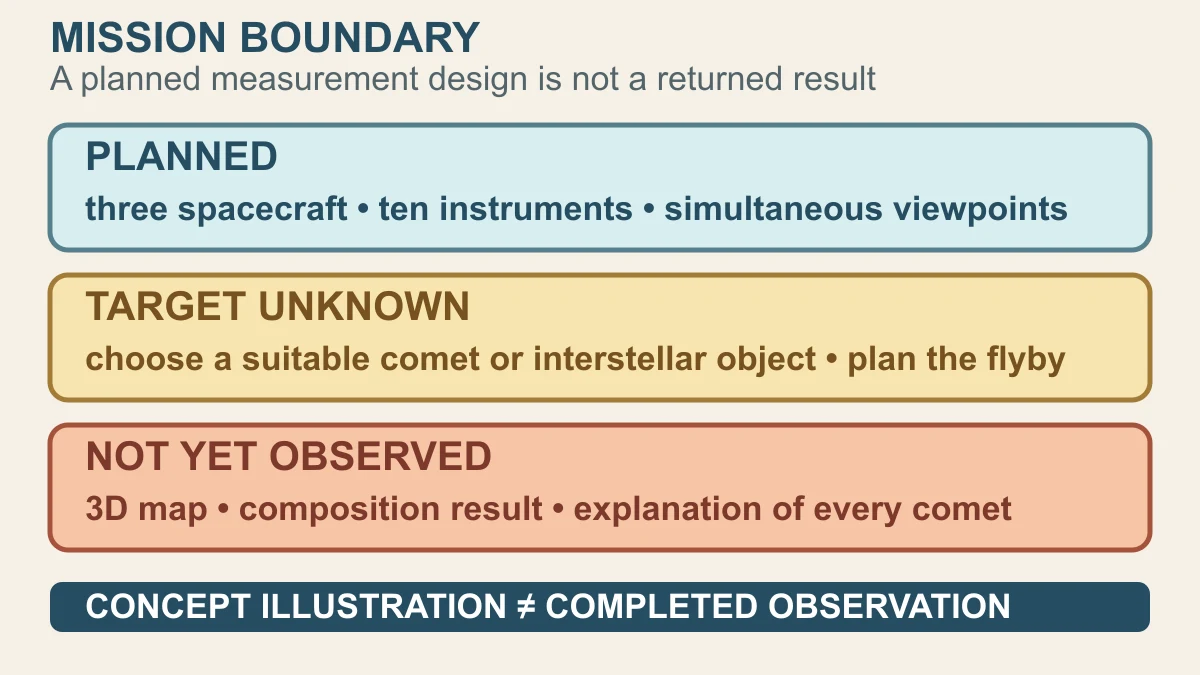
ESA calls the intended target dynamically new: a long-period comet that has made few or no previous trips through the inner Solar System, or a possible interstellar object. That choice matters because short-period comets have been heated and altered by repeated passages. A less-processed target could preserve different evidence about early Solar System material, but 'less processed' is a scientific expectation and selection goal, not a guarantee that every grain or surface feature is pristine in every sense.
Until a target is found and the encounter geometry is solved, the mission cannot say which side of a nucleus will face which probe, how active the coma will be, or whether the planned instruments will see every desired feature. Those details affect exposure, pointing, navigation, sampling and the interpretation of the final data. The CDF study and current ESA factsheet establish the architecture and its reasons; they do not substitute for a returned measurement set.
A completed Comet Interceptor result would need the target record, spacecraft positions, instrument calibration, time alignment and uncertainty alongside the images and spectra. Then a 3D reconstruction could be checked against the separate dust, gas and plasma observations. For now, the defensible conclusion is narrower: three spacecraft are being prepared to constrain a future comet from multiple directions. The map, composition and evolutionary story remain questions for the encounter, not facts already delivered by the concept illustration.
Sources and further reading
This article was written for Curiosity Desk. We do not copy other publishers or invent quotes. If a material error is found, we correct it openly.
Read the full standards →One answer should lead to a better question
Bring your curiosity to the group
Curious Minds is our public Facebook community for surprising science, strange history, Australian wildlife and everyday questions. No copied posts, no personal-friend invitations and no link dumping.
- Three self-contained discussion prompts each week
- Sourced answers and honest uncertainty
- Respectful conversation without spam