What cosmic rays make Phobos emit
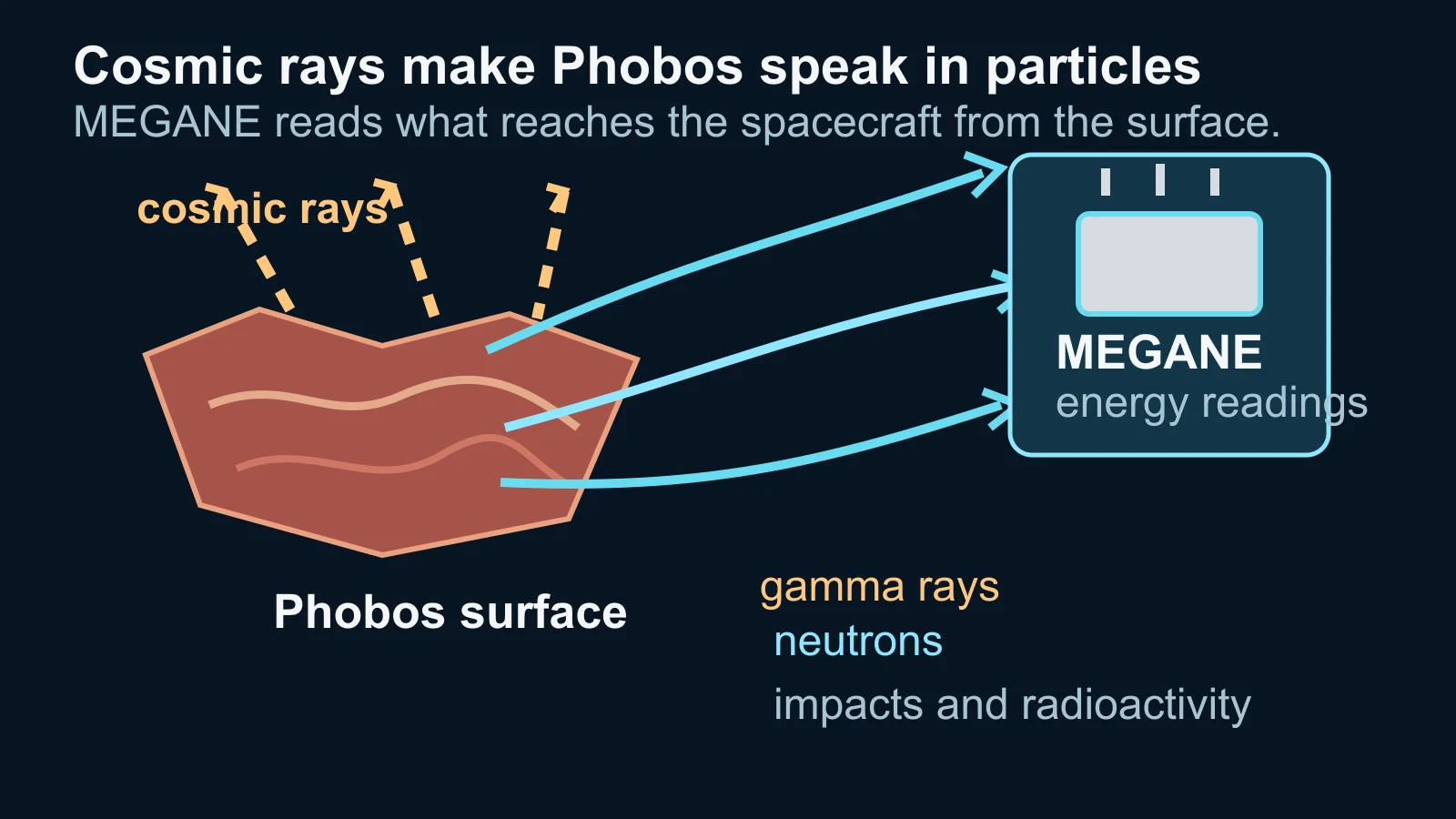
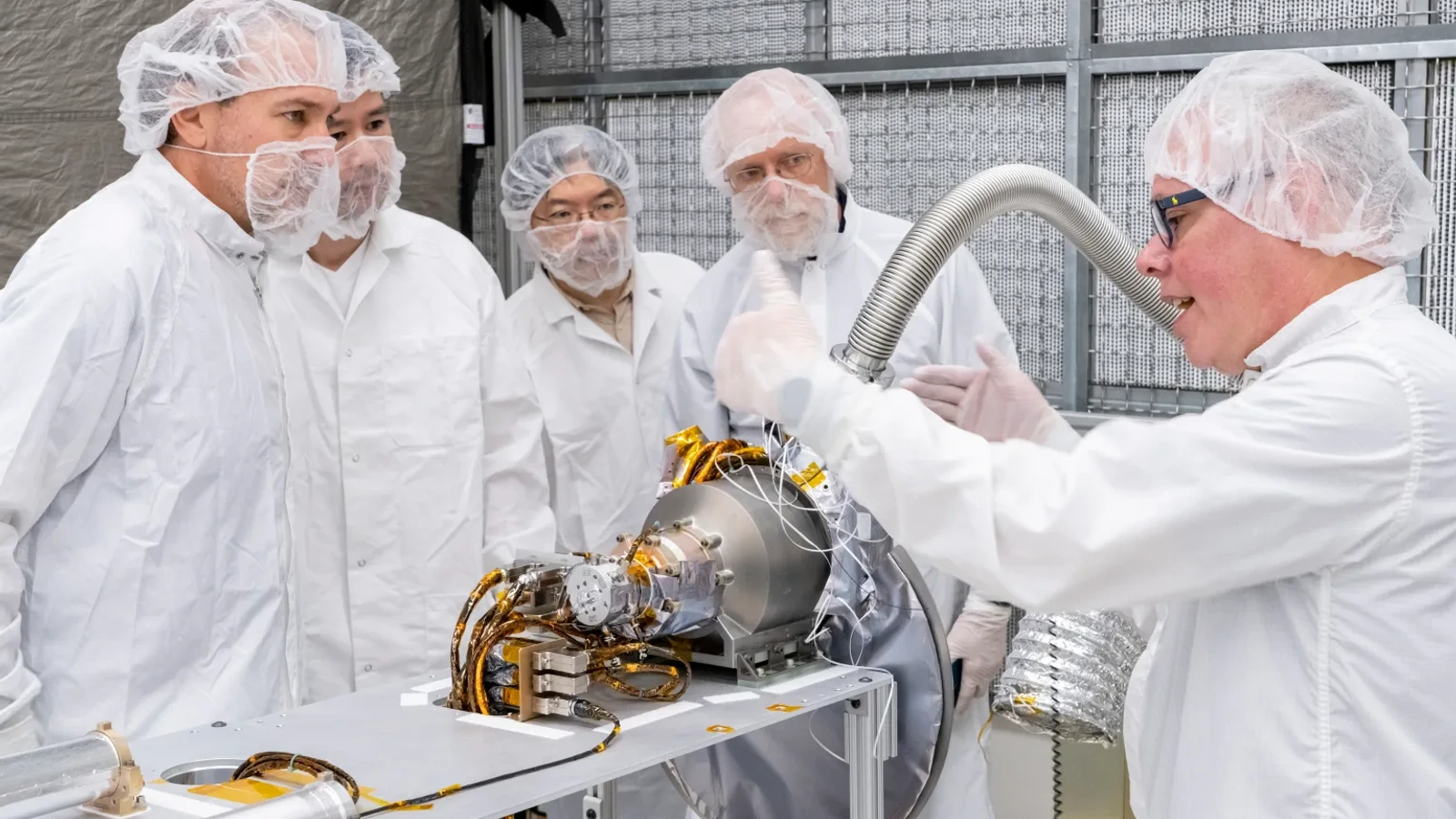
MEGANE will not photograph Phobos's chemistry. It will listen for particles produced when the moon's surface is continually exposed to space. JAXA describes cosmic rays striking the surface and natural radioactivity in the rocks as the sources of the gamma rays and neutrons that the instrument will detect.
Those particles carry information because their energies depend on the interactions taking place in and near the surface. A gamma ray or neutron arriving at the spacecraft is not a labelled sample. It is a signal that must be counted, measured and interpreted against the possible elements in Phobos's surface material.
That is the first important distinction in the headline question. MEGANE's measurement is remote spectroscopy: the instrument samples a stream of particle energies from orbit and uses those patterns to infer composition. It is not a scoop, a microscope or a visible-light camera, although its result can help decide where MMX should study and sample the moon.
How MEGANE turns energies into elements
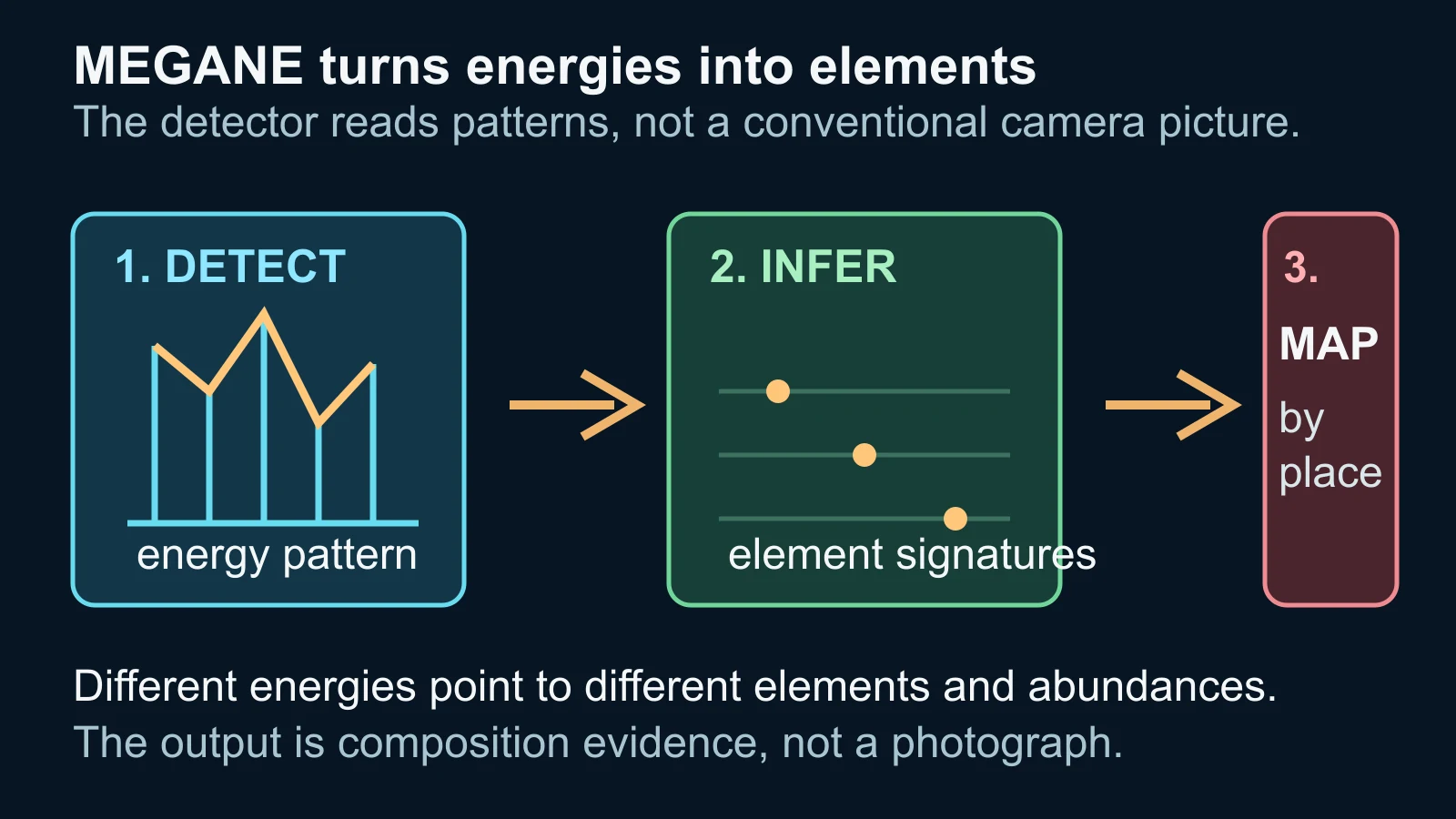
A spectrometer sorts incoming signals by energy. MEGANE's detector will record the energies of gamma rays and neutrons, and the mission team will compare the resulting patterns with the signatures expected from different chemical elements. The useful output is an estimate of which elements contribute to the signal and how their abundance changes across Phobos.
The diagram is intentionally short of invented numbers. The current JAXA instrument page establishes the particle sources and the compositional purpose, but it does not provide a returned MEGANE spectrum from Phobos. The article therefore explains the inference chain without pretending that a future peak, percentage or map has already been measured.
Once the spacecraft has enough observations from different positions, those inferences can be placed in a surface context. A composition map can then be compared with topography, visible and infrared observations, the eventual sampling locations and the other instruments on MMX. The strength of the result will come from that cross-checking, not from one dramatic line on a graph.
Why orbit gives the measurements a surface context
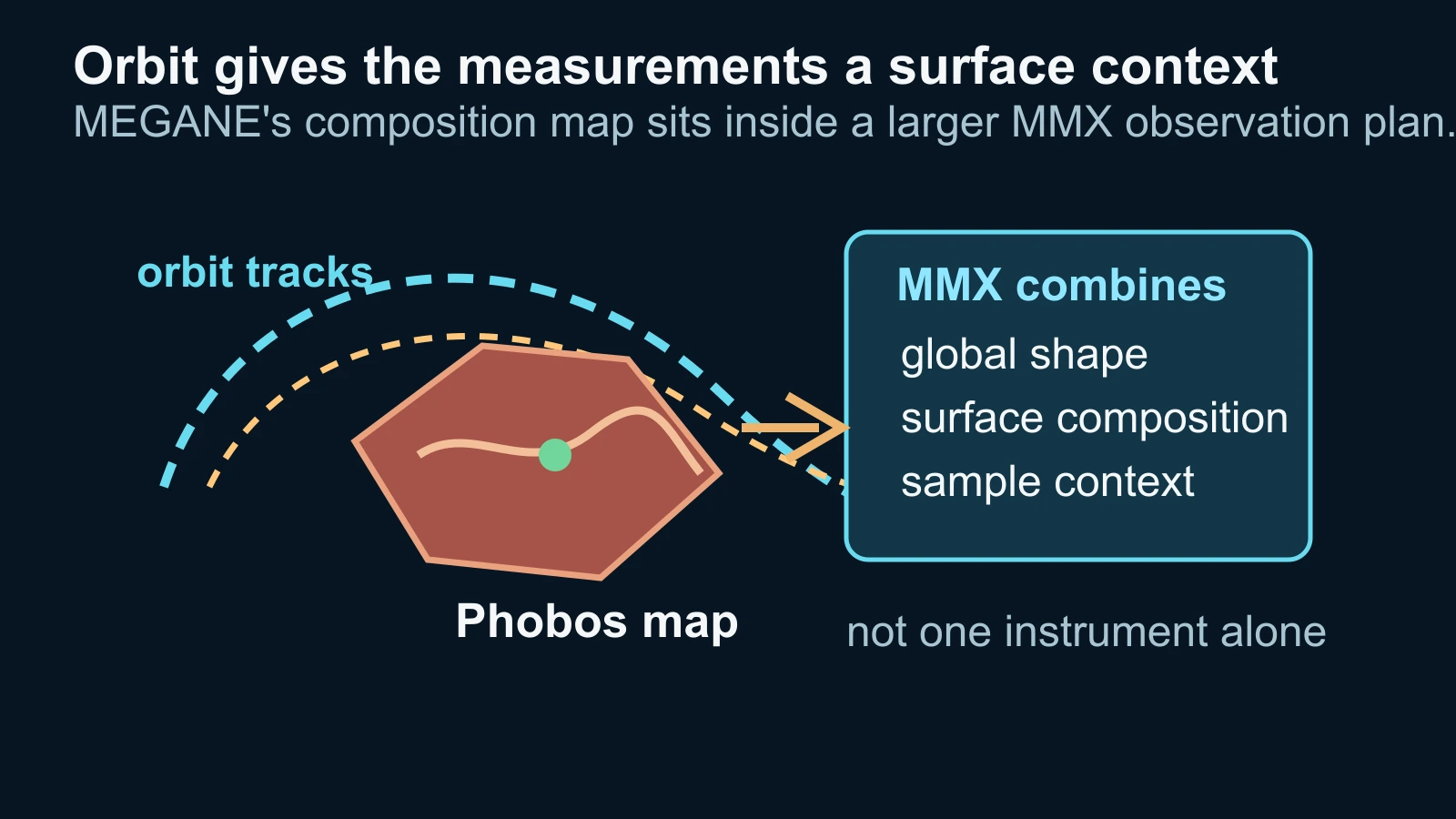
JAXA's MMX plan puts remote sensing before the sample return. The spacecraft will construct a global shape and topography model of Phobos, make higher-resolution observations, choose a landing site and later conduct detailed observations of selected locations. MEGANE's composition evidence is one layer in that sequence.
The current status matters. JAXA records that MMX launched on October 20, 2026, and is beginning a roughly five-year journey and mission. Its schedule places the journey toward the Martian sphere in 2027, Phobos observations and sampling in the 2027–2030 phase, and return to Earth in 2031. Those are mission plans and milestones, not MEGANE results already received from Phobos.
A composition measurement can still be useful before the capsule comes home. It can help identify regions that deserve closer observation and provide context for the grains that MMX plans to collect. But the remote map and the returned sample answer different questions: one surveys the moon from the spacecraft, while the other allows laboratories on Earth to examine material directly.
What composition can—and cannot—say about Phobos's origin
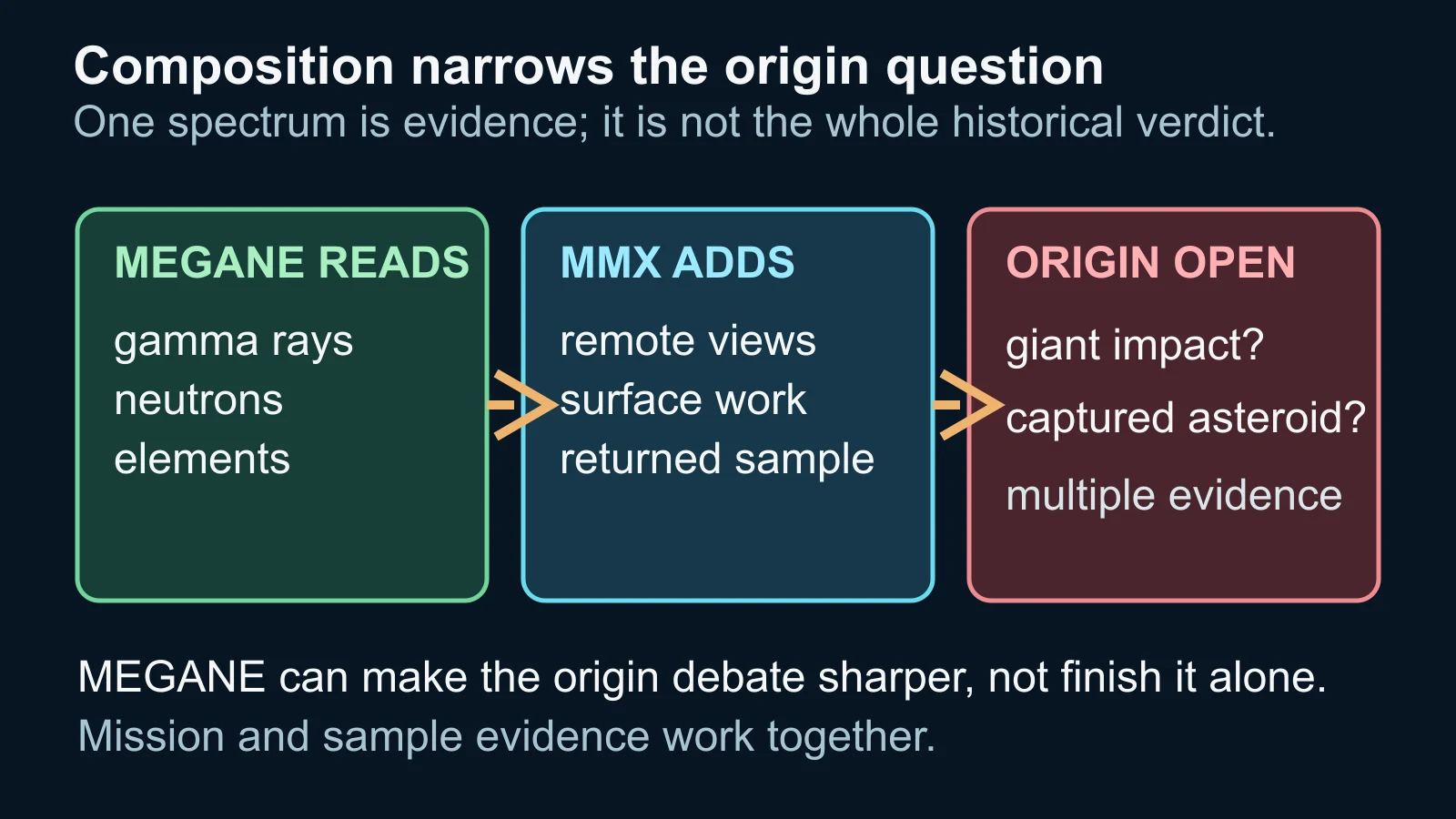
Phobos has two broad origin stories. In the giant-impact hypothesis, debris from a collision involving Mars and a large body gathered into the moon. In the capture hypothesis, Phobos began as an asteroid that Mars later trapped. JAXA presents these as competing explanations rather than a debate that has already been settled.
MEGANE can make that debate more testable by asking what elements are present, how they are distributed and whether the pattern looks more consistent with material connected to Mars, an asteroid-like body or a mixture. But elemental composition is evidence, not a one-step verdict. The interpretation needs the moon's shape, surface colours, minerals, gravity, other particle measurements and the material MMX brings home.
The honest boundary is therefore two-part. MMX has now launched, and MEGANE has a specific, source-supported way to read Phobos from orbit. What has not happened yet is the return of a Phobos composition map or sample result. Until those observations exist, the mission can sharpen the origin question and prepare the test; it cannot claim which history won.
Sources and further reading
This article was written for Curiosity Desk. We do not copy other publishers or invent quotes. If a material error is found, we correct it openly.
Read the full standards →One answer should lead to a better question
Bring your curiosity to the group
Curious Minds is our public Facebook community for surprising science, strange history, Australian wildlife and everyday questions. No copied posts, no personal-friend invitations and no link dumping.
- Three self-contained discussion prompts each week
- Sourced answers and honest uncertainty
- Respectful conversation without spam