In this processor, each qubit is a movable atom
A neutral-atom quantum computer uses electrically neutral atoms as physical qubits. Focused laser beams create optical tweezers: tiny traps that hold cooled atoms in a vacuum. Two long-lived internal states of each atom can encode the quantum alternatives called 0 and 1, including a superposition of both.
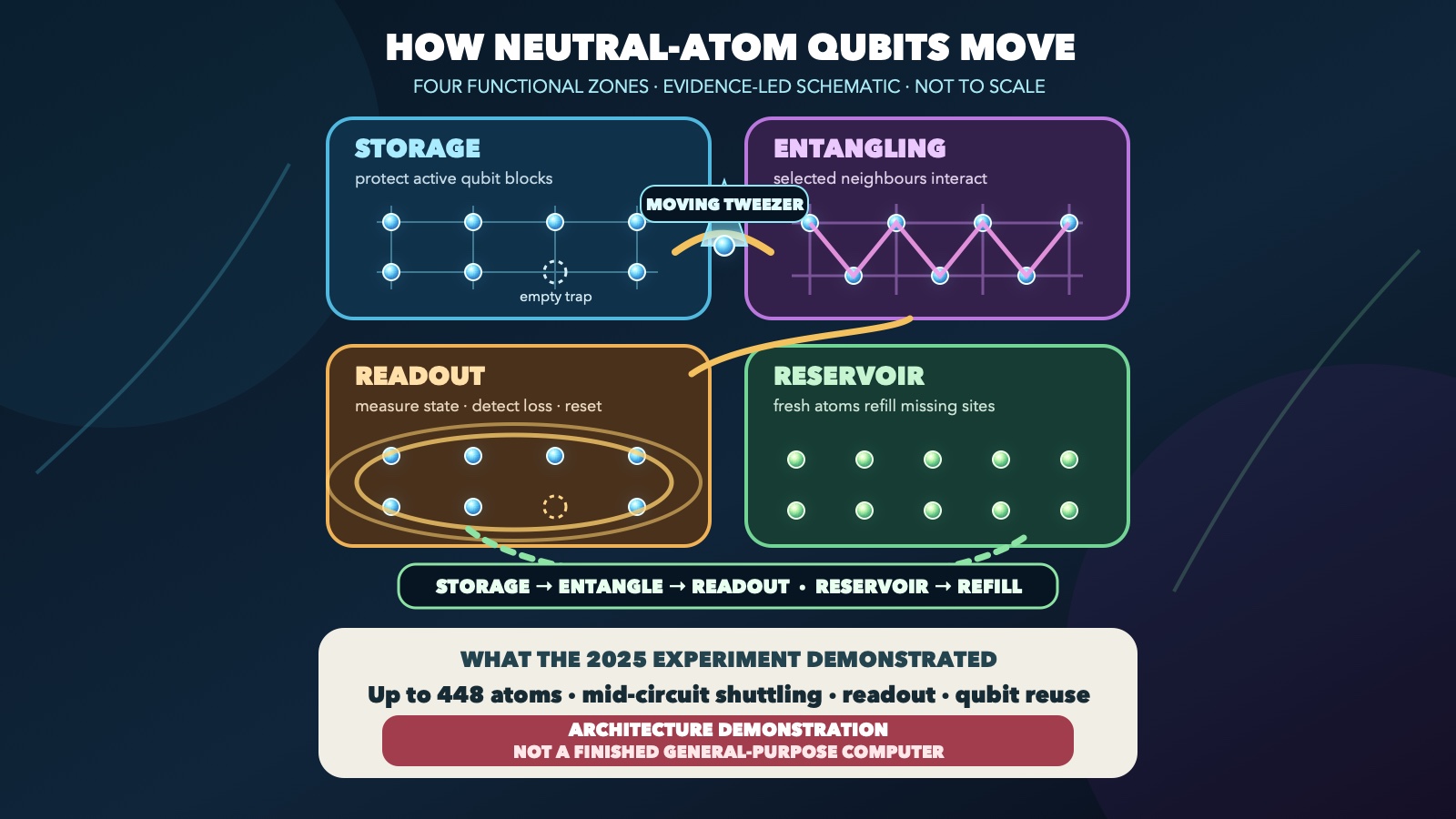
The unusual advantage is geometric. The trap locations are made by programmable light, so they do not have to behave like wires fixed permanently on a chip. Static tweezers can hold an ordered array while moving tweezers pick up atoms and shuttle them to new positions during a circuit.
Moving atoms changes which qubits can interact
Quantum algorithms need selected qubits to become entangled. In a neutral-atom processor, lasers can briefly excite atoms to high-energy Rydberg states. Nearby excited atoms interact strongly, enabling an entangling gate, but qubits that should not interact need to remain safely separated or otherwise protected.
Rearrangement makes that neighbourhood programmable. An array can bring selected atoms together in an entangling zone, apply parallel gates, then separate or interlace blocks for the next operation. The machine is not carrying a computed answer through space like a parcel; it is changing the interaction map while preserving the quantum state stored in the atoms.
A 448-atom experiment divided the machine into working zones
A 2025 Nature study used reconfigurable arrays of as many as 448 rubidium-87 atoms. Its logical processor separated jobs into storage, entangling, readout and reservoir zones. A two-dimensional acousto-optic deflector steered moving laser traps, while other optical controls performed single-qubit and entangling operations.
This zoned layout matters because measurement light that reveals one qubit can disturb another. Active logical information could wait in a protected storage zone while a used block moved to readout. Fresh atoms from the reservoir could fill empty sites, allowing the physical arrangement to be repaired without treating every lost atom as the end of the whole run.
Measurement can reveal loss without throwing every atom away
Many atomic readout methods deliberately remove atoms. The experiment instead used a state-selective optical lattice to convert an atom's internal qubit state into position. Imaging could distinguish the positions and detect whether an atom was missing, while retaining most atoms for another cycle.
Measured blocks were re-initialised and cooled before reuse. During deep circuits, logical information was teleported into a fresh encoded block, leaving accumulated physical errors behind in the old one. That old block could then be measured, reset and brought back. The aim was constant entropy: preventing physical disorder from growing without bound as layers accumulate.
Rearrangement helps error correction but does not remove errors
Motion is a capability, not a magic shield. Every transport, laser pulse, measurement and wait can introduce loss or decoherence. The architecture still needs quantum error-correcting codes, repeated checks and a decoder that infers the most likely errors from measured syndromes and known atom losses.
In one four-round surface-code test, the larger distance-five code produced a lower logical error per round than distance three when loss-aware machine-learning decoding was used. That is evidence of below-threshold behaviour for the tested circuit. It is not proof that arbitrary computations can already be extended indefinitely on the same hardware.
The result is an architecture demonstration, not a finished product
The researchers demonstrated ingredients for universal fault-tolerant processing, including repeated correction, logical operations, teleportation-based rotations and qubit reuse. The deep-circuit protocols involved dozens of logical qubits and hundreds of logical teleportations. They also reported practical bottlenecks: desktop-computer processing added latency, and programmed waveform memory limited some experiments to 27 layers.
A useful general-purpose quantum computer would still need much larger systems, lower and well-characterised error rates, fast control and decoding, reliable components, and an application that beats a classical alternative after all overhead is counted. Neutral atoms make one part of that challenge unusually tangible: the qubit layout itself can be rebuilt while the calculation is running.
Sources and further reading
This article was written for Curiosity Desk. We do not copy other publishers or invent quotes. If a material error is found, we correct it openly.
Read the full standards →One answer should lead to a better question
Bring your curiosity to the group
Curious Minds is our public Facebook community for surprising science, strange history, Australian wildlife and everyday questions. No copied posts, no personal-friend invitations and no link dumping.
- Three self-contained discussion prompts each week
- Sourced answers and honest uncertainty
- Respectful conversation without spam