A planet briefly blocks a little starlight
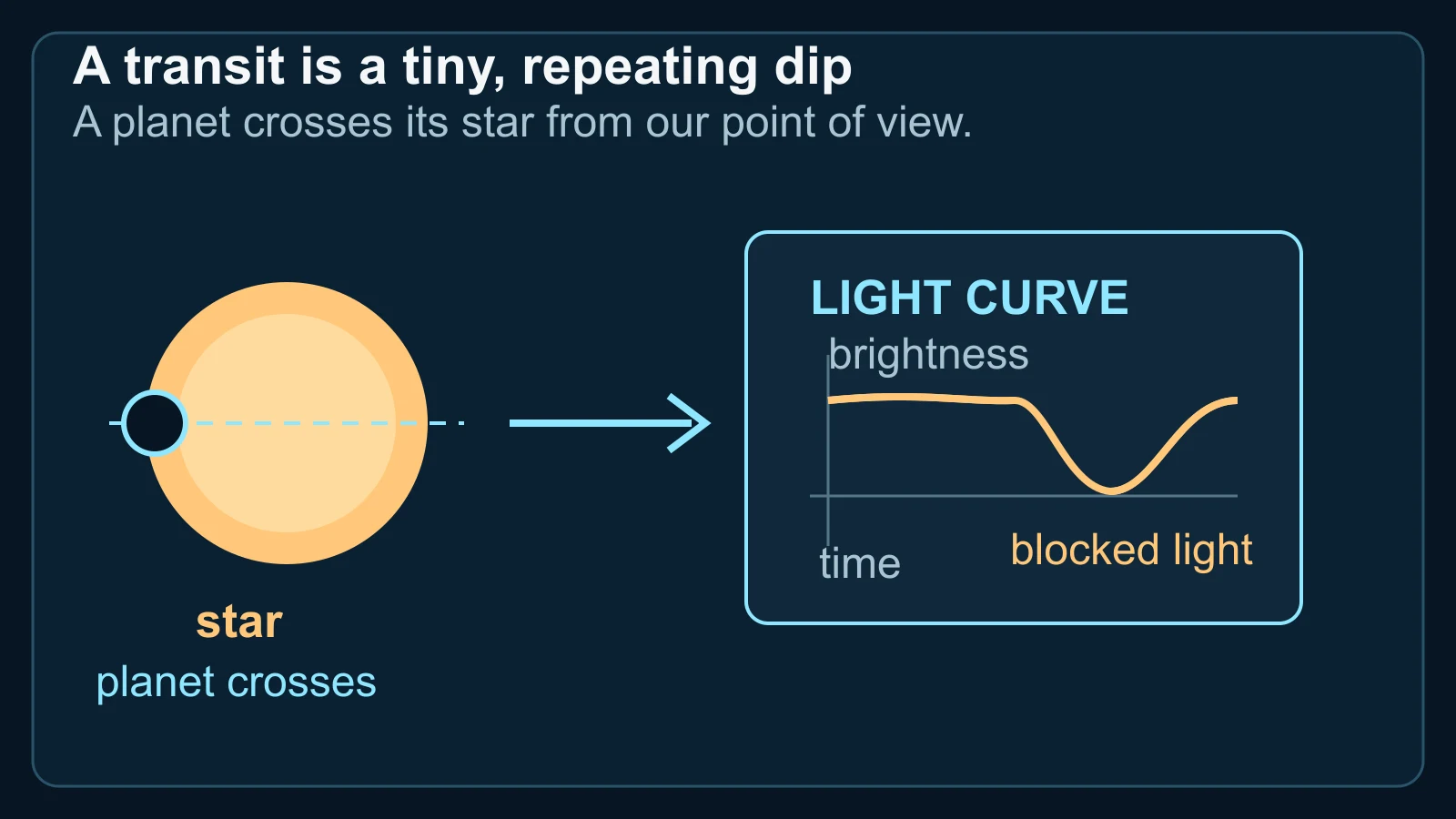
PLATO's basic trick is to watch a star instead of trying to photograph a planet beside it. When a planet crosses in front of its star from our point of view, it blocks a small amount of the star's light. A camera that measures brightness repeatedly can record that change as a dip in a light curve.
The dip is tiny because a planet usually covers only a small fraction of its star's visible disk. It is also a timing signal: if the same kind of dip returns at regular intervals, the observations can be tested against an orbiting body passing across the star again.
That is what the opening question means by ‘watching stars dim’. PLATO is planned to look for regular transit patterns in the light of bright Sun-like stars. It is not already reporting a new Earth twin; ESA lists the mission's launch as planned for April 2027, with the observations still ahead.
Why PLATO uses 26 cameras instead of one
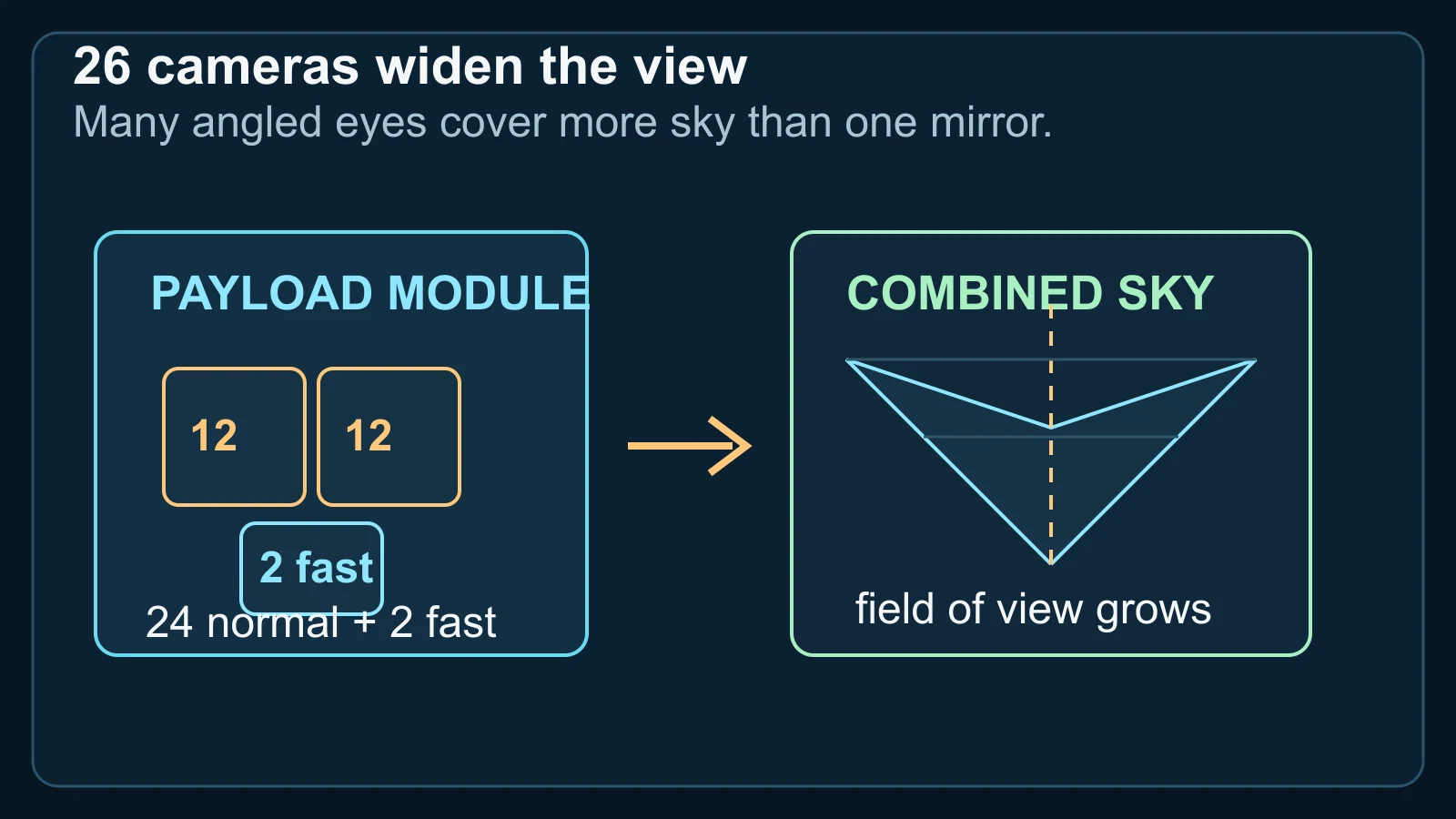
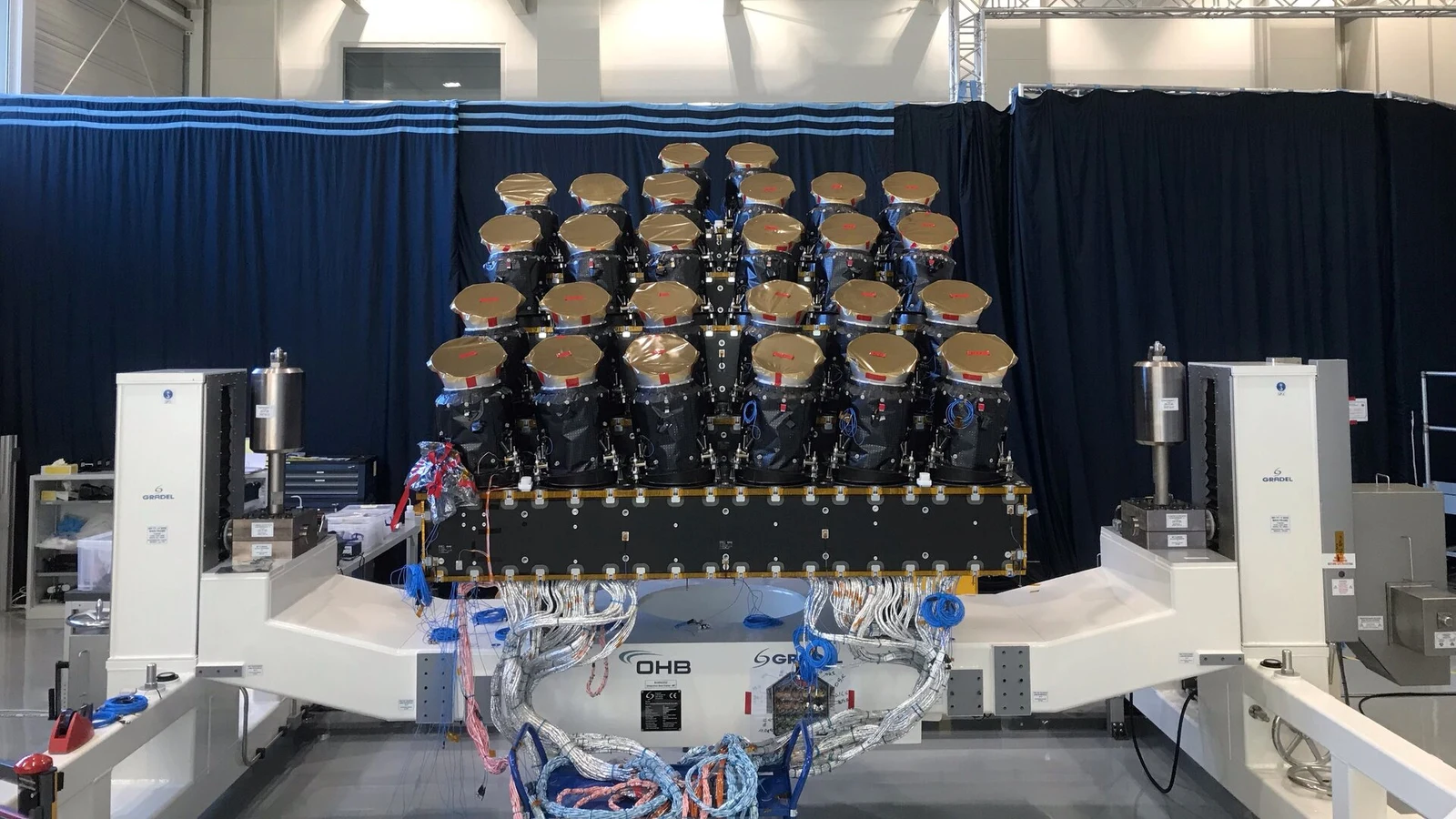
PLATO needs to watch a large patch of sky for a long time, so ESA designed a payload with 26 cameras rather than one very large mirror. Twenty-four normal cameras are grouped into four sets that point outward, increasing the combined field of view. Two fast cameras handle bright stars and provide fine guidance and navigation.
ESA's camera page gives the scale of the arrangement: each normal camera has a 1037-square-degree field of view, while the grouped layout reaches 2232 square degrees—about five percent of the whole sky at once. The mission page lists more than 200,000 stars as a target scale. Many angled views let PLATO watch more stars in parallel while its measurements still overlap in a coordinated instrument.
The exact payload photograph shows why the number matters. The repeated gold-covered apertures are not decorative copies of a single lens; they are the camera heads in the flight payload under integration. In the source-bounded diagram, the count is simplified into 24 normal plus two fast cameras and the wider combined sky view.
How repeated dips become a candidate transit
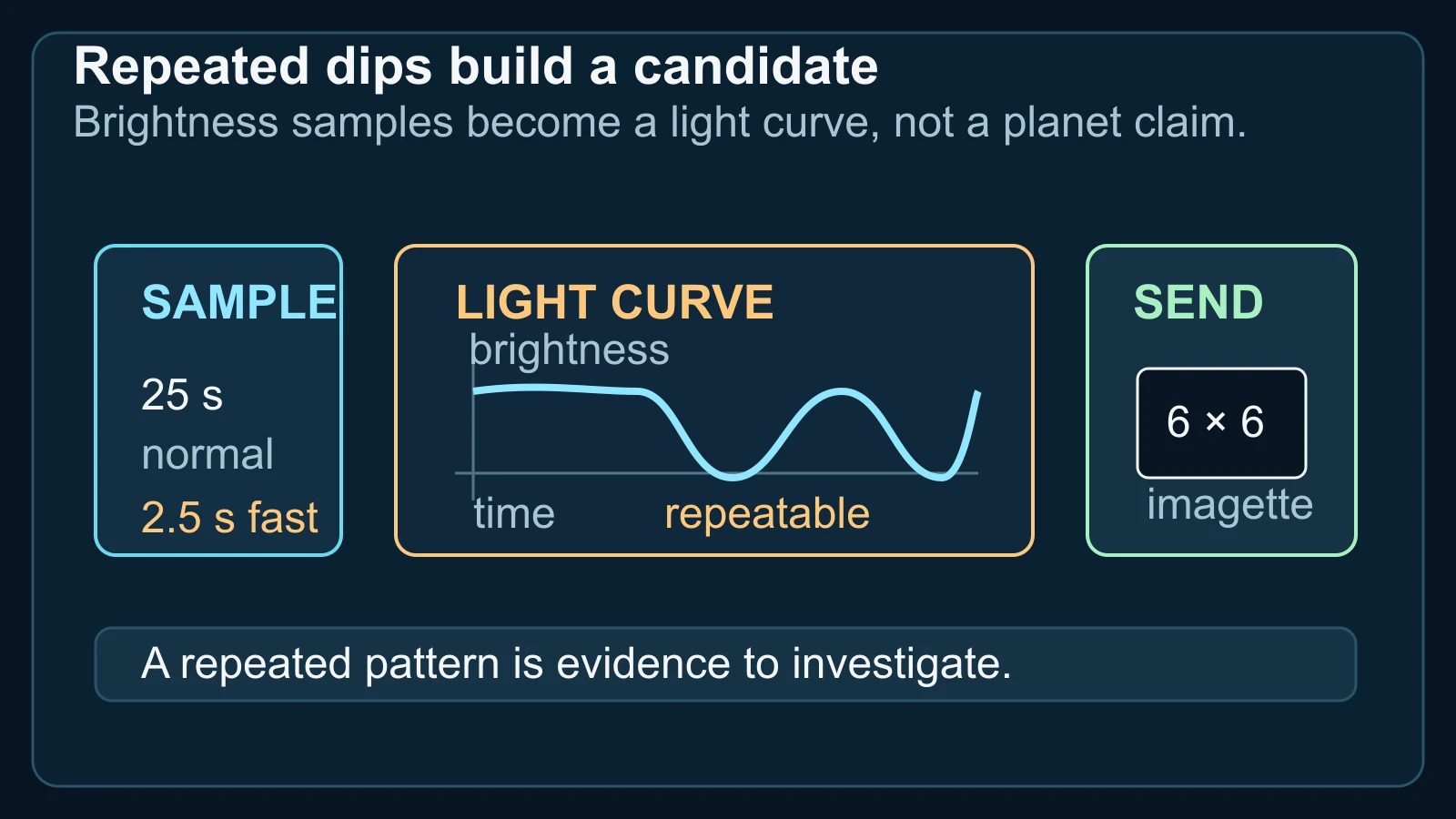
The normal cameras acquire images every 25 seconds. The two fast cameras capture an image every 2.5 seconds, or ten times as often, although they are limited to bright stars. Those repeated samples let the mission follow how a target's brightness changes instead of relying on a single exposure.
PLATO cannot send every pixel from its huge field back to Earth. ESA says the mission will send a smaller six-by-six-pixel image around each target star, called an imagette. That compact patch contains enough pixels to capture a planet crossing the star while keeping the downlinked data manageable.
A recurring dip is therefore a candidate transit: a pattern worth testing against timing and the star's own behaviour. The word candidate does important work. The light curve identifies a possible crossing geometry; it does not, by itself, supply every property needed to call the object an Earth-like or habitable planet.
What follow-up measurements still have to establish
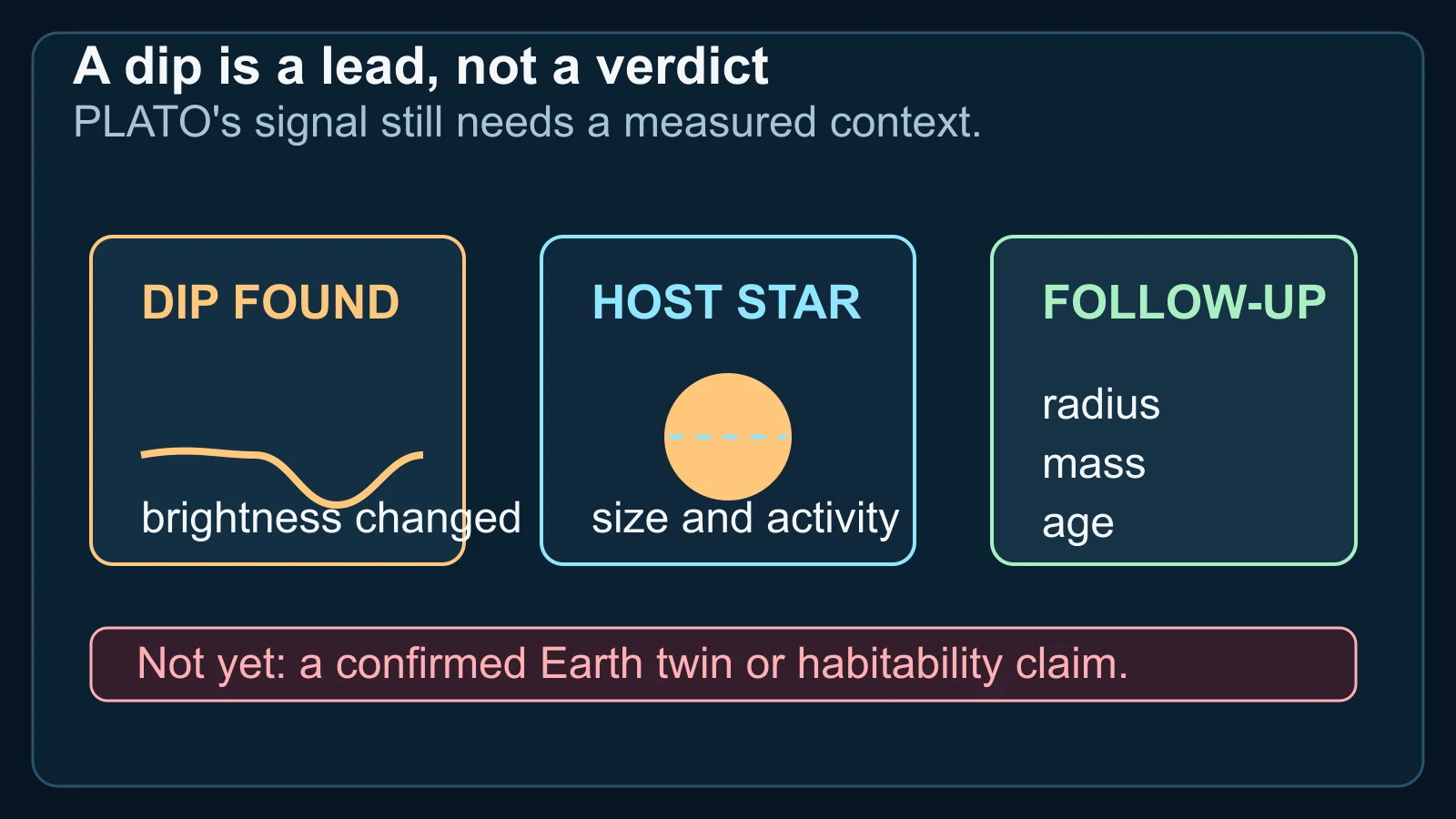
A transit can reveal a planet's size relative to its star, but a useful planet description needs more context. ESA's PLATO factsheet says the mission aims to characterise rocky, icy and giant planets through measurements of radii, masses and ages, while also studying the host stars through stellar seismology. Those are planned mission objectives, not measurements already returned by PLATO.
The host star matters because the size of the star sets the scale of the dip. A repeated light change must be interpreted with what is known about the star, the timing of the event and the wider observing record. ESA also says PLATO will identify interesting targets for further investigation by the James Webb Space Telescope and ground-based observatories.
So the honest answer is a chain, not a single camera moment: 26 cameras widen the search, repeated brightness samples expose a possible transit, and later measurements establish what kind of planet and system it is. Until those observations and follow-up checks exist, a dip is a promising lead—not a confirmed Earth twin or a verdict on habitability.
Sources and further reading
This article was written for Curiosity Desk. We do not copy other publishers or invent quotes. If a material error is found, we correct it openly.
Read the full standards →One answer should lead to a better question
Bring your curiosity to the group
Curious Minds is our public Facebook community for surprising science, strange history, Australian wildlife and everyday questions. No copied posts, no personal-friend invitations and no link dumping.
- Three self-contained discussion prompts each week
- Sourced answers and honest uncertainty
- Respectful conversation without spam