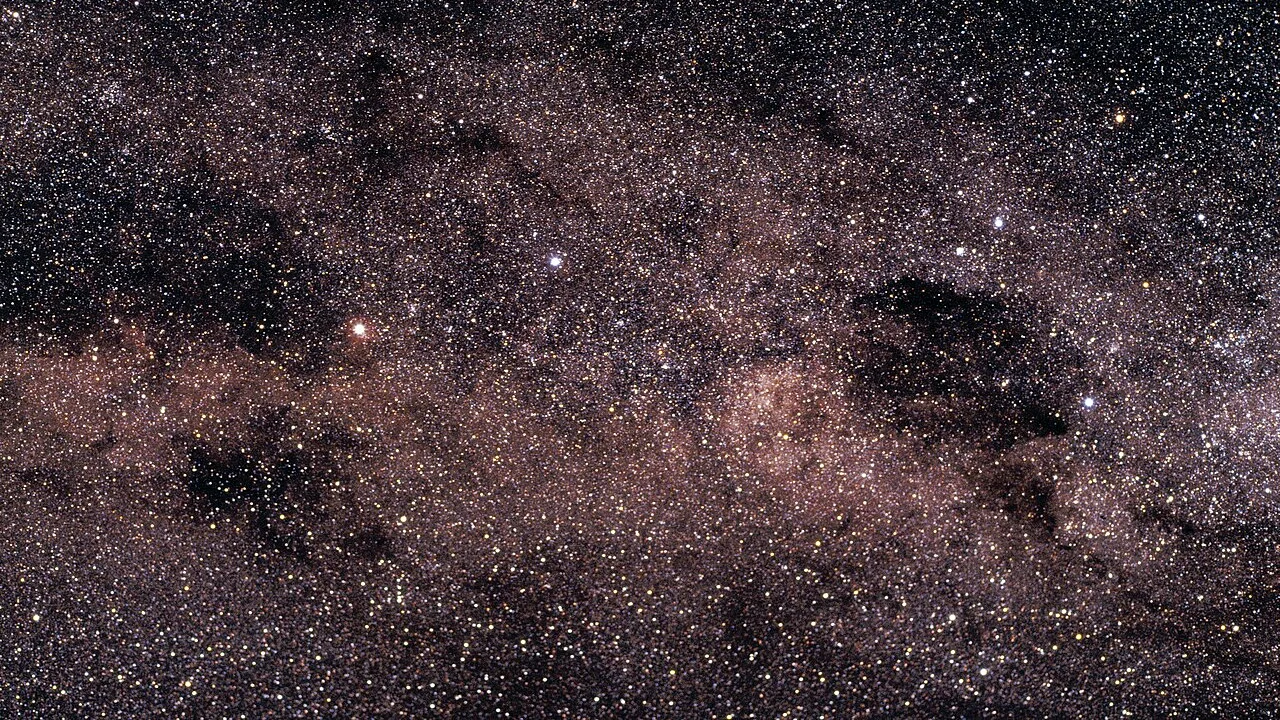
LIGO reads a phase shift smaller than ordinary noise
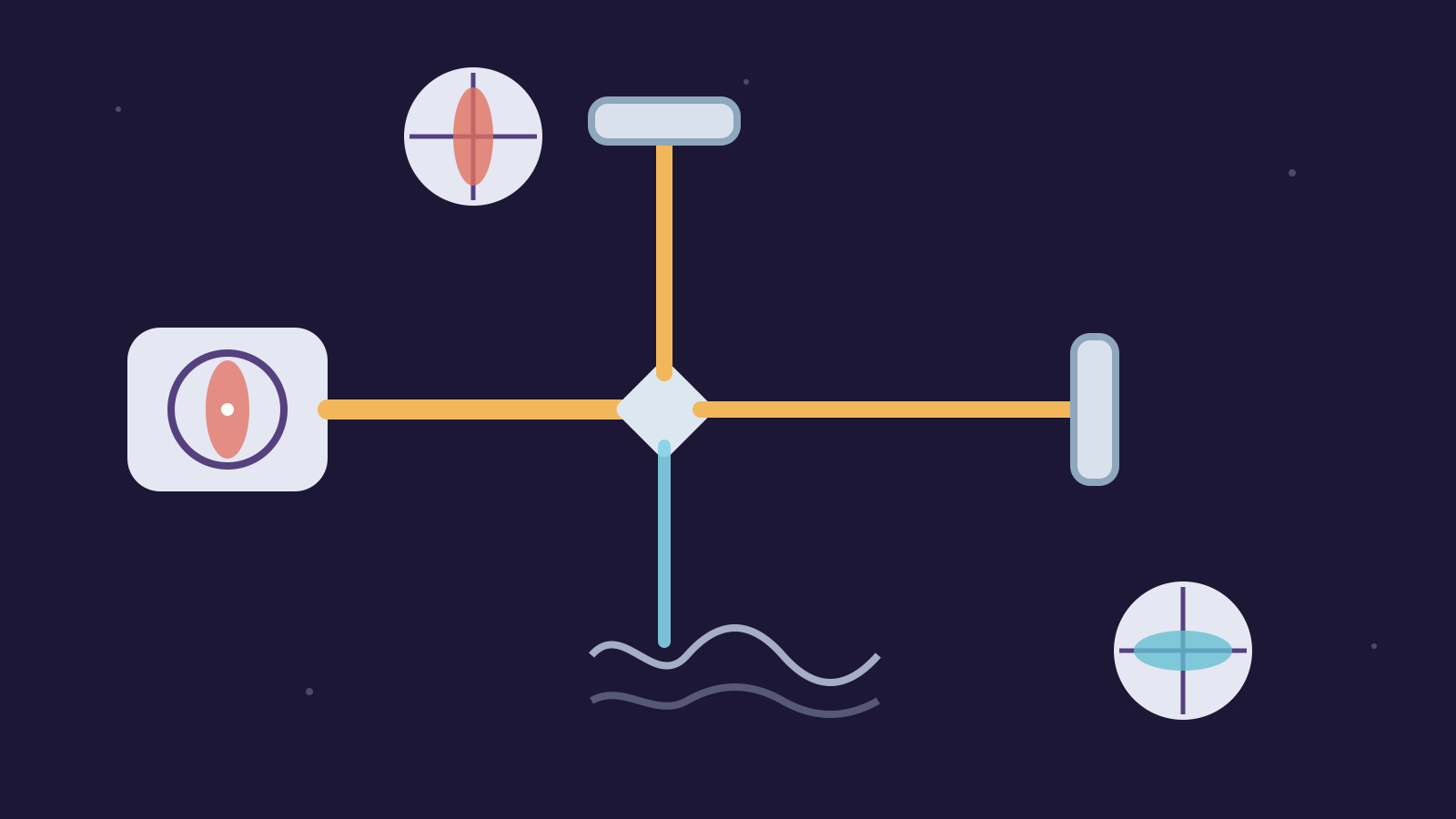
Each LIGO detector sends laser light along two perpendicular four-kilometre arms. A passing gravitational wave stretches one arm while squeezing the other by an extraordinarily small amount. Returning beams interfere, and a change in their relative phase reveals the disturbance.
At that precision, noise is not limited to trucks, wind or thermal motion. Light itself arrives with quantum fluctuations. Random variation in photon arrival produces shot noise, which is especially important at higher gravitational-wave frequencies. Fluctuating photon pressure can also push the 40-kilogram mirrors, adding radiation-pressure noise at lower frequencies.
Squeezing changes the shape of uncertainty
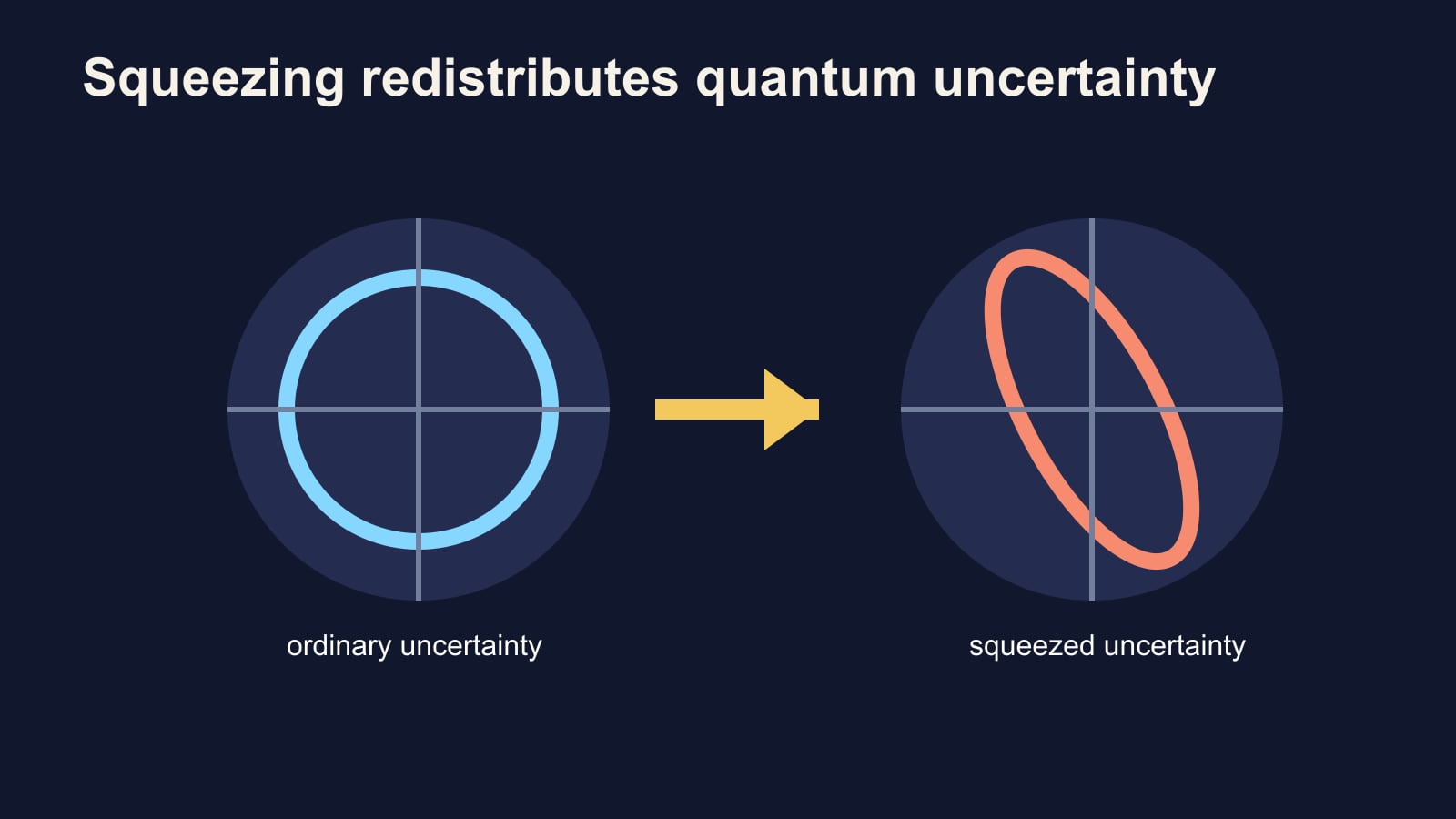
Quantum mechanics does not allow both the phase and amplitude of light to be perfectly definite. Ordinary vacuum fluctuations can be pictured as a round uncertainty cloud: similar uncertainty in both quantities. A squeezed state narrows that cloud in one direction while stretching it in the other.
The name therefore does not mean compressing the beam into a smaller pipe or turning down its power. Engineers prepare a special optical state and inject it into the interferometer's otherwise empty output port. If phase uncertainty is narrowed, photon-counting precision improves—but the corresponding amplitude uncertainty grows, increasing fluctuations that can push on the mirrors.
Early squeezing traded one frequency band for another
LIGO began using squeezed light in its third observing run to reduce high-frequency quantum noise. That made the phase measurement cleaner where shot noise dominated. The unavoidable widened amplitude uncertainty, however, strengthened radiation-pressure noise and could reduce sensitivity at lower frequencies.
This is the balloon analogy with a physical cost: squeeze one axis and another bulges. Simply adding more laser power has a related trade-off because more photons improve counting precision but increase the random force on the mirrors. A broadband detector needs the preferred squeezing direction to change with frequency.
A filter cavity rotates the squeeze angle
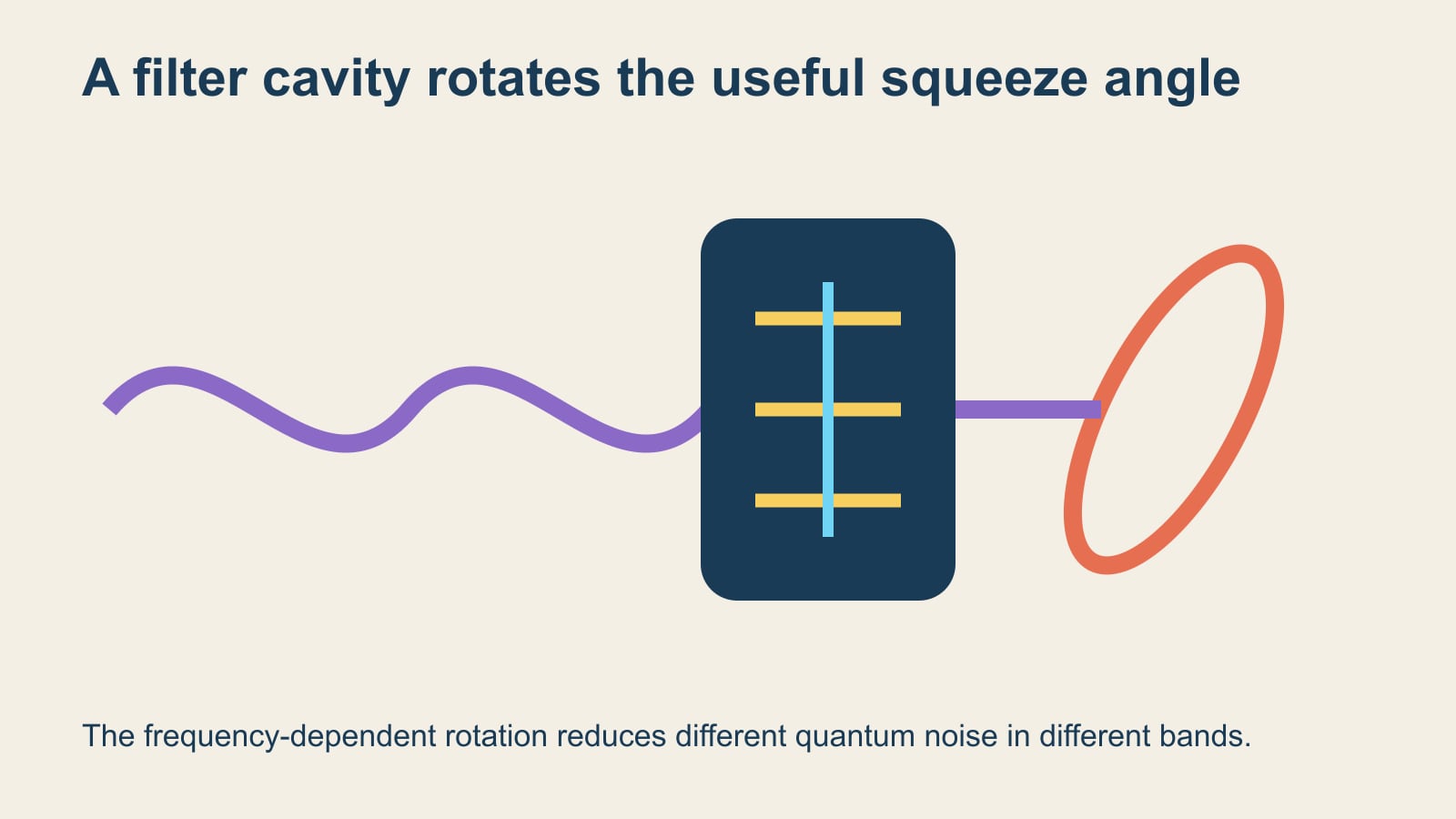
LIGO's A+ upgrade sends the squeezed state through a 300-metre optical filter cavity before it enters the main interferometer. The cavity delays different frequency components by different amounts, rotating which quadrature—the phase-like or amplitude-like property—carries the smaller uncertainty.
At high frequencies the system suppresses phase uncertainty and shot noise. At low frequencies it rotates the squeezed state so amplitude fluctuations and mirror kicks are reduced instead. The light is not responding to a gravitational wave in advance; the cavity prepares a frequency-dependent noise pattern against which later signals are measured.
The gain is sensitivity, not stronger gravitational waves
In the full-scale Physical Review X result, frequency-dependent squeezing reduced quantum noise across a broad band. The reported low-frequency improvement increased detector range by roughly 15 to 18 percent compared with no squeezing, corresponding to a much larger searchable volume and a possible detection-rate increase of up to 65 percent for relevant sources.
Squeezed light does not amplify a gravitational wave, create extra signal or evade the uncertainty principle. It engineers where unavoidable uncertainty appears. By moving less of it into the measurement that matters at each frequency, LIGO can distinguish fainter ripples from its own quantum machinery and listen to a larger region of the Universe. A larger reach also increases the chance of observing rare systems and comparing many events rather than relying on a few exceptionally loud collisions.
Quantum engineering still leaves ordinary detector noise
Squeezing targets the quantum part of LIGO's noise budget. Ground motion, thermal motion in mirror coatings and suspensions, scattered light, electronics and environmental disturbances do not disappear when the squeezed state is switched on. Their importance changes with frequency, so improvements matter only where quantum uncertainty is a significant limit.
The filter cavity and squeezer also have losses, alignment requirements and control systems of their own. Lost photons mix ordinary vacuum fluctuations back into the prepared state and weaken the benefit. The achievement is therefore not a perfect quantum trick in isolation: it is a controlled optical subsystem operating inside a full-scale observatory while the rest of the instrument remains calibrated and stable.
Sources and further reading
This article was written for Curiosity Desk. We do not copy other publishers or invent quotes. If a material error is found, we correct it openly.
Read the full standards →One answer should lead to a better question
Bring your curiosity to the group
Curious Minds is our public Facebook community for surprising science, strange history, Australian wildlife and everyday questions. No copied posts, no personal-friend invitations and no link dumping.
- Three self-contained discussion prompts each week
- Sourced answers and honest uncertainty
- Respectful conversation without spam