The first job was to know where to look
A rocket stage hitting the Moon is easy to imagine and hard to observe. There is no atmosphere to make a bright trail, the impact is not visible to the naked eye from Earth and the target is moving through a changing geometry. NASA's pre-impact plan combined ground-based telescopes with spacecraft observations because each platform had a different chance to catch useful evidence. The used Falcon 9 upper stage was expected to strike near the Einstein and Bell craters on 5 August 2026 after solar activity and gravitational forces changed its return path from the January 2025 Blue Ghost 1 launch.
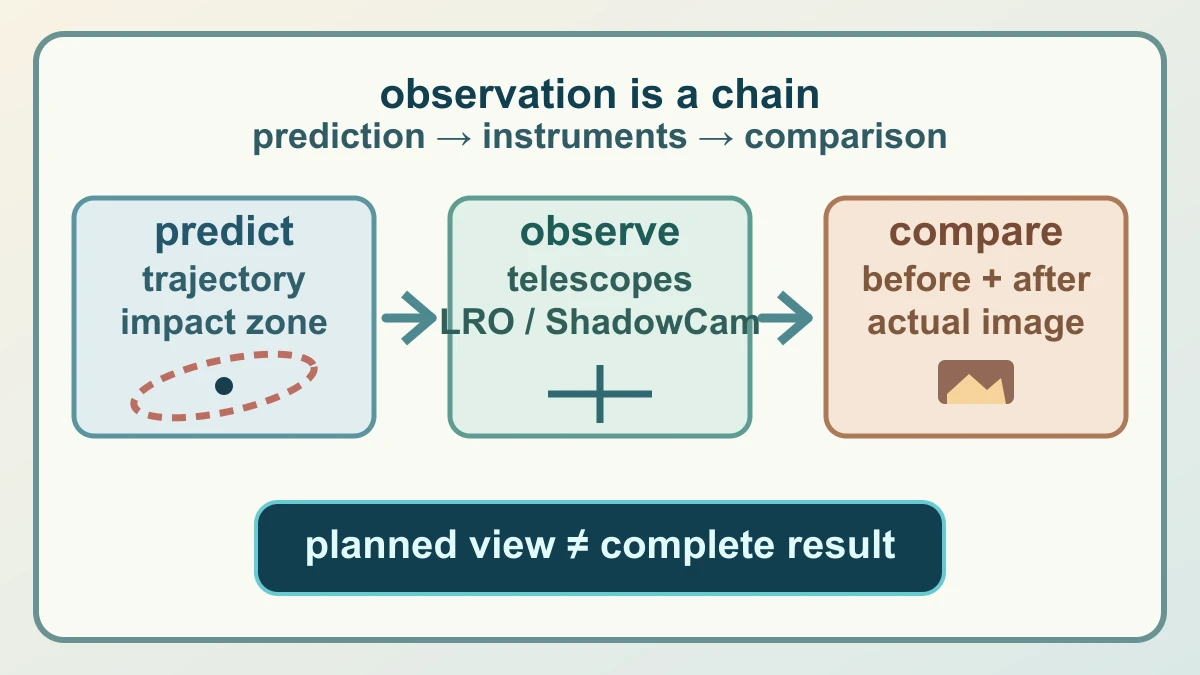
Prediction narrowed the search before any camera could help. NASA said independent astronomers first identified the trajectory from public data, after which the Center for Near Earth Object Studies refined the path and confirmed the expected lunar impact. After the event, NASA showed two predicted regions, each about 2.1 miles long and 0.4 miles wide; one calculation included lunar terrain and the other did not. That is a useful distinction: a prediction zone tells observers where to aim and search, while an actual image has to identify the new feature on the surface.
LRO had to wait, point and time the camera
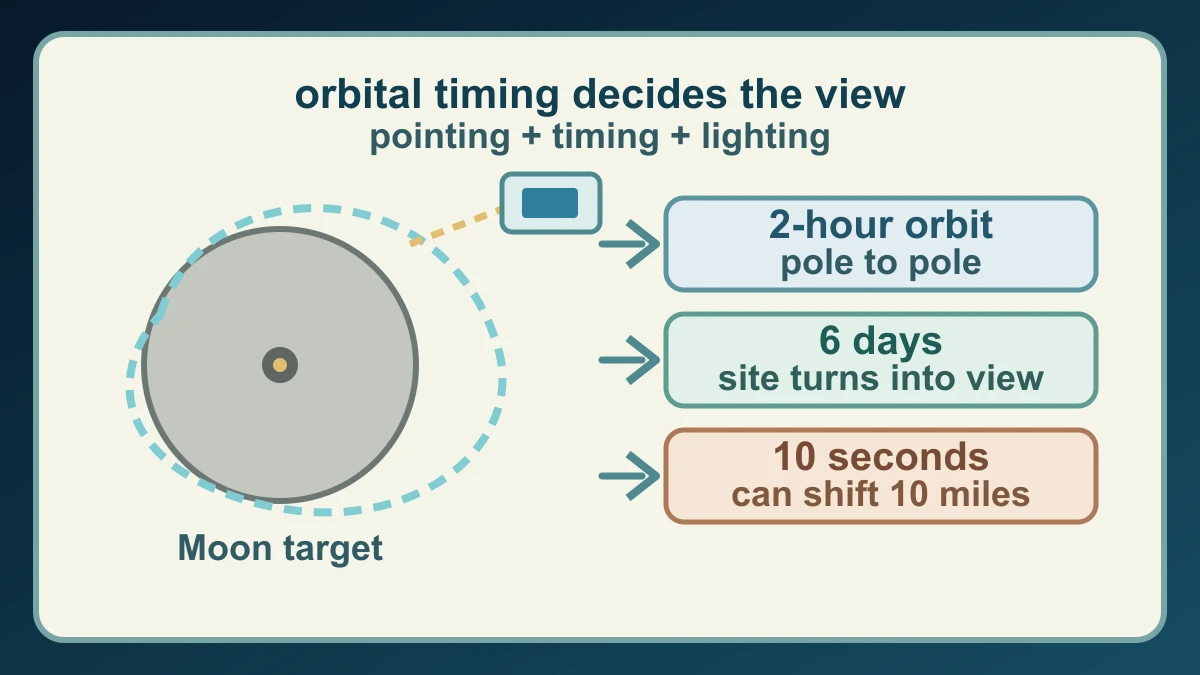
The Lunar Reconnaissance Orbiter could not simply watch the impact continuously. NASA says LRO circles the Moon from pole to pole about every two hours, while the Moon rotates beneath it. To photograph the selected site, engineers had to wait until the terrain turned into view; in this case that took six days. They also tilted the spacecraft so the Narrow-Angle Camera pointed toward the crater as LRO passed about 60 miles above the Moon at roughly one mile per second. A ten-second timing error could move the target about ten miles from the centre of the frame.
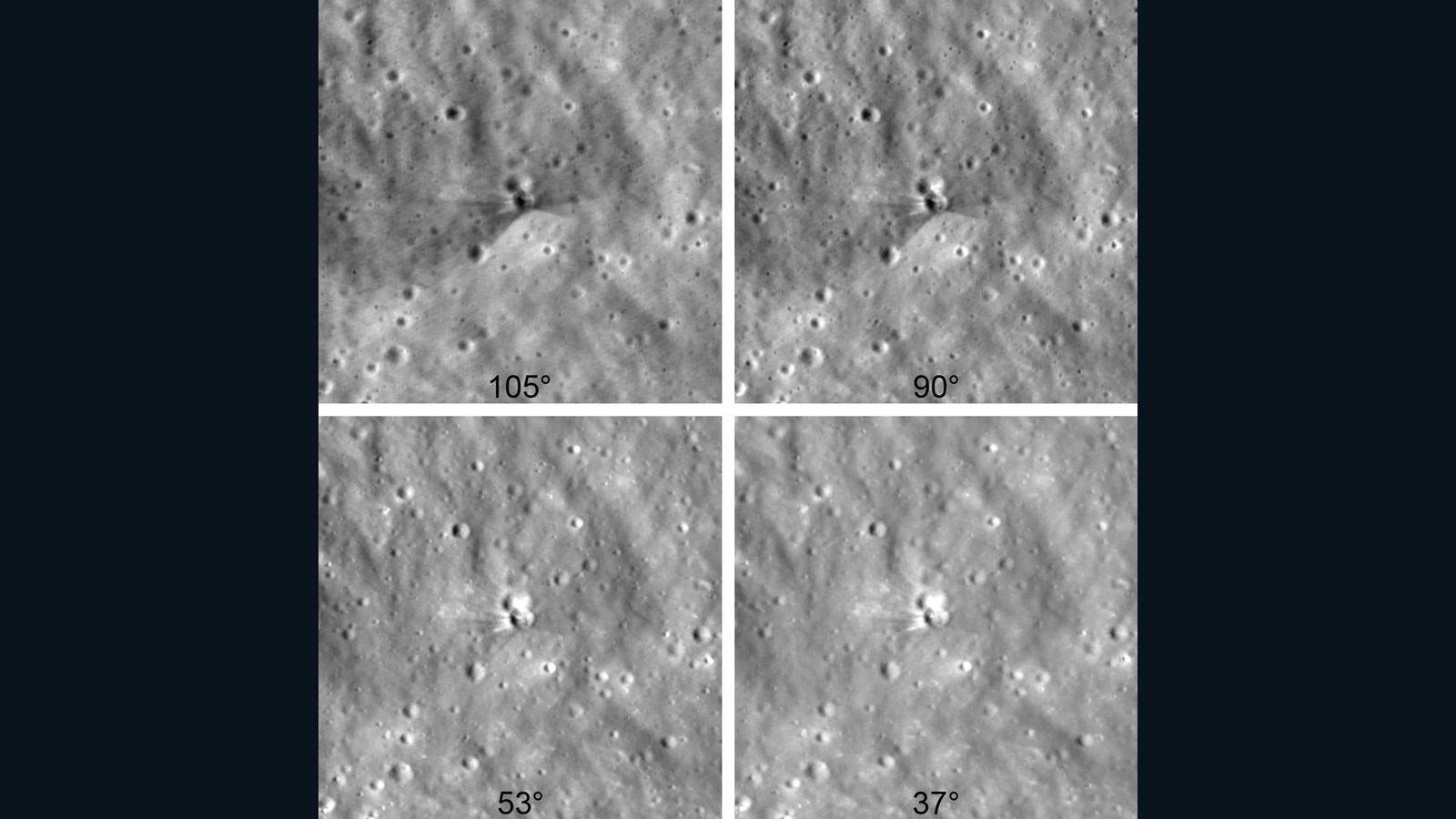
That timing explains why multiple platforms matter. The pre-impact plan included ground telescopes and South Korea's ShadowCam, but weather and lighting could make Earth-based viewing difficult, while spacecraft images could take days to arrive. LRO's later sequence used different viewing angles and changing sunlight to reveal the crater rim, ejecta and shadows. Its Narrow-Angle Camera can resolve features as small as about three feet, but resolution alone is not enough: the spacecraft must be pointed at the right place at the right time under useful illumination.
The crater became evidence through comparison
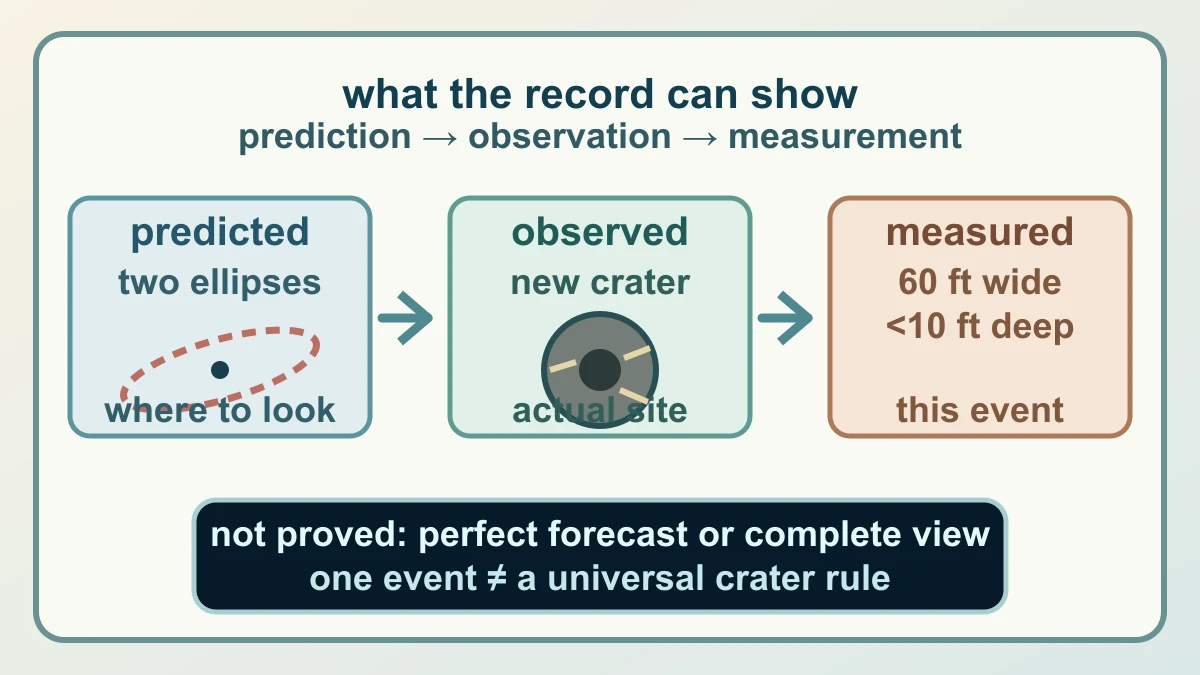
NASA's post-impact account confirms that the Falcon 9 upper stage struck the Moon on 5 August and that LRO imaged a new crater between 11 and 12 August. From the images, scientists measured a crater about 60 feet wide and estimated a depth of less than ten feet from its shadow. The different angles also separated older, space-weathered surface material from brighter fresh material excavated by the impact. Danuri's high-resolution camera imaged the site a few hours after the first crater image, and NASA says the predicted location was accurate to about 0.6 miles.
The result is therefore stronger than a predicted flash and narrower than a perfect experiment. It shows how trajectory work, an identified search zone, spacecraft pointing, changing lighting and before-and-after images can turn an unplanned impact into a measured lunar event. It does not prove that every planned telescope or spacecraft saw the impact, that impact forecasts are exact, or that one 60-foot crater is a universal rule for other rocket stages. The responsible reading is a chain of evidence: prediction finds the place, imaging confirms the feature and comparison explains what the new crater can reveal.
The comparison also protects the conclusion from a common shortcut. A new bright patch is not automatically an impact crater until the team can relate it to the predicted site, inspect its shape and shadows, and compare the surface with earlier imagery. That is why NASA's record includes the prediction ellipses, the actual coordinates, the follow-up Danuri image and the updated LRO sequence. Each step reduces one uncertainty while leaving others visible. The article can celebrate the successful observation without pretending that the Moon supplied a perfectly timed, fully instrumented laboratory test.
Sources and further reading
This article was written for Curiosity Desk. We do not copy other publishers or invent quotes. If a material error is found, we correct it openly.
Read the full standards →One answer should lead to a better question
Bring your curiosity to the group
Curious Minds is our public Facebook community for surprising science, strange history, Australian wildlife and everyday questions. No copied posts, no personal-friend invitations and no link dumping.
- Three self-contained discussion prompts each week
- Sourced answers and honest uncertainty
- Respectful conversation without spam