What the Carina image actually shows
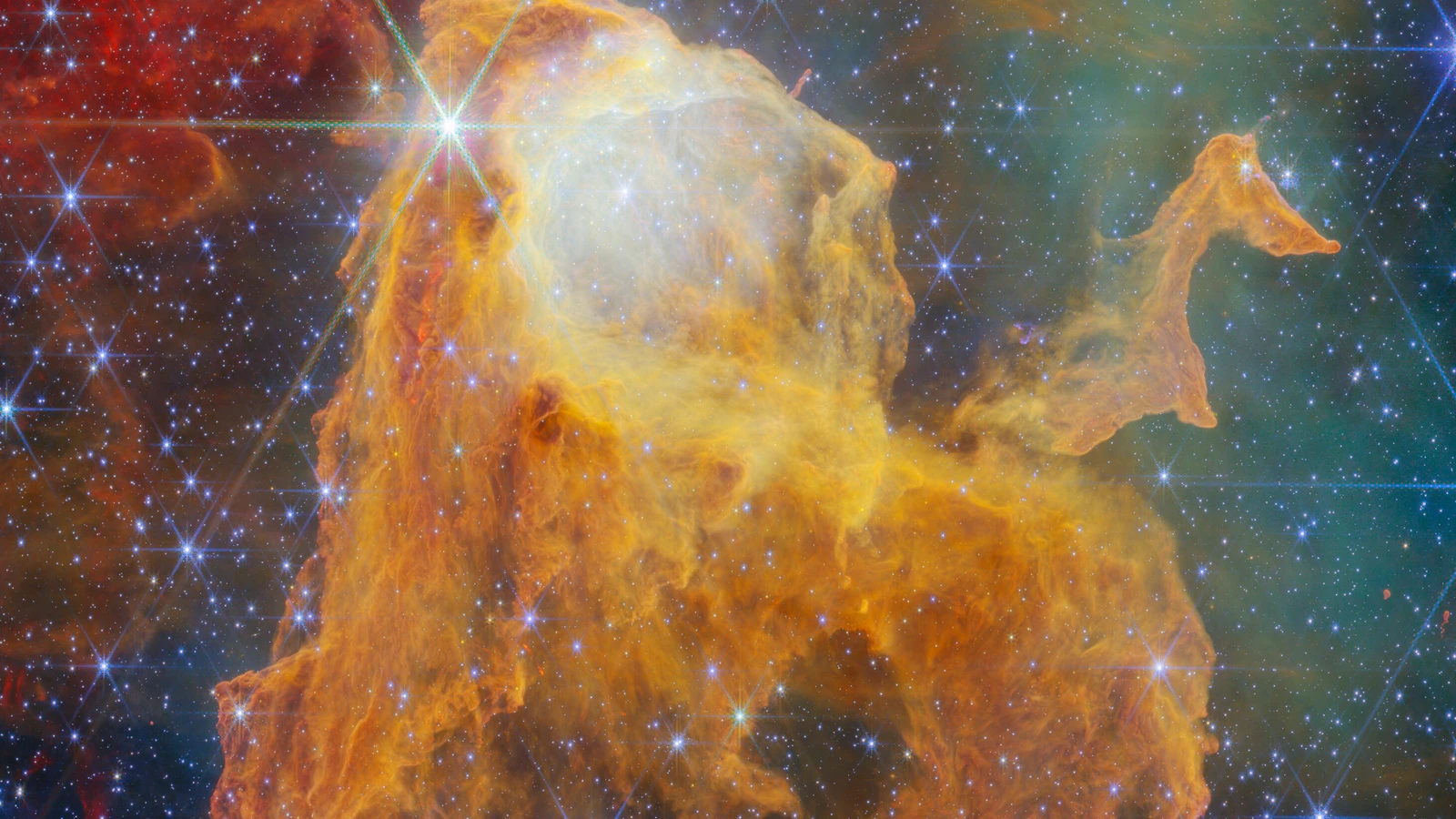
Webb's new Carina picture is best read as a map of infrared light, not as a conventional visible-light photograph. NASA's 21 August 2026 image article says the observation was captured on 6 August and shows a region that resembles a dark-headed comet with a swept tail. ESA/Webb identifies it as a cometary globule in the Carina Nebula, a nearby high-mass star-forming region about 7,500 light-years away. The bright colours are assigned to measurements made through Webb's filters; they translate infrared data into a form our eyes can compare.
ESA/Webb calls this object a compact young cluster of roughly 70 stars inside a dusty globule. Its image record gives source context for an object whose most massive star is about 19 times the Sun's mass and whose likely age is about 1.3 million years, while noting that earlier estimates were much younger. Those numbers are not ages or masses that Curiosity Desk has extracted from pixels. They are the observatory team's contextual interpretation, and they belong beside the image rather than being presented as a new measurement made by the picture itself.
The immediate visual answer is therefore narrower and more useful than the phrase hidden star cluster might suggest. Webb's composite reveals a bright, structured interior and a long, shaped envelope where dust and gas have not blocked every infrared signal. It shows that the globule contains luminous sources and that its material has a head-and-tail form. It does not show a literal photograph of stars in the same colours that human eyes would see, and it does not, by itself, label each point with an age, mass or stage of formation.
Why infrared reveals stars inside the dust
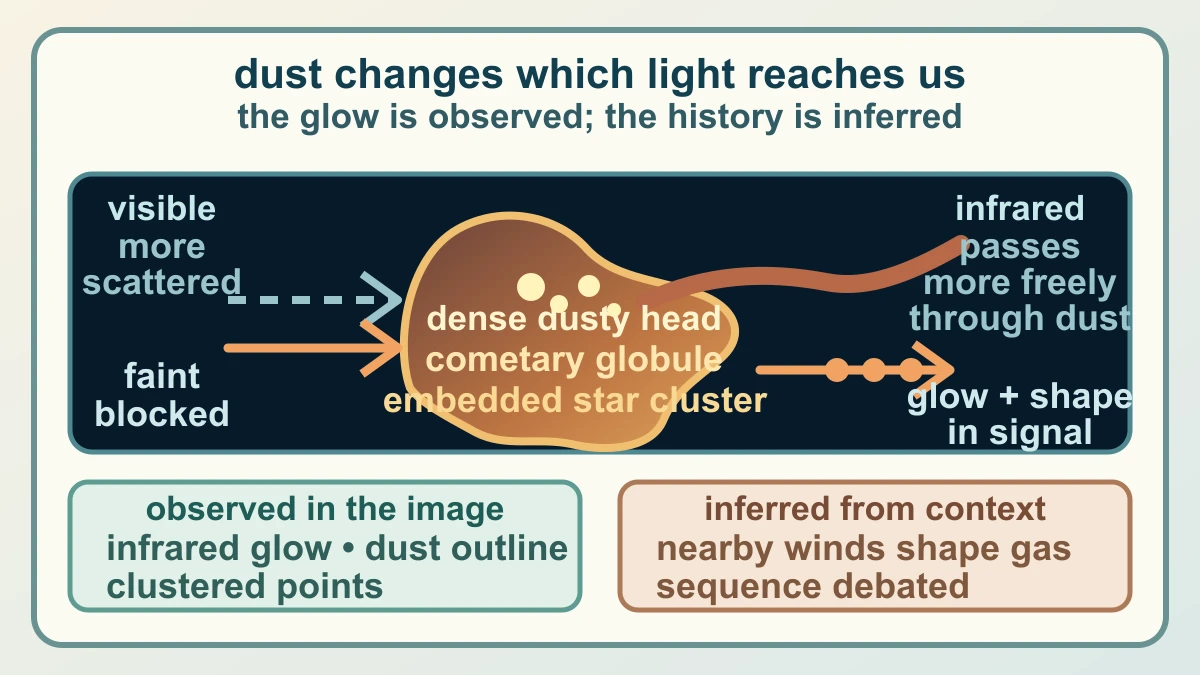
Dust is not an equally effective curtain at every wavelength. ESA's infrared-astronomy explainer describes infrared light as passing more freely through dust than visible light, which is why Webb's near- and mid-infrared instruments can look into regions where a visible image would show a darker silhouette. That does not make the material transparent or make every embedded source easy to identify. It changes which parts of the scene can contribute useful light to the detector, allowing astronomers to compare structure that would otherwise be heavily obscured.
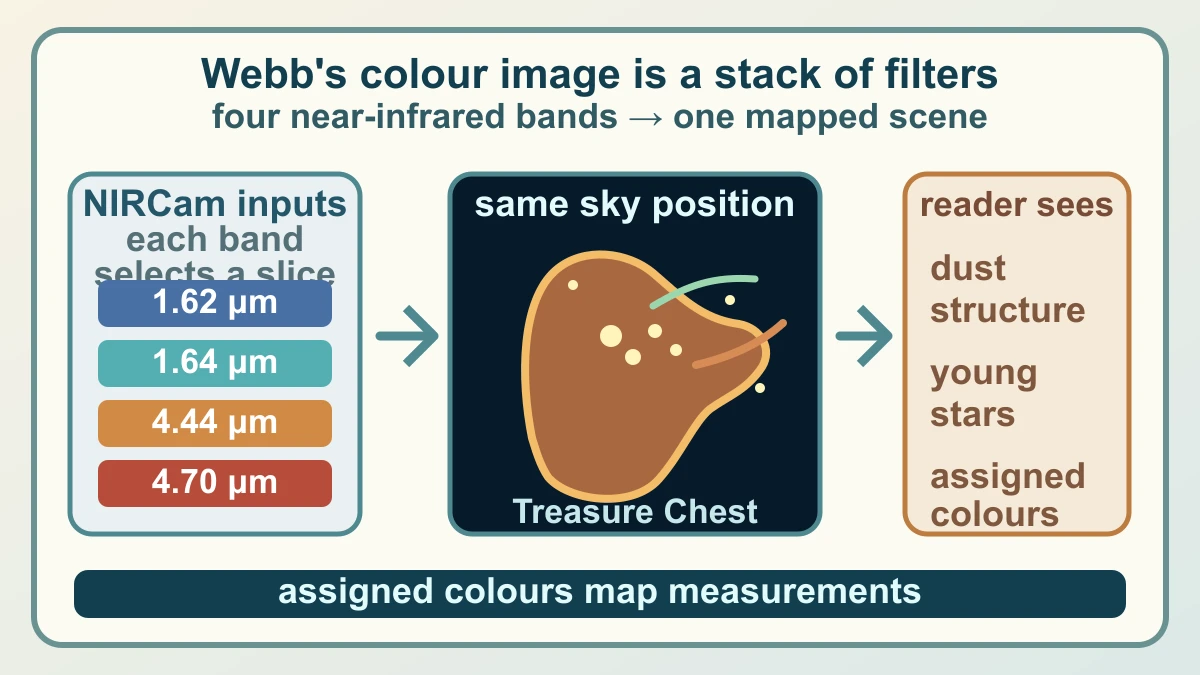
The Treasure Chest image combines measurements from four NIRCam filters and assigns display colours to them. A colour in the released composite is therefore a visual code for a selected band or combination of bands, not a claim that the dust is literally glowing in that hue. Comparing bands can reveal that some light comes from a compact source, some traces the surrounding material and some helps define the tail. The first diagram follows that measurement logic: filters are evidence channels, and the final colour image is a readable translation of those channels.
The image also sits inside a longer record of observations. The accessible primary study Opening the Treasure Chest in Carina used [CII], [OI], CO and H2CO measurements to examine the globule's gas morphology, motion and physical conditions. Its results are not the same thing as Webb's 2026 NIRCam composite, but they provide an independent way to discuss the gas and the influence of external radiation and winds. Keeping the data sets separate prevents a plausible explanation of the shape from being misreported as though the new picture alone had measured every part of the mechanism.
What the image suggests—and what it cannot prove
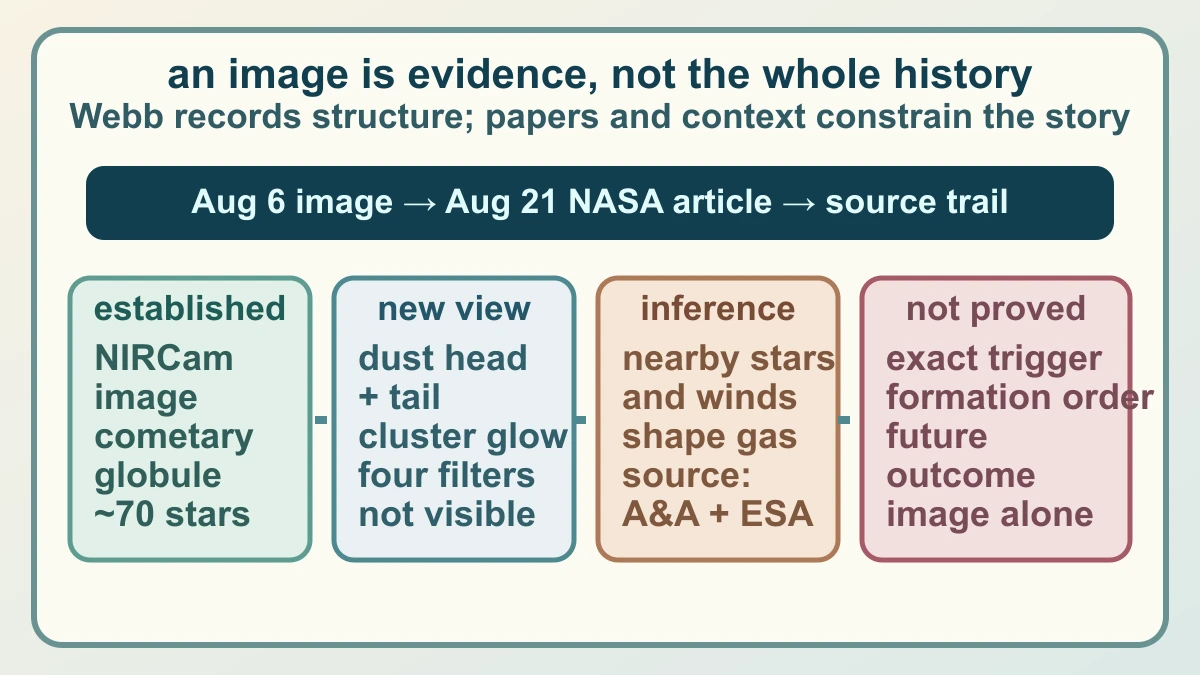
A shaped head and tail are clues about an environment being sculpted, not a time-lapse of the sculpting. ESA/Webb describes the globule as being shaped by radiation and winds from nearby massive stars, including Eta Carinae and the Trumpler 16 cluster. The earlier gas study likewise found evidence consistent with ultraviolet radiation and winds affecting the tail while the embedded cluster influences the head. Together, those records support a physical story about competing internal and external influences. The image alone still cannot tell us which event happened first or whether one simple sequence explains the whole object.
That limit matters because the cluster's age, the approximate mass of its most massive member and the relationship between the cluster and the surrounding cloud are source-context claims with their own methods. ESA notes that the formation sequence remains debated: one interpretation has the cluster forming first in a larger cloud before feedback removed less-dense gas, but the evidence does not turn the attractive comet shape into a settled chronology. A bright knot can be real while the explanation of how it got there remains conditional.
The strongest answer is consequently about observation and method. Webb's infrared filters make hidden structure in a dusty Carina globule easier to inspect, and the source record gives astronomers a richer starting point for studying young stars, disks, gas and feedback. The image does not by itself prove individual stellar ages, chemical composition, future star formation or a universal rule for how massive clusters form. Those claims need spectroscopy, calibrated measurements and models tested against more than one view. The reward is not certainty disguised as colour; it is seeing exactly where the evidence becomes a question.
Sources and further reading
- NASA — Webb Opens Treasure Chest ↗
- ESA/Webb — Webb opens a Treasure Chest filled with stars ↗
- ESA/Webb — Usage of Images, Videos, and Webb Texts ↗
- ESA/Webb — Infrared Astronomy ↗
- arXiv — Opening the Treasure Chest in Carina ↗
- NASA Science — James Webb Space Telescope mission ↗
- NASA — Images and Media Usage Guidelines ↗
This article was written for Curiosity Desk. We do not copy other publishers or invent quotes. If a material error is found, we correct it openly.
Read the full standards →One answer should lead to a better question
Bring your curiosity to the group
Curious Minds is our public Facebook community for surprising science, strange history, Australian wildlife and everyday questions. No copied posts, no personal-friend invitations and no link dumping.
- Three self-contained discussion prompts each week
- Sourced answers and honest uncertainty
- Respectful conversation without spam