Infrared light opens a view through M82's dust
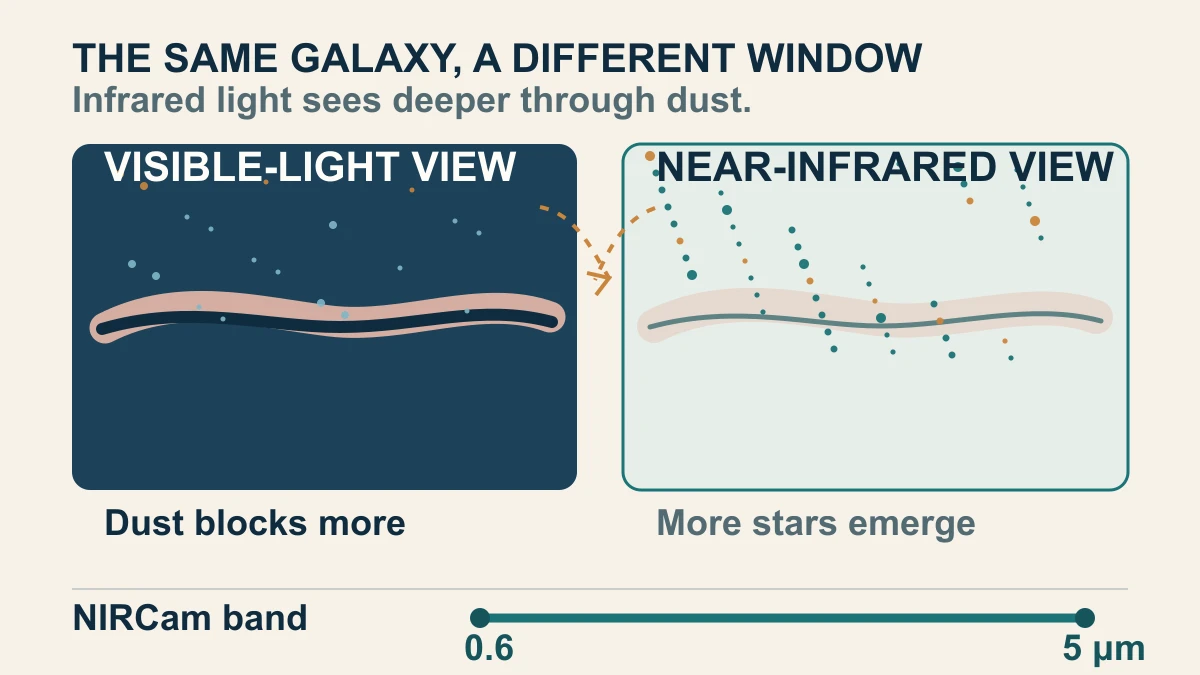
The short answer is that Webb is not simply taking a brighter ordinary photograph. Its NIRCam instrument records near-infrared light, and those longer wavelengths can pass through some of the dust that hides stars in visible light. The result is a view into the dusty Cigar Galaxy that exposes structure a familiar optical image would partly lose.
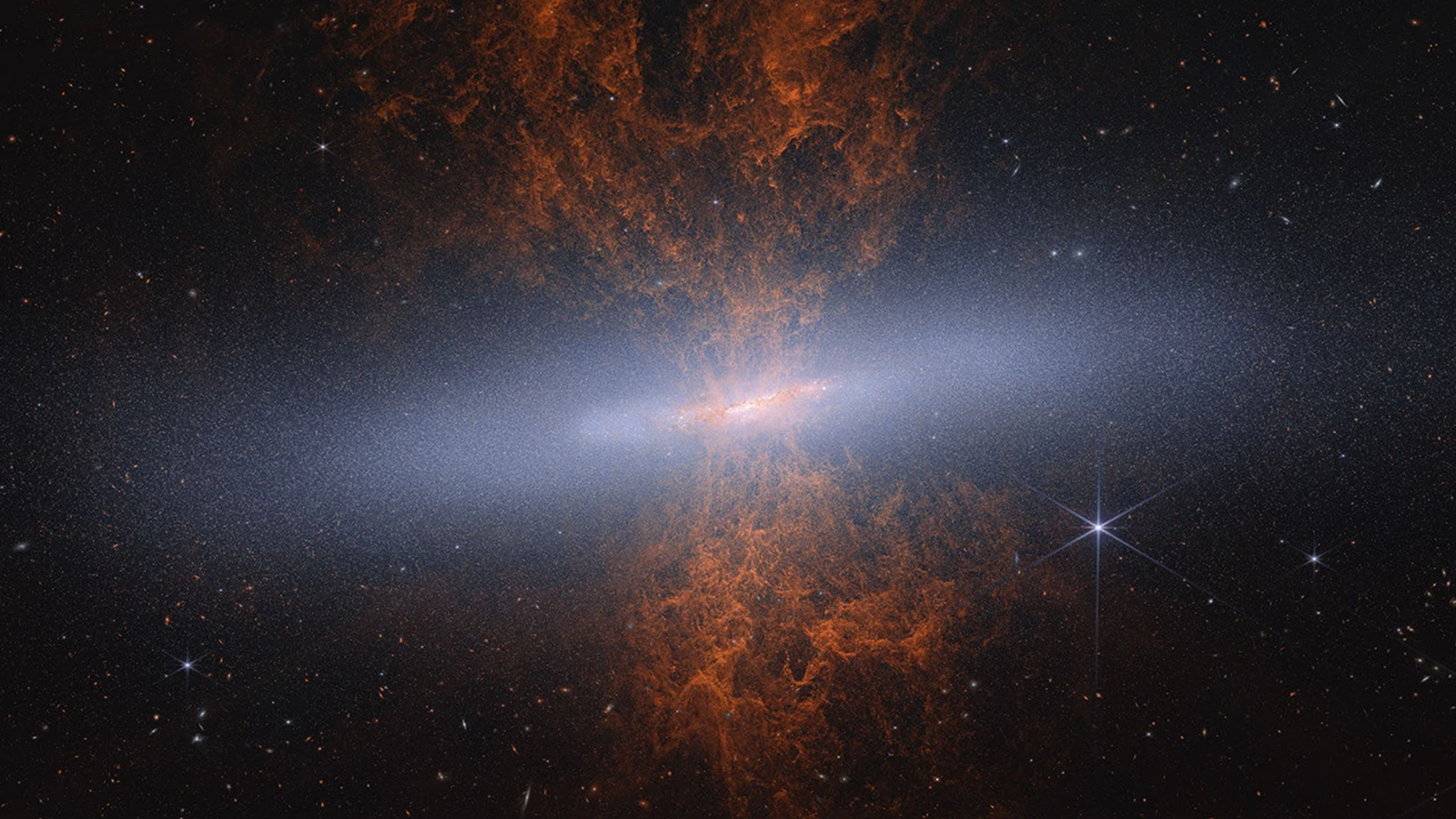
M82 is an edge-on starburst galaxy about 12 million light-years away. NASA's Webb observation uses a 65-hour NIRCam survey to study its disk and the material rising above and below it. The image is built from several infrared filters, so its colours are assigned to measured wavelength bands; they are a visual translation of the data, not a natural-colour scene seen by human eyes.
NIRCam covers roughly 0.6 to 5 microns and combines high-resolution imaging with short- and long-wavelength channels. That range matters because dust scatters and absorbs shorter visible wavelengths more readily than it affects every near-infrared band. Infrared does not make the dust disappear, but it changes which layers of the galaxy can contribute detectable light.
That is why the hero image can be both a documentary record and an invitation to ask a precise question: which stars and structures became measurable because of the wavelength choice? It is not evidence that Webb has seen every object in M82, nor does the colour mapping by itself identify the age, composition or motion of each point of light.
The resolved stars preserve a record of the starburst
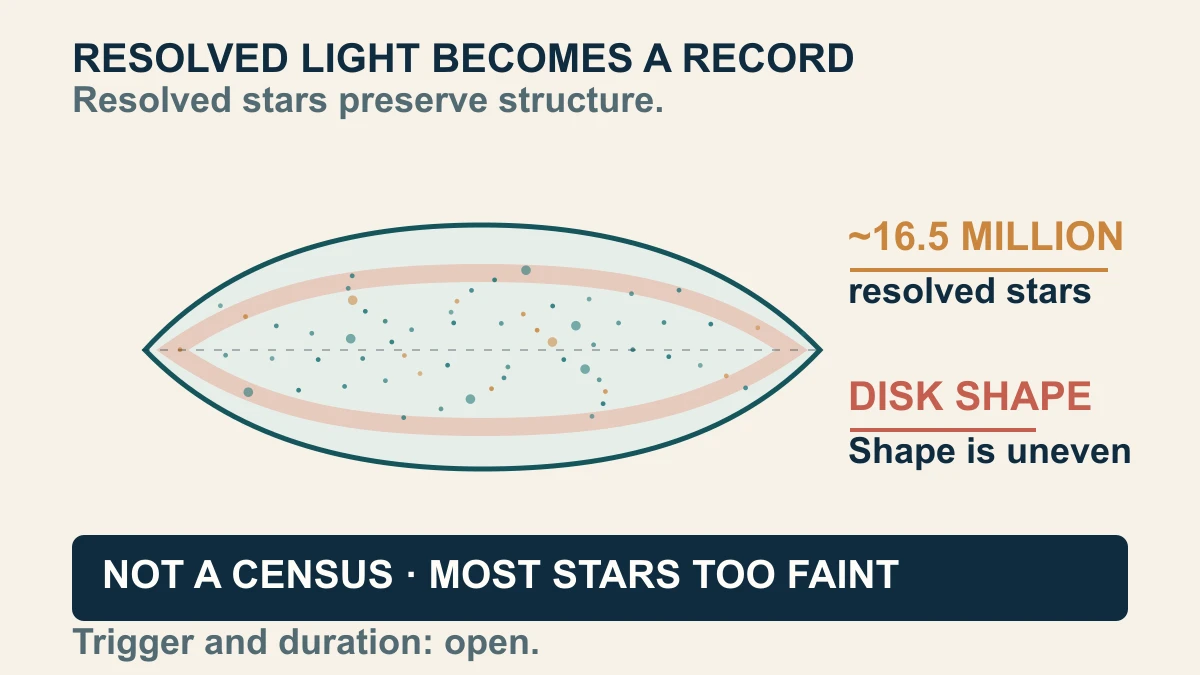
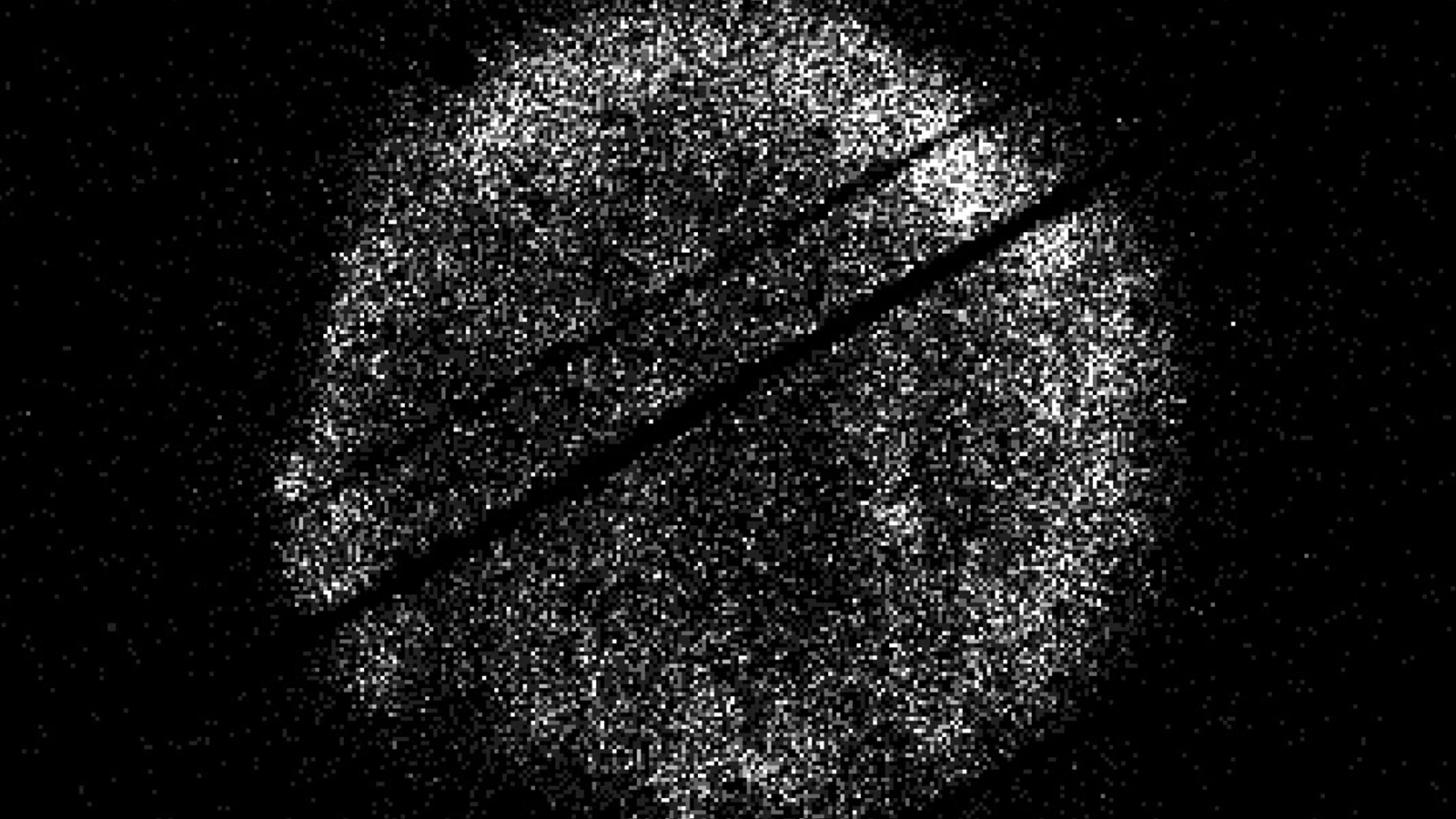
NASA reports that the NIRCam survey resolves approximately 16.5 million stars in the observed M82 field. That number is extraordinary because it turns a glowing, crowded galaxy into a partially resolved stellar record. It still describes the stars that the observation and analysis could separate from the background, not a complete inventory of every star in the galaxy.
The disk is not a perfectly even oval. Its shape and brightness carry clues about where the current burst of star formation is concentrated and how the galaxy's central regions are arranged. The useful reading is therefore structural: the image lets astronomers study populations and patterns across a nearby starburst, rather than treating the whole galaxy as one undifferentiated red cloud.
A resolved-star estimate also has a detection boundary. Stars can be too faint, too crowded or too deeply obscured to distinguish in this dataset, and the image covers a defined field rather than all of M82 at unlimited sensitivity. NASA explicitly presents the millions figure as a small portion of the galaxy's total stellar content, so the honest headline is a measured window into a much larger population.
This distinction changes what the image establishes. It establishes a powerful near-infrared observation of individual stellar light and disk structure; it supports a record of an intense star-forming environment. It does not, on its own, settle the exact ages of all the stars, reconstruct the complete history of the burst or prove why the burst began. Those questions need models, other observations and comparisons across time.
A concentrated star-forming region can drive an outflow
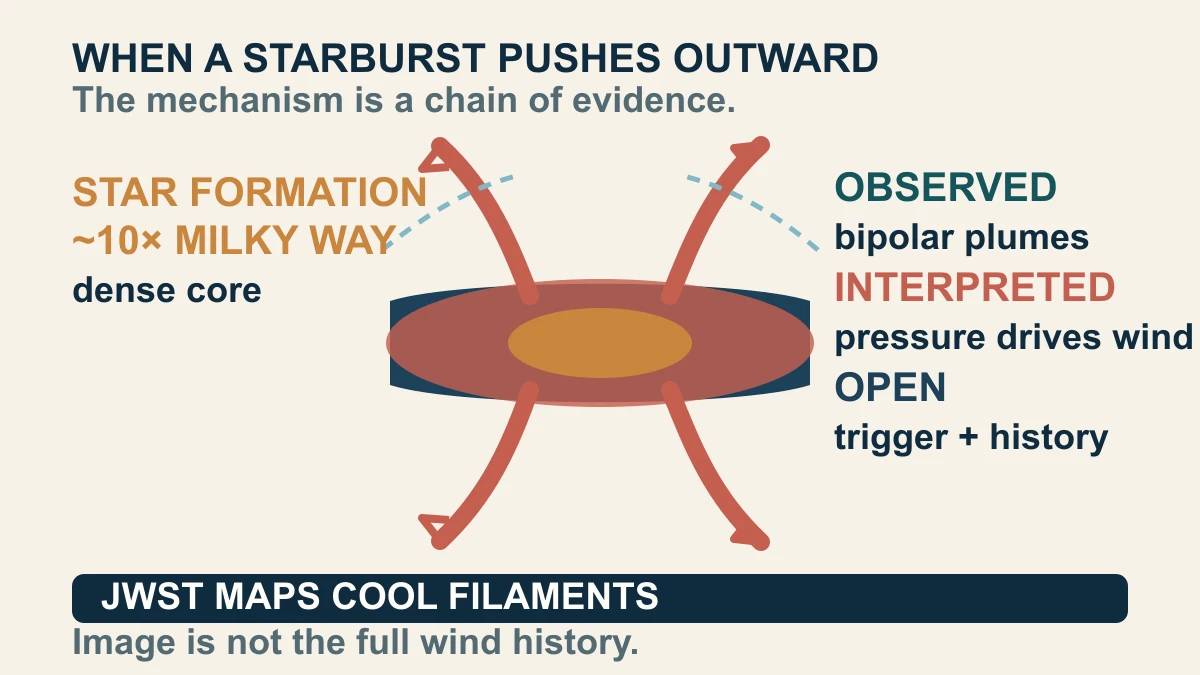
M82 forms stars at a rate roughly ten times that of the Milky Way, according to NASA's Webb feature, and that activity is associated with bipolar plumes extending away from the disk. The broad physical picture is that concentrated star formation supplies energy and pressure to gas and dust, helping launch a galactic wind. The plume is observed; the detailed chain of causes is an interpretation tested by research.
JWST/NIRCam research has found 3.3-micron polycyclic aromatic hydrocarbon, or PAH, emission in filamentary structures at the base of M82's wind. One study describes plumes about 50 parsecs wide and at least 200 to 300 parsecs long, with smaller clouds on scales of roughly 5 to 15 parsecs. Its cloud-crushing times are model estimates of about 0.5 to 3 million years, so they should be read as conditional physics, not as a stopwatch for the whole outflow.
A newer JWST study using MIRI and NIRCam follows PAH-traced cool filaments farther into the superwind. It reports a brightness pattern consistent with the starburst radiation field influencing PAH emission out to about 2.5 kiloparsecs, while its analysis leaves room for shielding and cool clouds that can survive for at least roughly 20 million years. These results refine the survival and dust-processing questions; they do not turn them into a single settled duration.
The evidence boundary is the important payoff. Webb shows stars, dust and outflow structure, and the research connects intense star formation with a physically plausible wind. The exact trigger—often discussed alongside a possible interaction or merger—the detailed timing and the wind's ultimate future remain open. A careful article can explain the mechanism without pretending that one remarkable image has closed every question about M82.
Sources and further reading
- NASA Science — NASA's Webb Pinpoints Millions of Stars Within Cigar Galaxy ↗
- NASA Science — Webb M82 Cigar Galaxy NIRCam image ↗
- NASA Science — Fast and Furious Star Formation in Starburst Galaxies ↗
- NASA Science — Webb NIRCam instrument ↗
- arXiv — JWST Observations of Starbursts: Dust Processing in the M82 Superwind ↗
- arXiv — JWST/NIRCam observations of the 3.3 micron PAH emission in M82 ↗
- NASA — Guidelines for using NASA Images and Media ↗
- NASA Science latest-news route surfaced the current M82 starburst feature ↗
This article was written for Curiosity Desk. We do not copy other publishers or invent quotes. If a material error is found, we correct it openly.
Read the full standards →One answer should lead to a better question
Bring your curiosity to the group
Curious Minds is our public Facebook community for surprising science, strange history, Australian wildlife and everyday questions. No copied posts, no personal-friend invitations and no link dumping.
- Three self-contained discussion prompts each week
- Sourced answers and honest uncertainty
- Respectful conversation without spam