A fire can build its own smoke elevator
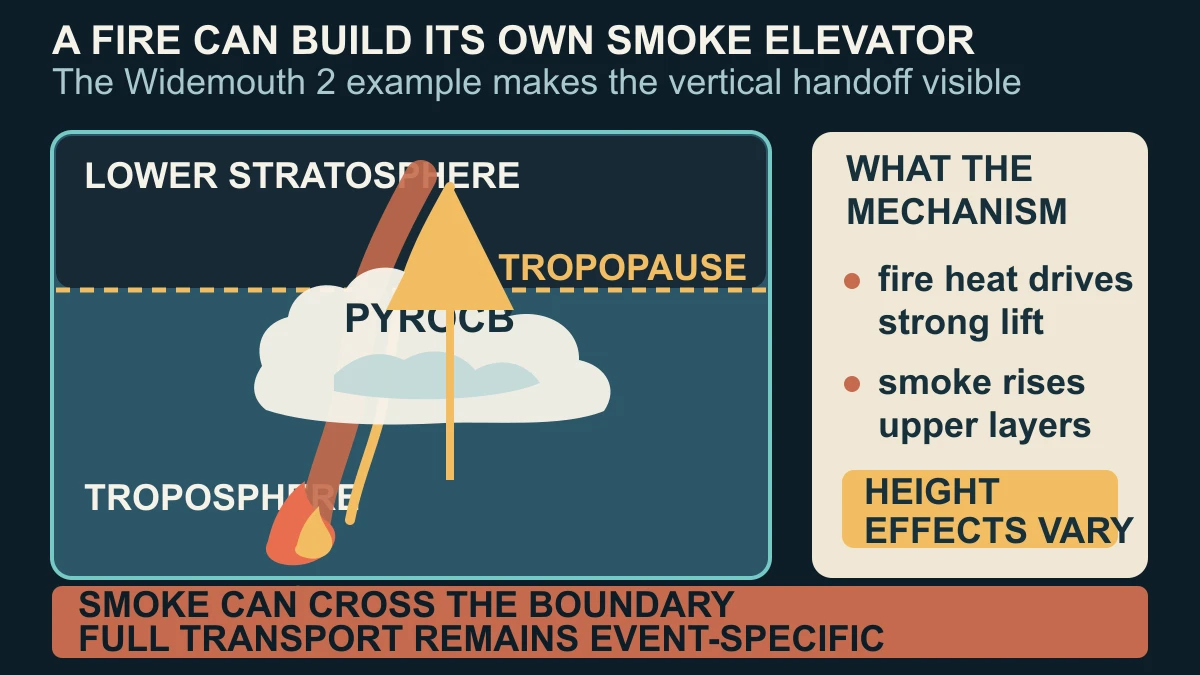
An extreme wildfire can do more than feed a drifting plume. Under the right atmospheric conditions, the fire's heat drives a powerful convective cloud called a pyrocumulonimbus, or pyroCb. That fire-generated thunderstorm can carry smoke and gases rapidly upward through the upper troposphere and, in some events, across the tropopause into the lower stratosphere. The mechanism is real, but it is not a guarantee for every fire.
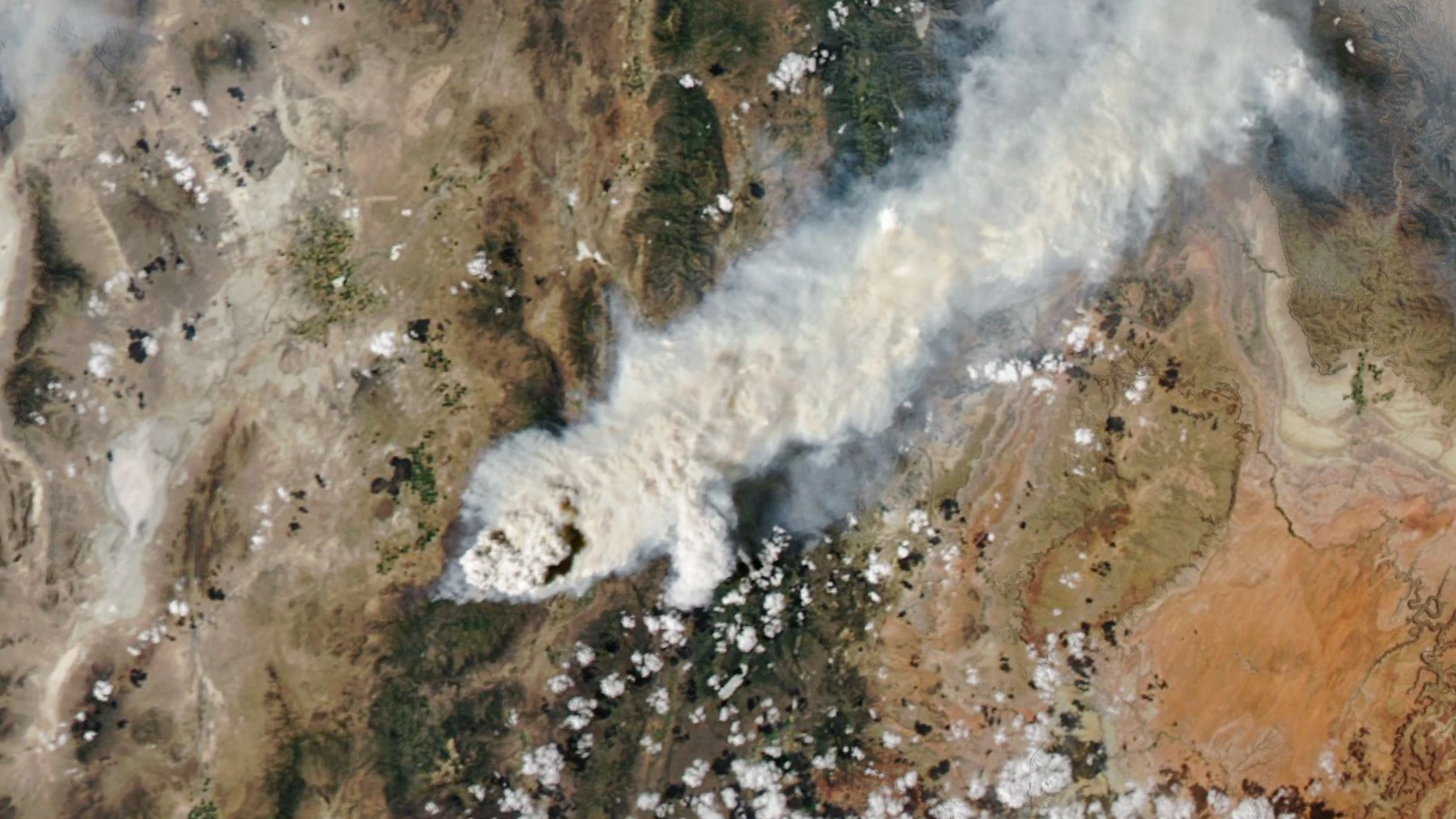
NASA's Earth Observatory gives the Widemouth 2 fire in Utah a concrete example. On August 2, 2026, NASA's Aqua satellite captured a smoke-infused pyroCb with a chimney of high cloud and smoke casting a shadow on lower-altitude smoke. The same account says the cloud tops were cold enough to meet a commonly used threshold for identifying pyroCbs. A later INSPYRE aircraft flight sampled smoke at roughly 12 kilometres above the surface, adding a measurement at altitude rather than only a view from above.
The phrase smoke into the stratosphere needs a careful boundary. A cloud top that reaches the upper troposphere is not identical to a measured, persistent stratospheric aerosol layer. The height, amount, composition, mixing and later motion can vary from event to event. The useful answer is therefore a chain: fire heat powers convection, convection can loft material unusually high, and several observing systems are needed to establish what happens after the cloud pulse.
What a satellite sees at the cloud top
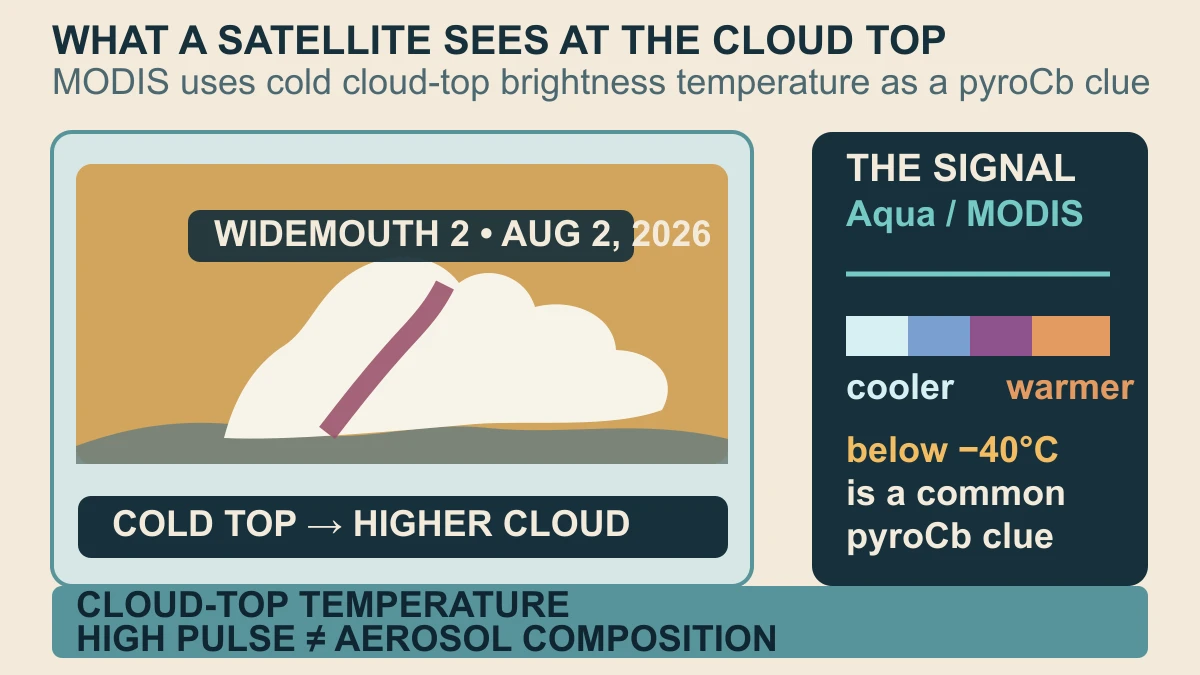
Satellites often find a pyroCb by measuring the temperature of the cloud top rather than by directly measuring the smoke's chemical composition. NASA's Earth Observatory describes cloud-top brightness temperatures below minus 40 degrees Celsius as a common threshold for identifying pyroCbs. Very cold tops are evidence that the cloud has grown high in the atmosphere; they are a height-related clue, not a complete reading of the aerosol layer above it.
The natural-colour Widemouth 2 scene shows why the signal is useful. The plume is not just a flat grey stain: a tall, smoke-infused cloud rises above the fire, and its shadow helps reveal the high structure against lower smoke. In the matching brightness-temperature view, the colder cloud tops stand out from warmer, lower plumes. NASA reports that Aqua's observations revealed two discrete pulses of pyroCb activity in this event.
That satellite result establishes that a high convective pulse was present and gives researchers a way to find similar events across large regions. It does not, by itself, tell us how much black carbon or organic aerosol entered the stratosphere, how long a layer will persist or how its radiative effect will develop. Those questions require vertical profiles, in-situ sampling, transport analysis and a record that distinguishes a measured event from a general possibility.
How SAGE III reads the aerosol layer
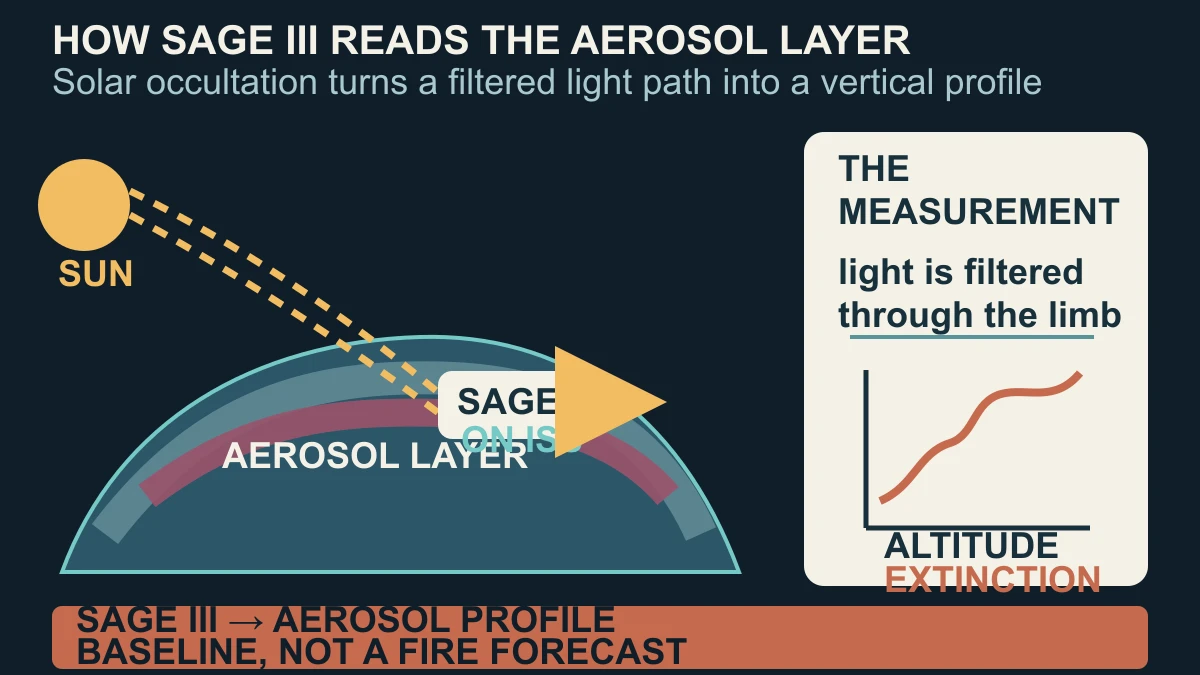
SAGE III supplies a different kind of view. Mounted on the International Space Station, the Stratospheric Aerosol and Gas Experiment III uses sunlight passing through the atmospheric limb during solar occultation. The instrument measures how the light is attenuated at different wavelengths and viewing heights, allowing scientists to derive vertical profiles of aerosols and other atmospheric constituents. The result is not a photograph of a smoke plume; it is a structured measurement of how the atmosphere changes with altitude.
That profile makes SAGE III useful as both a baseline and a way to notice an unusual aerosol signal. NASA's earlier account of the 2019–2020 Australian fires reported a dramatic rise in stratospheric aerosol observed above Australia. The 2026 NASA SAGE account uses the long-running instrument record to provide baseline aerosol loading and optical-extinction context while INSPYRE examines current fire-cloud injections. A baseline can show that the atmosphere differs from its usual state, but it does not identify every source on its own.
SAGE III also shows why instruments should not be collapsed into one vague idea of satellite monitoring. A cloud-top temperature from MODIS helps identify a high convective event. SAGE III measures a limb-integrated optical signal with altitude. Aircraft can sample particles and gases more directly inside a plume. Put together, these measurements can constrain a story about injection and persistence; kept separate, they prevent one compelling image from carrying claims that belong to another instrument or method.
What INSPYRE can test—and what remains uncertain
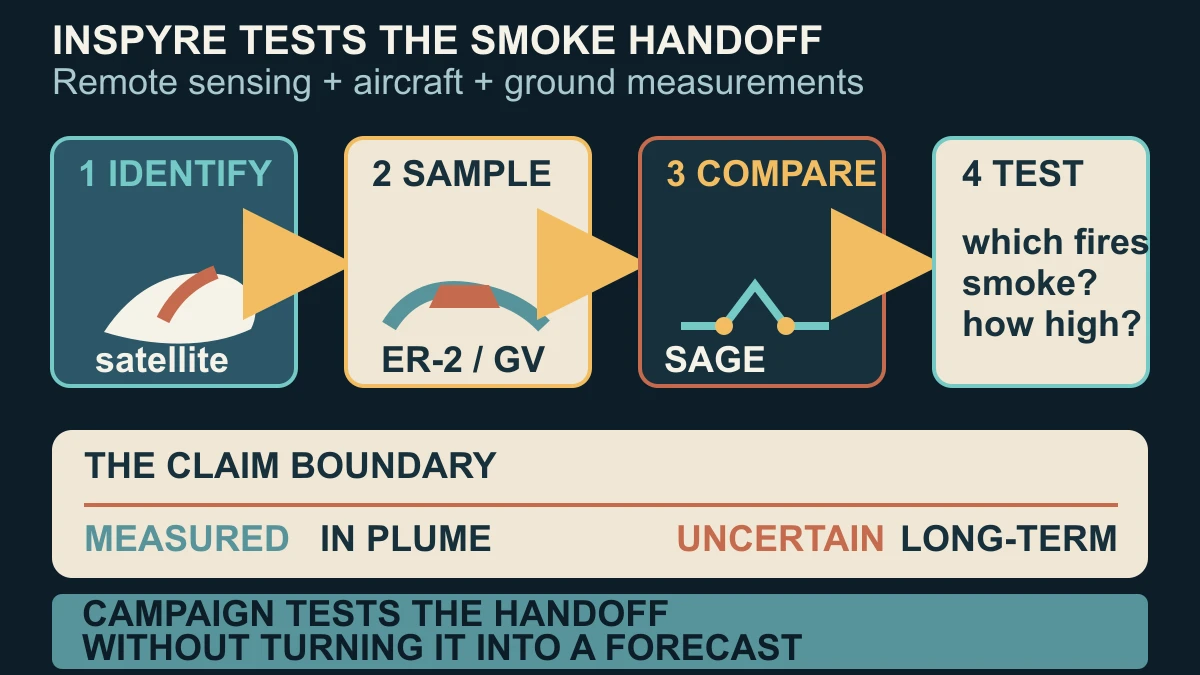
INSPYRE is designed to connect those views. NASA describes the 2026 experiment as a campaign using the ER-2, NSF/NCAR's Gulfstream V and ground-based platforms to study which fires produce smoke-injected clouds, what mechanisms control the injection and how the resulting plume affects upper-troposphere and lower-stratosphere composition and radiation. The NASA Airborne Science deployment record places the campaign over the western United States and Canada in August and September 2026 and records the work as in progress at the checked date.
Earlier research shows why the measurement chain matters. In a peer-reviewed study of the 2017 British Columbia event, observations and GEOS modelling followed smoke from near the tropopause at roughly 12 kilometres toward about 22 to 23 kilometres. The study found roles for both aerosol self-lofting and large-scale atmospheric motion, with the plume observed in the lower stratosphere for months. That is evidence from a specific case study, not a rule that every wildfire plume will climb the same way.
A separate 13-year airborne analysis estimated that pyroCbs accounted for 10 to 25 percent of black carbon and organic aerosols in the present-day lower stratosphere. The estimate describes a broad research record, not the fraction contributed by Widemouth 2 or a forecast of future climate effects. INSPYRE can narrow uncertainties about injection, chemistry and transport, but the honest endpoint remains open: not every fire makes a pyroCb, not every high cloud produces the same aerosol layer and the downstream radiative and ozone effects are still being tested.
Sources and further reading
- NASA Science — SAGE III and INSPYRE Assess PyroCb-Driven Stratospheric Smoke Injection from 2026 Wildfires ↗
- NASA Earth Observatory — Chasing Fire Clouds in Utah ↗
- NASA INSPYRE — Injected Smoke and Pyrocumulonimbus Experiment ↗
- NASA Airborne Science Program — MASTER INSPYRE 2026 deployment record ↗
- NASA SAGE — About SAGE III on the International Space Station ↗
- NASA Science — NASA's SAGE III Instrument Observes Aerosol Spike from Australian Fires ↗
- Das et al. — The long-term transport and radiative impacts of the 2017 British Columbia pyrocumulonimbus smoke aerosols in the stratosphere ↗
- Fromm et al. — Understanding the critical elements of the pyrocumulonimbus storm ↗
- Katich et al. — Pyrocumulonimbus affect average stratospheric aerosol composition ↗
- NASA — Guidelines for using NASA Images and Media ↗
This article was written for Curiosity Desk. We do not copy other publishers or invent quotes. If a material error is found, we correct it openly.
Read the full standards →One answer should lead to a better question
Bring your curiosity to the group
Curious Minds is our public Facebook community for surprising science, strange history, Australian wildlife and everyday questions. No copied posts, no personal-friend invitations and no link dumping.
- Three self-contained discussion prompts each week
- Sourced answers and honest uncertainty
- Respectful conversation without spam