London's 91% maximum is still a partial eclipse
For London, NASA lists the partial eclipse as beginning at 6:17 p.m. on 12 August 2026, reaching its maximum at 7:13 p.m., and ending at 8:06 p.m. At maximum, the Moon covers 91% of the Sun's apparent area. That is strikingly large coverage, but it does not mean the Sun has switched off. A thin, intensely bright crescent remains visible, so London is in a partial eclipse rather than the brief phase called totality.
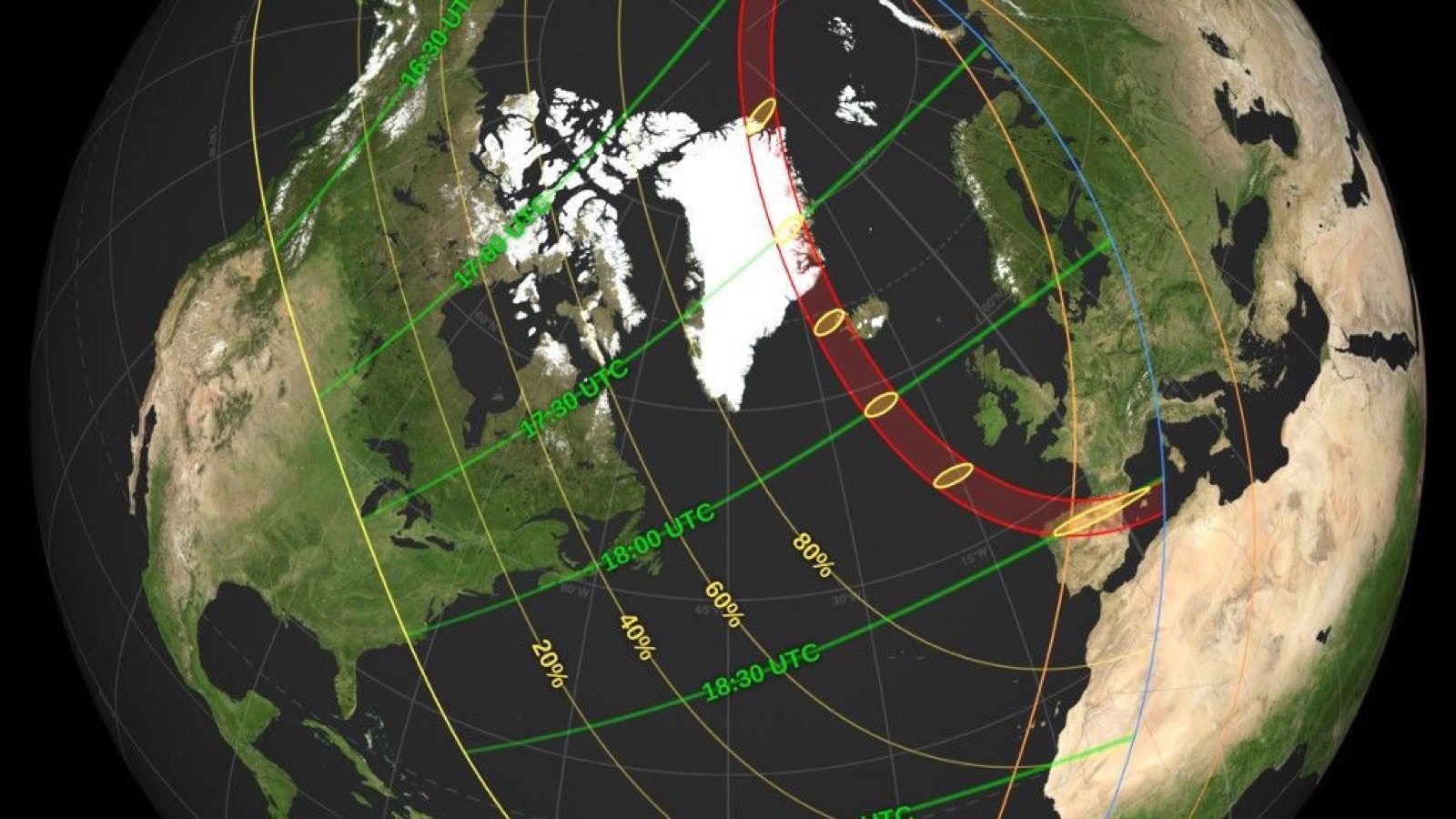
The distinction matters because eclipse percentages describe how much of the Sun's disk the Moon covers from one location; they do not describe a safe amount of naked-eye brightness. The uncovered portion is still direct sunlight. NASA's event page places London outside the red path of totality, even though much of the UK sees a dramatic partial eclipse. Nearby places can therefore have different experiences at the same moment: one location may be in the Moon's dark central shadow while another sees only the wider, lighter shadow around it.
The 2026 map shows why the event can be both wide-reaching and geographically selective. The red band runs across Greenland, Iceland, the North Atlantic and Spain. It marks the track where the Moon can cover the Sun's bright face completely. Wider curves outside that band mark partial coverage. London is inside those wider partial-eclipse contours, which is why its 7:13 p.m. maximum is substantial but not total.
A sunset can make the scene look unusual, but it does not turn a partial eclipse into totality. The Sun's low altitude may add haze and warm colour, and the event can end close to sunset in western Europe. Those effects change the view through the atmosphere, not the eclipse geometry. The answer to the time query is therefore also the answer to the more useful question: at 7:13 p.m., London has a 91% partial eclipse, with direct solar brightness still present.
Only the Moon's narrow inner shadow produces totality
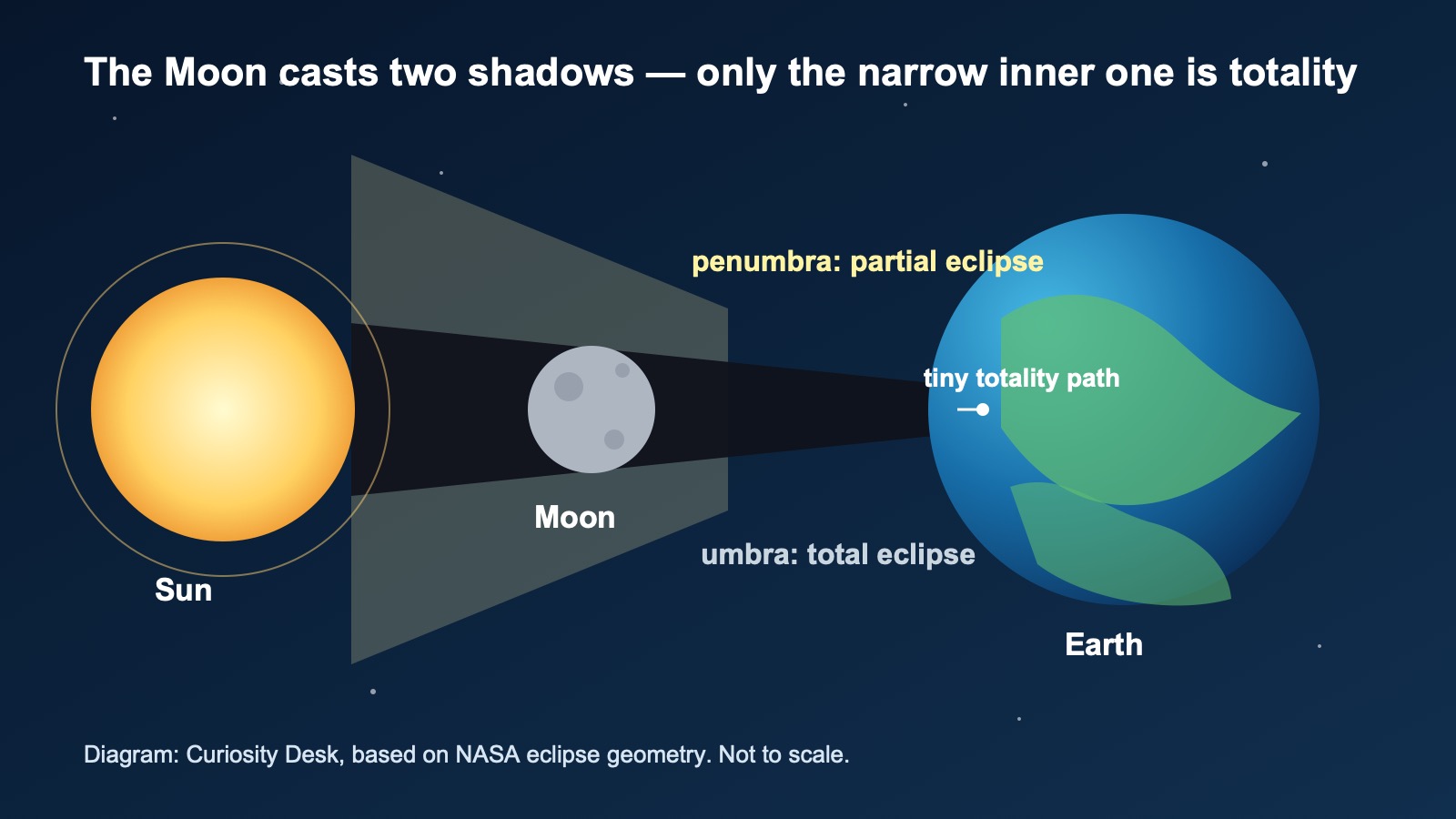
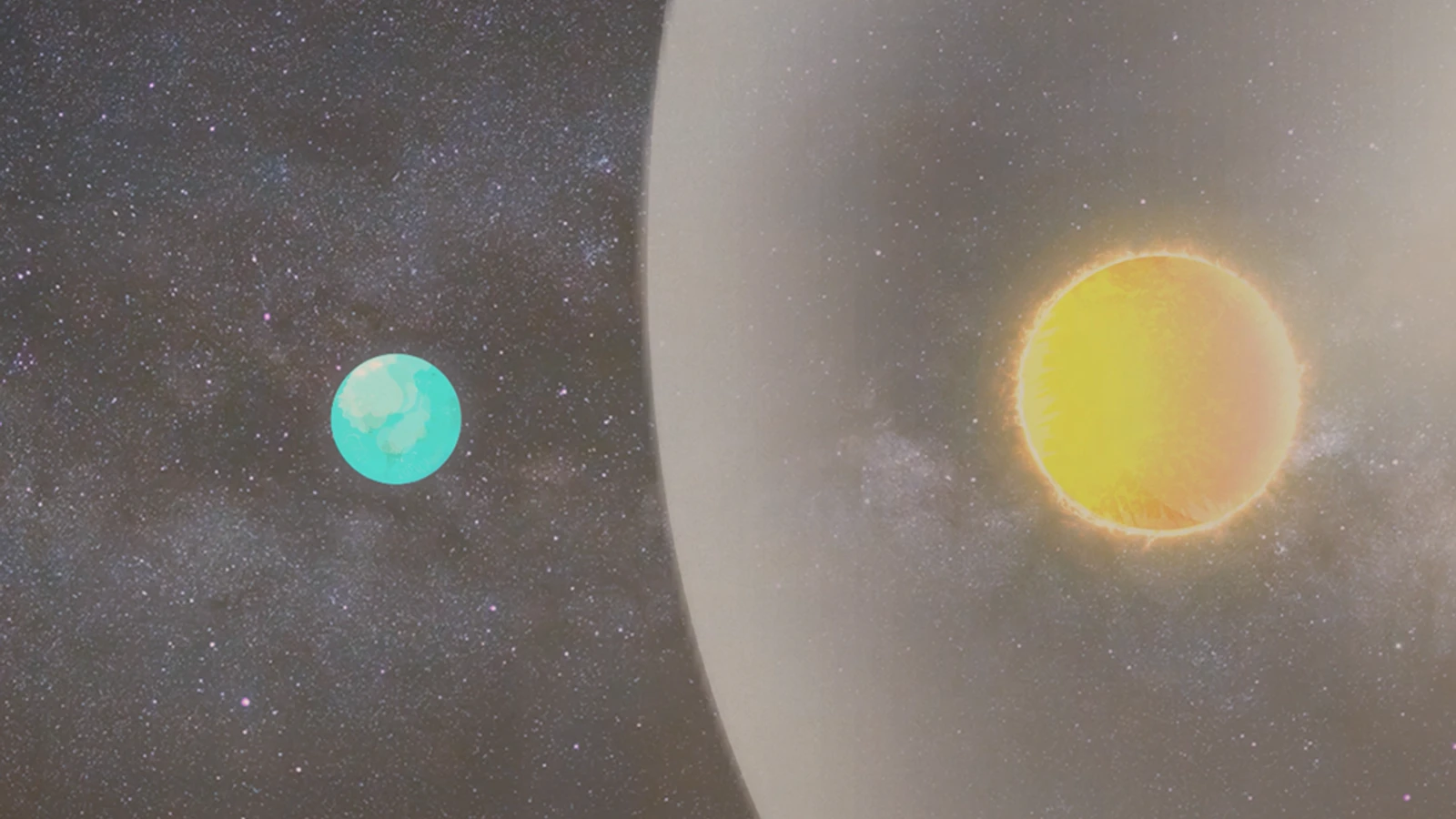
A solar eclipse begins when the Moon passes between Earth and the Sun. Because the Moon is much smaller than the Sun, it casts two different shadow regions. The broad penumbra is where an observer sees the Moon cover only part of the Sun. The narrow umbra is where the alignment is exact enough for the Moon to cover the bright solar disk completely. That moving inner shadow is the path of totality, and it is far narrower than the whole area that experiences a partial eclipse.
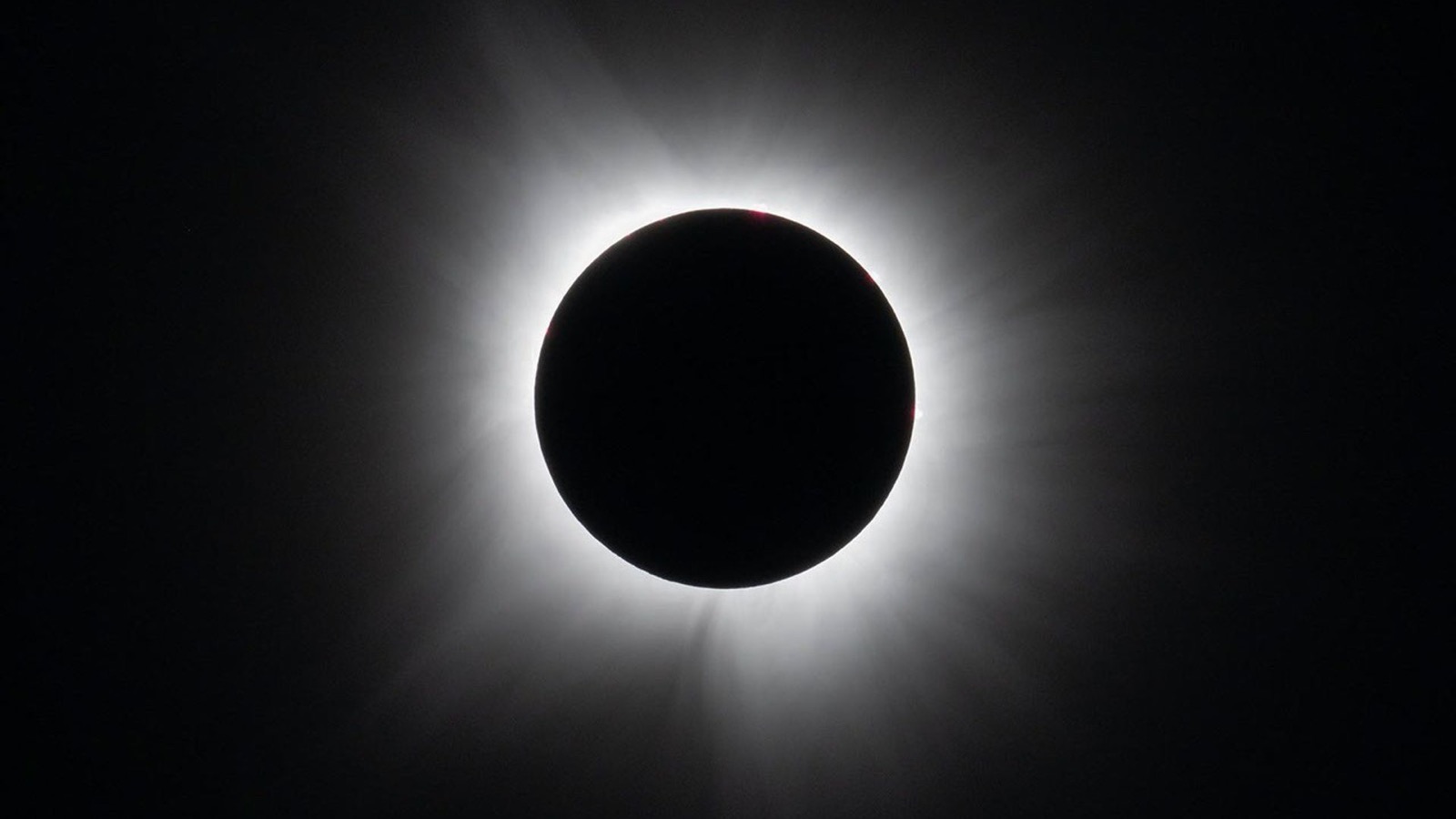
This is why a map's red stripe matters more than a rounded percentage. Within the umbra, daylight drops sharply and the Sun's corona can become visible for a short interval. Outside it, even a 91% partial eclipse leaves a visible piece of photosphere—the bright surface of the Sun. NASA says most places on the 12 August path of totality will have less than two minutes of totality; locations closest to the centre in Greenland, Russia or the North Atlantic have a little longer, still under two and a half minutes. The geometry produces a small moving target, not a broad region of darkness.
The viewing rule follows the geometry. NASA's safety guidance says direct viewing needs specialised solar eye protection throughout the partial phases. Ordinary sunglasses are not solar viewers. Nor should eclipse glasses or a handheld viewer be used with a camera, telescope or binoculars: those optical devices need a special-purpose solar filter secured at the front. This article cannot verify any product or local viewing conditions, so the safest practical boundary is to use NASA's current guidance and not improvise with damaged, ordinary or unfiltered optics.
During a total eclipse, direct unaided viewing is permitted only in the brief interval when the Moon completely covers the Sun's bright face. That exception does not apply to London on 12 August 2026, because London remains in the penumbra. The event is still worth understanding: its scale comes from the Moon's two shadows sweeping across Earth, while its safety rule comes from the remaining exposed crescent. The same mechanism explains both the map and the answer—partial is not a smaller version of totality.
A partial eclipse never opens a naked-eye viewing window
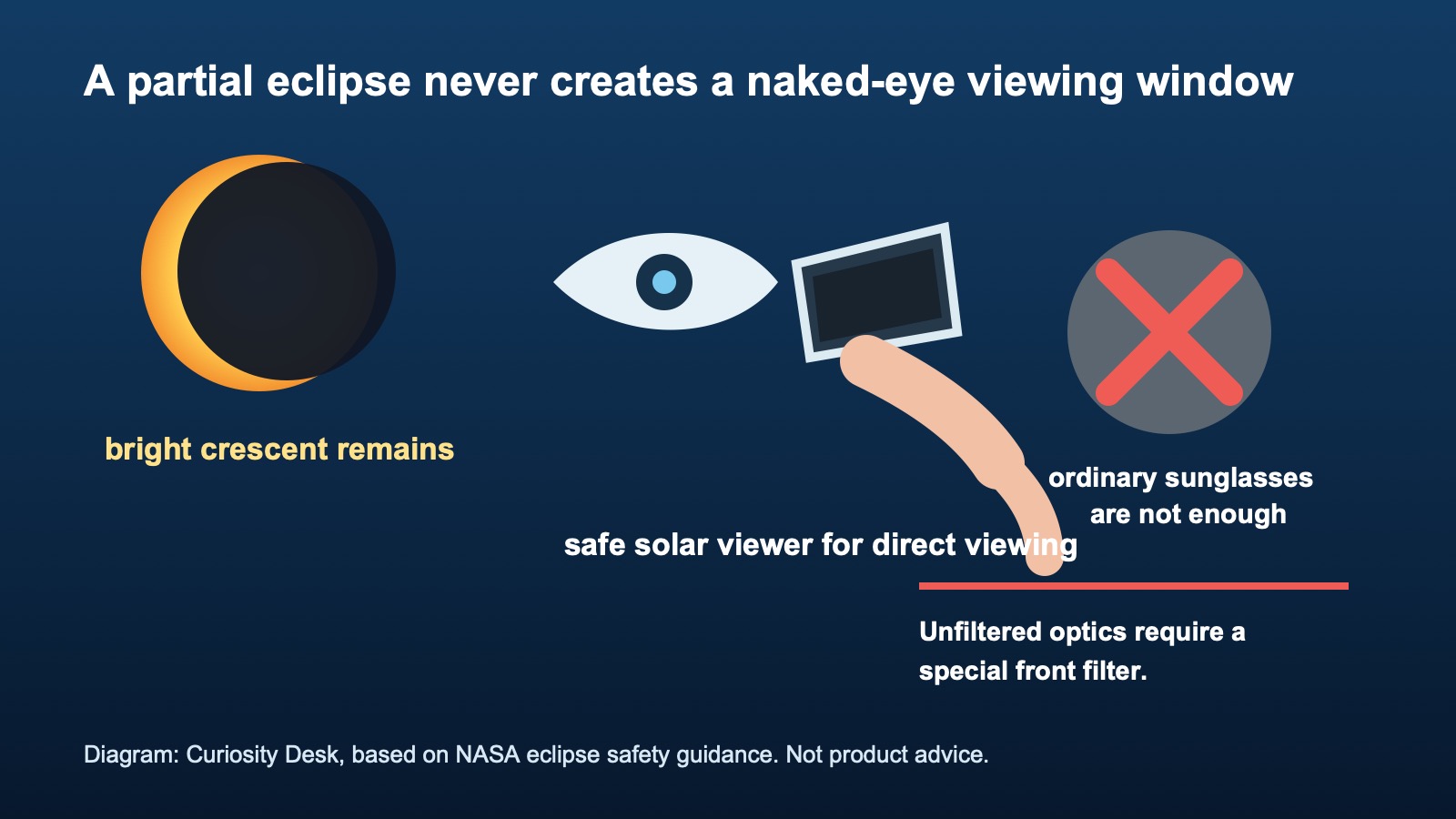
The crucial safety difference is not whether the sky feels dim; it is whether any bright part of the Sun remains exposed. In a partial eclipse it does, including London's 91% maximum. NASA says that direct viewing of a partial eclipse requires eclipse glasses or a safe handheld solar viewer at all times. Regular sunglasses are not a substitute, however dark they look, because they do not reduce sunlight in the way solar viewing filters are designed to do.
The same caution applies to improvised optics. NASA warns not to look at the Sun through a camera lens, binoculars or a telescope while wearing eclipse glasses or using a handheld viewer. Those instruments concentrate sunlight, so a special-purpose solar filter must be attached to the front of the optical device. This is an explanation of the published safety boundary, not a recommendation to assemble equipment or a verification that a particular viewer, filter or local setting is safe.
That boundary is straightforward for London: there is no totality interval there, so there is no moment when unaided direct viewing becomes safe. The most useful way to remember the rule is to link it to the map. If you are outside the thin totality path, you are in the penumbra, where a bright solar crescent remains. The eclipse is still a remarkable moving-shadow demonstration—but its partial phase is never a naked-eye viewing window.
Sources and further reading
This article was written for Curiosity Desk. We do not copy other publishers or invent quotes. If a material error is found, we correct it openly.
Read the full standards →One answer should lead to a better question
Bring your curiosity to the group
Curious Minds is our public Facebook community for surprising science, strange history, Australian wildlife and everyday questions. No copied posts, no personal-friend invitations and no link dumping.
- Three self-contained discussion prompts each week
- Sourced answers and honest uncertainty
- Respectful conversation without spam