Earth blocks the straight path, but not every curved path
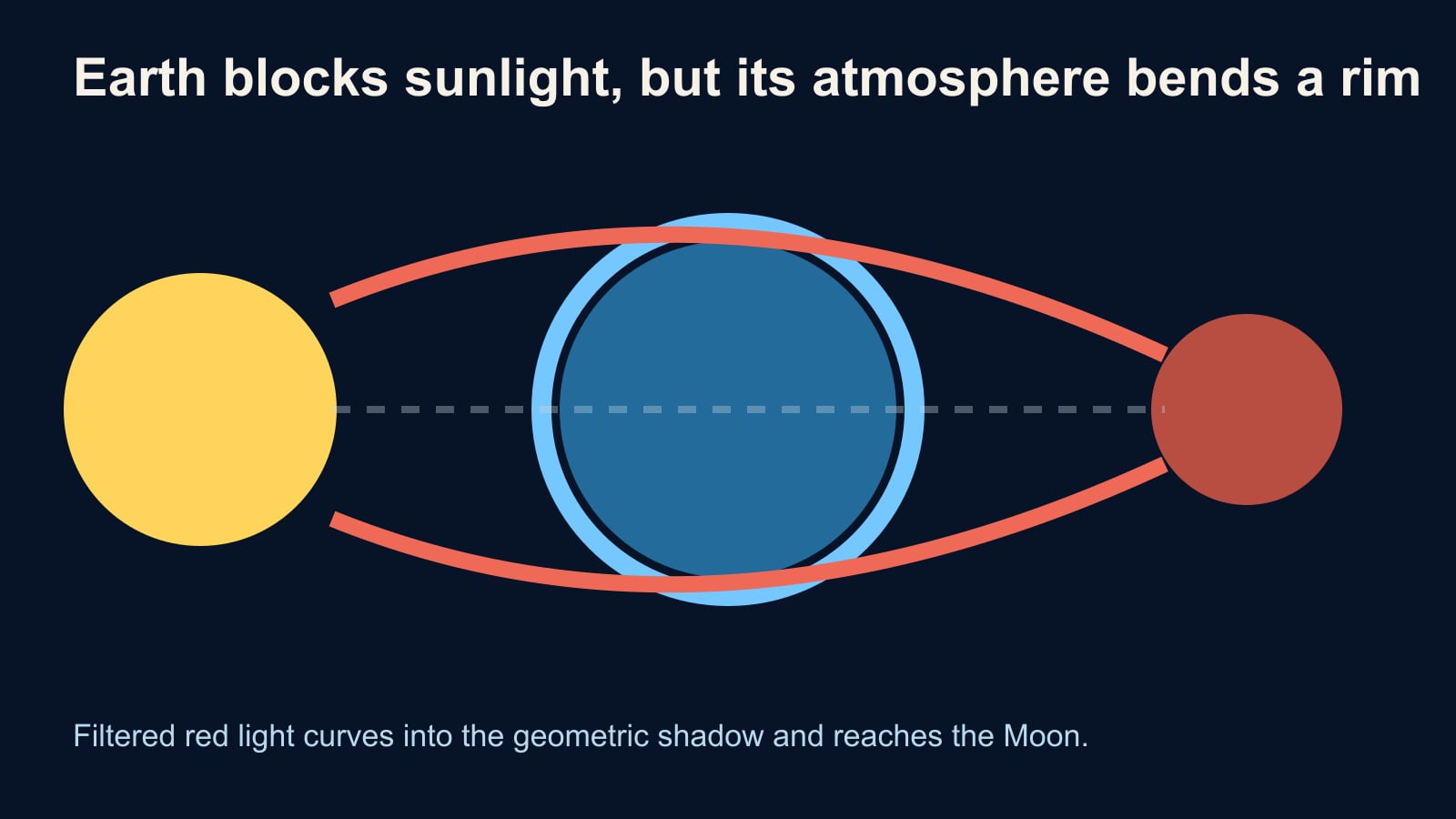
A total lunar eclipse occurs when the full Moon moves through Earth's dark central shadow, the umbra. Earth blocks the direct line from the Sun, so the lunar surface loses its ordinary white-grey illumination. If our planet had no atmosphere, the Moon inside that shadow would be much darker.
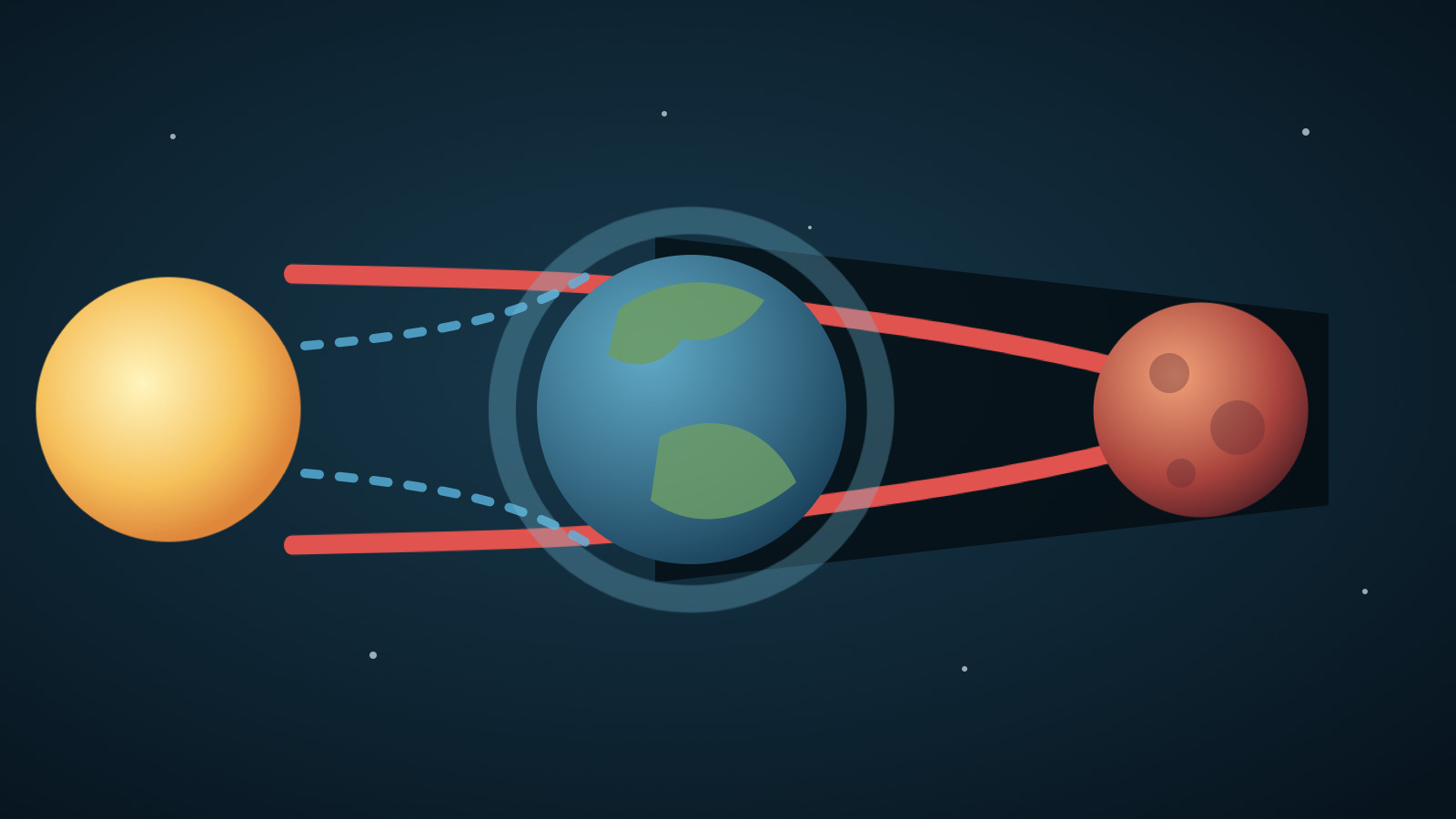
Earth does have a deep shell of air. Sunlight grazing the planet travels through a long, low path in that atmosphere before some of it is bent into the umbra. The Moon receives this indirect light from the bright atmospheric ring surrounding Earth's night side.
The atmosphere removes more blue than red
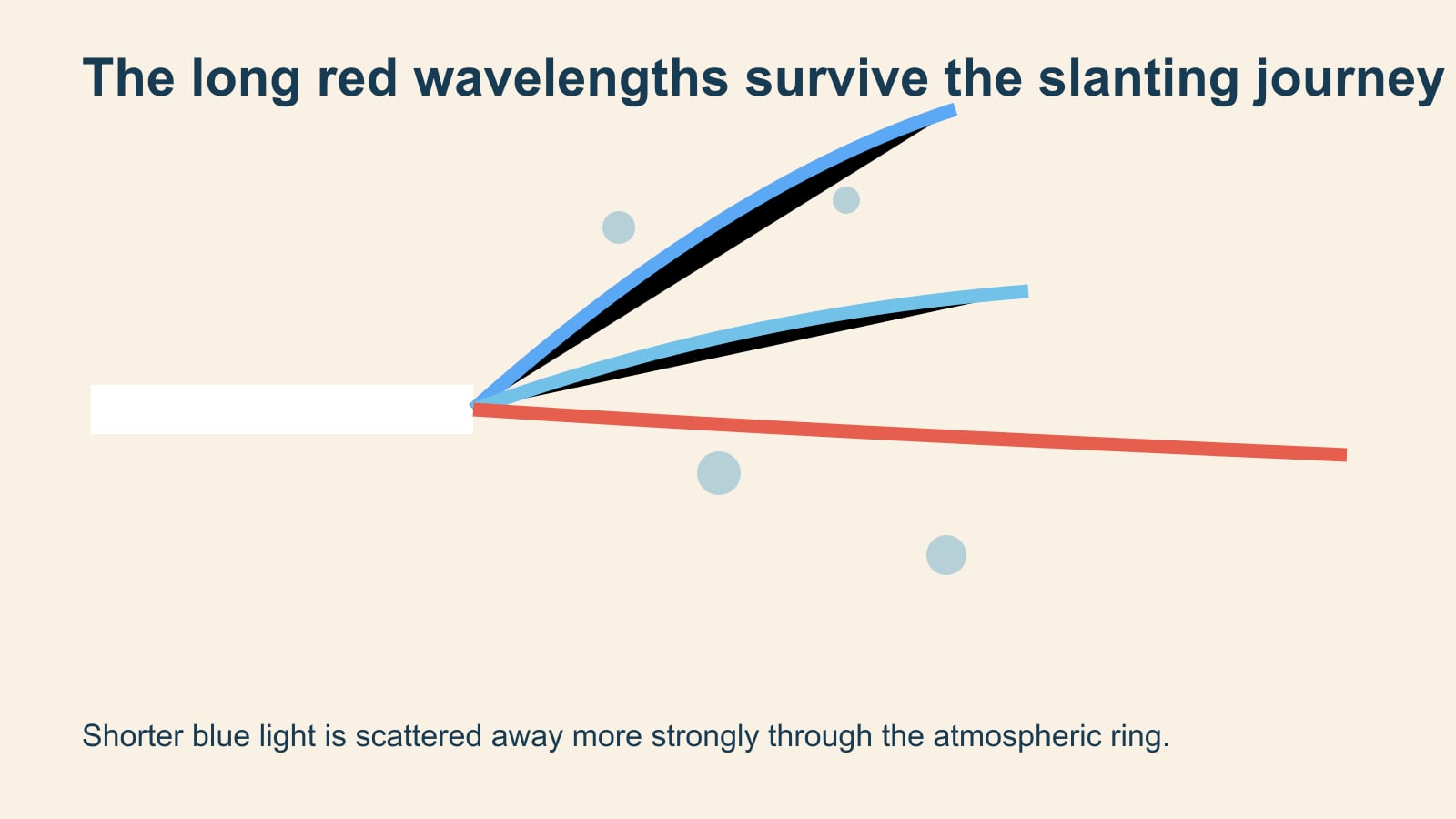
White sunlight contains many wavelengths. Molecules in the atmosphere scatter shorter blue and violet wavelengths more strongly than longer red and orange wavelengths. That is why blue light fills a clear daytime sky while a low Sun can look yellow, orange or red after its light crosses more air.
During an eclipse, the light heading toward the Moon takes an especially long route through Earth's atmospheric rim. Much of the shorter-wavelength light scatters away from that path. The redder portion survives more readily, so the light bent into the shadow arrives with a copper, orange or brick-red bias.
Refraction carries the filtered light into the shadow
Scattering explains the colour selection, but the Moon also needs a route to receive the surviving light. As sunlight passes through air whose density changes with altitude, its path bends slightly—a process called refraction. Around Earth's curved limb, those small bends aim some filtered rays inward behind the planet.
No single sunset supplies the whole eclipse. The illuminated rim of Earth's atmosphere encircles the planet as seen from the Moon, combining light that has passed through many sunrise and sunset regions. NASA's useful image of 'all the world's sunrises and sunsets' describes this ring of filtered illumination, not a literal projection from one horizon.
Dust and clouds change the colour and brightness
Not every total lunar eclipse has the same red. Clouds, smoke, volcanic aerosols and dust can absorb or scatter more of the grazing sunlight before it reaches the Moon. A relatively clear atmospheric rim may produce a brighter orange eclipse; a heavily loaded atmosphere can make the Moon deep red, brown or unusually dim.
The Moon's path through the umbra matters too. A passage near the shadow's centre receives less stray illumination than one closer to an edge. Surface reflectivity and viewing conditions affect what an observer records. 'Blood Moon' is therefore a dramatic nickname for a range of colours, not one fixed shade guaranteed by the geometry.
The Moon misses Earth's shadow most months
A full Moon occurs every lunar cycle, but its orbit is tilted by about five degrees relative to Earth's path around the Sun. Most months the full Moon passes above or below the umbra. A lunar eclipse happens only when the full Moon is close enough to a crossing point of those orbital planes.
When the alignment is right, Earth's atmosphere becomes part of an astronomical lighting system. The planet removes the direct beam, its air filters and bends the surviving edge-light, and the Moon reflects that red-orange remnant back to observers. The colour is not produced by the Moon; it is a global signature of the air around Earth.
An eclipse samples a ring of Earth's atmosphere
The light reaching different parts of the eclipsed Moon has skimmed different regions around Earth's limb. Those paths can cross clear air, cloud decks or aerosol-rich layers. Changes across the lunar face therefore contain information about how transparent the atmospheric ring was, although a casual photograph cannot identify one cloud or eruption by itself.
NASA has documented unusually dark eclipses after volcanic material spread through the upper atmosphere. That connection works because aerosols can block light that would normally be refracted into the umbra. Astronomers still need calibrated observations and atmospheric evidence before assigning a cause. The eclipse is a sensitive screen for filtered sunlight, not a simple global pollution meter.
Sources and further reading
This article was written for Curiosity Desk. We do not copy other publishers or invent quotes. If a material error is found, we correct it openly.
Read the full standards →One answer should lead to a better question
Bring your curiosity to the group
Curious Minds is our public Facebook community for surprising science, strange history, Australian wildlife and everyday questions. No copied posts, no personal-friend invitations and no link dumping.
- Three self-contained discussion prompts each week
- Sourced answers and honest uncertainty
- Respectful conversation without spam