The short answer: a temporary boundary for ascent
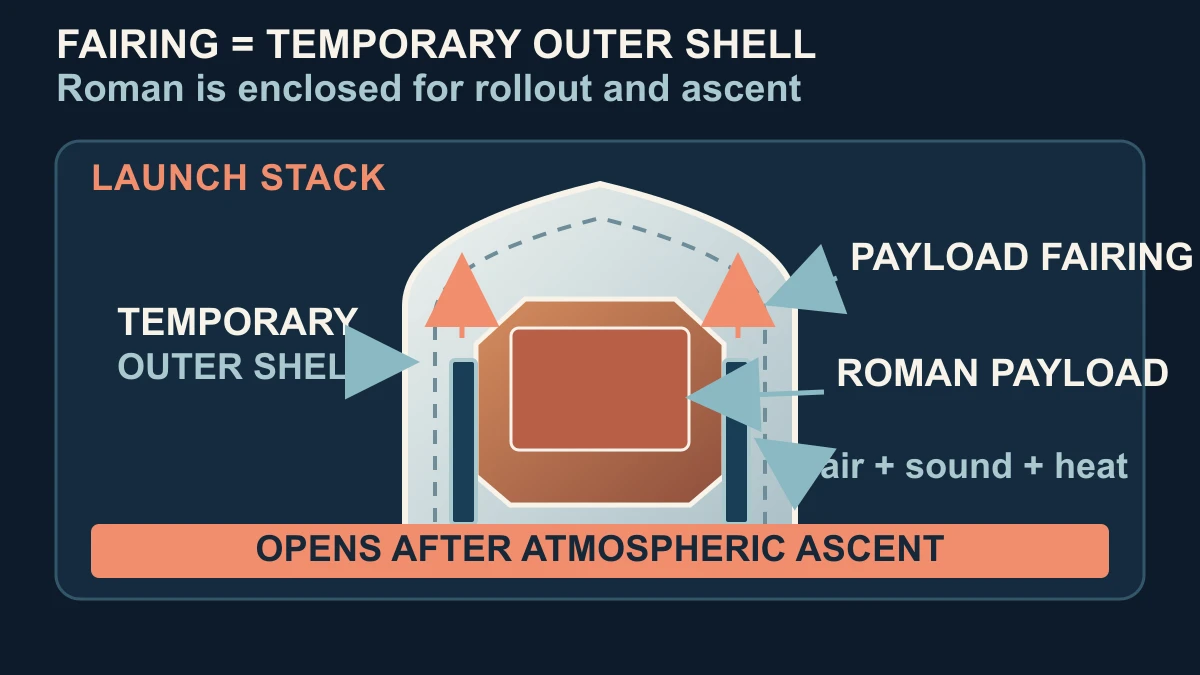
A payload fairing is the outer enclosure at the top of a launch vehicle. For Roman, it is a temporary boundary around the observatory while the combined stack is moved, lifted through the atmosphere and exposed to the loud, rapidly changing environment of ascent. It gives the payload a controlled aerodynamic cover before that cover is no longer needed.
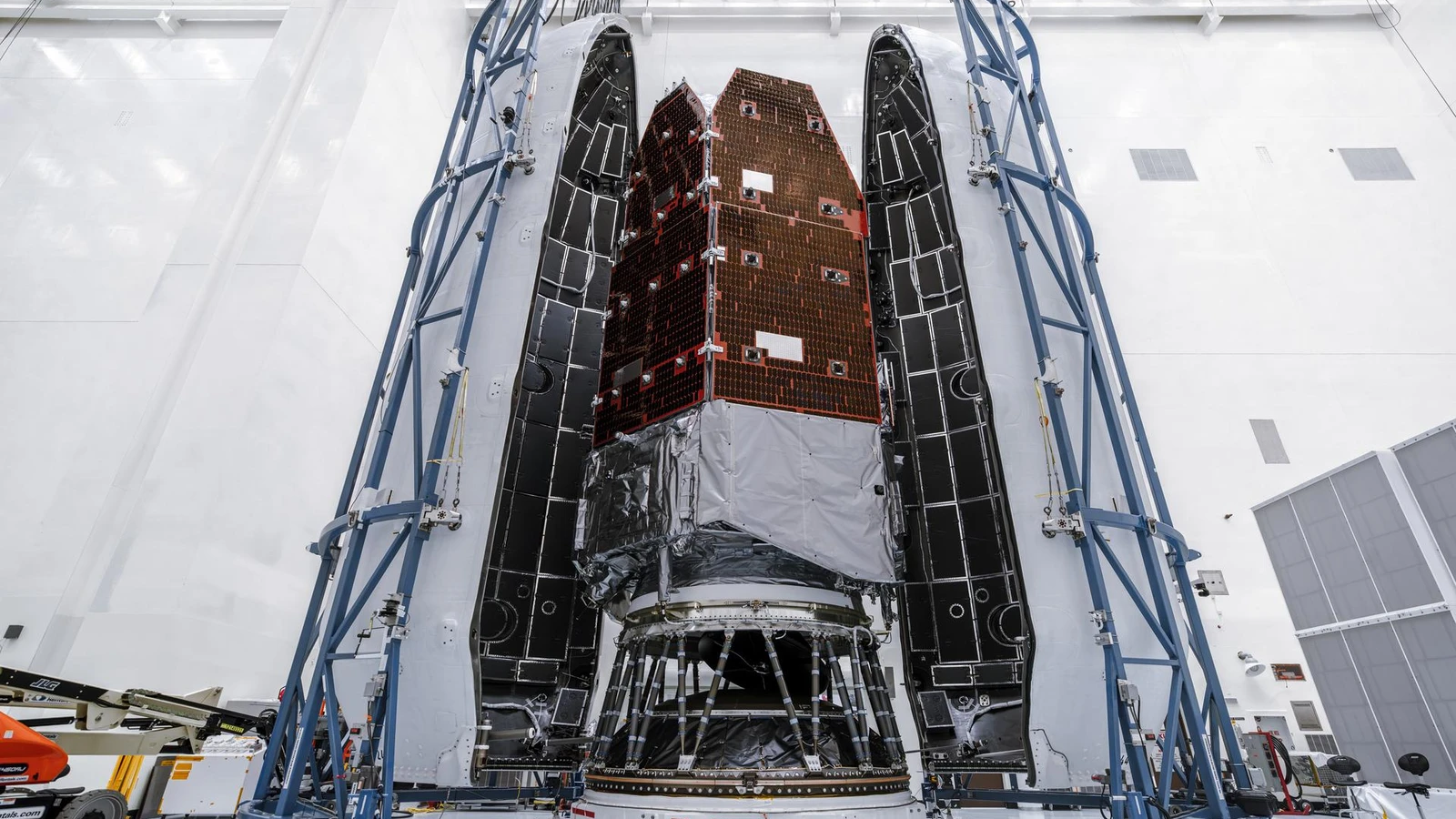
NASA's current Roman record shows the observatory encapsulated inside a Falcon Heavy fairing, with the two halves of the shell surrounding the spacecraft in the cleanroom. NASA describes the fairing as 43 feet tall and says encapsulation protects Roman during rollout, ascent and the early phases of flight. The current programme pages still describe a planned launch, not a completed one.
The useful distinction is between what the photograph shows and what the fairing does. The image shows Roman hardware positioned between the opened halves of the shell. The source record explains that the closed fairing protects against acoustic vibration, aerodynamic pressure and heating during ascent. It does not mean the shell is a permanent room around the telescope or that it protects Roman during the later science mission.
That makes the central question precise: why put a valuable observatory inside another structure if the structure will soon be thrown away? Because the hardest environmental transition is concentrated in launch. Once the vehicle has passed through the atmosphere and the launch sequence reaches separation, carrying the enclosure further would no longer serve the same protective job.
What the fairing must block during ascent
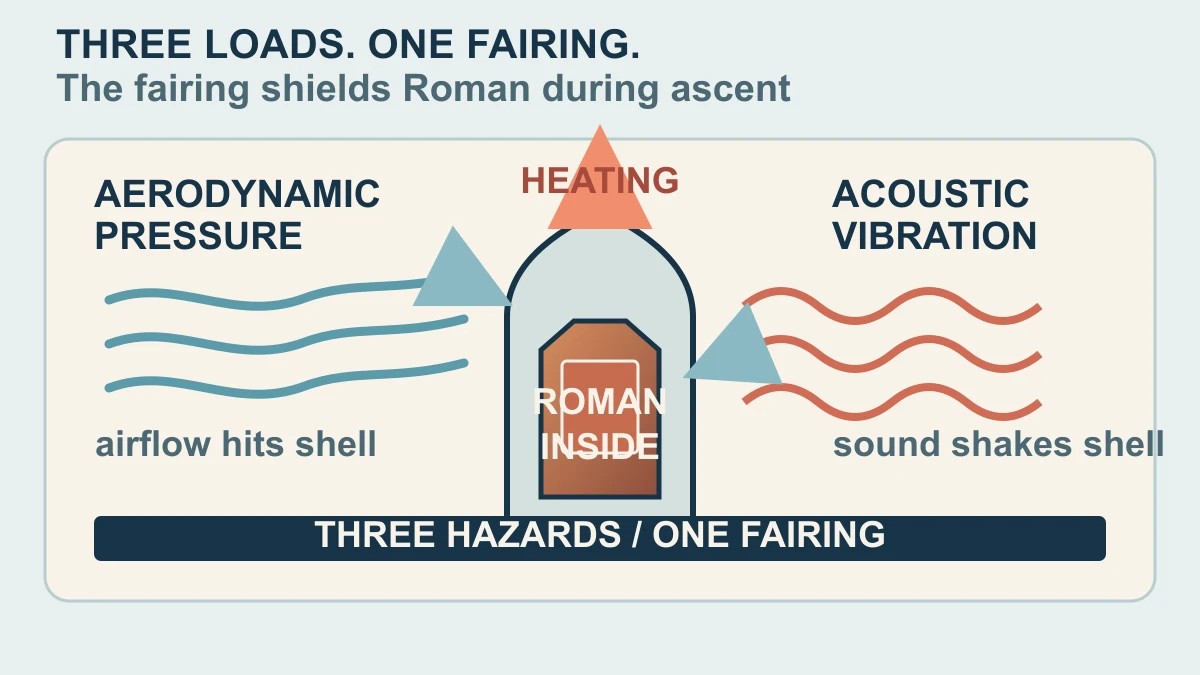
The first load is aerodynamic pressure. A rocket moving quickly through dense air has to push that air aside, and the payload sits inside a shell shaped to manage the flow around the launch stack. The fairing takes the exposed flow and pressure boundary, so Roman's sensitive hardware is not the surface directly meeting the atmosphere. NASA's general fairing guidance names aerodynamic pressure as one of the hazards the enclosure helps protect against.
The second load is acoustic vibration. Engines and the vehicle's surrounding flow generate intense sound pressure, and that acoustic energy can make structures vibrate. NASA says Roman underwent acoustic and vibration testing that reproduced demanding launch conditions; the test result establishes that the observatory was subjected to qualification work, not that the public record gives every fairing-specific load path or a guarantee about a future flight.
The third load is aerodynamic heating. Compressing and disturbing air around a fast-moving launch vehicle changes the thermal environment at the outer surface. The fairing presents a sacrificial, aerodynamic skin between that heating and the payload. The available NASA explanation establishes the protection category, while the package deliberately avoids inventing a Roman-specific temperature, pressure curve or material specification that the cited sources do not publish.
SpaceX's Falcon guide adds the vehicle-level compatibility frame: payloads are assessed against acoustic, vibration and shock environments inside the fairing, and the payload structure must remain compatible with the ascent environment. Roman's own test story fits that broader engineering logic. The fairing reduces direct exposure; the observatory still has to be designed and tested to survive the loads that reach it through the launch system.
The shell is therefore not a magic force field. It is a designed interface between a payload and a launch vehicle. It manages the external aerodynamic and thermal boundary, attenuates or redirects some acoustic exposure through the vehicle structure, and travels with the payload only for the portion of the flight where those launch hazards dominate.
Why the enclosure ends before Roman's science mission
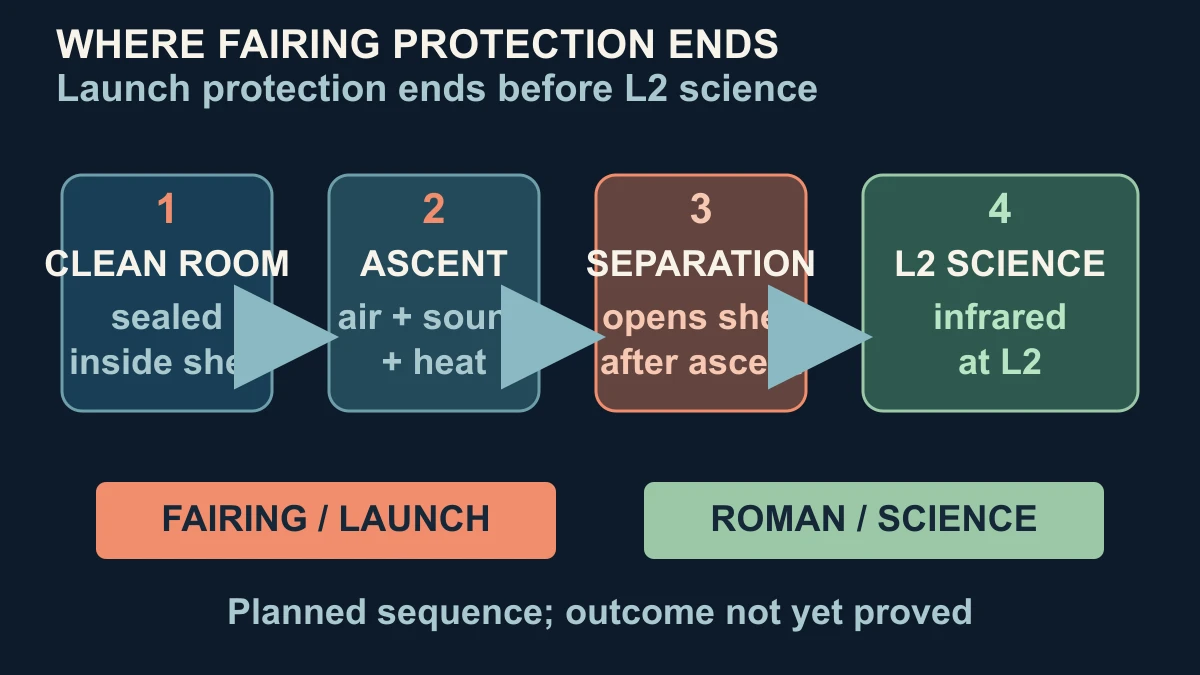
NASA's current launch coverage describes the fairing separating a few minutes into flight, after the relevant atmospheric ascent phase. The halves can then be recovered or handled as launch hardware while the payload continues on its own trajectory. This is the practical reason the enclosure is temporary: it is sized and shaped for getting Roman through launch, not for operating as part of an observatory in deep space.
After separation, Roman's mission has a different set of needs. NASA describes the observatory travelling toward the L2 region and carrying out wide-field infrared surveys, while the observatory's own sunshield and thermal design support its later operating environment. The fairing and the sunshield may both sound protective, but they belong to different phases and solve different problems: one covers launch, the other supports science operations.
The current evidence also has a clear limit. NASA establishes that Roman was encapsulated, moved to the launch-preparation facility and tested against demanding acoustic and vibration conditions. It gives a planned launch window and a planned post-launch journey. It does not prove that launch, fairing separation or science operations have happened, and it does not supply a public Roman-specific fairing qualification report detailed enough to fill every engineering gap.
So the photograph is best read as a boundary marker. Inside the opened shell is the observatory that will eventually do the science; around it is the launch enclosure that protected the stack on the way to the pad. The fairing's job ends when the atmosphere no longer demands that outer skin. Roman's next chapter—if the planned mission proceeds—belongs to its own deployed hardware, orbit and measurements, not to the discarded launch shell.
Sources and further reading
- NASA Science — Roman telescope enclosed in SpaceX Falcon Heavy fairing ↗
- NASA Science — Nancy Grace Roman Space Telescope arrives at hangar ↗
- NASA — Coverage for Roman Space Telescope launch from Florida ↗
- NASA — Roman observatory passes final major prelaunch tests ↗
- NASA Science — Closing the Fairings ↗
- SpaceX — Falcon User's Guide ↗
- NASA Science — Roman Space Telescope mission ↗
- NASA — Guidelines for using NASA images and media ↗
This article was written for Curiosity Desk. We do not copy other publishers or invent quotes. If a material error is found, we correct it openly.
Read the full standards →One answer should lead to a better question
Bring your curiosity to the group
Curious Minds is our public Facebook community for surprising science, strange history, Australian wildlife and everyday questions. No copied posts, no personal-friend invitations and no link dumping.
- Three self-contained discussion prompts each week
- Sourced answers and honest uncertainty
- Respectful conversation without spam